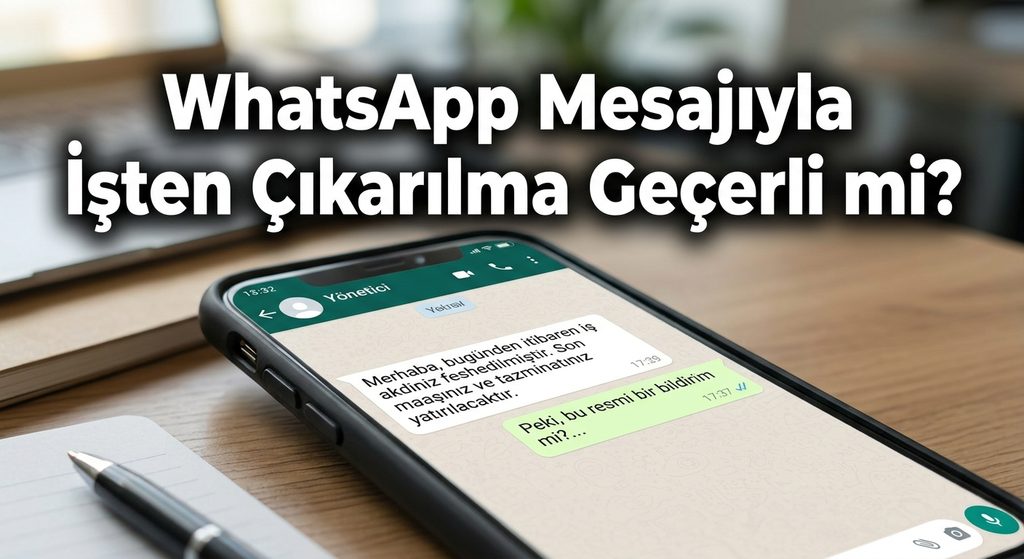
At ten in the evening, a WhatsApp message lands on your phone: “You do not need to come to work starting tomorrow, your termination has been processed.” There is no termination letter, no request for defense, and no reason given. A few days later, when you check e-Devlet, you see that your SGK registration has been closed. Is being dismissed from work in this manner legally valid?
In this article, we address the validity of dismissals made through electronic means such as WhatsApp, SMS, or email; the obligation for written termination and receiving a defense under the Labor Law, the exception for termination with just cause, the evidentiary value of messages, the use of an employee’s WhatsApp correspondence as grounds for termination, and the timeframes an employee must follow, all based on the decisions of the Supreme Court General Assembly, the Supreme Court 9th Civil Chamber, the Constitutional Court, and regional courts of justice.
Short answer
In terminations made for a valid reason, the employer must provide the notice of termination in writing, state the reason for termination clearly and definitively, and in cases related to the employee’s conduct or performance, must obtain the employee’s defense beforehand (Labor Law Article 19). Since a WhatsApp message sent without justification and without obtaining a defense does not meet these conditions, it may lead to the invalidation of the termination and reinstatement for an employee covered by job security. However, if the employer has made an immediate termination for just cause (Article 25/II; e.g., absenteeism or insult), the written form and defense requirement are not sought; in this case, the outcome is determined by the proof of just cause. A WhatsApp message is a document according to HMK Article 199; the employee can prove the termination intent and date with this message. As the one-month mediation period for reinstatement may start running from the date the message was received, it is not advisable to wait.
Contents
- Related legislation
- Nature of termination and the requirement for written form
- Is a WhatsApp message considered a “written notice”?
- Distinction between valid termination and just cause termination
- Evidentiary value of a WhatsApp message
- Can an employee’s WhatsApp correspondence be used as a reason for termination?
- What should an employee terminated via WhatsApp do?
- Correct termination procedure for the employer
- Why is it important to properly conduct the process in these files?
- Frequently asked questions
- Table of decisions and outcome
1. Relevant Legislation
Labor Law Art. 18/1
“In workplaces employing thirty or more workers, an employer terminating an indefinite-term employment contract of a worker with at least six months of seniority must rely on a valid reason arising from the worker’s competence or conduct, or from the requirements of the enterprise, workplace, or the job.”
Labor Law No. 4857 Art. 18 also does not consider union membership, filing a complaint against the employer; race, gender, marital status, family responsibilities, pregnancy, religion, political opinion, and similar reasons as valid grounds. The six-month seniority period is calculated by combining periods spent in the same employer’s workplaces; employer representatives who manage and direct the entire enterprise cannot benefit from this protection.
Labor Law Art. 19
“The employer must make the termination notification in writing and clearly and definitively state the reason for termination. An indefinite-term employment contract of a worker cannot be terminated for reasons related to that worker’s conduct or performance without first obtaining their defense against the allegations made against them. However, the employer’s right to terminate in accordance with the conditions of paragraph (II) of Article 25 is reserved.”
Labor Law art. 25/II grants the employer the possibility to terminate the employment contract immediately in cases that violate moral and good faith rules. These cases include the employee harassing the employer or another employee (subparagraph d), and the employee’s failure to continue work for two consecutive working days without permission from the employer or without a justifiable reason, or twice in one month on a working day following any holiday, or for three working days in one month (subparagraph g). Labor Law art. 26 stipulates that this right of termination must be exercised within six working days from the day the incident is learned, and in any case, within one year from the date the act occurred.
Code of Civil Procedure art. 189/2
“(2) Evidence obtained unlawfully cannot be taken into consideration by the court in proving a fact.”
Code of Civil Procedure art. 199
“(1) Written or printed texts, documents, drawings, plans, sketches, photographs, films, visual or audio recordings, data in electronic environments, and similar information carriers suitable for proving the facts in dispute are considered documents according to this Law.”
2. Nature of Termination and Requirement of Written Form
Supreme Court General Assembly of Civil Chambers, 25.03.2021, E. 2016/2412, K. 2021/343
A termination notice is “a unilateral right that terminates a continuous (fixed-term or indefinite-term) employment contract immediately or upon the expiry of a certain period, and by reaching the opposing party, creates a dissolving effect,” and is “a declaration of will that does not require the consent of the opposing party.” The Board also emphasized that “pursuant to Article 19 of the Labor Law, the termination notice must be in writing and its reason must be clearly and definitively stated.”
Principle derived from the decision: Termination is a unilateral declaration of will that takes effect upon reaching the opposing party and does not require acceptance. However, for termination with a valid reason, a written form and a clear and definite reason are mandatory pursuant to Article 19 of the Labor Law.
How is it used in practice?: When a WhatsApp message reaches the opposing party, the intention to terminate may be considered declared; therefore, instead of deeming the message “invalid” and waiting, the employee should calculate the deadlines accordingly. On the other hand, if the message does not meet the form and content requirements of Article 19, the invalidity of the termination may be asserted.
9th Civil Chamber of the Supreme Court, 20.09.2017, Docket No. 2016/19135, Decision No. 2017/13760
Conclusion: It has been stated that if there is no written notice, the termination should be deemed invalid and re-employment should be ordered.
“The court, by delving into the merits of the case, should first determine whether it is an employer termination, and if it is an employer termination, since no written notice was given, pursuant to Article 19 of the Labor Law No. 4857, a decision should be made regarding the invalidity of the termination and the re-employment of the plaintiff.”
Principle derived from the decision: The court must first determine by whom the termination was made. If it is understood that the termination was made by the employer and no written notification was given, the termination is invalid under Article 19, and the employee’s reinstatement is ordered.
How is it used in practice?: Against the employer’s frequently invoked defense “the employee quit themselves,” the employee must present WhatsApp messages showing the employer’s intent to terminate employment. If the termination is found to be made by the employer and there is no written notification, a reinstatement decision is issued.
Supreme Court 9th Civil Chamber, 01.06.2017, E. 2016/14206, K. 2017/9527
“While fulfilling the burden of proof, the employer will primarily demonstrate compliance with the formal conditions of termination. Accordingly, the termination must have been made in writing, the employer must have documented requesting the employee’s defense in certain situations, and the termination reasons on which it is based must have been shown concretely and clearly within the content of the written termination process.”
Principle derived from the decision: The employer’s burden of proof begins first with formal conditions: (1) is the termination in writing, (2) was a defense requested when necessary, (3) are the termination reasons shown concretely and clearly? The merits of the termination are not examined before these conditions are met.
How is it used in practice?: If an employer cannot document these three conditions in a termination made via WhatsApp, the termination may be deemed invalid without discussing the existence of a valid reason.
Note: Decisions from the same date are also known for their findings regarding the nature of WhatsApp correspondence as personal data (see section 6).
Istanbul Regional Court of Justice 29th Civil Chamber, 10.11.2017, E. 2017/3826, K. 2017/1524
While examining the plaintiff’s allegations that “the defendant company started terminating the employment contracts of workers employed in cleaning services by sending SMS messages to their mobile phones starting from August 30, 2016,” the provision “Article 19 of Law no. 4857 states that the employer must make the termination notification in writing and clearly and definitively state the reason for termination” was cited.
Principle derived from the decision: The allegation of collective dismissals being made via SMS was examined within the framework of the written and reasoned notification obligation in Article 19 of the Labor Law.
How is it used in practice?: The assessment valid for SMS messages also applies to WhatsApp messages: It is examined whether the message clearly and definitively contains the reason for termination and whether the other conditions in Article 19 are met.
Note: The source report does not contain information regarding the outcome of the decision; the full text should be examined via UYAP.
3. Is a WhatsApp Message Considered a “Written Notification”?
This question has not been fully clarified in practice. Three separate aspects must be distinguished when making an assessment:
- Written form: According to Articles 14-15 of the Turkish Code of Obligations, the written form, as a rule, requires a signature; a secure electronic signature produces the legal consequences of a handwritten signature. Since a WhatsApp message carries neither a wet signature nor a secure electronic signature, it is debatable whether it can be considered a “written” notification in a strict sense.
- Content: Even if the message is considered written, Labor Law art. 19 requires the termination reason to be stated clearly and precisely. Unjustified messages such as “You don’t need to come” or “Your exit has been processed” do not meet this condition.
- Defense: In case of termination for a valid reason related to conduct or performance, the employee’s prior defense must be taken. This step is often skipped in instant termination messages sent via WhatsApp.
Therefore, in practice, the most important question is not whether the message is considered “written”, but whether the employer provided a reason and took a defense. These two deficiencies generally invalidate a termination made for a valid reason for an employee covered by job security. On the other hand, the message is strong evidence proving the employer’s intention to terminate and the date of termination (see section 5).
4. Distinction Between Valid Termination and Just Cause Termination
The main distinction determining the outcome of termination made via WhatsApp is whether the termination is based on a valid reason or a just cause:
| Termination for a valid reason (Art. 18) | Immediate termination for just cause (Art. 25/II) | |
|---|---|---|
| Examples | Low performance, incompatibility with the job, workplace requirements | Absenteeism, insult, harassment, breach of honesty and loyalty |
| Written notification and clear reason | Mandatory (Art. 19) | Not required as a condition in source decisions; however, it is important for proof |
| Right to defense | Mandatory for reasons related to conduct or performance | Not sought (Art. 19/2 last sentence) |
| Notice period | Complied with or notice pay is paid | Immediate termination without notice |
| Time limit | No special period | 6 working days from the date of learning, in any case 1 year (Art. 26) |
| Severance pay | Paid (if conditions are met) | Not paid |
| Outcome of termination via WhatsApp | Usually invalid due to lack of form and defense | If just cause is proven, termination may be considered valid |
Constitutional Court, Appl. No: 2019/37012, 23.11.2022 (quoted from a secondary source)
In the first instance proceedings subject to the application, it was accepted that “the termination notice was not made in writing, and therefore the termination, which did not comply with the formal requirements, was invalid”; whereas in the retrial justification given in the decision, it was evaluated that “the written form requirement is not sought in the employer’s immediate termination for just cause, and the termination made due to the applicant’s actions was valid.”
Principle derived from the decision: Two different approaches are observed in the same file: In the first trial, the lack of written notification rendered the termination invalid; in the subsequent stage, it was accepted that the termination was an immediate termination for just cause, and that no written form was required for this termination.
How is it used in practice?: The legal nature of the employer’s termination and whether they can prove this nature determines the outcome. The employee should question what reason was stated at the time of termination, against the employer’s later characterization of the termination as “termination for just cause,” and whether the six-working-day period in Article 26 has passed.
Note: In the source report, this decision is mentioned both in terms of formal requirements and the examination of WhatsApp correspondence (see Section 6). The excerpts appear to belong to the parts where the Constitutional Court summarized the lower court proceedings. The applicant’s name and the outcome of the decision could not be independently verified; the full text should be examined from the Constitutional Court Decisions Database.
İzmir Regional Court of Justice 3rd Civil Chamber, 08.04.2026, E. 2026/538, K. 2026/742
Result: The decision for reinstatement was found to be erroneous.
In the event where the employee was sent a message via WhatsApp stating, “On the date the plaintiff was on leave, Ms. …[…] your employment has been terminated due to absenteeism. You do not need to come.”, it was determined that “the acceptance of the lawsuit and the decision for reinstatement are erroneous, without considering that there was no obligation for the defendant employer to send a warning notice to the plaintiff to inform them of their excuse, and given that the plaintiff’s termination declaration was reported to SGK with code 48 on 23/09/2024, and that the plaintiff’s employment contract was terminated for just cause by the defendant employer in accordance with Article 25/II-g of the Labor Law No. 4857.”
Principle from the Decision: The termination made via WhatsApp with the message “your employment has been terminated due to absenteeism” was evaluated as justified termination due to absenteeism (Art. 25/II-g); it was accepted that the employer is not obliged to send a warning notice to the employee to inform them of their excuse. The code 48 reported to SGK was taken into account as a fact supporting that the reason for termination was absenteeism.
How to apply in practice?: This decision shows that not every termination made via WhatsApp is automatically invalid: If the existence of a just cause (here, absenteeism) is proven, a formal deficiency may not change the outcome. From the employee’s perspective, documenting excuses (report, leave, correspondence) against an absenteeism claim is of vital importance.
Note: The quote states that the message was sent “on the date the plaintiff was on sick leave”. It should be examined from the full text of the decision whether the sick leave report covers the days counted as absenteeism, whether it was notified to the employer, and whether the period in Article 26 was observed; days on sick leave are not counted as absenteeism.
5. Evidential Value of WhatsApp Messages
According to Article 199 of the HMK, data in electronic environments are documents. WhatsApp messages can be used to prove the intention to terminate, the date of termination, the reason for termination, and actual termination.
Supreme Court 9th Civil Chamber, 31.03.2016, E. 2015/27643, K. 2016/7929
With reference to the provision in Article 199 of the HMK, which states “Data in written or printed form, deeds, drawings, plans, sketches, photographs, films, video or audio recordings, as well as data in electronic environments and similar information carriers suitable for proving disputed facts, are documents according to this Law”, it was determined regarding declarations of intent in the form of messages not denied by the parties that “This declaration of intent sent as a message… which is not denied by the plaintiff, is generally valid; it does not need to be in the form of a petition and signed.”
Principle derived from the decision: A declaration of intent expressed via a message not denied by the opposing party is generally valid; it does not need to be in the form of a petition and signed.
How is it used in practice?: This principle is particularly important with regard to the employee’s termination (resignation) statement; because the Labor Law does not stipulate a written form requirement for the employee’s termination, as in Article 19. A “I resign” message sent in anger can have legal consequences. However, regarding the employer’s termination for a valid reason, the special conditions in Article 19 are additionally sought.
Note: The source report does not specify who sent the message or through which channel; the incident of the decision should be examined from the full text.
Examples from commercial contracts
The following decisions relate to commercial contracts, not employment contracts; however, they are guiding in terms of demonstrating the role of WhatsApp messages in proving the intention to terminate.
Istanbul 1st Civil Court of Commerce, 08.03.2024, E. 2022/294, K. 2024/162
“Upon examination of the correspondences submitted to the file by the plaintiff, which the defendant did not object to, it was stated that the defendant notified the plaintiff via a WhatsApp message that ‘it had decided not to continue working due to budgetary reasons’, and there was no notification that the plaintiff failed to fulfill its contractual obligation, thus the termination made by the defendant was unjust”; and the fact that “in the WhatsApp correspondences not denied by the defendant, it was communicated by the defendant to the plaintiff that the contractual obligations could not be fulfilled due to financial reasons” was accepted as evidence of the unjust nature of the termination.
Principle derived from the decision: An undeniable WhatsApp message proves both the intent to terminate and the reason for termination. If the reason is not the other party’s breach of contract, but the terminating party’s own budget problems, the termination has been deemed unfair.
How is it used in practice?: In an employment relationship, messages from the employer such as “we cannot continue due to costs” indicate that the termination is based on operational requirements, not the employee’s conduct; in this case, the employer must prove a valid reason based on operational requirements and that termination was the last resort.
Istanbul 4th Civil Court of Commerce, 07.05.2026, File No. 2024/42, Decision No. 2026/375
Result: The claim of de facto termination was not accepted.
“Although the plaintiff relied on messages and emails as the reason for termination, due to Article 16 of the contract stating that notifications must be made in writing via a notary public, and the defendant’s personnel wishing to continue working after a short work stoppage, the claim that the defendant de facto terminated the contract based on the emails and messages presented as evidence was not accepted.” — “The personnel’s short work stoppage of about 1 hour and their subsequent desire to continue working, while the plaintiff prevented the defendant’s personnel from working, does not mean that the defendant’s employees abandoned their jobs and that the contract was terminated.”
Principle derived from the decision: If it is stipulated in the contract that notifications will be made via a notary public, a message or email alone may not be considered a termination. Furthermore, a short work stoppage followed by a desire to continue working cannot be interpreted as de facto termination.
How is it used in practice?: If job contracts or workplace regulations stipulate that notifications must be made in a specific manner, it should also be evaluated whether a WhatsApp message meets this form.
Note: The spellings of “ilişkin” and “davalı” in the quote are as in the source.
6. Can an Employee’s WhatsApp Correspondence Be Used as a Ground for Termination?
The second common situation in practice is an employer using an employee’s WhatsApp correspondence as a ground for termination. There are two distinct questions regarding this: Have the correspondences been obtained legally, and is the content sufficient for termination? The limits of an employer’s authority to read WhatsApp correspondence have been discussed in detail in a separate article; here, prominent decisions concerning termination are summarized.
Method of acquisition: prohibition of unlawfully obtained evidence
Supreme Court 9th Civil Chamber, 10.01.2019, Docket No. 2018/10718, Decision No. 2019/559
Result: The rejection of severance and notice period compensation claims was found to be erroneous.
The WhatsApp system is “a system that facilitates communication via the internet in a phone and internet environment” and is in “a protected state, closed to third parties.” “It is essential that employees’ communications within this scope are also protected as personal data.” — “In the concrete dispute, since WhatsApp conversations constitute private personal data, terminating the employment contract solely based on these correspondences, whose acquisition method is unclear, is unjust, and rejecting the claims for severance pay and notice period compensation instead of accepting them is erroneous.”
Principle from the decision: Termination based on WhatsApp communications whose acquisition method cannot be understood is unjust.
How to use in practice?: The employee should request an explanation of how the screenshots presented by the employer were obtained.
Constitutional Court, Samet Ayyıldız, App. No: 2018/34548, 28.12.2021
Result: It was ruled that the right to respect for private life and freedom of communication were violated.
“In the concrete case, considering that the employer did not present any information or documents indicating that a notification showing the employer’s authority to examine the workplace computer and its scope was made to the applicant, it is understood that no clear information was provided regarding the monitoring and inspection of communication made through the computer allocated for workplace use by the employer.” — “On the other hand, the applicant’s employment contract was terminated citing WhatsApp message contents, which fall within the scope of private life. However, the employer, as the defendant, could not demonstrate during the trial process the legitimate reasons and grounds for the interference, that the applicant’s expectations were considered and their rights were taken into account, and furthermore, that the applicant was informed about the interference.”
Principle from the decision: WhatsApp communications on a workplace computer are part of the private sphere; the employer cannot terminate based on these contents without prior explicit notification.
How to use in practice?: The employee should inquire whether there was a prior written notification indicating the employer’s monitoring authority.
Constitutional Court, App. No: 2019/37012, 23.11.2022 (quoted from a secondary source)
“Firstly, it must be emphasized that in cases where no full and clear prior information is provided regarding the monitoring of communication made through a computer allocated for use in the workplace and the terms of use of communication tools, it is a foreseeable situation for the employer that the employee, with a legitimate expectation that their fundamental rights and freedoms will also be protected in the workplace, may engage in personal correspondence via the workplace computer.” — “Furthermore, it is clear that in the concrete case, the monitoring of the program, which is known by everyone and the employer to be for personal use, is contrary to the applicant’s reasonable expectation regarding the protection of their private life and the secrecy of their communication.”
Principle derived from the decision: Monitoring a program known to be for personal use is contrary to the employee’s reasonable expectation of privacy.
How is it used in practice?: As stated in the note in section 4, the full text of the decision should be examined separately.
Content: just cause, valid reason, and protected behaviors
Court of Cassation, 9th Civil Chamber, 01.06.2017, File No: 2016/14205, Decision No: 2017/9526
“Firstly, the WhatsApp system is a system that enables communication via the internet on phones and the internet environment. Here, individuals communicate with others, and communication is also carried out within groups by forming groups. However, this system is protected internally and closed to third parties. Therefore, as long as it does not disrupt the workflow of the employees and does not affect their work, it is not forbidden for them to form a group and communicate within it.” — “Employees’ emails and notifications to the employer at the workplace are in the nature of democratic demands regarding labor rights, and it is not correct to make such peaceful behaviors a reason for termination. The defendant employer, who bears the burden of proof, could not prove a just and valid termination.”
Principle derived from the decision: As long as it does not disrupt the workflow of employees, forming a WhatsApp group is not prohibited. Peaceful and democratic demands regarding labor rights cannot be a reason for termination.
How to use in practice?: Employees terminated due to group correspondence regarding wages, overtime, or working conditions can rely on this decision; such a termination may also be associated with the prohibition of termination for pursuing rights under Article 18 of the Labor Law.
Note: Typographical errors in the quotation are as in the source.
Constitutional Court, App. No: 2019/33833, 20.07.2023
The lower courts evaluated that the applicant’s shares fell within the scope of “a valid reason arising from the employee’s competence or conduct” as per Article 18 of the Labor Law. However, the Constitutional Court stated the principle that “According to the ruling, conduct can only be considered a valid reason if it leads to negative consequences at the workplace. If the employee’s conduct does not have a negative impact on the production and employment relationship process at the workplace, it is not possible to cite such conduct as a valid reason for the termination of the employment contract.”; and stated that “Although the Court concluded that the applicant set a negative example for employees due to the cartoon shared in the WhatsApp group, it was overlooked that the entire group consisted of a certain number of individuals in managerial positions at the same level as the applicant” and “In the specific case, it was not alleged that the shares subject to the application were made during working hours or with work tools or at the workplace, and that the applicant failed to fulfill their responsibilities arising from the employment contract for these reasons”.
Principle derived from the decision: Conduct can only be a valid reason for termination if it causes negativity at the workplace. When evaluating whether a share in a WhatsApp group can be considered a valid reason, factors such as who constitutes the group, whether the share was made during working hours, with work tools, or at the workplace, and whether the employee neglected their work responsibilities should be considered.
How is it used in practice?: In terminations made due to shares outside working hours, from a personal phone, and in a limited group, the employee must emphasize that the share did not lead to a concrete negative impact at the workplace.
Note: It is observed that the Constitutional Court criticized the evaluation of the lower courts; as it is not stated in the source report regarding which right and with what outcome the decision was rendered, the full text should be checked from the Constitutional Court Decisions Database.
Court of Cassation, 9th Civil Chamber, 15.01.2020, App. No. 2019/7066, Dec. No. 2020/357
Result: The rejection decision, given on the grounds of just cause, was overturned; the termination was deemed based on a valid reason.
“When the information and documents in the file and the statements of the party witnesses are evaluated, it is evident that the plaintiff sent an obscene message in a WhatsApp group formed by some of the employees.” Since the target of the message was not clarified, “Although the termination was not based on just cause, it was understood that the plaintiff’s actions led to a negative situation at the workplace and that the termination, even if not based on just cause, was based on a valid reason, therefore, instead of rejecting the case on this ground, its rejection on the ground that the employment contract was terminated for just cause is erroneous, and thus it was necessary to overturn and annul the decisions of the Court of First Instance and the Regional Court of Justice.”
Principle from the decision: An offensive (obscene) message sent in a WhatsApp group by employees, if its target is not specific, may not constitute just cause; however, since it leads to negativity in the workplace, it can be considered a valid reason.
How is it used in practice?: The distinction between termination for just cause and termination for valid reason directly affects compensation: In termination for just cause, severance and notice pay are not paid; however, in termination for valid reason, they are paid, but the request for reinstatement is rejected. It should not be forgotten that in termination for valid reason, the employer must also have fulfilled their obligations of written notification and obtaining a defense as per Article 19 of the Labor Law.
Supreme Court 9th Civil Chamber, 28.11.2018, File No. 2018/2785, Decision No. 2018/21795
Result: The termination was deemed based on just cause.
“In the specific dispute, from the information and documents within the file; the incident that led to the termination of the employment contract was the plaintiff’s insulting another employee of the defendant, […], via phone message, and it is established that this situation constitutes a just cause for termination for the employer under Article 25/II-d of Labor Law No. 4857.” — “Since the words uttered by the plaintiff were of an abusive nature, the termination carried out by the employer is based on just cause.”
Principle derived from the decision: An employee’s insulting another employee via phone message is considered harassment/abuse under Article 25/II-d and constitutes a just cause for termination.
How is it used in practice?: An employee who has been insulted forwarding the message they received to the employer is evaluated differently from a third party covertly obtaining it. In this situation, the employer must also exercise their right to terminate within the six working day period specified in Article 26.
7. What Should an Employee Dismissed over WhatsApp Do?
- Do not delete the message, document it. Take a screenshot of the message, ensuring the sender’s number and date are visible; export the chat. If necessary, have evidence determined through a notary or a court.
- Do not resign, do not quit spontaneously. A message sent in anger like “I’m not working either” could be interpreted as a termination initiated by you.
- Request an explanation. In a polite and written response, ask the employer for the reason for termination and a written termination notice; state that you are ready to come to work.
- Check the SGK exit code. Review the code in the termination declaration from e-Devlet; it indicates the reason for the employer’s termination.
- Document your excuses. If there is an allegation of absenteeism, keep reports, leave requests, and correspondence.
- Do not miss the one-month period. For re-employment, an application must be made to a mediator within one month from the notification of the termination notice; if an agreement cannot be reached, a lawsuit must be filed in the labor court within two weeks from the last report (Labor Law art.20). Since the date the WhatsApp message was received can be considered the start of this period, a written notice should not be awaited.
- Also consider other receivables. If the conditions for re-employment are not met, or in addition; severance pay, notice pay, unused annual leave, overtime, and, if applicable, bad faith compensation can be claimed. Mediation as a prerequisite for filing a lawsuit also applies to these claims; the statute of limitations is five years.
| Scenario | Possible outcome |
|---|---|
| Job security exists; termination for valid reason; unsubstantiated WhatsApp message, no defense taken | Invalidity of termination and reinstatement; wages for the period of unemployment (max. 4 months) and non-reinstatement compensation (4-8 months) |
| Job security exists; employer proves a just cause (absenteeism, insult) | Termination may be deemed valid; severance pay and notice pay are not paid |
| Job security exists; no just cause but a valid reason | Reinstatement may be rejected; severance pay and notice pay are paid (whether the conditions of Article 19 are met is also debatable) |
| No job security; no just cause | Severance, notice, annual leave; bad faith compensation in case of abuse of the right to terminate |
8. Correct Termination Procedure for the Employer
- Determine the type of termination: Is it termination for a valid reason (Art. 18), or immediate termination for a just cause (Art. 25/II)? The procedures and outcomes of both are different.
- Request a defense: In cases related to conduct or performance, request a written defense from the employee clearly stating the allegations and provide a reasonable time.
- Prepare a written and reasoned termination notice: Clearly and precisely state the reason for termination; deliver the notice by hand against signature or via a notary public.
- Observe the deadlines: In case of termination for just cause, act within six business days from the date you learned of the incident (Art. 26); comply with notice periods or pay notice compensation.
- Select the SGK termination code consistent with the reason for termination: A discrepancy between the termination code and the reason stated in the termination notice can be used as evidence against the employer.
- Use WhatsApp only for informational purposes: The message should not replace an official termination notice; it should be used at most as an additional information channel.
- If you rely on employee correspondence, document how it was obtained: Illegally obtained correspondence cannot be used as evidence.
9. Why is it Important to Correctly Manage the Process in These Cases?
In terminations made via WhatsApp, three things often determine the outcome: the nature of the termination (valid or for just cause), the correct calculation of deadlines, and the timely securing of evidence. If the employee misses the one-month mediation period, they lose their right to reinstatement; conversely, if the employer does not exercise their just cause within six business days or fails to obtain a defense, they may lose a case they were entitled to win.
- From the employee’s perspective: securing the message and SGK record as evidence, calculating deadlines based on the message receipt date, structuring reinstatement and compensation claims together, and documenting excuses against just cause claims that the employer may later put forward.
- From the employer’s perspective: correct determination of the termination type, full implementation of the defense and written notification procedure, observance of the period specified in Article 26, and lawful acquisition of employee correspondence.
Regions we serve
2M Hukuk Law Firm is located in Tuzla and handles labor law disputes in labor courts and mediation offices in Istanbul and Kocaeli. On the Anatolian Side: Tuzla and Tuzla OSB, Pendik, Kartal, Ataşehir, Ümraniye, Kadıköy, and Sancaktepe; on the European Side: Başakşehir and İkitelli OSB, Esenyurt, Beylikdüzü, Bağcılar, Küçükçekmece, Şişli, Maslak, and Levent; in Kocaeli: we work on employee and employer cases from workplaces in Gebze, Çayırova, Dilovası, and Darıca.
2M Hukuk Law Firm
Postane Neighborhood, Seher Street No: 18/2, Tuzla / Istanbul
Phone and WhatsApp: 0505 390 25 48 · Email: info@2mhukuk.com
About our firm: 2M Hukuk Law Firm · Other articles: All Articles
Were you fired via WhatsApp? Your one-month period is running
Let’s evaluate the message, the SGK exit code, and the reason for termination together; let’s pursue your reinstatement and compensation rights from the mediation stage before the deadline expires.
10. Frequently Asked Questions
Is dismissal via WhatsApp message valid?
For an employee covered by job security, in the event of termination for a valid reason, the employer must provide written notice of termination, clearly and definitively state the reason for termination, and it is mandatory to obtain a defense beforehand in cases related to behavior or performance (Labor Law art. 19). A WhatsApp message sent without stating a reason and without obtaining a defense does not meet these conditions and may lead to the invalidity of the termination. However, if the employer has terminated immediately for just cause (art. 25/II) and proves this reason, the outcome may be different.
Is the message “You don’t need to come in from tomorrow” considered termination?
A message that clearly indicates the employer’s intention to end the employment can be considered an (actual/de facto) termination by the employer. Save a screenshot of the message and the sender’s number; check your SGK termination code from e-Devlet.
I was dismissed via WhatsApp. How soon should I apply?
For reinstatement, you must apply to a mediator within one month from the notification of termination (Labor Law art. 20). Since the date the WhatsApp message reached you can be considered the start of this period, you should not wait by saying “no written notification was received.” The statute of limitations for receivables such as severance and notice pay is five years.
What do I get if I win the reinstatement lawsuit?
If the court rules that the termination is invalid, the employee must apply to the employer to start work within ten working days from the notification of the final decision. If the employer does not re-employ the employee within one month, they are obliged to pay compensation for non-reinstatement, amounting to at least four and at most eight months’ wages. Additionally, wages for the idle period of up to four months and other rights are paid (Labor Law Article 21).
What happens if I’m not covered by job security?
Employees working in workplaces with fewer than thirty employees or those with less than six months of seniority cannot file a re-employment lawsuit. However, if there is no just cause, severance pay (with a minimum of one year of seniority), notice pay, unused annual leave pay, and, in cases of abuse of the right to terminate, malicious termination compensation amounting to three times the notice period’s wages can be claimed.
Is a defense and written notice required for termination with just cause?
Labor Law Article 19/2 states that the obligation to obtain a defense does not affect the right to terminate with just cause under Article 25/II. In reference decisions, it has been accepted that a written form is not required for immediate termination with just cause. However, the employer must prove the just cause and must exercise the right to terminate within six working days from the day they learned of the incident and, in any case, within one year from the incident (Labor Law Article 26).
Can an employer’s WhatsApp message be used as evidence in court?
Yes. According to Article 199 of the Civil Procedure Law (HMK), data in electronic form constitutes documentary evidence. Messages sent by the employer and not denied can be used to prove the intention to terminate, the termination date, and the reason for termination. If the authenticity of the message is disputed, an expert examination of the phone may be requested.
I resigned via WhatsApp. Is it valid?
In its decision no. 2015/27643 E., 2016/7929 K., the 9th Civil Chamber of the Court of Cassation stated that a declaration of will in the form of a message, which is not denied by the opposing party, is valid as a rule and does not need to be in the form of a petition and signed. Therefore, a resignation message sent in anger can have legal consequences; the legal implications should be considered before sending the message.
Can I be dismissed from my job because of my message in a WhatsApp group?
It depends on the content of the message and how it was obtained. A message containing insults to a colleague may be considered a just cause for termination (Court of Cassation 9th Civil Chamber, E. 2018/2785). A vulgar message with an unclear target was not considered just cause but a valid reason (Court of Cassation 9th Civil Chamber, E. 2019/7066). However, termination cannot be based on correspondence whose acquisition method is unclear (Court of Cassation 9th Civil Chamber, E. 2018/10718).
As an employer, can I give notice of termination via WhatsApp?
Not recommended. Make the termination notice in writing and signed, clearly and definitively stating the reason for termination; in cases related to conduct or performance, request a written defense beforehand. Deliver the notice by hand against a signature or through a notary. WhatsApp can only be used as an additional channel for informational purposes.
11. Decisions Cited in the Text and Conclusion
| Decision | Subject | Main finding |
|---|---|---|
| Court of Cassation General Assembly, E. 2016/2412, K. 2021/343, 25.03.2021 | Nature of termination | A right creating a disruptive novelty that must reach the other party; written and reasoned notification mandatory per Art. 19 |
| Court of Cassation 9th Civil Chamber, E. 2016/19135, K. 2017/13760, 20.09.2017 | Absence of written notification | If employer termination, termination is invalid if there is no written notification; reinstatement |
| Court of Cassation 9th Civil Chamber, E. 2016/14206, K. 2017/9527, 01.06.2017 | Burden of proof | Employer must first prove formal conditions |
| Istanbul Regional Court of Justice 29th Civil Chamber, E. 2017/3826, K. 2017/1524, 10.11.2017 | Termination via SMS | Art. 19 reminded (outcome to be verified) |
| Constitutional Court, B. No: 2019/37012, 23.11.2022 | Form and justified termination; WhatsApp scrutiny | Distinction between written form / justified termination (secondary source; full text to be checked) |
| Izmir Regional Court of Justice 3rd Civil Chamber, E. 2026/538, K. 2026/742, 08.04.2026 | Termination for absenteeism via WhatsApp | Justified termination under 25/II-g; warning not mandatory; reinstatement erroneous |
| Court of Cassation 9th Civil Chamber, E. 2015/27643, K. 2016/7929, 31.03.2016 | Documentary nature of the message | Declaration of intent via undisputed message is valid; signature not required |
| Istanbul 1st Commercial Court, E. 2022/294, K. 2024/162, 08.03.2024 | Commercial contract | WhatsApp message as evidence of unjust termination |
| Istanbul 4th Commercial Court, E. 2024/42, K. 2026/375, 07.05.2026 | Commercial contract | Message not deemed de facto termination when notary requirement exists |
| Court of Cassation 9th Civil Chamber, E. 2018/10718, K. 2019/559, 10.01.2019 | Unlawful evidence | Termination based on correspondence of uncertain acquisition method is unjust |
| Constitutional Court, Samet Ayyıldız, B. No: 2018/34548, 28.12.2021 | Private life | Termination based on WhatsApp content without prior notification constitutes a violation |
| Court of Cassation 9th Civil Chamber, E. 2016/14205, K. 2017/9526, 01.06.2017 | Group and democratic demand | Forming a group is not forbidden; peaceful demands cannot be a reason for termination |
| Constitutional Court, B. No: 2019/33833, 20.07.2023 | Criterion for a valid reason | If there are no negative circumstances at the workplace, there is no valid reason (outcome to be verified) |
| Court of Cassation 9th Civil Chamber, E. 2019/7066, K. 2020/357, 15.01.2020 | Abusive group message | Not justified but a valid reason |
| Court of Cassation 9th Civil Chamber, E. 2018/2785, K. 2018/21795, 28.11.2018 | Insult via message | Harassment under 25/II-d; justified termination |
In conclusion, for a termination made for a valid reason concerning an employee under job security, it is mandatory for the employer to make the termination notification in writing, to state the reason for termination clearly and precisely, and to obtain a prior defense in cases related to behavior or performance. A baseless notification sent solely via WhatsApp without adhering to this procedure may lead to the invalidity of the termination and reinstatement. On the other hand, in immediate termination for just cause under Article 25/II of the Labor Law, the requirement for written form and defense is not sought, however, the employer’s burden of proving the just cause and the period specified in Article 26 continue. WhatsApp messages are documents according to Article 199 of the HMK (Code of Civil Procedure); the employee can prove the employer’s intention to terminate and the termination date with these messages. However, if the employee’s personal correspondence is obtained unlawfully, these communications cannot be used as a basis for termination. In terminations made via message, the one-month mediation period for reinstatement should be diligently followed, as it may start running from the date the message was received.
This article is for general informational purposes only and does not constitute legal advice for specific cases. The mentioned decisions are based on the texts in their published sources; especially those bearing the note “quoted from a secondary source,” should be confirmed from UYAP or official decision databases before being used in a petition or application.