
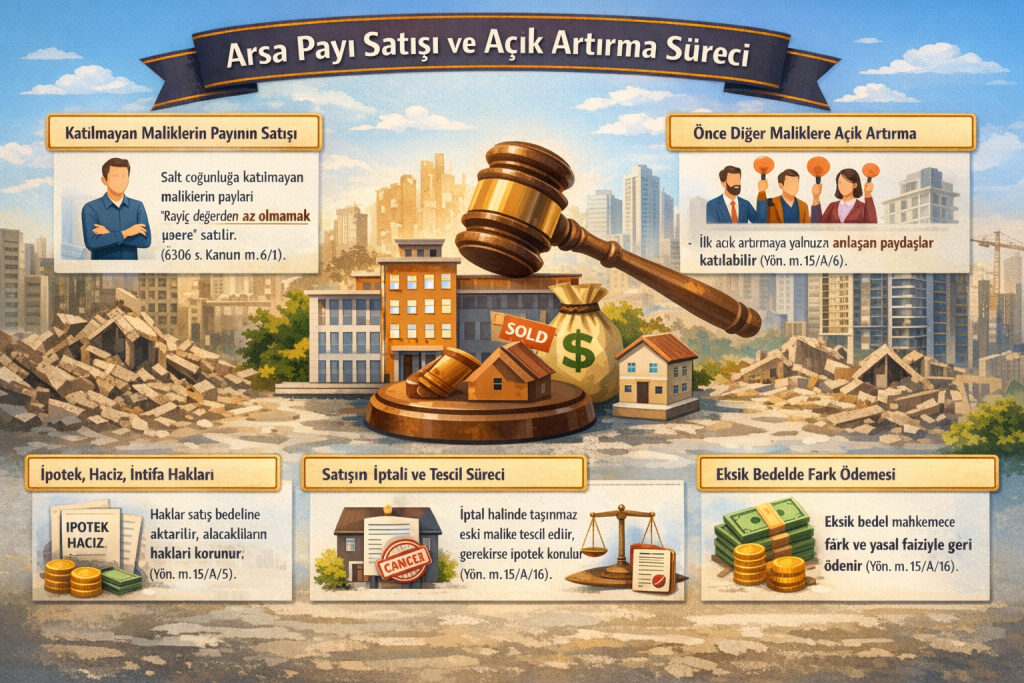
Land Share Sale and Auction Process
(Legal Analysis within the Framework of Law No. 6306, Article 6, and Implementation Regulation Articles 15 – 15/A)
One of the stages in urban transformation practices that leads to the most severe consequences is the sale of land shares belonging to owners who do not agree with a decision made by a simple majority. This is because, at this stage, the dispute is no longer merely about project preference, contractor selection, or sharing model; instead, a compulsory sale mechanism is directly initiated on the owner’s share. Law No. 6306 deemed it sufficient for shareholders to make a decision by a simple majority to prevent the transformation process in risky structures and application areas from being protracted; it also allowed for the sale of shares belonging to owners who did not agree with this decision, within certain procedures. The Implementation Regulation, on the other hand, detailed how this sale will be initiated with which documents, which notifications will be made, how the price will be determined, how the auction will be conducted, and how the title deed and encumbrance transactions will be concluded after the sale. Therefore, the land share sale process is not merely an “auction”; it is a multi-layered administrative procedure consisting of stages such as decision-making, notification, appraisal, sale, registration, and judicial review. (Law No. 6306 Art. 6/1, Art. 6/9; Implementation Regulation Art. 15, Art. 15/A)
Sale of Shares Belonging to Non-Consenting Owners
According to Law No. 6306, in parcels where risky structures are located, all fundamental implementation decisions such as **_reconstruction of buildings, evaluation with a flat-for-land or revenue sharing model, sale of shares, consolidation, subdivision, partition, abandonment, creation, and registration procedures in the land registry_** can be taken by **a simple majority of the shareholders, in proportion to their shares, regardless of whether they are shareholders of the structure.** Once this decision is made, the terms of the offer and agreement are duly notified to the owners who did not participate in the decision; if the offer is not accepted despite this, the land shares of these owners enter the sale process. The system here aims to implement the majority decision by ensuring the transfer of the share of the owner who did not participate in the decision, **for no less than its fair market value**, rather than forcibly making the owner a direct partner in the project. The text of the law specifically stipulated that the sale would be carried out under the guarantee of payment, not arbitrarily, by stating that the land shares of those who did not participate in the decision would be put up for sale **after their fair market value is determined by the Presidency and for no less than this value.** The regulation also mandated the submission of a detailed file, ranging from meeting invitation documents to the simple majority decision minutes, from notification documents showing that the terms of the agreement have been communicated, to SPK licensed valuation documents, for this sale to commence. **(Law No. 6306 art. 6/1; Implementation Regulation art. 15/2, art. 15/3, art. 15/A/1)**
Public Auction to Other Owners First
The legislator has given the first priority in the sale of land shares not to third parties from outside, but to other shareholders who have reached an agreement. The reason for this is to ensure that the group of owners who made the transformation decision can carry out the project internally and that the ownership structure in the parcel is primarily preserved within the existing owner community. For this reason, not everyone can participate in the first auction; the first sale is conducted only among shareholders who have agreed by a simple majority proportionate to their shares. The regulation is very clear on this point: “No one other than the shareholders who have agreed by a simple majority proportionate to their shares can participate in the first sale.” If none of the agreeing shareholders wish to acquire the share to be sold in the first sale, only then can the participation of third parties in subsequent sales come into question. Thus, the system first grants the opportunity to purchase to the owners forming the majority; it aims for the project to be continued without external interference. During the auction, the commission chairman requests oral bids, not lower than the fair market value, by explaining the information regarding the share offered for sale; the submitted bids are recorded in the minutes and signed. At this stage, the sale is conducted not as a classic private law tender, but as an administrative auction meticulously shaped by law and regulation. (Law No. 6306, Art. 6/1; Implementation Regulation Art. 15/A/6, Art. 15/A/7, Art. 15/A/8)
Sale Conducted by the Presidency or TOKİ
The Law has also separately regulated the possibility that a sale to shareholders might not take place in the first instance. In risky areas and reserve building areas, if a sale to shareholders cannot be made, these shares shall be purchased by the Presidency, Administration, or TOKİ, which will implement the transformation project, by paying their fair value. This regulation opens up an area of intervention for public authorities to prevent the blockage of transformation. However, in risky buildings, the system operates slightly differently; here, the sale process is repeated until a sale is made to the agreed-upon shareholders or to third parties who agree to proceed in accordance with the agreement made by the decision of the agreed-upon shareholders. In other words, while public institutions can intervene and purchase shares in risky areas and reserve building areas, in individual risky building parcels, the priority remains with the agreed-upon owners and their accepted purchasing model. The Regulation also maintains the same line, detailing how subsequent sales will be repeated if the first sale is unsuccessful, and under what conditions third parties can be included in the system. In this respect, the sales process is not merely a sharing among owners; it is a special transformation tool where the Presidency, Administration, or TOKİ can participate in the process directly as a buyer if necessary. (Law no. 6306, art. 6/1; Implementation Regulation art. 15/3, art. 15/A/11, art. 15/A/12, art. 15/A/13)
Required Application File for Sale and Initiation of the Process
For the sale of a land share to be carried out, it is not enough to simply state that “the majority has been achieved”. The regulation mandates the submission of a comprehensive application file to the Directorate, or to the Administration if authority has been delegated, for the sales process to commence. This file must include documents proving that the owners were invited to the meeting, minutes showing that the meeting was held, minutes of the decision or equivalent contract and power of attorney samples showing that a simple majority was reached in proportion to their shares, documents showing that the offer and terms of agreement were communicated to owners who did not participate in the decision, and valuation documents prepared by real estate appraisal institutions authorized by the CMB. Furthermore, the regulation explicitly states that structures do not need to have been demolished for the sale transaction to take place. This is very important in practice; because most owners believe that the sale can only be made after the building has been demolished. However, the regulation allows the decision-making and sales procedure to be advanced even before the structure has been physically demolished. Therefore, deficiencies in the sales file are not merely formal flaws; they are fundamental reasons for illegality that could lead to the complete annulment of the sale in future lawsuits. (Implementation Regulation Article 15/A/1)
Fair Market Value Determination
The most crucial safeguard in the sale of land shares is the principle of fair market value. The law has mandated that the sale must not be for less than the fair market value; the regulation, in turn, has meticulously detailed how this fair market value will be determined. Accordingly, a Price Determination Commission, consisting of at least three people, is established within the Directorate or Administration to determine the fair market value of the land shares to be sold. The Commission determines the fair market value, also taking into account the property value previously assessed by CMB-licensed valuation institutions on behalf of the owners. In the background, there is the valuation system outlined in Regulation Art. 12; the property value is determined according to the principles in Article 11 of Expropriation Law No. 2942 or in accordance with valuation standards accepted by the Capital Markets Board. In other words, the valuation is not based solely on a rough market estimate; the property’s area, zoning status, location, usability, environmental characteristics, and comparable sales data are all taken into consideration. Underestimation of the fair market value is one of the most frequent subjects of litigation in practice. Because a low valuation results in the owner losing their property without receiving its true equivalent. For this reason, a technical review of the valuation report is often the most critical area of scrutiny in the sales process. (Law No. 6306, Art. 6/1; Implementation Regulation Art. 12/2, Art. 12/3, Art. 15/A/3)
How Does the Auction Process Work?
After the date and place of the public auction are determined, this matter is duly notified to the owners who agree with a simple majority proportional to their shares, or to the contractor whom these owners have agreed upon (provided that the contractor is also an owner), and to the owner whose share will be sold. The Regulation stipulates that this notification shall be made via the electronic notification address if an electronic notification address has been registered with the land registry; if not, it shall be made through notification via the e-Devlet (e-Government) Gateway and by announcement for a period of fifteen days at the relevant headman’s office (muhtarlık). Electronic notification is deemed to have been made at the end of the fifth day following the date it reaches the recipient’s electronic address; notification made via e-Devlet and the headman’s office announcement is deemed to have been made on the last day of the headman’s office announcement. On the day of the public auction, the identities of the participants are established, and a record is drawn up; subsequently, the commission chairman announces the information regarding the share put up for sale and asks for bids not below the current market value. Each bid is recorded in the auction minutes and signed by the bidder. Participants who will not continue bidding must also record this fact in the minutes and sign it. At the end of the sale, the commission decides to sell to the highest bidder, and this person is required to deposit the sale price within seven days and, within the same period, sign and submit the contract and other documents in accordance with the majority decision, unconditionally and without reservation. If the payment is not deposited within this period, or if the contract is not signed for a reason not attributable to the contractor, the next bidder in line is considered. Therefore, the public auction is not merely a ‘highest bid wins’ logic; it is a multi-stage process completed by depositing the payment and signing the project documents. (Implementation Regulation Art. 15/A/4, Art. 15/A/7, Art. 15/A/8, Art. 15/A/9)
Participation of Third Parties in the Sale
If stakeholders do not make a purchase in the first sale, it is possible for third parties to participate in subsequent sales; however, this participation is not entirely unrestricted. The Regulation stipulates that for third parties to participate in the public auction, they must first declare in writing that they will accept the decision taken by a simple majority, sign the contract made in accordance with this decision, and any other documents required by the implementation. Additionally, third parties must deposit a cash collateral equivalent to ten percent of the determined fair value of the land share to be sold. This collateral is deposited with the relevant accounting unit; it is immediately refunded to those who do not win the tender. The third party who wins the tender must deposit the payment and sign the documents within seven days; otherwise, the collateral will be recorded as revenue for the Presidency. This system aims to prevent third parties from participating in the process solely for speculative purposes and to filter out serious buyers who genuinely accept the transformation decision. The law and regulation clearly indicate that the third party must comply with the simple majority decision and the project model even after the purchase. (Implementation Regulation Art.15/A/11, Art.15/A/13, Art.15/A/14, Art.15/A/15)
Transfer of Mortgage, Lien, and Usufruct Rights to the Sale Price
One of the most sensitive issues in land share sales is the fate of encumbrances such as mortgages, precautionary attachments, attachments, usufruct rights, and similar restrictions on the immovable property. The law and regulation clearly stipulate that these rights will not prevent the sale. This means that the existence of a mortgage or attachment on the share to be sold does not stop the auction from taking place. However, these rights do not disappear either; they continue over the sale price after the sale. The regulation states that after the sale, a block will be placed on the bank account where the sale price is deposited to prevent payment to the owner, and the situation will be reported to the creditor, the relevant enforcement office, or the court. Rights and annotations in the land registry are ex officio cancelled by the land registry office after the sale, upon the request of the Directorate or the Administration. Thus, while the new owner receives a clean title, the holders of old encumbrances continue their rights over the sale price. This mechanism aims to protect both the urban transformation process and the rights of creditors simultaneously. Therefore, issues such as how the bank’s claim will be protected in mortgaged properties and to whom and in what order the sale price will be paid in attached shares are of technical importance. (Law No. 6306, Art. 6/1; Implementation Regulation, Art. 15/A/5)
Registration Process After Sale
The process does not end after the sales price is paid; the actual transfer of ownership is completed with the land registry registration. The Regulation stipulates that after the sales price is paid, the sales transaction must be reported to the relevant land registry office and registration must be made in the name of the new owner. After the registration process is completed by the land registry office, the new land record is sent to the Directorate or the Administration, and the situation is also separately notified to the party whose share was sold. With the sale, the new owner becomes a party to the decision mostly taken on the parcel, and the transformation process becomes binding for them as well. Since the rights and annotations in the land registry are automatically canceled after the sale, the new owner acquires a share free of encumbrances; however, as mentioned above, previous encumbrances are considered to have been transferred to the sales price. The post-sale registration process is not merely a change in the land registry record; it also means that the majority decision produces definitive results at the ownership level. Therefore, any illegality in any of the stages of sale announcement, auction, payment of price, and contract signing may lead to the subsequent registration also becoming subject to a lawsuit. (Implementation Regulation Article 15/A/10)
Registration Process in Case of Sale Cancellation
Law No. 6306 also meticulously regulates what happens if the sale of a land share is canceled by a court decision. According to the law, if the sales transaction is canceled by a court decision and the sold land or land share has not subsequently been transferred to a third party, or has not been subjected to another practice that legally or practically renders its direct registration in the name of the previous owner impossible, the immovable property is registered ex officio in the name of its former owner. However, a statutory mortgage for the amount of the sale price is established and registered in favor of the buyer until the sale price is reimbursed. This regulation both protects the former owner who lost their property due to an unlawful sale and ensures that the buyer, who paid the sale price, remains secure until the reimbursement is made. In other words, when a cancellation decision is issued, the system does not merely close the matter by saying “the sale is deemed void”; it strikes a balance between the return of the title deed and the security of the payment. In this respect, the cancellation of a sale is a highly sensitive stage that produces technical consequences in title deed law. (Law No. 6306, Art. 6/1)

Difference Payment in Case of Cancellation Due to Underpayment
The legislator has not always preferred the outright cancellation of the sale transaction; instead, it has adopted a special correction model, especially for cases where the sale price was calculated incorrectly. According to Law No. 6306, if a sale transaction is canceled by a court decision solely on the grounds that the sale price was calculated incorrectly, the court decision is not in the form of a complete reversal of the sale; but rather is applied by requiring the payment of the difference between the sale price and the correct price to be calculated as specified by the court, from the owner who purchased the share to the former owner whose share was sold. Furthermore, the regulation similarly stipulates that this difference shall be paid together with legal interest accruing from the date of the tender. Moreover, if the court decides that the former owner’s loss should be compensated by the Presidency or the Administration, the Presidency or the Administration may pay this amount and then seek recourse from the purchasing owner. The logic of this system is as follows: If the illegality lies solely in the valuation, instead of disrupting the entire sales process from start to finish, a price equalization is made in favor of the owner. For this reason, fair value lawsuits often result in disputes related to the collection of the difference and interest for the inadequate price, rather than the return of ownership. (Law No. 6306, Art. 6/1; Implementation Regulation Art. 15/A/16)
The Importance of the Sale File Before Building Permit Application
The Regulation has established an important control mechanism to prevent a majority decision from effectively turning into a license before the shares of owners who did not participate in the decision are sold. Accordingly, prior to applying to the relevant Administration for a building permit based solely on a majority decision, the decision and proposal must have been duly notified to the owners who did not participate in the decision, and an application must have been made to the Directorate, or to the Administration if authority has been delegated, for the sale of these owners’ shares. The Directorate or Administration, as a result of a preliminary review of the sales file, sends a letter containing information on whether a simple majority has been achieved and whether notification procedures have been completed to the institution that will issue the building permit. This regulation demonstrates that the sales procedure is not merely a subsequent independent process, but is directly linked to the licensing and construction process. In practice, most disputes arise from allegations that sales notifications were incomplete or that the simple majority calculation was incorrect, despite the permit having been issued. Therefore, controlling the sales file before the building permit application is critically important for the lawful commencement of the transformation process. (Implementation Regulation Art. 15/4)
Why is Expert Lawyer Support Necessary?
Although the land share sale and auction process formally appears limited to a few minutes and one auction day, it is actually a technical field where administrative law, land registry law, condominium law, valuation law, and notification law come into play simultaneously. Many issues such as the incorrect calculation of a simple majority, improper issuance of meeting invitations, incomplete neighborhood headman announcements, erroneous electronic notifications, lack of oversight for SPK-licensed valuation reports, procedural deficiencies in the transactions of the Price Determination Commission or Sales Commission, errors in the sales announcement, or failure to deposit the sale price on time, can lead to the cancellation of the sale or significant loss of rights for the owner. Especially the support of an Istanbul urban transformation lawyer is of great importance for overseeing simple majority decisions in large and multi-owner projects, establishing an auction process compliant with regulations, early detection of the risk of insufficient price, and correctly determining the litigation strategy. For owners particularly seeking a Tuzla urban transformation lawyer on the Anatolian Side, legal control of documents from the beginning to the end of the process often becomes more crucial than filing a lawsuit. For this reason, 2M Law Office offers services in one of its prominent areas of expertise, where the need for technical and detailed legal support becomes evident in urban transformation projects, particularly concerning the decision-making process of condominium owners, land share sales, auction procedures, contractor disputes, and administrative litigation stages. Especially in transformation projects carried out in Istanbul, Tuzla, Pendik, Kartal, Maltepe, and surrounding areas, obtaining expert lawyer support for transactions directly affecting ownership, such as share sales, is crucial for preventing losses that are difficult to compensate later. (Law no. 6306, art. 6/1, art. 6/9; Implementation Regulation art. 15, art. 15/A)

Conclusion
The process of land share sale and public auction is one of the most powerful mechanisms established by Law No. 6306 to prevent urban transformation from stalling; however, it also constitutes one of the most serious interventions with consequences for the owner. The process consists of the stages of; taking a simple majority decision, proper notification of the offer to the owners who did not participate in the decision, determination of the fair market value, conducting the public auction, depositing the sale price, title deed registration, transferring encumbrances to the sale price, and judicial review when necessary. A deficiency in any link of this chain may lead to the cancellation of the sale or a dispute over the price difference. Therefore, in practice, the real issue is not only the question of “was a majority achieved?”; but rather, each of the questions such as was the majority decision established in a manner suitable for sale, is the notification in compliance with the legislation, is the fair market value correct, was the auction procedure fully implemented, must be examined separately. The most important way to protect property rights in urban transformation is precisely to conduct meticulous legal review at these stagesr. (Law No. 6306 Art. 6/1, Art. 6/9; Implementation Regulation Art. 15, Art. 15/A)
Frequently Asked Questions
Kentsel dönüşümde çoğunluk kararına katılmayan malikin arsa payı zorla satılabilir mi?
Evet. 6306 sayılı Kanun’a göre riskli yapıların bulunduğu parsellerde yapılacak uygulamalara hisseleri oranında paydaşların salt çoğunluğu ile karar verilebilir. Bu karara katılmayan maliklere, alınan karar ve anlaşma şartları tebliğ edilir; malikin bu şartları kabul etmemesi halinde arsa payı rayiç değerden az olmamak üzere açık artırma ile satılabilir. Kanun koyucu burada dönüşümün azınlık maliklerin itirazı nedeniyle durmasını önlemeyi amaçlamıştır. Ancak satış işlemi keyfi değildir; rayiç değer tespiti, usulüne uygun tebligat, açık artırma ve satış komisyonu gibi çok sayıda şekil şartına bağlıdır. Bu şartlardan herhangi biri ihlal edilirse satış işlemi idare mahkemesinde iptal edilebilir. (6306 s. Kanun m.6/1; Uygulama Yönetmeliği m.15, m.15/A)
Arsa payı satışında rayiç değer nasıl belirlenir?
Arsa payı satışında satış bedeli rayiç değerden daha düşük olamaz. Bu rayiç değer, İl Müdürlüğü veya yetkili idare bünyesinde kurulan Bedel Tespiti Komisyonu tarafından belirlenir. Komisyon, taşınmazın değerini belirlerken genellikle SPK lisanslı gayrimenkul değerleme kuruluşlarının raporlarını esas alır ve taşınmazın konumu, imar durumu, emsal satışlar, kullanım durumu ve piyasa koşulları gibi unsurları dikkate alır. Yönetmelik ayrıca değerlemenin 2942 sayılı Kamulaştırma Kanunu’nun 11. maddesindeki kriterlere veya SPK değerleme standartlarına uygun yapılması gerektiğini açıkça düzenlemiştir. Eğer rayiç değer eksik belirlenmişse, malik satış işlemine karşı dava açabilir ve mahkeme fark bedelin ödenmesine karar verebilir. (6306 s. Kanun m.6/1; Uygulama Yönetmeliği m.12/2, m.12/3, m.15/A/3)
Açık artırmaya kimler katılabilir?
Arsa payı satışında ilk açık artırmaya yalnızca hisseleri oranında salt çoğunluk ile anlaşan paydaşlar katılabilir. Bunun sebebi, dönüşüm projesinin öncelikle mevcut malik grubu içinde yürütülmesini sağlamaktır. Eğer ilk satışta paydaşlar payı satın almazsa, sonraki satışlarda üçüncü kişilerin de açık artırmaya katılması mümkün hale gelir. Ancak üçüncü kişilerin satışa katılabilmesi için salt çoğunluk kararını ve proje şartlarını kabul ettiklerini yazılı olarak beyan etmeleri ve rayiç bedelin %10’u oranında teminat yatırmaları gerekir. Bu düzenleme, satış sürecinin spekülatif alıcılar tarafından manipüle edilmesini önlemek amacıyla getirilmiştir. (Uygulama Yönetmeliği m.15/A/6, m.15/A/11, m.15/A/13)
Arsa payı üzerinde ipotek veya haciz varsa satış yapılabilir mi?
Evet. Taşınmaz üzerinde ipotek, haciz, ihtiyati haciz veya intifa hakkı bulunması arsa payı satışına engel değildir. Kanun ve yönetmelik, bu tür hakların satış sonrası ortadan kalkmayacağını; ancak taşınmazdan satış bedeline taşınacağını düzenlemiştir. Yani satış yapıldıktan sonra ipotek veya haciz hakları satış bedeli üzerinde devam eder ve alacaklıların hakları bu bedelden karşılanır. Yönetmelik ayrıca satış bedelinin yatırıldığı banka hesabına malike ödeme yapılmaması için bloke konulacağını ve alacaklılara bu durumun bildirileceğini düzenlemektedir. Böylece dönüşüm süreci devam ederken üçüncü kişilerin alacak hakları da korunmuş olur. (6306 s. Kanun m.6/1; Uygulama Yönetmeliği m.15/A/5)
Arsa payı satışı mahkeme tarafından iptal edilirse ne olur?
Arsa payı satışı idari işlem niteliğinde olduğu için idare mahkemesinde dava konusu yapılabilir. Mahkeme satış işlemini hukuka aykırı bulursa iki farklı sonuç ortaya çıkabilir. Eğer satış sonrası pay üçüncü kişiye devredilmemişse veya taşınmaz üzerinde geri dönüşü imkânsız bir işlem yapılmamışsa, arsa payı tekrar eski malik adına tescil edilir. Ancak satış bedelinin iadesi sağlanıncaya kadar alıcı lehine satış bedeli tutarında kanuni ipotek tesis edilir. Buna karşılık mahkeme yalnızca satış bedelinin eksik hesaplandığını tespit ederse satış tamamen iptal edilmez; bunun yerine satış bedeli ile gerçek rayiç değer arasındaki farkın faiziyle birlikte eski malike ödenmesine karar verilebilir. Bu nedenle arsa payı satış davalarında en sık görülen uyuşmazlıklar değerleme hatalarından kaynaklanmaktadır. (6306 s. Kanun m.6/1; Uygulama Yönetmeliği m.15/A/16)