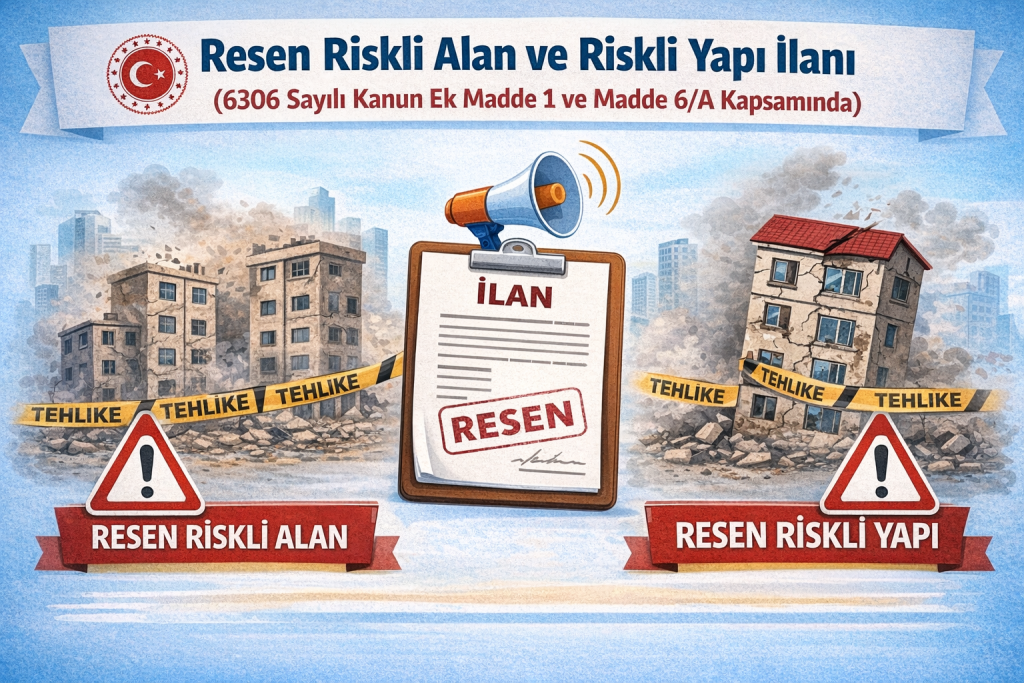
Ex Officio Declaration of Risky Area and Risky Structure (Within the Scope of Law No. 6306, Additional Article 1 and Article 6/A)
In the urban transformation process, the declaration of risky areas and the designation of reserve building areas are among the most critical stages directly affecting property rights, investment decisions, and project development processes. These operations carried out under Law No. 6306 on Transformation of Areas Under Disaster Risk grant broad powers to the administration, especially after the amendments to Laws No. 7181, 7410, and 7471.
Below, the process is explained in detail, with relevant legal articles specified in parentheses.
Risky Area Declaration Criteria (65% Unlicensed Building Requirement)
(Law No. 6306, Additional Article 1/1-a,b)
For an area to be declared as a “risky area”, the conditions specified in Additional Article 1 must be met. Accordingly;
Places where public order or safety has deteriorated to an extent that stops ordinary life,
Areas with inadequate planning or infrastructure services,
Regions with construction contrary to zoning regulations,
Areas with damaged structures or infrastructure,
Areas where at least 65% of the structures are unlicensed or contrary to zoning regulations
may be designated as risky areas by the President.
These criteria are especially the most frequently wondered topics in searches such as “how are risky areas declared”, “what is the 65% unlicensed building requirement”, and “urban transformation risky area criteria”.
When defining the boundaries of a risky area, “implementation integrity” is considered. This means not only risky buildings but also neighboring parcels deemed necessary for project integrity can be included (Additional Article 1/1).
Declaration of Risky Area by Presidential Decree
(Law No. 6306, Additional Article 1/1)
The declaration of a risky area is not a technical report process, but an administrative procedure carried out directly by Presidential decree. The decree enters into force upon its publication in the Official Gazette.
Following this declaration;
Zoning plans may be amended,
Expropriation or registration in the name of the Treasury may be carried out,
Implementations can be carried out without requiring the owner’s consent,
Public tenders may be conducted under Law No. 4734, Article 21/b (Additional Article 1/2-b).
Therefore, the declaration of a risky area is not an ordinary zoning procedure; it is a powerful administrative act that directly affects property rights.
Period for Filing a Lawsuit (As of the Official Gazette)
(Law No. 6306, Additional Article 1/2-a)
The period for filing a lawsuit against the risky area decision starts from the date of its publication in the Official Gazette.
The law explicitly stipulates:
A separate lawsuit cannot be filed against the risky area decision based on implementation procedures. (Additional Article 1/2-a)
In accordance with this provision, if the Official Gazette announcement is missed, the annulment of the risky area decision cannot be requested based on subsequent demolition, eviction, or zoning implementations. Legal questions such as “urban transformation risky area lawsuit period”, “objection period to risky area decision”, “when to file a risky area annulment lawsuit” are evaluated within the scope of this article.
Authority for Ex Officio Implementation Without Owner’s Consent
(Law No. 6306, Article 6/A)
Article 6/A, especially with amendments 7181 and 7471, has granted broad intervention powers to the administration.
In areas where structures are at risk of collapse, transformation applications can be carried out ex officio by the Presidency without requiring the consent of the owners (Article 6/A/1).
Risk assessment of structures; can be carried out ex officio by opening closed areas with the assistance of law enforcement (Article 6/A/2).
If evacuation is not carried out within the specified period, forced eviction and demolition can be performed with the assistance of law enforcement (Article 6/A/3).
All transactions, including sales, transfers, mortgages, and cancellation of annotations in the land registry, can be carried out without requiring the owner’s consent (Article 6/A/4).
Public and privately owned immovable properties can be registered in the name of the Treasury (Article 6/A/5).
Existing construction contracts shall be deemed terminated without the consent of the parties (Article 6/A/6).
Entitlement studies are conducted based on the immovable property’s value; a debt agreement can be made, and title transfer will not occur without payment (Article 6/A/7).
These regulations form the legal basis for practices such as “demolition without owner’s consent,” “termination of contract in urban transformation,” “registration in the name of the Treasury,” and “ex officio urban transformation implementation.”
Designation of Reserve Building Area
(Within the Scope of Applications of Law No. 6306, Article 2 and Article 6/A)
A reserve building area is a new settlement area designated for use in transformation applications. It can also be determined outside a risky area.
In reserve area applications;
Registration can be made in the name of the Treasury (Article 6/A/5),
Floor easement and condominium ownership can be established in the name of the Treasury (Article 6/A/5),
A tender can be issued without requiring an implementation project (Article 6/A/5 – Amendment No. 7471).
These areas are generally planned for the relocation of rights holders or for the purpose of new housing production.
Searches such as “What is a reserve area for construction?”, “cancellation of reserve area declaration”, “title deed transfer of reserve area”, “rights ownership in a reserve building area” are evaluated within this scope.
30% Property Transfer Requirement
(Amendment to Law No. 7471 – Article 6/A of Law No. 6306 and related regulations)
A significant change has been made in reserve area implementations with Law No. 7471 dated 7/11/2023. Accordingly, a 30% property transfer requirement has been stipulated for the implementation to commence in certain situations. While this regulation provides project security for investors, it has become a factor that could lead to negotiation and loss of rights risks for landowners.
Rights ownership calculations;
Existing property value,
Value of the new independent unit,
Indebtedness amount,
Calculations are carried out based on a flat-for-land agreement or revenue sharing model (Article 6/A/7).
Why is Expert Legal Support Necessary? (The Legal Dimension of Urban Transformation)
The declaration of a risky area and a reserve building area is not merely an “urban planning” issue; it is a set of powerful administrative procedures that directly affect property rights and lead to serious consequences. A decision in processes carried out under Law No. 6306 creates a wide range of effects, extending from annotation on the title deed to eviction, and from contract terminations to registration in the name of the Treasury. Therefore, the “we’ll fix it later” approach is often not possible in the urban transformation process; missing a short deadline or taking a wrong step can lead to irreversible loss of rights .
Why is Legal Risk High in Urban Transformation?
Urban transformation practices often:
Restrict property rights and result in consequences affecting the right to use/benefit,
Include administrative procedures that can alter title deed records (registration, transfer, annotation, cancellation),
Lead to disputes that can effectively render existing land share in exchange for construction contracts or floor-for-share protocols dysfunctional,
Can escalate into irreversible stages such as forced eviction and demolition,
Simultaneously operate technical-legal processes such as registration in the name of the Treasury, rights valuation, and indebtedness.
This scenario creates the necessity for both landowners and investors/contractors to “start with the most appropriate strategy.”
Most Frequent Causes of Rights Loss
The most problematic points in practice are the following:
Missing the Official Gazette announcement date (critical for litigation period and objection rights),
Incorrect calculation of the lawsuit period or selection of the wrong type of lawsuit,
Incorrect calculation of entitlement and valuation accounts (land share, square meter, equivalent of independent section, equalization),
Failure to check the provisions of the indebtedness agreement / payment plan,
Mismanagement of the default–termination process of the flat-for-land / land share agreement made with the contractor,
Making procedural errors in owner majority decisions, notifications, meetings, and minutes.
A significant portion of these errors is not “correctable” later; because the process might have been registered in the land registry, evacuation/demolition might have occurred, or the list of beneficiaries might have been finalized.
Urban Transformation Consultancy with 2M Hukuk Law Office (Istanbul Anatolian Side and Throughout Turkey)
In the legal dimension of urban transformation; correct strategy, time management, and evidence/document structuring determine the fate of the process. 2M Hukuk Law Office, based in Istanbul Anatolian Side; provides comprehensive legal consultancy to landowners, apartment owners, and investors throughout Turkey in risky areas, reserve building areas, risky building detection, and applications of Law No. 6306.
What Does 2M Hukuk Provide?
1) Process Analysis and Roadmap
In each file, the nature of the risky area/reserve area, the notification process, majority owner decisions, land registry annotations, and contracts are evaluated together. The goal is to clarify “where you are” and flawlessly plan “what to do next.”
2) Litigation and Administrative Application Strategy (6306 Applications)
In cases of risky area declaration, reserve building area processes, implementation procedures, eviction-demolition phases, and disputes over entitlement; the correct type of lawsuit and precise timing are critically important. 2M Law devises an application and litigation strategy that strengthens the legal position against administrative actions during the process.
3) Contract Security: Flat-for-Land-Share / Land-Share-for-Construction Contracts
Contractor selection and the contracting phase are the areas that generate the most disputes in urban transformation. Clauses such as default, termination, penalty clauses, delivery period, rent assistance, technical specifications, and mortgage/collateral can lead to years of grievances if not strongly structured in favor of the landowner.
4) Entitlement – Valuation – Indebtedness Control
Issues such as loss of square meters, land share disputes, indebtedness costs, and risks of non-delivery are the most critical “outcome” areas for landowners. 2M Law focuses on identifying legal risks in advance during valuation and entitlement processes to prevent loss of rights.
5) Project Law for Investors and Contractors
In reserve area and urban transformation projects, land acquisition, owner consensus, land registry–zoning–permit coordination, and dispute management determine the security of the investment decision. 2M Law also provides consultancy that de-risks the process from an investor’s perspective.