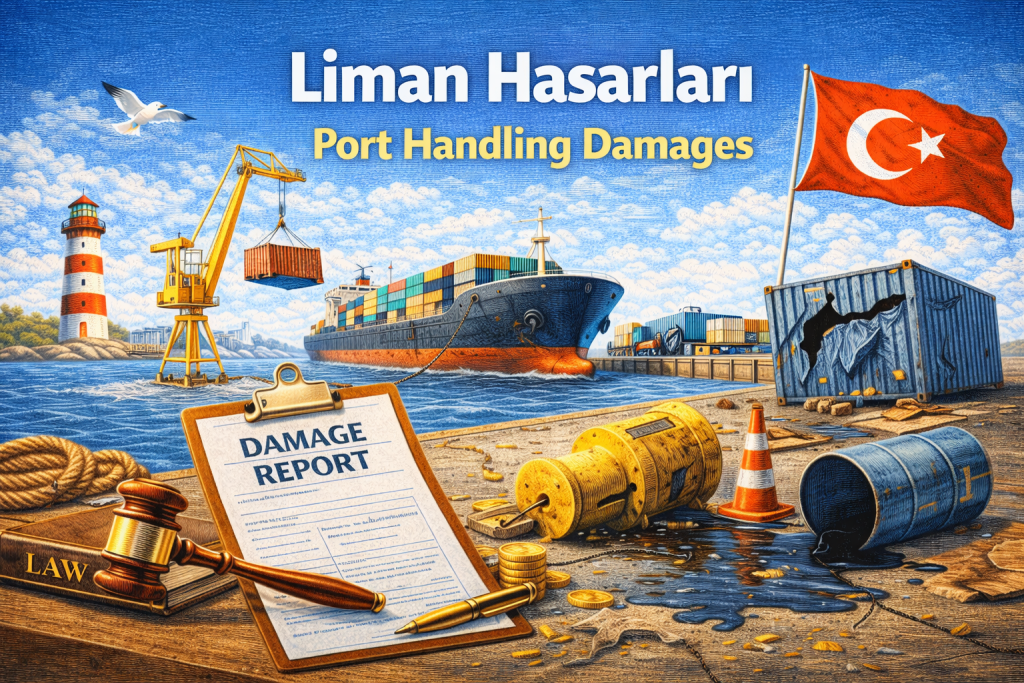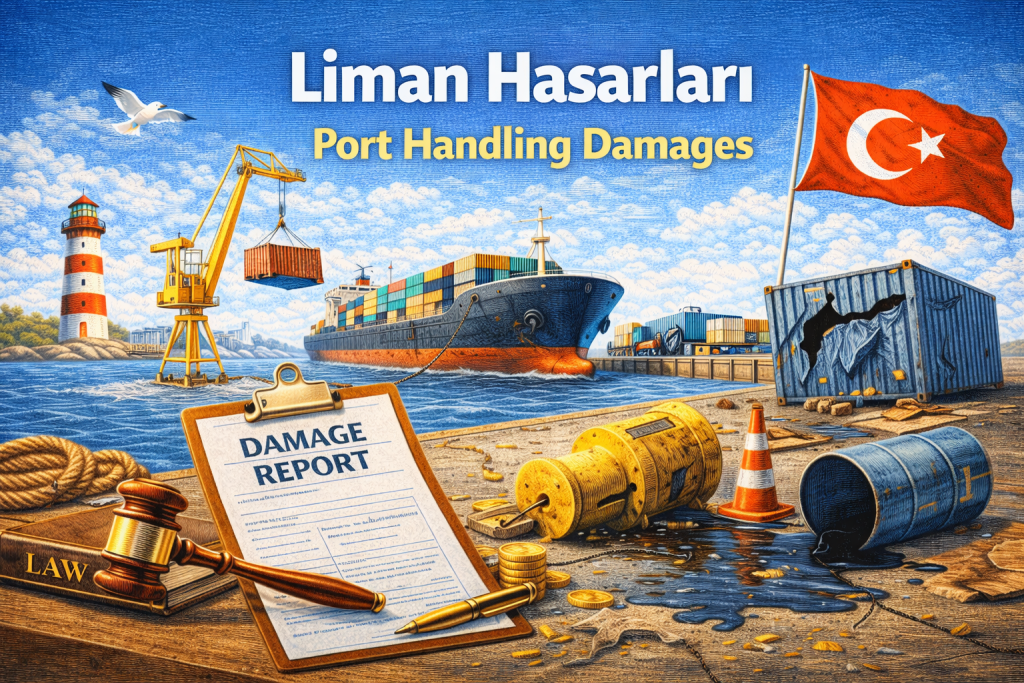
PORT – TERMINAL DISCHARGE / LOADING DAMAGES (Port and Terminal Cargo Handling Damage Claims in Turkey)
What Is Port Discharge/Loading Damage? (What Are Port and Terminal Handling Damages?)
Port discharge and loading damages refer to losses occurring during the unloading of cargo from a ship or the loading of cargo onto a ship. Cargo damage, container damage, equipment-related losses, improper stowage, short delivery, delay or commercial losses occurring during terminal operations are evaluated within this scope.
In maritime commercial law, damages arising from port and terminal operations create complex liability relationships among the carrier, port authority, terminal operator, cargo owner, and other commercial parties.
Port and terminal handling damages refer to losses occurring during loading or discharge operations, including cargo damage, container damage, equipment-related losses, improper stowage, short delivery and operational delays. These disputes create complex liability relationships among carriers, port authorities, terminal operators and cargo interests.
Main Causes of Port Damages (Common Causes of Port and Terminal Damage)
Damages occurring during port and terminal operations can arise from various reasons. The most common causes are:
Cargo falling or being damaged during discharge or loading
Faulty use of crane and terminal equipment
Improper stowage or unsecured cargo
Container damage or deformation
Terminal operation errors
Port personnel negligence
Commercial loss due to delay
Misdelivery or short delivery of cargo
Determining the actual cause of the damage is critically important for establishing the chain of liability.
Port damages may result from cargo dropping, crane operation errors, improper stowage, container damage, terminal mistakes, personnel negligence, delays or misdelivery. Determining the actual cause is essential for identifying liability.
Liability of Port and Terminal Operators (Liability of Port and Terminal Operators)
Port and terminal operators are responsible for the safe execution of discharge and loading operations. Fault for damages arising from terminal services is assessed based on operational records, technical examinations, and contractual provisions.
The liability of the port operator is determined by the contractual relationship, terminal service conditions, and maritime trade practices.
Port and terminal operators are responsible for safe cargo handling operations. Liability is assessed based on operational records, technical analysis and contractual obligations. The scope of responsibility depends on service agreements and maritime practices.
Liability of the Carrier and Other Parties (Carrier and Third-Party Liability)
In port damage disputes, liability may not solely belong to the port operator. The carrier, ship operator, cargo owner, agent, or insurance company may also be included in the chain of liability.
Therefore, the following elements are considered together:
Provisions of the contract of carriage and bill of lading
Terminal service agreements
Port operation records
Loading and unloading instructions
Insurance coverage
Technical inspection reports
Correct determination of liability directly affects the success of a compensation claim.
Liability in port damage disputes may extend beyond port operators to carriers, ship operators, cargo interests, agents or insurers. Contract terms, operational records, handling instructions and technical reports must be evaluated together.
Evidence Determination in Port Damage Disputes (Evidence in Port Damage Claims)
Rapid evidence determination is of vital importance in port damage disputes. The following documents, in particular, are decisive in the legal process:
Survey reports
Photo and video records
Tally sheets and terminal records
Container delivery records
Port operation reports
Loading and unloading documents
Equipment usage records
Witness statements
Failure to collect evidence in a timely manner may result in loss of rights.
Rapid evidence preservation is crucial in port damage disputes. Survey reports, photos, tally sheets, terminal logs, handling records and witness statements play a decisive role. Failure to collect evidence promptly may result in loss of rights.
Port Damage Disputes in Istanbul Ports (Port Damage Disputes in Istanbul Ports)
Istanbul is one of Turkey’s busiest maritime trade centers, where port discharge and loading damage disputes frequently arise due to high cargo traffic at Ambarlı, Haydarpaşa, and Zeytinburnu ports.
Damages occurring at Istanbul ports due to intense port operations, terminal services, and international trade activities can lead to serious commercial losses.
2M Hukuk Law Firm provides legal representation services to domestic and foreign clients in port damage disputes arising in Istanbul ports.
Istanbul is one of Turkey’s busiest maritime trade hubs, where port handling disputes frequently arise due to high cargo traffic at Ambarlı, Haydarpaşa and Zeytinburnu ports. 2M Hukuk Law Firm provides legal representation in port damage disputes in Istanbul.
Istanbul, Tuzla, Kocaeli and Yalova Port Damage Disputes (Port Damage Claims in Tuzla, Kocaeli and Yalova)
Tuzla Shipyards Region, Kocaeli Izmit Gulf ports, and Yalova/Altınova shipyards are centers where ship maintenance, repair, and commercial transportation activities are intense. Damages arising from terminal operations, shipyard activities, and loading processes are frequently observed in these regions.
Tuzla-based 2M Hukuk Law Firm ensures rapid legal intervention, evidence detection, and compensation processes are carried out in these regions.
Tuzla Shipyards Region, Kocaeli Gulf ports and Yalova shipyards are major maritime activity centers where port handling damages frequently occur. 2M Hukuk provides rapid legal intervention from its Tuzla-based office.
International Port Disputes and Insurance Processes (International Port Disputes and Insurance Issues)
In international transportation, port damages often concern insurance companies, P&I clubs, and international commercial parties. Insurance coverage, liability regime, and applicable law play a decisive role in dispute resolution.
2M Hukuk Law Firm provides legal consultancy in Turkish and English in international port disputes.
International port damage disputes often involve insurers, P&I clubs and international commercial parties. Insurance coverage and applicable law play a decisive role in dispute resolution.
Time Limits and Loss of Rights Risks in Port Damage Cases (Time Limits and Legal Risks)
In port damage disputes, limitation periods, evidence gathering, and procedural actions are of great importance. Failure to report the damage in a timely manner or choosing the wrong legal path can lead to difficult-to-remedy losses of rights.
Therefore, it is important to seek expert legal support in port damage disputes.
Limitation periods, procedural requirements and timely notification are critical in port damage disputes. Failure to act promptly may result in irreversible legal losses.
Why 2M Hukuk Law Firm? (Why Choose 2M Hukuk Law Firm?)
2M Hukuk Law Firm, based in Tuzla, is a TR/EN bilingual maritime commercial dispute resolution office operating along the Istanbul–Kocaeli–Yalova port and shipyard line, taking swift action in port and terminal damage disputes. We provide legal consultancy and representation services to shipowners, carriers, cargo owners, port operators, and international maritime companies.
2M Hukuk Law Firm is a Tuzla-based maritime law office providing rapid legal action in port damage disputes across the Istanbul–Kocaeli–Yalova corridor.
Legal Assistance for Port Damage Claims
You can contact 2M Hukuk Law Firm for the compensation of damages arising from port loading and unloading incidents.
For legal assistance regarding port and terminal damage claims in Turkey, contact 2M Hukuk Law Firm.