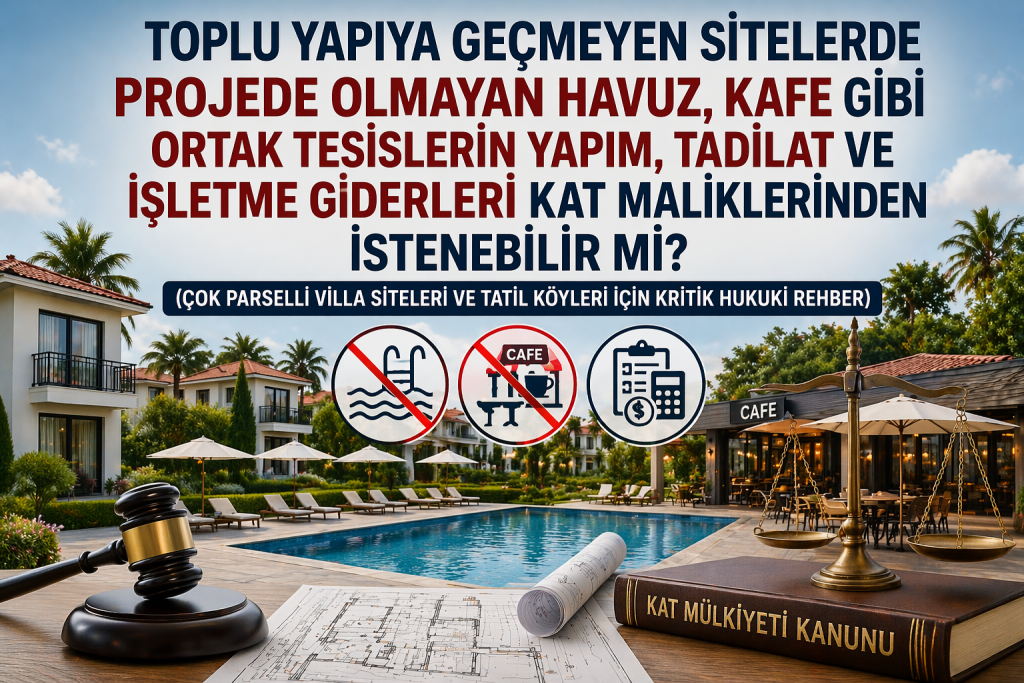
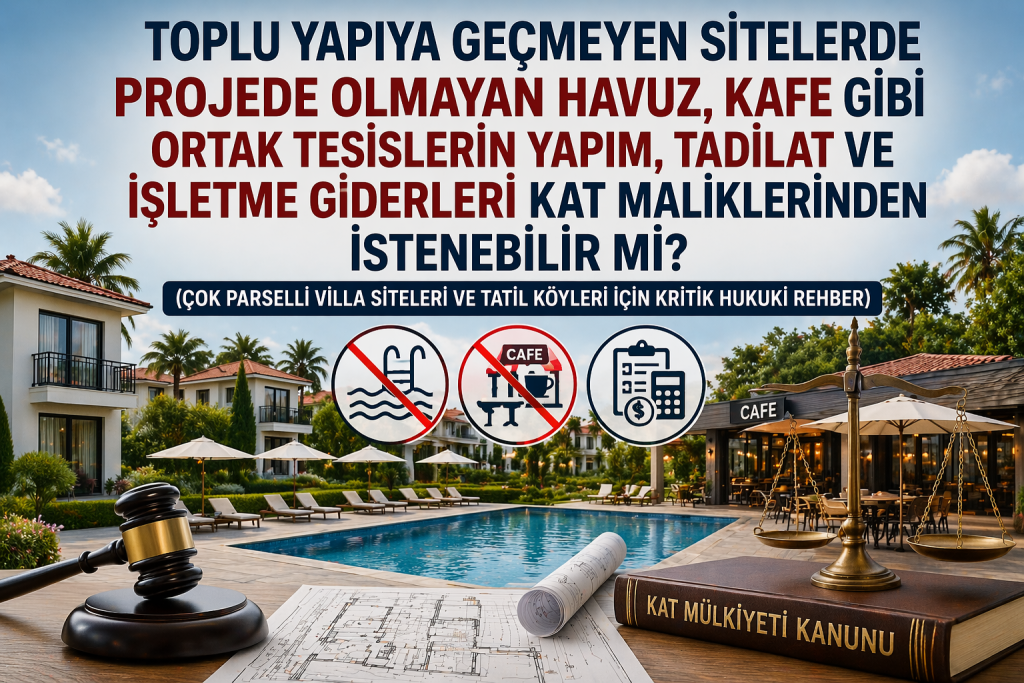
One of the most debated issues in villa complexes and holiday villages established on multiple parcels is **whether the expenses requested by the site management are truly legal**. In practice, the reflection of expenses such as pools, cafes, social facilities, roof alterations, or aesthetic renovations, which are not included in the project, to homeowners as “dues” or “common expenses” leads to serious disputes.
Are You Obligated to Pay for Facilities Built Contrary to the Project?
Can the Site Management Demand Expenses Not Included in the Project From You?
1. Expenses of Facilities Not Included in the Architectural Project and Demand for Dues
In complexes built on multiple parcels, the issue of whether construction, renovation, or renewal expenses for facilities not included in the architectural project (such as a pool, cafe, etc.) can be demanded as dues from homeowners has been clearly decided in Supreme Court rulings.
According to the decision numbered Court of Cassation 20th Civil Chamber-2017/2361-2018/5455 -10.09.2018, presented as the main source; the form in the project belonging to the main immovable property must be preserved unless it is changed with the consent of all floor owners and approved by the municipality. The fact that a new facility adds value to the building does not justify making changes contrary to the project. The decision explicitly states that, “the plaintiff has no right to demand the expenses of the works carried out contrary to the project from the other floor owners” and it was ruled that owners who did not approve the construction of facilities made in a manner not included in the project cannot be held responsible for their construction costs.
Similarly, in the decision numbered Court of Cassation 18th Civil Chamber-2012/5855-2012/8123 -26.06.2012, which serves as the main source; it was ruled that the costs of renovations made contrary to the project in a complex built on multiple parcels and not transitioned to Collective Building Management cannot be demanded from the other floor owners. The Court of Cassation stated that owners can only be held responsible for repair expenses incurred in accordance with the project.
2. Status of Complexes Not Transitioned to Collective Building Management
The fact that the site is not subject to the Condominium Law (KMK) or has not transitioned to collective building management does not change the rule that expenses for facilities contrary to the project cannot be claimed. The main source, the decision of the Supreme Court 18th Civil Chamber-2012/5855-2012/8123 -26.06.2012, was rendered in a dispute precisely of this nature (where collective building management had not been adopted, and each parcel had a separate management plan), confirming that expenses contrary to the project should be rejected. In the case at hand concerning this decision; the Supreme Court evaluated the concrete dispute in a very clear and instructive manner. In the incident, despite there being a site consisting of multiple parcels, it had not transitioned to collective building status, a separate management plan was arranged for each parcel, and a common management plan covering all parcels was not created. Despite this, based on a decision taken site-wide, a claim for debt was made against some owners under the name of roof repair expenses and enforcement proceedings were initiated. However, during its review, the Supreme Court particularly emphasized two critical points: If there is no collective building management, no binding decision can be made site-wide. In the specific case, since there was no legally binding superior management among the parcels, it was accepted that decisions covering the entire site could not automatically be imposed on all owners. In other words, even if there is a de facto management, the decisions made by this management are not binding on everyone. The cost of construction contrary to the project cannot be charged to other owners. In the expert examination conducted on the file, it was determined that the roof was constructed in a completely different manner from the system envisioned in the project (with trapezoidal sheet metal and a steel system instead of tile covering). At this point, the Supreme Court established a very important principle: Condominium owners are only responsible for repair expenses made in accordance with the project. The cost of renovations made contrary to the project, arbitrarily, or with a different system cannot be charged to other owners.
According to information obtained from secondary sources; in sites with multiple parcels that have not transitioned to a collective building management system, the authority to collect dues has also been restricted. In the decisions numbered Court of Cassation 18th Civil Chamber-2015/2716-2015/17808 -07.12.2015 and Court of Cassation 20th Civil Chamber-2017/1044-2018/681 -06.02.2018, it was emphasized that in cases where collective building management has not been adopted, the site management does not have the general authority to collect dues, and this authority belongs to the management of the respective parcel.
3. Non-compliance of the Management Plan with Mandatory Law and the Project
The claim that the management plan mentioned in the question cannot be contrary to mandatory law and zoning regulations is supported by Court of Cassation decisions which serve as secondary sources. Although there is no direct assessment of dues cancellation based on “zoning regulations” in the presented decisions, the “approved architectural project” has been accepted as a mandatory limit.
According to information obtained from secondary sources; in its decision numbered Supreme Court 5th Civil Chamber-2023/9445-2024/5530 -07.05.2024, facilities such as a poolside cafe (Pool Bar), which are not in the project, were evaluated and it was clearly stated that “the right of use granted to the independent section owner by the management plan will not grant the right to act contrary to the project in the main property.” It was also stated that the management plan could be annulled if it contradicts mandatory provisions. The decision of the Supreme Court 18th Civil Chamber-2014/8671-2014/11705 -30.06.2014 also indicates that decisions of the management plan or the board of apartment owners cannot override mandatory rules (the prohibition of non-compliance with the project).
4. Legal Remedies Available to Apartment Owners
The ways apartment owners can follow to avoid paying facility expenses that are contrary to the project are found in the presented court decisions as follows:
Objection to Enforcement Proceedings: The primary source, the decision of the Supreme Court 18th Civil Chamber-2012/5855-2012/8123 -26.06.2012, was rendered in a lawsuit for the annulment of an objection to enforcement proceedings initiated directly for expenses contrary to the project, and it registered the legitimacy of the objection and that the owners cannot be held responsible for these costs.
Detection of Non-conformity to the Project through Expert Examination: Expert examination is the most fundamental means of proof in all decisions. As secondary sources, in the decisions of the 18th Civil Chamber of the Supreme Court of Appeals-2013/12133-2013/12964 -07.10.2013 and the 18th Civil Chamber of the Supreme Court of Appeals-2013/13986-2013/16302 -25.11.2013, it has been ruled that it is mandatory to determine manufacturing contrary to the project and interventions in common areas by applying the approved architectural project on site (in situ) and with an expert’s sketch.
Prevention of Intervention and Restoration to Former State: As a secondary source, the decision of the 20th Civil Chamber of the Supreme Court of Appeals-2017/1288-2018/49 -15.01.2018, indicates that requests for the prevention of interventions contrary to the project, such as sheds and shower cabins built next to the pool in a villa complex established on multiple parcels, and their restoration to their former state, are admissible. The decision of the 20th Civil Chamber of the Supreme Court of Appeals-2017/2465-2018/4821 -25.06.2018, on the other hand, states that every floor owner has a current legal interest in requesting the restoration of non-conformities to the project to their former state.
Action for Negative Declaratory Judgment and Annulment of Decision: As a secondary source, in the decision of the 20th Civil Chamber of the Supreme Court of Appeals-2017/4460-2018/7760 -30.11.2018, it is seen that the action for negative declaratory judgment and restitution filed against unfair common expense/expenditure demands was successful, taking into account the limitations in the management plan. Additionally, the decision of the 20th Civil Chamber of the Supreme Court of Appeals-2017/4811-2017/7559 -11.10.2017 confirms that general assembly decisions and operational projects related to luxury/aesthetic renovations made without obtaining the necessary consent can be annulled.
Conclusion: The presented court decisions confirm that even in sites established on multiple parcels and not yet converted to a complex building regime, construction and renovation expenses for facilities like swimming pools and cafes, which are not included in the approved architectural project, cannot be demanded from apartment owners. Apartment owners; by objecting to enforcement proceedings, preventing interference, filing negative declaratory actions, and demonstrating non-compliance with the project through on-site expert examination, can be exempted from such unfair expense demands. Management plan provisions do not constitute a legal basis for creating actual situations contrary to the approved architectural project or for circumventing mandatory rules.
Direct Conclusion
In villa complexes built on multiple plots, which have not yet officially transitioned to the “collective building” regime under the Condominium Law (KMK), in accordance with Supreme Court precedents, the provisions of the Condominium Law (especially KMK Article 72) are applied by analogy in the resolution of disputes. However, this analogous application does not grant unlimited authority to the management. It is unlawful to demand dues or advances from condominium owners for the construction, renovation, or renewal expenses of facilities (such as swimming pools, cafes, etc.) that are not included in the approved architectural project, were built later in violation of zoning regulations, or whose nature has been factually altered. Even if such a provision exists in the management plan, these articles are invalid because the management plan cannot contradict mandatory legal provisions and zoning rules 2. Condominium owners can avoid paying these unlawful expenses by objecting to enforcement proceedings directed at them, filing negative declaratory and annulment lawsuits, and furthermore, by initiating lawsuits for the prevention of interference with facilities that violate the project and having the violation determined by expert examination.
Open Questions, Exceptions, and Uncertainties
Exception (Unanimity and Zoning Amnesty): If all apartment owners (unanimously) decide in accordance with Article 44 of the Condominium Law and make modifications to the project in accordance with zoning regulations, incorporating the relevant facilities (pool/cafe) into the project, these facilities will acquire the status of legal common areas, and their expenses will be subject to common charges. Furthermore, in cases where a Zoning Amnesty (Building Registration Certificate) was obtained in the past, whether this certificate automatically alters the architectural project is a matter of debate in practice; as a rule, a building registration certificate prevents demolition, but it does not, by itself, establish the status of a common area within the meaning of the Condominium Law.
Uncertainty (Unjust Enrichment): If the objecting apartment owner actively uses this pool or cafe despite it not being included in the project, it is open to debate in doctrine whether the management or other owners can make a claim based on Article 530 of the Turkish Code of Obligations (TCO) (management of affairs without mandate for the benefit of the principal) or unjust enrichment provisions. Article 2 of the Turkish Civil Code (TCC) (rule of good faith) can be interpreted against the owner here L
Conclusion and Practical Assessment
As a result, even in multi-parcel sites not fully subject to the KMK, the limits of property rights and the obligation to contribute to common expenses are defined by the approved architectural project and zoning legislation. Demanding fees for the maintenance and renovation of unauthorized or subsequently added facilities (pool, cafe) not included in the project lacks a legal basis. The first practical step lawyers should take in such disputes is to obtain the approved architectural project and site plan from the relevant municipality. The litigation strategy should not be based solely on the defense “KMK does not apply” (as the Court of Appeals applies it by analogy), but rather on the premise that “the requested expense pertains to facilities that do not have the legal status of a common area and are contrary to the project.” As a long-term solution, it should be recommended that the site be officially transitioned to the “Collective Structure” regime in accordance with KMK Article 72 et seq. and that the management plan be revised in compliance with the law.
Frequently Asked Questions
Projede yer almayan havuz, kafe veya sosyal tesis giderleri kat maliklerinden istenebilir mi?

Hayır. Yargıtay içtihatlarına göre, onaylı mimari projede yer almayan tesislerin giderleri kat maliklerine zorunlu olarak yüklenemez. Maliklerin bu tür giderlere katılması için açık rıza veya projeye uygunluk gerekir.
Site yönetimi projeye aykırı tadilat yaparsa herkes ödeme yapmak zorunda mı?
Hayır. Kat malikleri yalnızca projeye uygun onarım ve zorunlu giderlerden sorumludur. Projeye aykırı veya lüks nitelikteki harcamalar tüm maliklere yüklenemez.
Toplu yapı statüsü olmayan sitelerde aidat nasıl belirlenir?
Bu tür sitelerde aidat, Kat Mülkiyeti Kanunu’na göre değil, yönetim planı ve genel hükümler (Türk Medeni Kanunu) çerçevesinde belirlenir. Bu nedenle her aidat kaleminin hukuki dayanağı ayrı ayrı değerlendirilmelidir.
Projeye aykırı giderler için başlatılan icra takibine nasıl itiraz edilir?
Kat malikleri, kendilerine yöneltilen icra takibine borca ve ferilerine itiraz ederek süreci durdurabilir. Devamında menfi tespit veya karar iptali davası açılarak borcun hukuka aykırılığı ileri sürülebilir.
Site yönetimi projeye aykırı yapıları yasal hale getirebilir mi?
Evet, ancak bunun için:
Tüm kat maliklerinin oybirliği veya gerekli çoğunlukla karar alması
Projenin belediye tarafından onaylanması
gerekir. Aksi halde yapılan değişiklikler hukuken geçerli sayılmaz.
Why is Expert Legal Support Necessary?
Issues such as expenses contrary to the project, multi-parcel site structures, and collective structure status; are among the areas where most mistakes are made in practice and carry the highest financial risk. An incorrect legal assessment;
To unjust fee payments
To the annulment of enforcement proceedings
To the invalidation of management decisions
Can lead to lengthy and costly lawsuits.
Therefore, for the correct management of the process, it is of great importance to get support from an expert team in the field, such as 2M Law Office. Specifically:
With the support of an Istanbul collective structure lawyer, the site’s legal status is correctly analyzed
With a Tuzla lawyer, local practice and court processes are correctly structured
With a site lawyer, dues, management, and decision-making processes are made legally compliant
Thanks to collective property transition consultancy, site management is transformed into a strong and sustainable structure. It should not be forgotten that even the smallest mistake made in this area can lead to:
Unnecessary payment obligations
Loss of rights
Management crises. Therefore, especially in multi-parcel villa complexes and holiday villages, obtaining expert lawyer support from the beginning is the safest and most correct approach for both condominium owners and site managements.