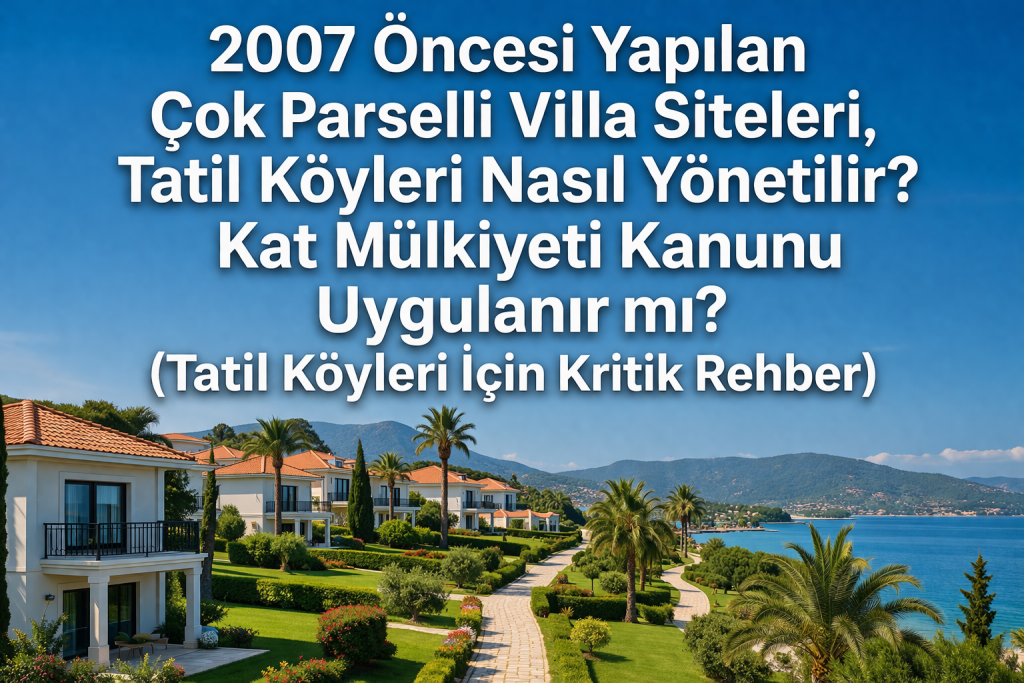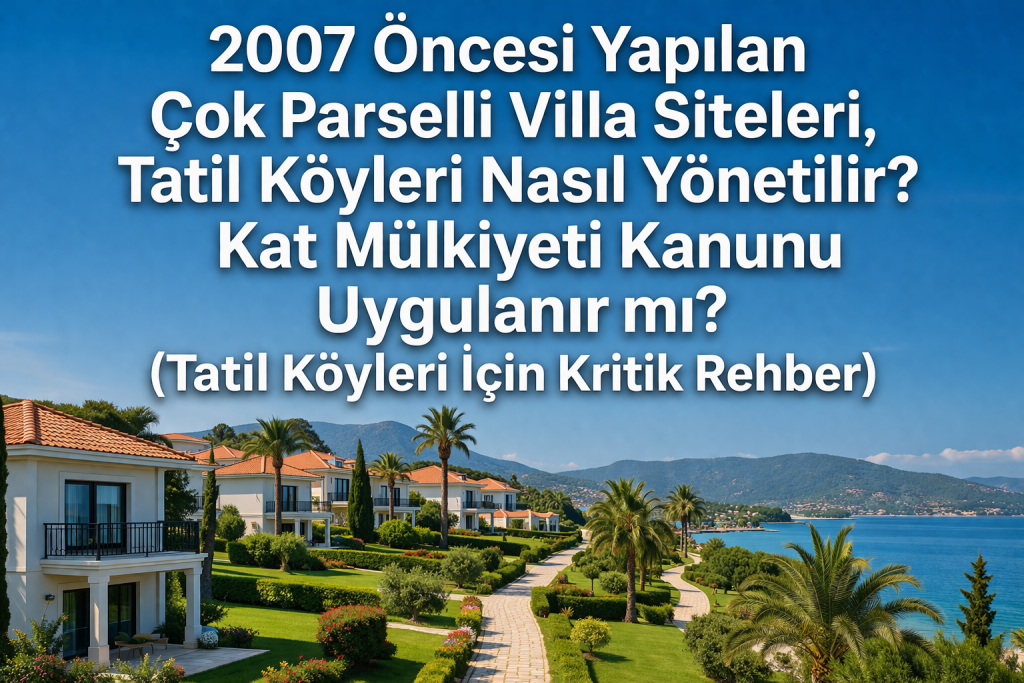
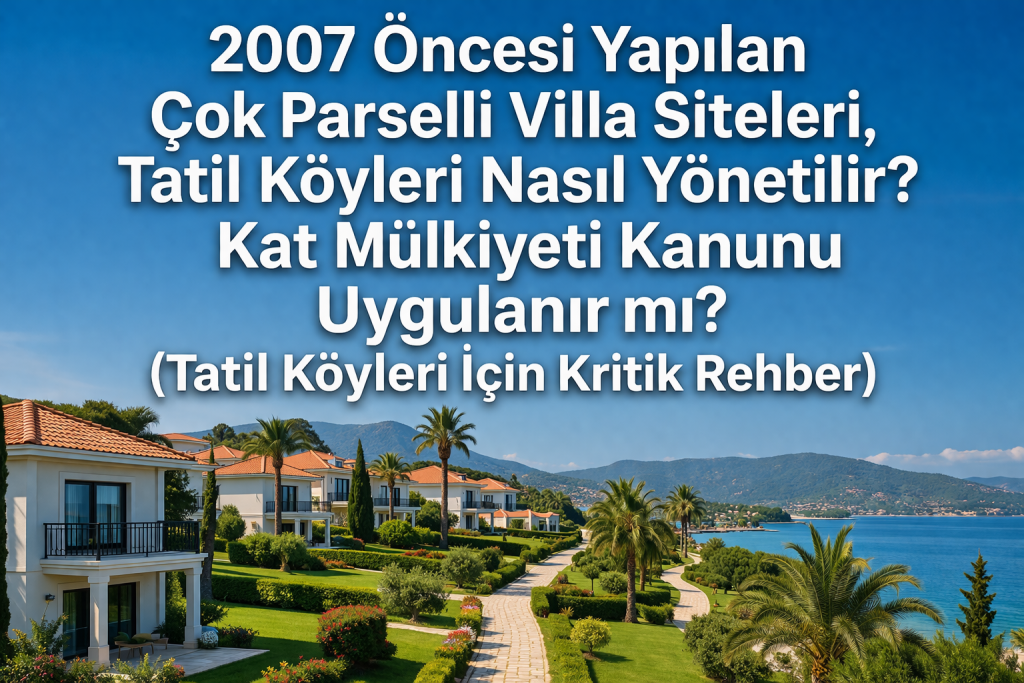
Holiday villages, villa sites, and summer residential areas built before 2007 and established on multiple parcels are among the most commonly misunderstood legal areas in Turkey. Especially the notion that “there is a site management” often does not align with the legal reality.
Firstly, it should be known that, Condominium Law (KMK) does not automatically apply to such structures. For KMK to be applicable to cover more than one parcel, it is necessary to have transitioned to the “mass housing” status introduced by Law No. 5711.
1. LEGISLATION INFORMATION NOTE AND LEGAL FRAMEWORK
Relevant Articles of Condominium Law No. 634:
Article 66: Defines mass housing. It refers to structures built on multiple development parcels according to a settlement plan, and which are connected in terms of management.
Article 69: Regulates the management bodies (block, island, and mass housing representatives board) within the scope of mass housing.
Article 70: States that a “single management plan” shall be drawn up for the structures and areas within the scope of mass housing, and that this plan shall be binding on all owners.
Article 72: Regulates the obligation to contribute to the common expenses of mass housing and that these decisions shall be considered as documents in the sense of EML Article 68.
Provisional Article 3: Stipulates that a decision can be made by simple majority for mass housing structures established before 2007 to adapt their management plans to the Condominium Law (KMK).
Additional Article 1: It states that all disputes arising from the application of the Condominium Law (KMK) shall be resolved in Civil Courts of Peace. (However, if there is no collective building status, the Civil Court of First Instance may be responsible, as the dispute would be subject to general provisions.)
Turkish Civil Code (TMK): Articles 688-695: It regulates the principles of management, participation in expenses, and utilization in shared ownership. In “de facto” situations where the Condominium Law (KMK) is not applicable, these provisions are fundamental.
Important Note: If your site has not transitioned to a collective building status, instead of the 5% late payment compensation specified in KMK Art. 20, legal interest will be applied unless there is a contrary provision in the management plan. Enforcement proceedings should be based on the contractual obligations in the management plan, not on the KMK.
2. APPLICABILITY OF THE CONDOMINIUM LAW (KMK) TO HOLIDAY VILLAGES AND VILLA SITES (APARTMENT REQUIREMENT)
For the Condominium Law to be applicable, the structure does not necessarily have to be an “apartment”. In Supreme Court decisions, it has been accepted that the provisions of the KMK can be applied to holiday villages or sites containing villas. However, the fundamental rule is that the KMK can be established for properties located on a single parcel (Supreme Court 3rd Civil Chamber, dated 16.01.2001, Docket No. 2000/11743, Decision No. 2001/263 K.).
In a site consisting of 53 villas established on multiple parcels, the villa site structure was evaluated under the Law on Condominium Ownership (KMK) without requiring an apartment condition, however, it has been stated that general provisions should apply throughout the site because a collective structure (toplu yapı) has not been adopted (Court of Appeals 5th Civil Chamber, dated 17.03.2025, 2024/9595 E., 2025/3512 K.). Therefore, it is possible for each individual parcel to be subject to the provisions of the Law on Condominium Ownership (KMK) within itself (Court of Appeals 20th Civil Chamber, dated 14.02.2019, 2017/6398 E., 2019/1031 K.).
3. THE STATUS OF SITES BUILT BEFORE 2007 AND NOT ADOPTING COLLECTIVE STRUCTURE STATUS
Pursuant to Article 66 and subsequent articles added to the Law on Condominium Ownership (KMK) by Law No. 5711, for sites established on multiple parcels to be subject to the KMK under a single management, it is mandatory to adopt a “collective building management”. Sites completed before 2007, if they do not adapt their management plans in accordance with KMK Provisional Article 3, the provisions of the KMK cannot be directly applied throughout the site.
According to the precedents of the Court of Appeals, in sites consisting of multiple parcels that have not adopted collective building management, disputes are resolved not by the provisions of the Law on Condominium Ownership (KMK), but by the general provisions of the Turkish Civil Code (TMK) regarding shared ownership (Court of Appeals 20th Civil Chamber, dated 28.09.2017, 2017/3782 E., 2017/7047 K.; Court of Appeals 15th Civil Chamber, dated 01.03.2021, 2021/448 E., 2021/546 K.). In such structures, the direct application of the Law on Condominium Ownership (KMK), the provisions of the Civil Code regarding collective ownership, or the Law on Cooperatives is not possible (Court of Appeals 3rd Civil Chamber, dated 28.01.2013, 2012/22721 E., 2013/1155 K.).
4. AUTHORITY OF DE FACTO MANAGEMENT FOR DUES COLLECTION AND ENFORCEMENT PROCEEDINGS
The powers of the “de facto site management” established in sites built on separate parcels and that have not transitioned to collective building status are evaluated in two different ways, based on the Condominium Law (KMK) and General Provisions (Contract Law):
Lack of Authority Under KMK: Since collective building management has not been adopted, the de facto management organized under the name of “site management” concerning all parcels has no legal basis in the sense of the KMK. According to Articles 20 and 35 of the KMK, the authority to collect common expenses and dues belongs solely to the “parcel managers” appointed by the board of condominium owners of each individual parcel. The de facto site management cannot exercise the powers of the parcel managers, cannot collect dues, and cannot initiate enforcement proceedings based on the KMK (Supreme Court 20th Civil Chamber, dated 06.02.2018, file no. 2017/1044, decision no. 2018/681; Supreme Court 18th Civil Chamber, dated 05.06.2012, file no. 2012/3722, decision no. 2012/7004; Supreme Court 18th Civil Chamber, dated 07.12.2015, file no. 2015/2716, decision no. 2015/17808).
Authority within the Scope of the Management Plan and General Provisions: Even if the Condominium Law (KMK) is not applicable, the management plan annotated in the title deed constitutes a “contract” binding the parties in accordance with Article 689 of the Turkish Civil Code (TMK). If the management plan grants the de facto management the authority to collect dues and initiate enforcement proceedings, the management can exercise this authority based on the contract (general provisions), not the Condominium Law. The Court of Cassation has accepted that if there is an explicit provision in the management plan, the de facto management has active standing (locus standi) and can collect dues/initiate enforcement proceedings (Court of Cassation 20th Civil Chamber, dated 22.06.2020, 2020/1751 E., 2020/2005 K.; Court of Cassation 3rd Civil Chamber, dated 28.01.2013, 2012/22721 E., 2013/1155 K.).
Nature of Interest and Enforcement Document: As stated in the legislative information note, if there is no collective building status, the monthly 5% late payment compensation stipulated in Article 20 of the Condominium Law (KMK) cannot be applied. Unless there is a contrary provision in the management plan, legal interest shall be applied from the date of default (Court of Cassation 3rd Civil Chamber, dated 16.12.2010, 2010/17700 E., 2010/20750 K.). Furthermore, in sites that have not transitioned to collective building status, the operational projects prepared by the superior management cannot be considered as documents in the sense of Article 68 of the Enforcement and Bankruptcy Law (İİK), contrary to Article 72 of the Condominium Law (KMK) (Court of Cassation 12th Civil Chamber, dated 12.12.2006, 2006/22314 E., 2006/23655 K.).
5. COMPETENT COURT
In sites consisting of more than one parcel where collective property management has not been implemented, disputes will be resolved according to general provisions, not KMK (Condominium Law) provisions. Therefore, the rule in KMK Additional Article 1 stating that the Civil Court of Peace is competent does not apply. In dues and enforcement disputes of such de facto managements, the Civil Court of First Instance is competent (Adana Regional Court of Justice 5th Civil Chamber, dated 07.11.2017, 2017/18 E., 2017/18 K.; Supreme Court of Appeals 20th Civil Chamber, dated 19.06.2017, 2017/1731 E., 2017/5575 K.). However, if the dispute concerns only the internal management of a single parcel, the Civil Court of Peace remains competent, as the KMK will be applied on a parcel-by-parcel basis (Supreme Court of Appeals 20th Civil Chamber, dated 04.12.2018, 2018/5780 E., 2018/7852 K.).
6. ADDITIONAL CONTEXT OBTAINED FROM SECONDARY SOURCES
The following information has been compiled from secondary sources to provide additional context when limited information is found in decision texts:
Registration and Amendment of the Management Plan: In de facto collective properties established before 2007, a new management plan can be prepared and registered in the land registry by a simple majority based on Provisional Article 3 of the KMK. These registration and amendment disputes are resolved in the judicial courts (Civil Court of Peace) due to the contractual relationship between the co-owners (Court of Jurisdictional Disputes, Civil Chamber, dated 02.11.2011, 2011/46 E., 2011/207 K.).
Cooperative and De Facto Management Relationship: In some cases, de facto management is carried out through a cooperative. While the provisions of the Condominium Law (KMK) come into play for owners who are not members of the cooperative, if the cooperative transforms into a site management cooperative and the management plan is annotated in the land registry, the cooperative general assembly can replace the board of condominium owners and exercise its authority to collect dues and enforce collection (under the provisions of contract and management without agency) (Bakırköy 2nd Civil Court of Commerce, dated 16.06.2020, 2017/1141 E., 2020/307 K.; Court of Appeals 23rd Civil Chamber, dated 20.04.2015, 2015/3069 E., 2015/2743 K.).
Conflict Between Parcel Management and Collective Building Management: In cases where the de facto collective building management lacks the authority to collect dues, payments made by owners to their own parcel managements are considered valid, and the de facto superior management is prevented from making duplicate collections (Court of Appeals 18th Civil Chamber, dated 22.02.2016, 2015/21918 E., 2016/2879 K.).
Impact of Special Protocols: In holiday village operations, against claims of due enforcement based on Article 20 of the Condominium Law (KMK), special share transfer and liquidation protocols (agreements) between the parties can supersede the KMK and be taken as a basis for resolving the dispute (Court of Appeals 11th Civil Chamber, dated 27.05.2025, 2024/5041 E., 2025/3750 K.).
Direct Result
In a villa holiday village completed before 2007, having separate condominium ownership deeds on separate parcels but not having officially transitioned to “collective building” status under Law No. 634 on Condominium Ownership (KMK), in disputes concerning the entire site, the collective building provisions of the KMK cannot be directly applied. For the KMK to be applicable, the structure does not have to be a multi-story “apartment building” in the classical sense; villas built with horizontal architecture are also within the scope of the KMK. However, since the site spans multiple parcels and has not been transitioned to collective building status in accordance with KMK Art. 66 et seq., the powers of the de facto management concerning the entire site, collection of dues, and enforcement proceedings are not directly subject to the KMK; but are subject to the contractual obligations in the “Management Plan” annotated in the land registry and the provisions of the Turkish Civil Code (TMK) regarding shared ownership (TMK Art. 688-695). The de facto management’s authority to collect dues and initiate enforcement proceedings is valid based on the contractual authority it derives from the management plan; however, the special advantages provided by the KMK in these proceedings (e.g., 5% late payment penalty or direct jurisdiction of the Civil Court of Peace) cannot be utilized.
Collective Building (KMK Art. 66): Refers to multiple structures built on more than one development parcel, according to a specific settlement plan, connected to each other in terms of infrastructure facilities, common areas, social facilities, and management.
Community of Persons Unable to Transition to Collective Management: As highlighted by Yasaman (2023) L3, is a community of owners consisting of multiple parcels, which is de facto managed as a site or holiday village but has not been legally integrated into the collective building provisions of the KMK.
Identical/Parallel Management Plans: As stated in Özkan’s (2022) study L1, before the 2007 law amendment, it is the method of annotating the title registry of each parcel in sites established on more than one parcel with management plans containing entirely identical (özdeş) provisions to fill the legal void.
Horizontal Property: It is the concept that refers to the possibility of establishing condominium ownership not only in superimposed independent sections (apartments), but also in independent sections arranged side-by-side (villas, terraced houses).
A. Contractual Commitment (Management Plan) Approach: According to this approach supported by Özkan (2022) L1 and Akay (2025) L7, since there was no collective building regulation in the Condominium Law (KMK) before 2007, the founders, while establishing separate condominium ownership for each parcel, included provisions in the management plans annotated in the title registry regarding “common management with other parcels, participation in common expenses, and use of common facilities.” Akay (2025) L7 states that the management plan is a fundamental contract that regulates the relationships to be established in the main structure and determines the rights and duties of the parties. According to this approach, the management plan annotated in the title registry is a “contract” binding all owners and is the source of legitimacy for the de facto management.
B. De Facto Situation and General Provisions (TCC) Approach: According to this view, highlighted by Yasaman (2023) L3 and Kayaduman (2022) L4, in cases where condominium ownership is not established or multiple parcels are not unified under a single management umbrella, there is no possibility of directly applying the CCPCA. Yasaman (2023) L3 argues that the CCPCA cannot be applied in disputes related to the management of such structures, and the issue should be resolved within the framework of the Civil Code’s provisions regarding shared ownership (TCC Arts. 688-695).
Open Questions, Exceptions, and Uncertainties
Content of the Management Plan: The biggest uncertainty is the content of the management plan annotated in the land registry. If the management plan does not clearly state the participation rates and procedures of owners in other parcels for common expenses, cost sharing will have to be done according to shared ownership rules under TCC Art. 689 et seq., which will lead to significant calculation disputes.
Exception for Transition to Complex Structures: CCPCA Provisional Article 3 offers a way out for such de facto sites established before 2007. According to the relevant article, for complex structures established before 2007 to adapt their management plans to the CCPCA, a decision by a simple majority of the condominium owners’ board is sufficient. This exception, departing from the general rule requiring unanimity (CCPCA Art. 24), facilitates the establishment of the de facto situation on a legal basis.
Conclusion and Practical Evaluation
As a result; in a holiday village built before 2007, consisting of villas with condominium ownership established on separate parcels, the collective building provisions of the Condominium Law (KMK) cannot be directly applied to disputes concerning the entire site. However, this does not mean that the site cannot be managed or that fees cannot be collected. The management plan, annotated in the land registry, constitutes a valid contract in the sense of the Law of Obligations and the Turkish Civil Code (Articles 688-695) and authorizes the de facto management to collect fees and initiate enforcement proceedings.
Frequently Asked Questions
2007 öncesi yapılan villa sitelerinde Kat Mülkiyeti Kanunu uygulanır mı?

Hayır, birden fazla parsel üzerine kurulu sitelerde toplu yapı statüsüne geçilmemişse Kat Mülkiyeti Kanunu site genelinde uygulanamaz. Bu durumda uyuşmazlıklar genel hükümlere göre çözülür.
Tatil köyü veya villa sitelerinde aidat nasıl toplanır?
Toplu yapı yoksa aidatlar KMK’ya göre değil, tapuya şerh edilmiş yönetim planına (sözleşmeye) dayanarak toplanır. Yönetim planında hüküm yoksa Türk Medeni Kanunu hükümleri uygulanır.
Site yönetimi icra takibi yapabilir mi?
Evet, ancak bu takip Kat Mülkiyeti Kanunu’na dayanarak değil, yönetim planındaki sözleşmesel yükümlülüklere dayanarak yapılabilir. Bu nedenle hukuki dayanak çok önemlidir.
Bu tür sitelerde hangi mahkeme görevlidir?
Eğer site toplu yapı statüsünde değilse, uyuşmazlıklar Sulh Hukuk değil, Asliye Hukuk Mahkemesi’nde görülür. Yanlış mahkemede açılan davalar ciddi hak kaybına yol açabilir
2007 öncesi siteler nasıl hukuken güvence altına alınır?
En doğru yöntem, Kat Mülkiyeti Kanunu Geçici Madde 3 kapsamında toplu yapı statüsüne geçiştir. Bu sayede site yönetimi hukuki zemine oturtulur ve tüm maliklere karşı bağlayıcı hale gelir.
Why is Expert Lawyer Support Necessary?
Multi-parcel villa sites and holiday villages built before 2007 are among the areas where the most mistakes are made in practice. Particularly, lawsuits filed with incorrect legal grounds, erroneous enforcement proceedings, and invalid site management decisions can lead to significant financial losses.
At this point, it is of great importance to receive support from a team specialized in the field, such as 2M Hukuk Avukatlık Ofisi. Because:
With the support of an Istanbul condominium lawyer, the legal status of the site is correctly analyzed
Regional practices are taken into account with a Tuzla lawyer and a Tuzla condominium lawyer
Thanks to a holiday village site management lawyer, fee, management, and contract processes are correctly structured
With a villa site management lawyer, the transition to collective building is carried out professionally. It should not be forgotten that the smallest legal error made in such sites:
May lead to the inability to collect fees
May lead to the annulment of management decisions
It can lead to the dismissal of lawsuits. Therefore, proceeding with an expert lawyer from the beginning of the process is the safest way for both managers and property owners.