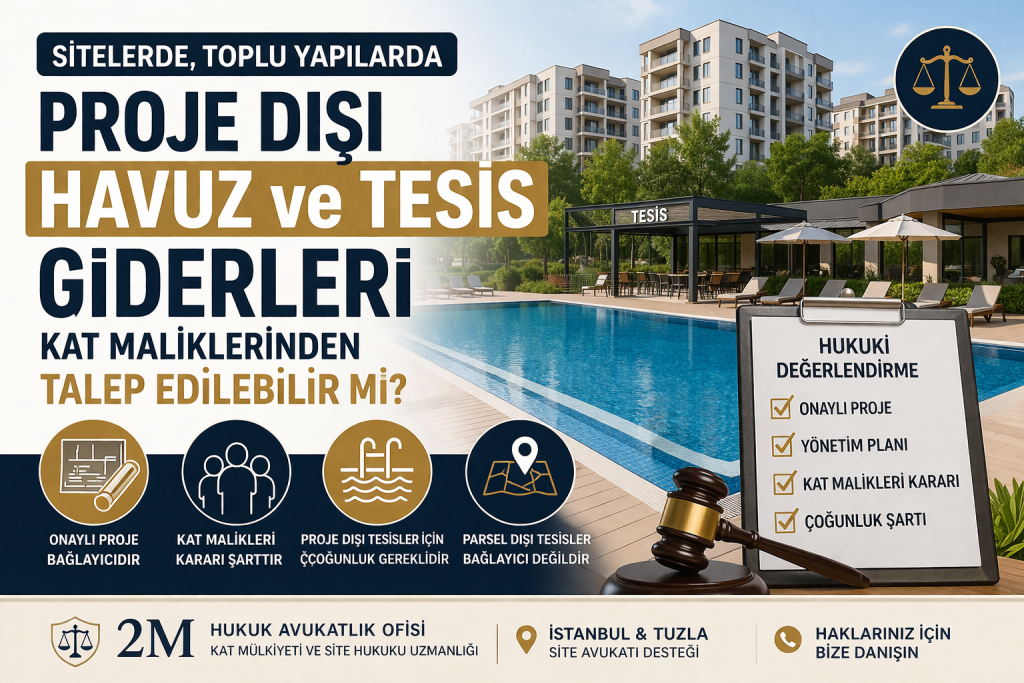
1. Status of Facilities Not Included in the Approved Architectural Project and Dues Obligation
Supreme Court rulings have made the construction and maintenance costs of facilities not included in the approved architectural project or added later contingent upon certain conditions for them to be claimed from co-owners. In the judgment of the Supreme Court’s 18th Civil Chamber dated 03.10.2011, with file no. 2011/9626 and decision no. 2011/9525 , it was explicitly stated that the construction costs of non-project elements such as a solar energy system platform and a treadmill, which were not present in the architectural project, could not be included in the advance payment to be collected from co-owners. Similarly, in the decision of the Supreme Court’s 20th Civil Chamber dated 15.05.2019, with file no. 2019/449 and decision no. 2019/3476 , it was emphasized that if a proper decision was not made by the board of co-owners for an alteration constituting a project change (construction of a meeting room), no fee or due could be demanded for this facility.
2. Costs of Maintenance, Repair, and Restoration of Unauthorized Constructions
There are also Supreme Court decisions imposing liability regarding the maintenance and repair costs of structures built outside the project or unauthorized. According to the ruling of the Supreme Court 18th Civil Chamber dated 31.01.2013, with file no 2012/14026 and decision no 2013/1285, all floor owners are responsible for constructions made unauthorized (illegal) during the initial construction of the site, contrary to the approved architectural project, in proportion to their land shares. The decision affirmed that the protection, repair, and restoration of the main property are among the duties of the manager, and within this scope, an advance/dues can be requested from the floor owners for the maintenance-repair and restoration costs of unauthorized constructions.
3. Legal Status of Facilities Outside Parcel Boundaries
The binding nature of decisions made for facilities located outside the registered parcel boundaries of the site (pool, road, etc.) is limited. In the ruling of the Supreme Court 5th Civil Chamber dated 13.11.2023, with file no 2023/5627 and decision no 2023/10753, it was ruled that a general assembly decision taken for the renovation of a pool located outside the parcel boundaries forming the site is not binding for all owners as long as there is no collective building management plan, and this expense cannot be claimed as dues. The ruling of the Supreme Court 20th Civil Chamber dated 14.09.2020, with file no 2020/132 and decision no 2020/2888, also confirms that decisions made for facilities outside parcel boundaries are only binding for owners who voted in favor.
4. Assessment within the Scope of Useful Innovations and Additions
Whether subsequently added facilities fall under the scope of “beneficial innovation” is critical for the fee demand. In the judgment of the 20th Civil Chamber of the Court of Cassation dated 07.02.2019, numbered 2017/6353 E. and 2019/771 K., elements such as a vitamin bar and music system added to the pool area were evaluated as “beneficial innovation” within the scope of Article 42 of the Condominium Law (KMK), and it was implied that participation in costs could be requested with a duly obtained majority decision. However, in another decision by the same chamber dated 02.10.2017 (2017/3082 E., 2017/7185 K.), it was stated that participation in expenses is mandatory under Article 20 of the Condominium Law, as a pool that was part of the project but built later became a common area.
5. Secondary Sources and Additional Context Analysis The following points have been compiled as secondary sources from the presented decision summaries:
Additions Outside the Project and Consent Requirement: In the decision of the 18th Civil Chamber of the Court of Cassation dated 20.01.2015 (2014/14720 E., 2015/749 K.), which is a secondary source, it was emphasized that additions to common areas (waterfall, storage, etc.) can be made with 4/5 written consent pursuant to Article 19/2 of the Condominium Law, but these facilities must not obstruct the use by other owners.
Elevator Example and Exemption from Use: In the decision of the 18th Civil Chamber of the Court of Cassation dated 18.06.2015 (2014/20786 E., 2015/10588 K.), it was stated that if a decision has not been made for the addition of an elevator floor not included in the project, the owner cannot be held responsible for the expense. Furthermore, in the decision dated 03.06.2010 (2010/6097 E., 2010/8413 K.), it was stated that certain floors could be exempted from maintenance/repair expenses by the management plan, but exemption from construction expenses requires an explicit provision.
Cooperative and OIZ Practices: In secondary sources (Bakırköy 3rd Civil Court of First Instance, 2017/566 P. ; Court of Cassation 3rd Civil Chamber, 2025/1417 P. ), there are opinions that dues can be collected for routine operating expenses, but large costs of an out-of-project or renovation nature should be evaluated separately as a “participation fee” instead of dues.
Illegally Built Structures Cannot Be Legalized: In the decision of the 5th Civil Chamber of the Court of Cassation dated 06.11.2023 (2023/4898 P., 2023/10399 D. ), it was stated that making an additional payment under the name of dues for an illegally built winter garden would not eliminate the unlicensed/illegal nature of the structure and would not legitimize the interference with the common area.
Conclusion: For dues to be requested for the maintenance and renovation of out-of-project or subsequently added facilities (pool, cafe, etc.); it depends on the facility being within the parcel boundaries, a decision being made in accordance with the procedure (unanimity in some cases, 4/5 or simple majority in some cases) at the board of flat owners, and the regulations in the management plan. While it is possible to collect dues/advances for the restoration of illegal structures built outside the project, operating and maintenance expenses of newly built facilities that are not in accordance with procedures cannot always be demanded from owners who did not participate in the decision or claim a violation of the project.
Frequently Asked Questions
Projede olmayan havuz için aidat ödemek zorunda mıyım?

Hayır. Onaylı projede yer almayan bir tesis için usulüne uygun karar yoksa aidat talep edilemez.
Site yönetimi sonradan yaptığı kafe veya sosyal alan için para isteyebilir mi?
Ancak Kat Mülkiyeti Kanunu’na uygun şekilde alınmış bir karar varsa ve gerekli çoğunluk sağlanmışsa talep edilebilir.
Kaçak yapılan bir tesisin giderlerinden sorumlu muyum?
Kaçak yapıların kaldırılması veya eski hale getirilmesi için yapılan giderlere kat maliklerinin katılması mümkündür.
Why is Expert Lawyer Support Necessary?
In sites that have not transitioned to the status of a mass housing complex, out-of-project facilities, the obligation for dues, and the responsibility of flat owners constitute a highly technical area shaped by Court of Cassation precedents. In such disputes, an incorrect payment or insufficient legal objection can lead to serious loss of rights.
Especially with the support of a legal expert specializing in condominium law, such as an Istanbul collective housing lawyer or a Tuzla residential complex lawyer:
The legality of maintenance fee demands is analyzed
The annulment of residential complex management decisions can be ensured
The refund of unjust payments can be demanded
Litigation processes can be carried out against illegal construction and common area violations. In this regard, 2M Law Office, experienced in condominium ownership and residential complex management disputes, prevents the loss of rights by providing professional support in both litigation and consultancy processes.