Without Risky Building Detection, Can Condominium Owners Enter into a Contract with a Contractor by Simple Majority? (2023–2026 Current)
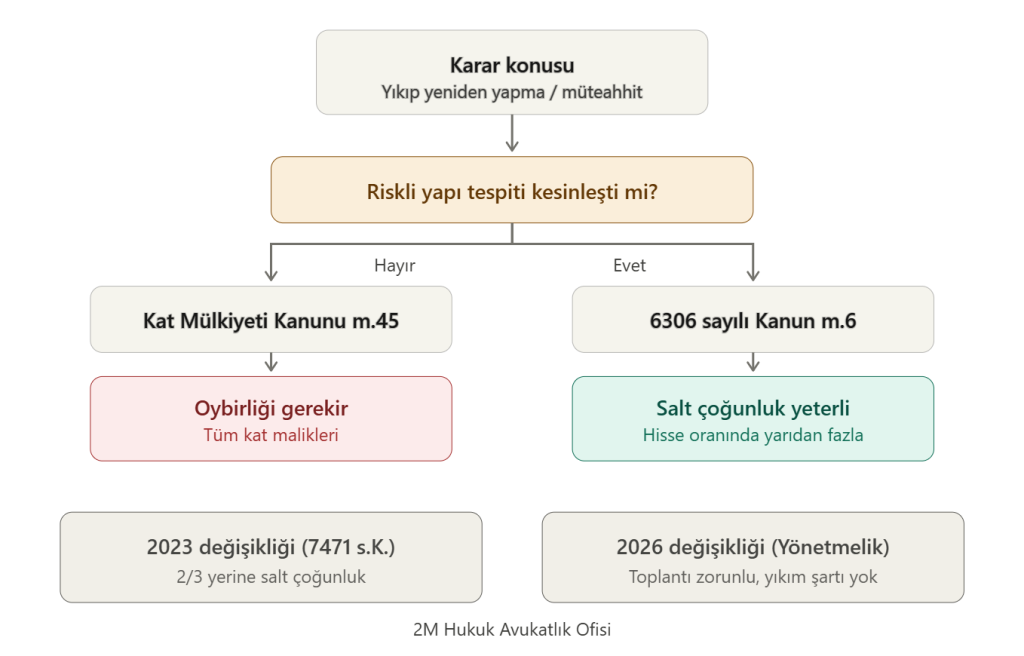
No. Before a risky structure determination in a building becomes final, condominium owners cannot take a decision by simple majority (more than half of the votes) to demolish and rebuild the building or sign a construction contract with a contractor for a share of the flats. If the risky structure process has not been initiated, the building is subject to the Condominium Law No. 634 (KMK), and according to KMK art. 45, decisions of this nature require the unanimous consent of all condominium owners. The simplified quorum (no longer 2/3, but a simple majority) introduced by Law No. 6306 only comes into effect after the risky structure determination has become final.
In this article, we examine the current legal situation after the 2023 (Law No. 7471) and 04.02.2026 Regulation amendments, along with the relevant articles of the law and implementing regulation.
1. The Crux of the Problem: Which Law Applies?
The key to the quorum debate in urban transformation lies in a single question: Is there a final determination of a risky structure for the building, or not?
IF there is NO risky structure determination: The property is entirely under the regime of the Condominium Law. Decisions such as demolition and rebuilding, and contractor selection require unanimity.
IF there IS a risky structure determination (and it has become final): The special provisions of Law No. 6306 and the simplified simple majority quorum come into play.
In practice, almost all erroneous applications stem from signing a contract with a contractor by saying “there’s a majority anyway,” without ever initiating the risky structure process. This is a legally flawed approach.
2. IF there is NO Risky Structure Determination: KMK Art. 45 and the Unanimity Requirement
In a building where condominium ownership is established and which is physically standing, decisions regarding the substance of the property are subject to Law No. 634.
According to Article 45 of the Condominium Law (KMK), the demolition and reconstruction of the main property, its encumbrance with a right, or similar important management activities are only possible with a decision taken by the unanimous consent of all floor owners. Demolishing and rebuilding the building, and determining which contractor and by what method it will be renewed, is considered an “extraordinary/important management activity” by its nature.
The result is the same for co-ownership: According to Article 692 of the Turkish Civil Code (TMK), construction works of an extraordinary disposition nature are subject to the acceptance of all co-owners.
The established approach of the Court of Cassation is as follows:
Court of Cassation, 20th Civil Chamber, 06.12.2018, E. 2017/2398, K. 2018/7959: The demolition and reconstruction of the main immovable property and the selection of a contractor constitute an “important management activity” and require unanimity according to Article 45 of the Condominium Law (KMK).
Court of Cassation, 20th Civil Chamber, 03.04.2018, E. 2017/3116, K. 2018/2580: If the building has not been identified as a risky structure and still exists, unanimity is mandatory for a reconstruction decision according to Article 45 of the Condominium Law (KMK).
In a building not identified as a risky structure, a decision on a contractor agreement taken by a simple majority constitutes an interference with the property rights of other owners and is invalid.
3. 2023 Amendment: The “2/3 Majority” is a Thing of the Past, Era of Simple Majority
This is the most frequently overlooked point when updating old content.
When Law No. 6306 came into force, the quorum for decisions in risky structures was 2/3 of the land share. However, this ratio was reduced by Law No. 7471 dated 07/11/2023 (Official Gazette 09.11.2023).
The current text of Article 6 of Law 6306 no longer uses “2/3”; it now uses the phrase “the absolute majority of shareholders in proportion to their shares“. This means:
Former quorum: 2/3 of the land share
Current quorum: absolute majority of the land share (more than half — P+1)
There is a critical detail here: This “absolute majority” is not of those participating in the meeting, but the absolute majority of all owners in proportion to their shares. In this respect, it aligns with the “more than half in terms of number and land share” criterion in Article 30 of the Condominium Law (KMK).
Therefore, if the phrase “2/3 majority” still appears in urban transformation texts, this belongs to the pre-2023 legislation and should be updated.
With the “Regulation Amending the Implementation Regulation of Law No. 6306” published in the Official Gazette dated 04.02.2026 and numbered 33158, two important innovations have been introduced in the decision-making process.
a) Meeting summons became mandatory again
For a period, meeting summons and formal requirements were not sought under Law 6306; this led to meetings where owners were left uninformed. With the new regulation, the meeting procedure has returned:
At the request of at least one of the owners, all owners are invited to the meeting.
The summons is made by filling out Annex-12 form attached to the Regulation.
The call is notified by being announced for 15 days in the relevant headman’s office or on the building’s door/notice board if the structure has not yet been demolished, or through a notary public.
Documents regarding the owners’ invitation to the meeting and the meeting minutes have been included among the documents that must be in the file (amendment to Regulation art. 15/A).
b) The “demolition first” condition has been lifted for parcels with risky structures
This is the most noteworthy amendment. Current Regulation art. 15(2) stipulates that for parcels containing risky structures; “without requiring the structures to have been demolished” and regardless of whether the owners are shareholders:
to the consolidation of parcels,
to subdivision, partition, abandonment, creation, and registration procedures,
to the reconstruction of buildings,
to the sale of shares,
to evaluation through flat-for-land agreements or revenue sharing and other methods,
stipulates that decisions can be made by the simple majority of shareholders in proportion to their shares. This provision is a reflection in the regulation of the understanding added to Article 6 of Law No. 6306 by Law No. 7471.
c) Other amendments
Title deed annotation (art. 8/9): After the risky structure annotation is cancelled, it has become mandatory to add an annotation to the declarations section stating that the parcel is still within the scope of 6306.
Auction and sale (art. 15/A): The procedure for notifying owners who did not participate in the decision and selling their shares has been detailed.
Provisional article 5 regulations regarding rental assistance (art. 16) and the collateral ratio have been added.
5. Are Old Supreme Court Precedents Still Valid?
Here, a tension arises between case law and current legislation that needs to be carefully managed.
Earlier Supreme Court decisions required the structure to have been demolished and the condominium ownership/easement to have ended for the special majority to be applicable:
Supreme Court 20th Civil Chamber, 20.11.2017, File No. 2017/3337, Decision No. 2017/9610: The 2/3 rule is applicable only after the structure is demolished and the condominium ownership/easement ends.
Supreme Court 5th Civil Chamber, 20.05.2025, File No. 2025/2632, Decision No. 2025/7778: Even if there is a risky building annotation in the title deed, if the building has not been physically demolished on the meeting date and condominium ownership continues, unanimity is required for a reconstruction decision.
However, the Regulation amendment of 04.02.2026 has explicitly removed the “demolition first” requirement for risky building parcels. In this situation, two possibilities emerge:
IF there is a risky building determination: Current legislation allows for decisions to be made by a simple majority without waiting for demolition. Nevertheless, at this point, interference with property rights and compliance with procedure (meeting call, notification) will be decisive in any cancellation lawsuits filed. It is also possible that this new provision in the Regulation may be interpreted differently in the future by the judiciary and in administrative courts (Council of State).
IF there is NO risky building determination: None of the above discussions apply. In this case, the only valid criterion is unanimity as per Article 45 of the Condominium Law, and the fundamental logic of earlier case law remains fully valid.
Summary: The “demolition requirement” debate is only relevant for buildings for which a risky building determination has been made. If there is no determination at all, unanimity is mandatory, even without proceeding to the proportion/demolition debate.
6. The Outcome of a Majority Decision Made Without a Risky Building Determination
Without initiating the risky building process, a decision for “reconstruction + contractor agreement” made by a simple majority while the building is still standing is legally flawed:
Court of Appeals 20th Civil Chamber, 27.11.2018, E. 2017/3178, K. 2018/7601: If decisions requiring unanimity are taken by majority, the decision is null and void under KMK Article 33.
Court of Appeals 6th Civil Chamber, 01.11.2022, E. 2022/2693, K. 2022/5086: Contractor agreements made by a simple majority without operating a risky building process in accordance with Law No. 6306 are invalid under TMK Article 692.
Practical outcome: Eviction, demolition, and construction processes carried out based on such agreements lead to legal and financial risks that are difficult to reverse with subsequent annulment/nullity lawsuits.
7. Exceptions: Risky Area and Reinforcement Decisions
Declaration of risky area: In regions declared as “risky area” by Presidential/Cabinet decision, a reconstruction decision can be made by a simple majority. This is a different administrative status from individual “risky building detection.”
Reinforcement: In cases where Law No. 6306 is not applied, if the court determines that the strengthening of the building is mandatory, repairs can be made without seeking the consent of the condominium owners (cf. Court of Appeals 20th Civil Chamber, 17.09.2019, E. 2019/2423, K. 2019/4926). There is a discussion in doctrine regarding the quorum for reinforcement decisions.
8. Conclusion
In light of the examined legislation and jurisprudence:
Before the risky building detection becomes final, condominium owners cannot decide on reconstruction or a contractor agreement by a simple majority; at this stage, unanimity is required according to KMK Article 45.
When the risky building detection becomes final, the quorum to be applied is no longer 2/3, but a simple majority (Law No. 7471, Official Gazette 09.11.2023).
With the regulation amendment of 04.02.2026, the condition of “demolition first” has been lifted for risky building parcels; conversely, the obligation to issue a meeting invitation with ANNEX-12 has returned.
Majority decisions made without a determination are absolutely null and void and are subject to annulment.
The correct execution of the process is critical for both accelerating the transformation and preventing its reversal by annulment/nullity lawsuits.
9. Frequently Asked Questions (FAQ)
How many votes are required for a decision in urban transformation? In buildings where the risky building determination has been finalized, a simple majority (more than half) based on the owners’ shares is sufficient. The old 2/3 ratio was abolished in 2023.
Can a contract be made with a contractor without a risky building determination? No. If there is no determination, the building is under the Condominium Law (KMK) regime, and a decision to demolish and rebuild/contract requires unanimity.
Is the 2/3 majority still valid? No. With Law No. 7471 (09.11.2023), the quorum has been reduced to a simple majority. Texts containing the phrase “2/3” are not up-to-date.
Is it mandatory for the building to have been demolished? With the regulation amendment of 04.02.2026, a decision can be made with a simple majority in risky building parcels “without the requirement for the structures to have been demolished.” However, this is only valid for buildings where a risky building determination has been made.
Can a decision be made without being called to a meeting? After 04.02.2026, upon the request of one of the owners, all owners must be called to a meeting with the ANNEX-12 form, and the invitation must be announced for 15 days / served by a notary.
What happens to the owner who does not join the majority? A proposal is served to the owner who does not participate in the decision; if not accepted within the period, their land share may be subject to sale through the open auction procedure specified in Article 15/A of the Regulation.
Why is Expert Urban Transformation Lawyer Support Necessary?
Urban transformation legislation, as we saw above, is fundamentally changing at short intervals (2023 and 2026 amendments); the decision quorum, meeting procedure, notification, and sales procedures are reshaped with each amendment. Even the smallest procedural error in the process — for instance, making a decision before the risky structure determination is finalized, not properly issuing the meeting invitation with Annex-12, or incomplete notification to owners who did not participate in the decision — can lead to the reversal of the entire transformation process through annulment and nullity lawsuits filed subsequently. For this reason, structuring the process correctly from the outset is often much less costly than correcting errors later.
An urban transformation lawyer provides support in the following matters during the process:
Risky structure determination and objection process: Evaluation of the determination report, and determining the strategy regarding finalization or objection to the determination.
Meeting and decision process: Annex-12 invitation, meeting minutes, simple majority calculation, and proper execution of notification to owners who did not participate in the decision.
Contractor (construction in return for land share) agreement: Eviction, delivery period, rent assistance, penalty for delay, and arrangement and negotiation of termination conditions in favor of the owner.
Rights of minority owners: Sale of shares through public auction, fair market value, and objection processes to share sales.
Administrative and judicial disputes: Following up on lawsuits arising from condominium ownership, through administrative judicial remedies against risky area/risky building decisions.
Based in Tuzla, 2M Law Office provides consultancy and litigation services in the field of urban transformation and real estate law to both property owners and rights holders, as well as institutional investors and contractors. Property owners and investors looking for an Istanbul urban transformation lawyer, Tuzla urban transformation lawyer, and Küçükçekmece urban transformation lawyer; can make an appointment with our office for risky building detection, simple majority decisions, contractor contract negotiations, and condominium ownership disputes. For your urban transformation cases in Tuzla, Küçükçekmece, Pendik, Kartal, and surrounding districts of Istanbul, we provide legal support compliant with current legislation at every stage of the process.
A single procedural error in your urban transformation process can take years. For your risky building, land share construction, and condominium ownership disputes, by contacting 2M Law Office, you can receive a legal assessment specific to your case.