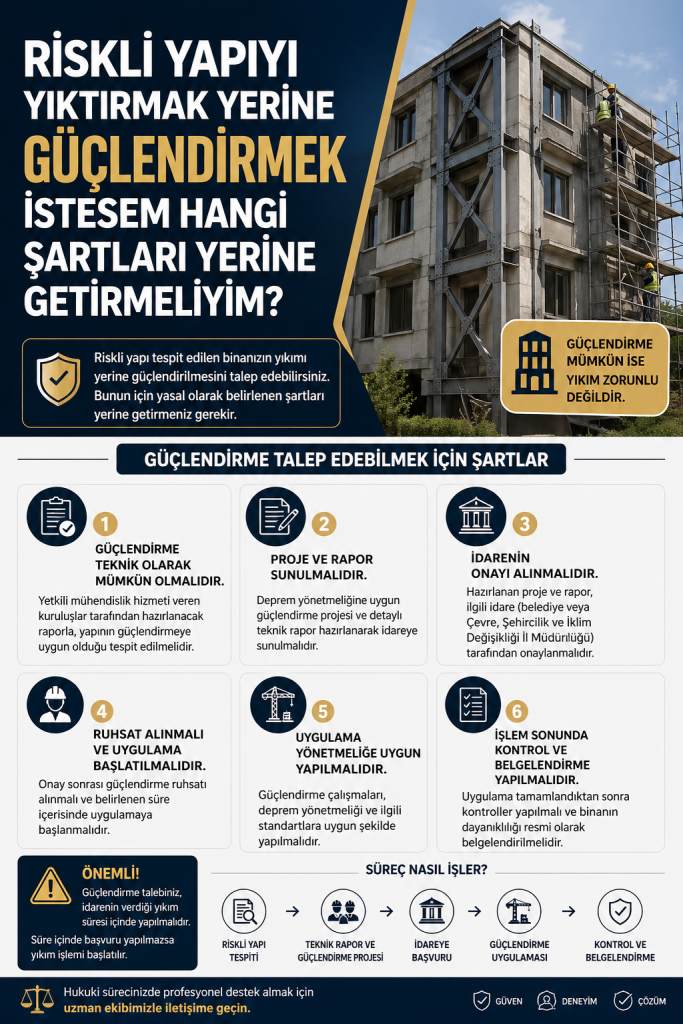
The strengthening process, conditions, timeframes, and legal consequences in risky structures within the scope of Article 8/7 of the Implementation Regulation of Law No. 6306
In buildings identified as risky, the first option that comes to mind is usually demolition. However, the strengthening alternative in urban transformation allows the building to be cleared of risk by improving its load-bearing system to ensure disaster safety, without being demolished. In cases where the structure’s economic life is sufficient, it carries architectural value, or the owners do not wish to undertake the burden of rebuilding, strengthening is a preferable method from both a technical and legal perspective.
In this article, based on Article 8, paragraph 7 of the Implementation Regulation of Law No. 6306 on the Transformation of Areas Under Disaster Risk, the scope of the strengthening alternative, the required conditions, the process to be followed, timeframes, and the removal of the risky structure annotation in the land registry have been discussed.
Legal Basis: Implementation Regulation Art. 8/7
The option of strengthening a risky structure instead of demolishing it is clearly regulated in the Implementation Regulation of Law No. 6306. While the provision was initially included as paragraph 5 in its first publication, with the amendment dated 21/05/2024, the paragraph number shifted, and it became paragraph 7 of Article 8 in the current text. The current text of the paragraph is as follows:
| “(7) In cases where strengthening is requested instead of demolishing the risky structure, within the period given to the owners for the demolition of the risky structure; the owners must ensure that it is determined that strengthening is technically possible, a strengthening decision must be taken as specified in the second paragraph of Article 19 of the Condominium Law, a strengthening project must be prepared and a license must be obtained within the framework of zoning legislation. After the strengthening work is completed within the period determined by the licensing authority according to the nature of the strengthening to be done, an application is made to the Directorate for the removal of the risky structure annotation in the land registry.” |
As can be seen, the paragraph recognizes strengthening as an alternative equivalent to demolition and subject to procedure; however, it links this to the fulfillment of four basic conditions within a certain period.
Four Essential Conditions Required for Strengthening
According to Article 8/7 of the Regulation, owners who choose the strengthening method must complete the following four procedures within the legal period given to them for the demolition of the risky structure:
Ensuring that it is determined that strengthening is technically possible. Not every risky structure can be strengthened; first, it must be reported by an authorized engineer/organization that the load-bearing system of the structure is suitable for strengthening.
Taking a strengthening decision as specified in Article 19/2 of the Condominium Law. Since strengthening is in the nature of “repair and installation” carried out in common areas, the board of condominium owners must take a decision in this regard.
Preparation of the reinforcement project. A reinforcement project, compliant with the current earthquake regulation (Turkish Building Earthquake Regulation) and suitable for obtaining a permit, must be prepared.
Obtaining a permit within the framework of zoning legislation. The reinforcement work must be contingent upon a permit obtained from the relevant authority (municipality).
These four conditions are a whole; if any are left unfulfilled, the path to reinforcement closes, and the administration becomes authorized to initiate the demolition process for the risky building. Therefore, it is of great importance that the choice of reinforcement is planned before the deadline for demolition expires and with the assistance of a lawyer.
Quorum for Reinforcement Decision: KMK Art.19/2
Article 19/2 of the Condominium Property Law No. 634, to which the paragraph refers, requires the written consent of four-fifths (4/5) of all co-owners for construction, repair, and installation work in common areas. Therefore, as a rule, the reinforcement decision must also be taken by a 4/5 qualified majority.
However, it is further stipulated in the same article that if a court determines that a defect in common areas is damaging the main structure and requires urgent repair, or that reinforcement of the main structure is mandatory, then the consent of the co-owners will not be required for the reinforcement to be carried out in accordance with its project and technical specifications. In other words, in cases where a 4/5 majority cannot be achieved, there is an exceptional way to enable reinforcement through a court determination.
Step-by-Step Reinforcement Process
The process followed from the determination of a risky building to the removal of the annotation in the land registry is, in summary, as follows:
| Stage | Process |
| 1. Risk identification | The building is identified as a risky structure by a licensed institution; this identification becomes final, and the “risky structure” annotation is entered into the land registry. |
| 2. Decision period begins | Owners are given a period for demolition. Strengthening should be preferred within this period. |
| 3. Technical feasibility | It is determined by a report that strengthening is technically feasible. |
| 4. Owner’s decision | A strengthening decision is taken in accordance with Condominium Law (KMK) article 19/2 (as a rule, by 4/5 majority). |
| 5. Project | A strengthening project compliant with earthquake regulations is prepared. |
| 6. Permit | A strengthening permit is obtained from the administration within the framework of zoning regulations. |
| 7. Implementation | Strengthening is completed within the period determined by the permitting authority according to the nature of the work. |
| 8. Removal of annotation | An application is made to the Directorate for the removal of the risky structure annotation in the land registry. |
Timelines: Critical Threshold to Pay Attention To
The regulation distinguishes between two separate periods for strengthening:
Preparation period: All technical assessment, owner’s decision, project, and licensing procedures must be completed within the period given to owners for the demolition of the risky structure. If this period is missed, the administration can initiate the demolition process.
Implementation period: The strengthening work itself must be completed within the period determined by the licensing authority, according to the nature of the strengthening to be carried out.
The most common loss of rights in practice is the inability to obtain a license before the period given for demolition expires. For this reason, it is recommended to make the strengthening decision early and to proceed with the project and licensing processes concurrently.
Removal of the “Risky Structure” Annotation in the Title Deed
After the strengthening work is completed within the period determined by the administration, an application must be made to the Directorate of Infrastructure and Urban Transformation for the removal of the “risky structure” annotation in the title deed. Until the annotation is removed, the structure legally remains in the status of a risky structure; this can create hesitation in transactions such as sales, mortgages, etc., so the application should not be neglected after the work is completed.
Strengthening or Demolition? Advantages and Disadvantages
Strengthening is not the right solution for every structure. Owners must make their decision by taking into account economic and legal consequences, as well as technical suitability.
| Advantages of Strengthening | Aspects to Consider |
| Since the building is not demolished, the risk of owners remaining without housing/workplace for a long time decreases. | Not every structure is technically suitable for strengthening; it may not be possible for severely damaged or economically obsolete structures. |
| It can generally be completed in a shorter time and at a lower cost compared to reconstruction. | Strengthening does not add new square meters/floors to the building; there is no increase in zoning or floor gain as in demolition and reconstruction. |
| The existing condominium ownership and neighborhood structure are largely preserved. | Achieving a 4/5 qualified majority may be more difficult than a demolition decision. |
| Upon completion, the risky building designation on the title deed is removed, and the building is cleared of risk. | Some incentives provided in demolition and reconstruction (e.g., fee/tax exemptions related to new construction) may not be utilized to the same extent in strengthening. |
Support and Incentives in Strengthening
Whether supports such as rent assistance and interest-subsidized loans under Law No. 6306 can be applied to reinforcement depends on the conditions of the relevant administration and program. For example, under the Istanbul Metropolitan Municipality Council Decision dated 12.11.2025 and numbered 1277, it has been announced that rent assistance applied to risky buildings is also made valid for buildings inspected by the Rapid Screening Method, needing joint reinforcement, and granted a reinforcement permit according to earthquake regulations. However, since central rent assistance amounts and interest-subsidized loan conditions can be periodically updated by the administration, current announcements and local council decisions should be additionally confirmed before applying.
Points to Consider from a Legal Perspective
Time management: Technical assessment, owner’s decision, project, and permit must all be completed within the period given for demolition.
Quorum for decision: If a 4/5 majority cannot be achieved, the court determination method specified in Condominium Law (KMK) article 19/2 can be considered.
Right to object: The right to appeal/litigate against risky building determinations or administrative actions rejecting reinforcement within legal timeframes is reserved.
Document integrity: Complete archiving of the report, board decision, project, and permit is crucial both against demolition pressure and during the phase of removing the annotation (on the title deed).
Conclusion
The strengthening alternative in urban transformation is a legally recognized, viable way to bring a risky structure to disaster safety without demolishing it. However, its success depends on the correct determination of technical suitability, securing the necessary majority among property owners, and the complete fulfillment of four basic conditions within the period given for demolition. The correct structuring of the process from the beginning both prevents loss of rights and ensures the smooth removal of the risky structure designation in the title deed after strengthening.
2M Law Firm provides consultancy and litigation services in the fields of urban transformation, risky structure detection, strengthening processes, and real estate law, especially in Istanbul and Tuzla. Before clarifying your preference for strengthening or demolition, it is recommended to evaluate your process with an urban transformation lawyer.