
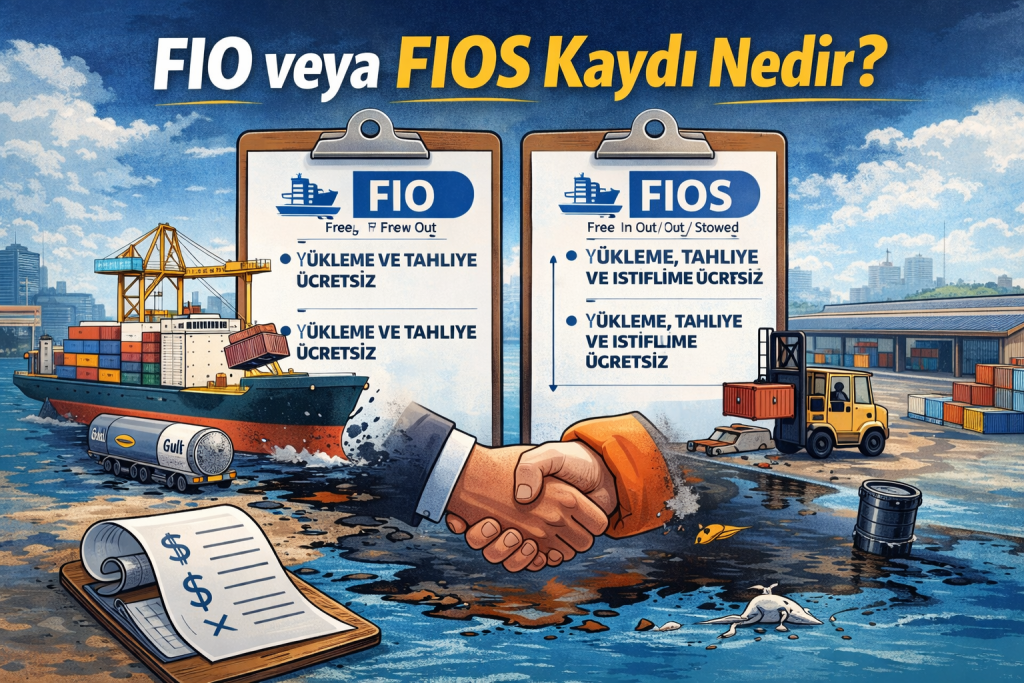
In maritime transport, who is responsible for damages occurring during loading and unloading is often a matter of dispute based on the FIO and FIOS clauses found on the bill of lading or charter party. Although these clauses might initially seem to completely eliminate the carrier’s liability, in practice the situation is much more technical and limited.
Legal Nature of FIO / FIOS Clauses
FIO (Free In and Out) and FIOS (Free In and Out Stowed) clauses are commercial terms in a contract of carriage that regulate the cost and organizational responsibility for loading, unloading, and stowage operations. These clauses determine the operational risk sharing between the parties; they do not eliminate the carrier’s fundamental obligations arising from the law.
What Does the FIO (Free In and Out) Clause Mean?
The FIO clause indicates that the costs and actual organization of loading and unloading operations belong to the cargo interest instead of the carrier or shipowner. In this case, the carrier is not obliged to provide port workers, arrange cranes, or pay handling fees for loading and unloading. However, this situation is limited solely to the aspects of cost and organization.
What Does the FIOS (Free In and Out Stowed) Clause Mean?
The FIOS clause, in addition to FIO, also places the operation of stowage under the responsibility of the cargo interest. This means that the loading, discharging, and arrangement of the cargo within the ship are entirely organized by the cargo interest. The FIOS clause is frequently used, especially for bulk cargo and project cargo.
Does the FIO / FIOS Clause Completely Release the Carrier from Liability?
No. The FIO or FIOS clause does not eliminate the carrier’s statutory duty of care. According to the Turkish Commercial Code, the carrier must;
Keep the ship fit for cargo,
Ensure the integrity of holds, hatches, bilge and drainage systems,
Perform its general superintendence duty in accordance with maritime rules.
Therefore, in cases of damage caused by reasons such as leaking hatch covers, bilge or ballast faults, or structural defects in the ship’s equipment, the **carrier’s liability may continue** even if an FIO or FIOS clause is present in the bill of lading.
Importance of FIO / FIOS Clause in Practice
FIO/FIOS clauses play a decisive role especially in the following matters:
Whether the carrier or the cargo interest will be held responsible for the fault of port workers,
Whether the damage incurred can be classified as a **maritime claim**,
The scope of **subrogation claims** that insurance companies will direct to the carrier.
In judicial practice, it is assessed that a FIO/FIOS clause alone does not eliminate liability; instead, whether the damage occurred within the carrier’s sphere of control, the vessel’s suitability for cargo, and how the actual operation was carried out are evaluated together. An article proposal.
How Should FIO / FIOS Clauses Be Assessed?
In practice, for a sound legal assessment, a FIO or FIOS clause should be considered in conjunction with;
Other provisions of the bill of lading,
Charter party terms,
Actual loading and unloading process,
Survey reports,
Supreme Court and Regional Courts of Appeal precedents. Otherwise, defenses based solely on a single clause in the bill of lading can lead to serious loss of rights in practice.
FIO Defense in Insurance Subrogation Cases
The FIO/FIOS defense is frequently raised in subrogation indemnity lawsuits filed by insurance companies through succession. However, in Supreme Court practice, it is accepted that the carrier cannot be absolved of liability based on a FIO/FIOS clause in cases of damage arising from structural defects, lack of supervision, or the vessel’s unsuitability for cargo.
Conclusion
While FIO and FIOS clauses are important commercial arrangements in maritime transport, they do not automatically eliminate the carrier’s statutory liability. The effect of these clauses must be evaluated in each specific case, considering the nature and manner of the damage, and whether the carrier fulfilled its duty of care. Incorrect or incomplete assessments can lead to serious legal consequences, especially in maritime lien, precautionary attachment, and insurance subrogation cases.
Frequently Asked Questions
FIO veya FIOS kaydı varsa taşıyan yük hasarından tamamen kurtulur mu?
Hayır. FIO ve FIOS kayıtları yalnızca yükleme, boşaltma ve istifleme işlemlerinin masraf ve organizasyon sorumluluğunu yük ilgilisine devreder. Taşıyanın gemiyi yüke elverişli halde bulundurma, ambarların ve sintine sistemlerinin sağlamlığını sağlama ve genel nezaret yükümlülüğü devam eder. Bu nedenle yapısal kusur, sızıntı veya sintine/balast hatalarından kaynaklanan hasarlarda taşıyan sorumlu tutulabilir.
FIO/FIOS kaydı yük hasarının deniz alacağı sayılmasını engeller mi?
Hayır. FIO veya FIOS kaydı, hasarın deniz alacağı niteliğini otomatik olarak ortadan kaldırmaz. Zarar, gemide taşınan eşyaya ilişkin zıya veya hasar niteliğindeyse ve taşıyanın hâkimiyet alanında meydana gelmişse, Türk Ticaret Kanunu kapsamında deniz alacağı olarak değerlendirilir. Bu durumda gemi üzerinde kanuni rehin ve ihtiyati haciz gibi özel güvencelere başvurulabilir.
Why is Expert Legal Support Necessary?
FIO and FIOS clauses are among the most frequently misinterpreted contractual clauses in maritime transport. In practice, there is a widespread but erroneous perception that these clauses exempt the carrier from liability in all circumstances. However, decisions by the Supreme Court (Yargıtay) and Regional Courts of Justice clearly demonstrate that FIO/FIOS clauses relate only to the cost and organization of loading, unloading, and stowage; and do not eliminate the carrier’s statutory duty of care and supervisory obligation.
The smallest error in legal classification in such disputes;
can lead to an incorrect assessment of whether the damage constitutes a maritime claim,
to filing a lawsuit in the wrong court,
to the loss of strong security rights such as a statutory lien or precautionary attachment on the vessel,
and to insufficient or ineffective defense in insurance subrogation cases.
Especially in technical maritime damages such as wetting of cargo, bilge or ballast leaks, or leaking hatch covers; the correct determination of whether the damage occurred within the carrier’s sphere of control or under the control of the cargo owner/interested party within the scope of FIO/FIOS is of great importance. This determination cannot be made solely by examining the bill of lading entry, but rather by evaluating the actual operation, survey reports, the vessel’s technical condition, and established jurisprudence collectively.
In a center where maritime trade is intense, such as Istanbul; in cargo damages occurring at large ports like Ambarlı, Haydarpaşa, Pendik, Tuzla, Kumport, Marport, courts adopt an extremely technical approach to maritime commercial law and Supreme Court precedents. Therefore, an incorrect structuring of the FIO/FIOS defense can lead to the loss of even seemingly strong cases.
At this point, 2M Hukuk Law Office, with its specific practical experience regarding disputes arising in Istanbul ports concerning maritime transport, bill of lading disputes, the effect of FIO/FIOS clauses, determination of maritime receivables, and insurance subrogation cases; adopts an approach that does not limit the process to just the litigation phase, but rather provides strategic legal protection from the outset.
Processes conducted without expert legal support in maritime trade disputes often result in irreversible loss of rights. The correct interpretation of technical clauses like FIO/FIOS and the establishment of the right defense strategy is only possible with specialized legal support in this field.