The consideration of storm and severe wind as force majeure (exoneration from liability) in damages caused by ship operators to cargo, ports, or private properties.
1. Legal Framework and General Principles
According to the Turkish Commercial Code (TCC), ship operators (carriers and owners) are generally responsible for loss and damage occurring during the period from the receipt to the delivery of goods (TCC Art. 1178, Art. 1061). However, TCC Art. 1182/1-a stipulates that the carrier and their personnel shall be deemed faultless in the event of “perils and accidents of the sea or other waters suitable for the operation of the ship.” For a weather event to be considered force majeure or a peril of the sea and thus eliminate liability, the event must be unforeseeable, irresistible, free from fault, and unpredictable.
2. Concrete Examples Where Force Majeure Defense Was Accepted
Court decisions exonerate ship operators from liability in cases where weather conditions are “abnormal” and “unpreventable”:
Heavy Seas and Full Storm Conditions: In the incident where containers fell into the sea due to a full storm of 10-11 Beaufort intensity during an Atlantic Ocean crossing; since it was determined that the captain had received route advice, conducted risk analysis, and it was impossible to avoid the storm, the incident was considered force majeure within the scope of “perils of the sea,” and the case was dismissed (Istanbul Regional Administrative Court 12th Civil Chamber – 2022/1721 ). Similarly, in the case of damage to acid plant goods whose lashings broke in a 9-10 Beaufort storm, the carrier was found faultless on the grounds that the damage could not be prevented despite the captain receiving meteorological consultation (Istanbul 17th Commercial Court – 2019/190 K
Towage and Rope Breakages: The breaking of a tugboat’s tow rope in the Istanbul Strait under 7-8 Beaufort winds and 4-4.5 meter wave height was characterized as “an unforeseeable and irresistible real cause”; both the tugboat and the ship operator were found faultless and relieved of responsibility (Istanbul Regional Court of Justice 14th Civil Chamber-2021/1376 ).
Port and Building Damages: In the incident where a ship, dragging its anchor due to a severe storm, leaned against a building on the shore, the shipowner was not held responsible after weather reports confirmed a 7-9 Beaufort storm and it was determined that the captain had taken all necessary precautions to prevent the accident (Istanbul 17th Commercial Court-2018/133 k). Furthermore, in the incident where a ship broke its ropes and damaged fenders while berthing, the lawsuit was dismissed, as severe weather conditions were accepted as force majeure (Court of Cassation 11th Civil Chamber-2015/672 K).
3. Concrete Examples Where the Force Majeure Defense Was Rejected
Courts do not accept the force majeure defense in cases where weather conditions were foreseeable or the operator did not show due diligence:
Foreseeability and Seasonal Conditions: In the damage caused by strong monsoon winds in the Arabian Sea, it was ruled that these winds were “knowable and foreseeable” in the relevant season, and therefore could not be considered force majeure. It was determined that the primary cause of the damage was the cargo not being secured to withstand tremors (lashing defect) (Istanbul 17th Commercial Court-2021/443).
Stowage and Lashing Defects: Even if the ship is exposed to a storm of force 8, the storm does not break the causal link if the cargo is not properly secured in the holds or is stowed incorrectly. In one incident, the carrier was held responsible after it was determined that the cause of the cargo overturning was “insufficiently robust lashing” (Istanbul Regional Court of Appeals 14th Civil Chamber – 2017/1038). In another example, despite force 9-10 weather, the shipowner was found responsible for crushing damage caused by cargo being stowed one on top of the other beyond technical limits (Istanbul 17th Commercial Court – 2017/262 ).
Failure to Take Precautions and Disregard Warnings: Despite warnings issued via radio announcements before a storm in the marina, the storm was not considered force majeure when the captain left the vessel without reinforcing the mooring lines. Since the damage was “preventable with necessary precautions,” the operator was found 100% at fault (Court of Cassation 11th Civil Chamber – 2020/5872 ).
Weather Conditions Deemed “Normal”: 6 Beaufort wind and sea state 5 were considered “normal weather conditions” given the size of the ship; the defense of force majeure was rejected due to the captain’s failure to file a sea protest and deficiencies in the logbook entries (Istanbul 17th Commercial Court – 2024/37 K).
4. Secondary Sources and Additional Context
The following points have been compiled from secondary sources that provide additional context when there is limited information in the judgment texts:
Port Operations and Natural Disasters: The excessive rainfall and flood disaster that occurred in Mersin Port in 2016 was considered an “unforeseeable and irresistible” force majeure event for port operators (Adana Regional Court of Justice 9th Civil Chamber-2020/751 K; Supreme Court 11th Civil Chamber-2023/3818 K). However, for carriers, if there are “unsuitability” situations such as wear and tear in the container lid seals, the fault investigation continues despite the force majeure defense.
Tornado and Full Gale: The overturning of cranes in the port area due to wind and a tornado at 11 Beaufort (above full storm) is considered a force majeure event as long as no technical fault is found (Istanbul 19th Commercial Court-2018/777 K).
Analogy with Building Liability: In cases where warehouse roofs on land are blown off by a storm, causing damage to marine vehicles (yachts, etc.), the intensity of the storm and the technical adequacy of the building are examined; if the storm is of an “unforeseeable” magnitude, the building owner may be relieved of liability (Supreme Court 11th Civil Chamber-2009/15127 k).
5. Analysis and Conclusion
For ship operators to be relieved of liability by citing a storm or severe wind as force majeure, the cumulative existence of the following conditions is required:
Severity of Weather Event: The weather conditions being “abnormal” and “unforeseeable” (generally 9 Beaufort and above) for the vessel’s tonnage and route.
Duty of Care: The captain’s obligation to follow meteorological data, make route revisions, and utilize all available means for the safety of the cargo/vessel.
Break in Causation: The damage being directly caused by the weather event; human/technical faults such as poor stowage, inadequate lashing, or lack of technical maintenance not being the primary cause of the damage.
Judicial decisions do not view the mere existence of a storm as a “get-out-of-jail-free card”; especially in cargo damages, they prioritize stowage and securing supervision (duty of superintendence) in accordance with Article 1178 of the Turkish Commercial Code (TTK).
Frequently Asked Questions
Fırtına veya şiddetli rüzgâr gemi işletenini her durumda sorumluluktan kurtarır mı?
Hayır. Yargı kararlarına göre fırtına veya şiddetli rüzgârın tek başına varlığı, gemi işletenini otomatik olarak sorumluluktan kurtarmaz. Türk Ticaret Kanunu m. 1182/1-a kapsamında sorumluluktan kurtuluş için hava olayının öngörülemez, karşı konulamaz, sezilemez ve kusurdan bağımsız olması gerekir. Mahkemeler özellikle hava olayının geminin tonajı, rotası ve mevsim koşulları bakımından “anormal” olup olmadığını ve kaptanın tüm önlemleri alıp almadığını denetlemektedir.
Hangi hâllerde fırtına “mücbir sebep” kabul edilmektedir?
Uygulamada fırtınanın mücbir sebep sayılabilmesi için genellikle 9 Beaufort ve üzeri hava koşulları aranmaktadır. Kaptanın meteorolojik danışmanlık alması, rota risk analizi yapması, gerekli manevraları denemesi ve zararın buna rağmen kaçınılmaz şekilde meydana gelmesi hâlinde illiyet bağının kesildiği kabul edilmektedir. Ağır deniz koşullarında konteynerlerin denize düşmesi, römorkaj halatının kopması veya geminin demir taraması gibi olaylarda, teknik ve insani kusur yoksa gemi işletenleri sorumluluktan kurtulabilmektedir.
Hangi durumlarda mücbir sebep savunması reddedilir?
Mahkemeler, hava koşulları öngörülebilir ise veya zararın asıl nedeni insanî ya da teknik kusur ise mücbir sebep savunmasını reddetmektedir. Mevsimsel muson rüzgârları, 6–7 Beaufort seviyesindeki “normal” sayılan hava durumları, yetersiz istifleme ve sabitleme (lashing) kusurları, bakım eksiklikleri veya kaptanın uyarılara rağmen tedbir almaması hâllerinde fırtına, illiyet bağını kesen bir neden olarak kabul edilmemektedir. Bu gibi durumlarda gemi işleteni tam sorumlulukla karşı karşıya kalmaktadır.
Şiddetli fırtına nedeniyle demir tarayan bir geminin iskeleye/binaya çarpması halinde donatan tazminattan sorumlu tutulur mu?
İstanbul 17. Asliye Ticaret Mahkemesi’nin 18.05.2021 tarihli kararına konu olayda, şiddetli fırtına koşullarında (7–9 Beaufort rüzgâr ve 2–4 metre dalga) demir tarayan bir geminin kıyıdaki binaya yaslanması sonucu meydana gelen zararda, donatan sorumlu tutulmamıştır. Mahkeme; geminin denize, yola ve yüke elverişli olduğunu, kaptanın sevk ve idaresinde kusur bulunmadığını, kazanın hava şartları nedeniyle meydana geldiğini ve kaptanın kazayı önlemek için gerekli tüm tedbirleri aldığını tespit etmiştir. Bu nedenle donatanın, gerek TTK m. 1062 (gemi adamının kusuruna dayalı sorumluluk) gerekse TBK m. 66 (adam çalıştıranın sorumluluğu) kapsamında sorumluluğunun doğmadığı; fırtınanın somut olayda illiyet bağını kesen mücbir sebep/deniz tehlikesi niteliğinde olduğu kabul edilerek, sigortacının rücu davası reddedilmiştir.
Şiddetli rüzgâr ve ağır deniz koşullarında verilen römorkaj hizmeti sırasında halat koparsa, hizmet verilen gemi (donatan/işleten) tazminattan sorumlu olur mu?
Hayır. İstanbul Bölge Adliye Mahkemesi 14. Hukuk Dairesi’nin 21.11.2024 tarihli kararına konu olayda, İstanbul Boğazı’nda verilen römorkaj (aktif refakat/çeki) hizmeti sırasında römorkörün çeki halatı ve buna bağlı tel halatın, şiddetli rüzgâr (7–8 Beaufort), ağır deniz ve güçlü akıntı koşulları altında kopması nedeniyle meydana gelen zararda, hizmet verilen geminin kusurlu olmadığı tespit edilmiştir. Mahkeme; olayın mücbir sebep niteliğinde hava ve deniz şartlarından kaynaklandığını, gemi kaptanının ve işletenin kusurunun bulunmadığını, halat kopmasının “karaman vurmak” olarak bilinen ve kötü hava koşullarında kaçınılmaz şekilde ortaya çıkabilen bir denizcilik riski olduğunu kabul etmiştir. Ayrıca, römorkaj tarifeleri ve sözleşmelerinde yer alan, hizmet alan geminin kusuru olmasa dahi sorumluluğunu ağırlaştıran hükümler, TBK m. 115 ve m. 510/2 çerçevesinde geçersiz sayılmıştır. Bu nedenle, römorkaj hizmeti bir vekalet/iş görme ilişkisi olarak nitelendirilmiş; vekalet verenin kusuru ispatlanamadığından, halat hasarından dolayı hizmet alan geminin tazminat sorumluluğunun bulunmadığı sonucuna varılarak dava ve istinaf başvurusu kesin olarak reddedilmiştir.
Sert muson rüzgârları ve kötü hava koşulları sırasında deniz taşımacılığında meydana gelen yük hasarı, mücbir sebep sayılarak taşıyanı ve sigortacıyı sorumluluktan kurtarır mı?
İstanbul 17. Asliye Ticaret Mahkemesi’nin 08.09.2021 tarihli kararına göre, öngörülebilir nitelikteki sert hava koşulları (Arap Denizi’nde mevsimsel muson rüzgârları gibi), yükün gemi içinde yetersiz istiflenmesi ve sabitlenmesi (lashing) ile birleştiğinde mücbir sebep olarak kabul edilmez. Somut olayda, havaalanı yer hizmetlerinde kullanılan ve yapıları gereği ambalajlanması mümkün olmayan proje yüklerinin, gemiye alındıktan sonra taşıyan tarafından yeterli ve her türlü sarsıntıya dayanıklı şekilde sabitlenmediği, bağlama kayışlarının sefer sırasında gevşediği ve bunun düzenli kontrol edilmediği tespit edilmiştir. Mahkeme; kötü hava koşullarının bu bölgede bilinebilir ve öngörülebilir olduğunu, bu nedenle taşıyandan daha yüksek düzeyde özen ve sağlam lashing beklenmesi gerektiğini vurgulamış; hasarın temel nedeninin hava muhalefeti değil, taşıyanın yükleme–istif–sabitleme yükümlülüğünü gereği gibi yerine getirmemesi olduğuna hükmetmiştir. Bu sebeple, yük hasarının nakliyat sigortası teminatı kapsamında kaldığı kabul edilmiş ve sigortacının poliçe limiti dahilinde tazminat ödemekle sorumlu olduğuna karar verilmiştir.
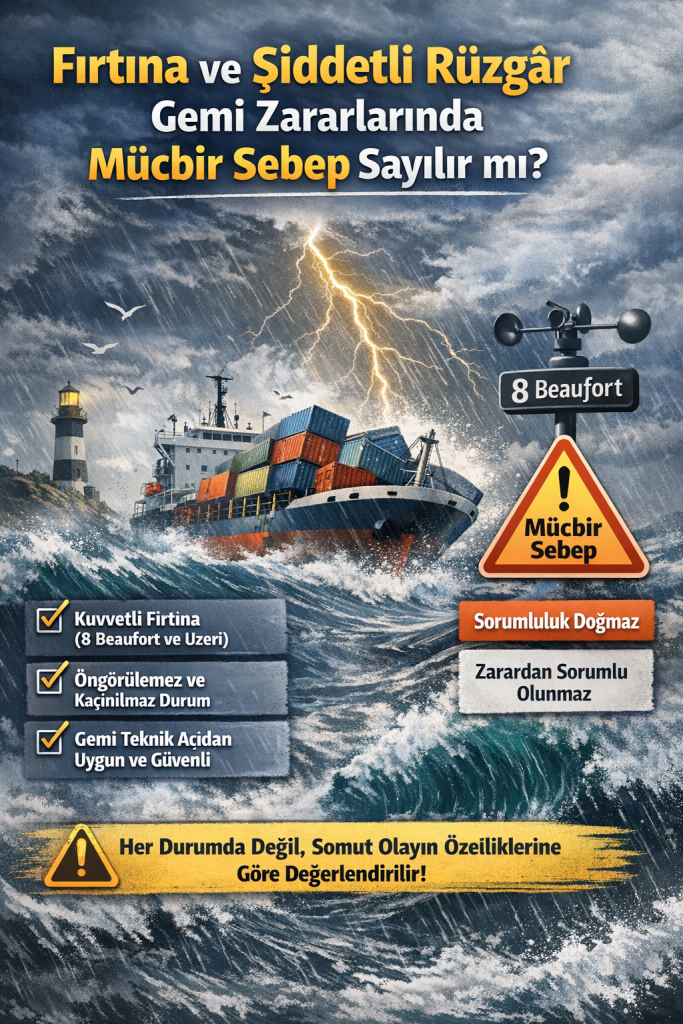
Gemi 8 Beaufort şiddetinde fırtınaya maruz kalsa bile taşıyanın “mücbir sebep” savunması neden reddedilir?
Çünkü deniz taşımacılığında 8 Beaufort seviyesindeki fırtına, özellikle belirli rota ve mevsimlerde öngörülebilir ve yönetilebilir bir deniz riski olarak kabul edilir. Hukuken mücbir sebebin kabulü için olayın öngörülemez, karşı konulamaz ve taşıyanın kusurundan tamamen bağımsız olması gerekir. Ancak uygulamada mahkemeler, yük hasarının çoğu durumda fırtınanın kendisinden değil; yanlış istif, yetersiz sabitleme (lashing), uygun olmayan bağlama malzemesi kullanımı veya sefer sırasında gerekli kontrollerin yapılmaması gibi taşıyana atfedilebilen kusurlardan kaynaklandığını tespit etmektedir. Bu nedenle, fırtına mevcut olsa dahi eğer yük her türlü sarsıntıya dayanacak şekilde sabitlenmemişse veya taşıyanın özen yükümlülüğü ihlal edilmişse, illiyet bağı kesilmez ve mücbir sebep savunması reddedilir. Özetle, 8 Beaufort fırtına tek başına “kurtuluş bileti” değildir; belirleyici olan, taşıyanın bu hava koşullarına karşı gerekli teknik ve operasyonel tedbirleri alıp almadığıdır.
Şiddetli rüzgâr nedeniyle bir yapının (depo çatısı gibi) uçup tekneye veya gemiye zarar vermesi hâlinde mücbir sebep kabul edilir mi?
Evet, olağanüstü şiddette ve öngörülemez nitelikteki rüzgâr ve fırtına, somut olayın özelliklerine göre mücbir sebep olarak kabul edilebilir ve yapı malikinin sorumluluğunu ortadan kaldırabilir. Nitekim Yargıtay 11. Hukuk Dairesi tarafından verilen 14.07.2011 tarihli kararda; marinada bulunan bir yatın, komşu depoya ait çatının fırtına nedeniyle uçarak üzerine düşmesi sonucu zarar görmesi olayında, çatının uçmasının binanın teknik yetersizliğinden değil, olağanüstü kuvvetteki fırtınadan kaynaklandığı tespit edilmiştir. Mahkeme; rüzgârın fırtına–kuvvetli fırtına seviyesinde olduğunu, olayın öngörülemezlik kriterini karşıladığını ve zararın doğrudan mücbir sebepten meydana geldiğini kabul ederek, bina maliklerinin sorumlu tutulamayacağına hükmetmiştir.
Özetle; yapı teknik olarak yeterli, bakım ve özen yükümlülüğü yerine getirilmiş ve zarar olağanüstü bir hava olayı nedeniyle meydana gelmişse, rüzgâr ve fırtına sorumluluktan kurtuluş sebebi sayılabilir. Ancak her olayda bu sonuca otomatik olarak varılmaz; rüzgârın şiddeti, öngörülebilirliği ve yapının teknik durumu birlikte değerlendirilir.
Why is Expert Legal Support Necessary?
Damages caused by storms and strong winds are frequently experienced, especially in ports, marinas, and along the Bosphorus in Istanbul, leading to high-value compensation claims. The critical aspect in these disputes is correctly proving whether the weather event was a force majeure or a foreseeable risk.
Elements such as the evaluation of meteorological reports, ship’s logs, sea protest, and the examination of stowage and lashing techniques require high technical expertise. An improperly structured defense can lead to the ship operator being held fully liable. Therefore, it is vitally important to work with a team experienced in maritime law and port-related damages, and one that closely follows judicial precedents. At this point, 2M Law Office ensures the correct management of the process by providing expert legal support regarding storm-induced marine damages and force majeure defenses.