Legal Analysis of Damages Caused by the Collision of the Ship Named “Gotia” with Emirgan Pier and Resulting Environmental Pollution
1. Summary and Legal Characterization of the Incident
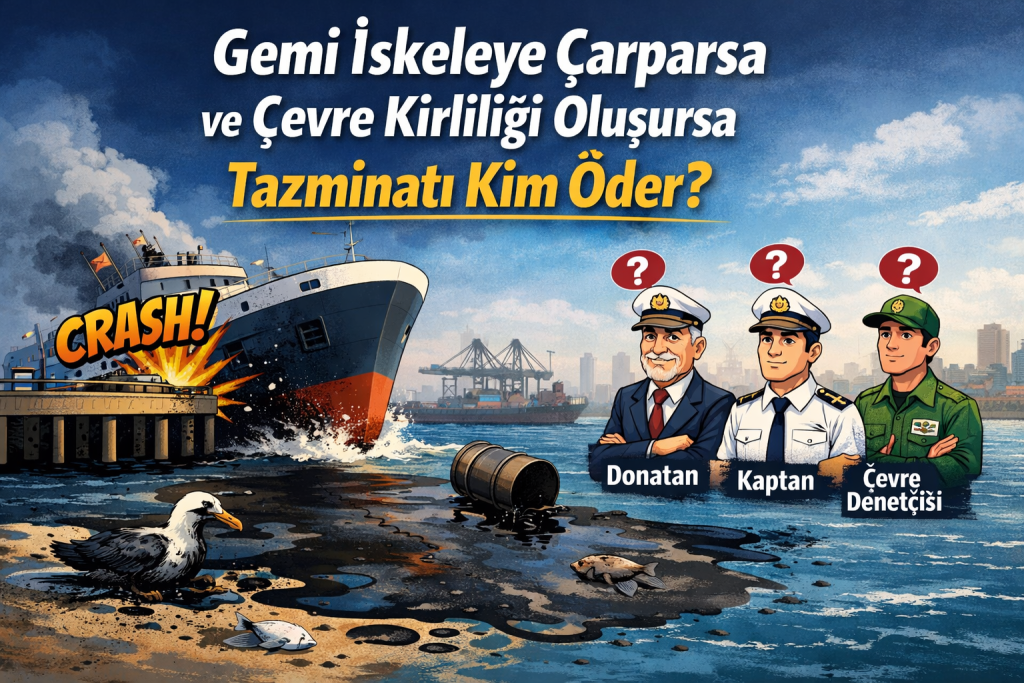
On 06.10.2002, the Maltese-flagged dry cargo ship named “Gotia” collided with Emirgan Pier during its passage through the Istanbul Strait. As a result of this accident, material damage occurred to the pier, and the fuel that leaked into the sea due to the perforation of the ship’s fuel tank, spread to Emirgan and the Sea of Marmara, causing widespread environmental pollution and ecological damage. In Supreme Court decisions, this situation has been characterized as damage arising from the operation of the ship and a tortious act.
2. Responsibility Analysis: Who is Responsible, and Why?
According to judicial decisions, the shipowner and the ship captain were held jointly and severally liable (jointly and severally) for the damages incurred:
Shipowner (Gotia Shipping Ltd.): The shipowner’s liability is fundamental for damages arising from the operation of the ship and for faults committed by the crew (captain) while performing their duties.
Ship Captain: According to the established jurisprudence of the 11th Civil Chamber of the Supreme Court of Appeals (e.g.: 2015/7089 E., 2016/6225 K K.), the ship captain has the status of “polluter” according to Article 2 of Environmental Law No. 2872. Pursuant to Article 28 of the same Law, the condition of fault is not sought for the captain’s liability in damages arising from environmental pollution; the principle of “strict liability” is applied. For this reason, the captain has passive legal standing.
3. Nature of the Claim: Is it a Maritime Claim?
Although compensation claims specific to the “Gotia” incident were directly based on the provisions of the Environmental Law in the decisions, the following analysis can be made within the framework of secondary sources and general maritime law principles:
Nature of Maritime Claim: Pursuant to Article 1352/1-n of the Turkish Commercial Code (TTK) No. 6102, damages from environmental pollution caused by the operation of a ship, and material loss or damage caused by the operation of a ship pursuant to Article 1352/1-h, are defined as “maritime claims.”
Right of Maritime Creditor: As stated in secondary sources (e.g., Istanbul 18th Civil Court of First Instance, 2024/488 E. Decision), tort claims arising from material damages caused by the operation of a ship are of the nature of a maritime claim granting a “right of maritime creditor” pursuant to Article 1320/1-e of the TTK.
4. Place Where Lawsuits Will Be Filed and Competent Court
In the case of the “Gotia” vessel, lawsuits were heard before the Istanbul 17th Civil Court of First Instance (acting as a Maritime Specialist Court).
Competent Court: Pursuant to Article 5/2 of the TTK, Maritime Specialist Courts are competent for disputes related to maritime trade and maritime law. In places where these courts are not available, Civil Courts of First Instance designated by the Council of Judges and Prosecutors are assigned to hear these cases.
Competent Court: Compensation lawsuits arising from maritime accidents can be filed in the court of the place where the accident occurred, the ship’s home port, or the defendant’s domicile. In the specific case, Istanbul Courts have been designated as competent for the accident in the Istanbul Strait.
5. Additional Information and Context from Secondary Sources
Strict Liability: Pursuant to Article 28 of the Environmental Law, the liability of polluters is an objective liability; meaning it is sufficient to establish a causal link between the damage and the act, and compensation is awarded regardless of whether the defendant is at fault (Supreme Court 11th Civil Chamber, 2024/2174 E.
Statute of Limitations: In tort cases arising from environmental pollution, the statute of limitations begins to run from the date the act and the perpetrator are learned. However, in cases of ongoing pollution, since the wrongful act continues, objections based on the statute of limitations can be rejected (Istanbul 17th Administrative Court, 2020/2 E.
Ports Law Connection: If a wreck had occurred as a result of the accident and this wreck had endangered navigation safety, the shipowner and captain would also have been obliged to remove the wreck pursuant to Article 7 of Ports Law no. 618. However, in the “Gotia” incident, the main dispute is over material damage and pollution compensation.
Precautionary Attachment: For such claims qualifying as maritime claims, it is possible to request a precautionary attachment on the ship pursuant to Article 1352 et seq. of the Turkish Commercial Code (TCC). For foreign-flagged vessels, jurisdiction belongs to the court where the ship is located (TCC Art. 1355).
Result: The damages caused by the vessel “Gotia” constitute a “maritime claim” under both general provisions (tort) and special laws (Environmental Law and Turkish Commercial Code). The shipowner and captain are strictly liable for environmental pollution, and are jointly and severally liable for pier damage under the scope of vessel operation liability. Maritime Specialized Courts are the venue for resolving such cases.
Frequently Asked Questions
Geminin iskeleye çarpması sonucu oluşan hasar ve çevre kirliliği deniz alacağı mıdır?
Evet. Geminin işletilmesi sırasında iskele, rıhtım veya kıyı yapılarına verilen zararlar ile çevre kirliliğinden doğan talepler, Türk Ticaret Kanunu m.1352 uyarınca deniz alacağı niteliğindedir. Bu nitelik, alacaklıya gemi üzerinde ihtiyati haciz ve kanuni rehin gibi güçlü hukuki imkânlar sağlar.
Çevre kirliliğinden kaptan da sorumlu tutulabilir mi?
Evet. 2872 sayılı Çevre Kanunu uyarınca gemi kaptanı “kirleten” sıfatına sahiptir. Çevre kirliliğinden doğan zararlarda kusur aranmaz; kusursuz (tehlike) sorumluluğu uygulanır. Bu nedenle kaptanın pasif dava ehliyeti bulunur ve donatanla birlikte müteselsilen sorumlu tutulabilir.
Donatan sorumluluğunu sınırlandırabilir mi?
Kural olarak evet. Donatan, 1976 LLMC Sözleşmesi kapsamında sorumluluğunu sınırlandırmak ve fon tesis etmek için dava açabilir. Ancak çevre kirliliği bakımından özel kanun hükümleri ve kaptanın ağır kusuru gibi istisnalar, bu hakkın sınırlarını daraltabilmektedir. Her olayda ayrıca değerlendirme yapılması gerekir.
Why is Expert Legal Support Necessary?
Maritime accidents involving ship-shore structure collisions and environmental pollution are subject to a much more complex legal regime than classical tort cases. In such incidents, the Turkish Commercial Code, Environmental Law, international conventions (LLMC), and established Supreme Court precedents are applied concurrently. Incorrect legal characterization can lead to the case being filed in the wrong court or the loss of protective mechanisms specific to maritime claims (precautionary attachment, ban from sailing).
Especially in incidents involving environmental pollution, the principle of strict liability can lead to very severe consequences for the shipowner and captain. Technical issues such as statute of limitations, causal link, the concept of ongoing pollution, and limitation of liability directly affect the outcome of the case. A single procedural error at this point can cause high-value compensation claims to escalate uncontrollably.
In accidents occurring in a narrow, high-current, and high-traffic region like the Istanbul Strait; the captain’s navigation and management decisions, the use of tugboats, anchoring preferences, and the navigation plan are examined in detail. These technical evaluations can only be accurately made with a legal approach that is well-versed in maritime practice and higher court decisions.
In this context, 2M Hukuk Avukatlık Bürosu (2M Law Office) strategically manages the process from the beginning with its practical experience in disputes arising from ship collisions, damages to coastal structures, maritime claims due to environmental pollution, precautionary attachments, and limitation of liability (fund establishment) cases; particularly for conflicts occurring along the line of Istanbul Strait, Emirgan, Bebek, Kandilli, Haydarpaşa, and Tuzla.
In such cases, processes conducted without the support of an expert lawyer often result in irreparable material and legal losses.