
Essential Elements, Evidence, and Practical Guide in Arrest Based on a Maritime Claim
Ship arrest is one of the most effective legal tools for protecting claims in maritime trade. However, for this path to be successfully pursued, it depends on the petition for arrest being prepared completely, based on correct legal grounds, and meeting the approximate proof requirement. In practice, numerous arrest requests are rejected due to formal deficiencies or erroneously structured petitions.
This study analyzes the essential elements, legal grounds, and means of proof that must be included in petitions requesting the provisional attachment of a ship, in light of relevant judicial decisions.
1. Ship’s Identification Information and Identification
In requests for ship arrest, it is essential that the ship to be arrested is identified without any room for doubt. According to the decision of the Istanbul Regional Court of Justice, 14th Civil Chamber (2025/51-2025/80 K), all identification details of the ship must be included in the petition. These details are:
Ship’s name,
Home port,
Flag,
Port of registry and registry number (if any). The decision emphasized that the absence of this information would be contrary to the requirement of clearly indicating which ship’s arrest was decided.
2. Nature of the Claim as a “Maritime Claim” and Legal Basis
A request for preliminary attachment must be based on the provisions of Article 1352 et seq. of the Turkish Commercial Code (TCC). In the petition, it must be clearly stated which of the 22 types of maritime claims listed in the law the receivable falls under. The types of maritime claims found in sample decisions are as follows:
Damages Arising from Ship Operation (Collision/Damage): Losses or damages caused by the ship in accordance with TCC Article 1352/1-a (Supreme Court 11th Civil Chamber, 2013/18320
Cargo Damage and Loss: Cargo damages arising from the contract of carriage in accordance with TCC Article 1352/1-g (Samsun Regional Court of Justice 3rd Civil Chamber, 2023/34
Fuel and Material Supply: Costs of fuel and equipment supplied to the ship in accordance with TCC Article 1352/1-f and l (Supreme Court 11th Civil Chamber, 2013/6720
Seafarer Wages: Wage claims of the captain and crew in accordance with TCC Article 1352/1-o (Istanbul Regional Court of Justice 13th Civil Chamber, 2019/906
Towage and Port Services: Service fees rendered in accordance with TCC Article 1352/1-n (Istanbul Regional Court of Justice 13th Civil Chamber, 2022/1014
3. Amount of Claim and Condition of Prima Facie Evidence
In accordance with Article 258 of the Enforcement and Bankruptcy Law (EBL) and Article 1362 of the TCC, the creditor must present evidence that will convince the court of the existence and amount of their claim. Full proof is not required; “prima facie evidence” is deemed sufficient. The claim items (principal, interest, expenses) must be calculated in detail in the petition.
Example: In the case file of İzmir BAM 17. HD (2023/471 K); the total amount of damage has been quantified by individually specifying items such as the cost of goods, evacuation fee, warehouse rent, and occupancy fee.
Example: In the case file of İstanbul BAM 13. HD (2025/2019 K); a detailed calculation table has been presented by multiplying fuel quantities by unit prices (mt x USD).
4. Basic Evidence to Be Attached to the Petition
Documents that courts deem sufficient for approximate proof and should be attached to the petition are as follows:
Contracts: Freight contract, charter party, service or sales contract.
Commercial Documents: Invoices, proformas, payment receipts.
Maritime Trade Documents: Bill of lading, delivery order, ship registry records.
Delivery and Confirmation Documents: Fuel delivery documents sealed by the ship captain, service forms, work orders.
Damage Assessments: Expert reports, protest letters, court determination files, photographs.
5. Request for Security and Prohibition of Departure
Security: According to Article 1363 of the Turkish Commercial Code (TCC), a creditor requesting a precautionary attachment for a maritime claim must deposit security in the amount of 10,000 Special Drawing Rights (SDR). The decision of the Denizli Regional Court of Justice, 4th Civil Chamber (2024/36) accepted the failure to deposit this security as a ground for rejection. However, in claims of seamen, a decision for attachment without security can be rendered (Istanbul Regional Court of Justice, 14th Civil Chamber, 2022/2109).
Prohibition from Sailing: According to Article 1353/1 of the Turkish Commercial Code (TCC), only a precautionary attachment of the ship can be decided for maritime claims; a preliminary injunction or a prohibition from sailing cannot be requested in addition. However, placing the ship under custody during the enforcement stage of the attachment results in a prohibition from sailing.
6. Additional Contexts Obtained from Secondary Sources
Maintenance and Repair Services: According to the decision of the Istanbul Regional Court of Justice, 14th Civil Chamber (2024/1068), which serves as a secondary source, maintenance and repair contracts, captain-approved request forms, and proforma invoices are of critical importance for prima facie evidence.
Port Services: The decision of the Supreme Court, 11th Civil Chamber (2014/9364) proceeded from the presumption that port services cannot be provided free of charge, found it sufficient to prove that the service was rendered.
Sister Ship Attachment: The decision of the Istanbul Regional Court of Justice, 43rd Civil Chamber (2022/266) emphasizes that if the attachment of another vessel (sister ship) belonging to the debtor is requested, the registry records showing the ownership link between the vessels and the “Register” documents must be appended to the petition.
Discussion on Maturity: The decision of Samsun Regional Administrative Court 3rd Civil Chamber (2025/1346 ) reminds that it must be clearly stated in the petition that the receivable is due (payment day has arrived) and that the performance has been fully completed, otherwise the request may be rejected.
In Conclusion, Petition Content Summary:
Status of Parties: It should be clarified whether they are the owner, operator, charterer, or ship manager.
Ship Information: Name, IMO, Flag, Port of Registry.
Receivable Detail: Its type, amount, and calculation method within the scope of Turkish Commercial Code (TTK) Article 1352.
Element of Danger: The risk of the ship departing from the port and the claim that the collection of the receivable will become impossible.
List of Evidence: Contract, invoice, captain-approved documents, and technical reports.
Legal Basis: Provisions of TTK Articles 1352, 1353, 1362, and 1363.
Frequently Asked Questions
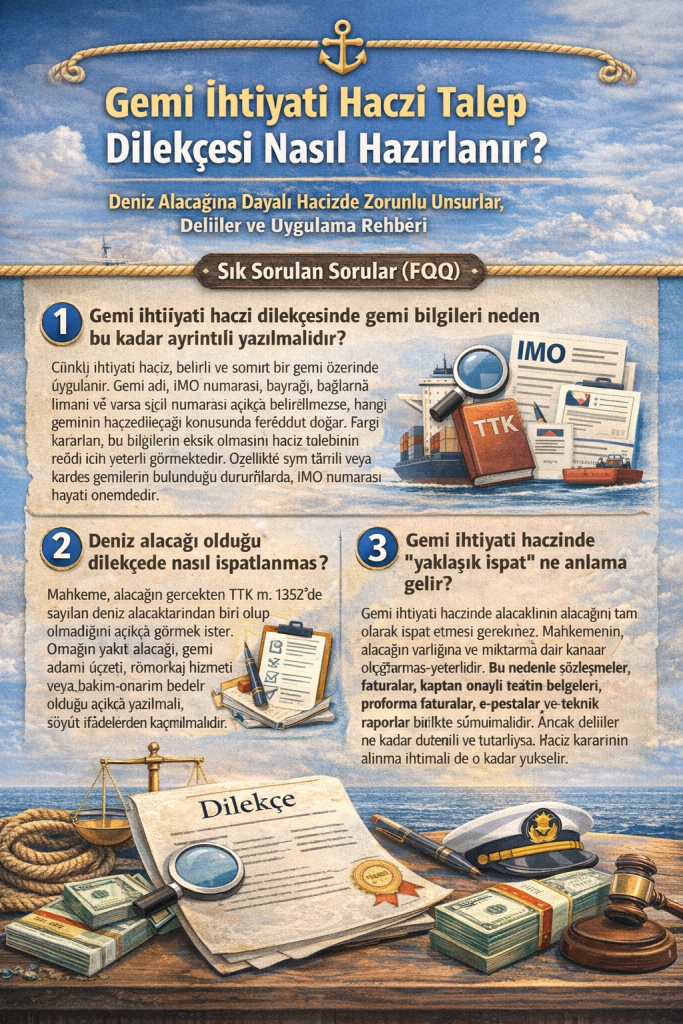
Gemi ihtiyati haczi dilekçesinde gemi bilgileri neden bu kadar ayrıntılı yazılmalıdır?
Çünkü ihtiyati haciz, belirli ve somut bir gemi üzerinde uygulanır. Gemi adı, IMO numarası, bayrağı, bağlama limanı ve varsa sicil numarası açıkça belirtilmezse, hangi geminin haczedileceği konusunda tereddüt doğar. Yargı kararları, bu bilgilerin eksik olmasını haciz talebinin reddi için yeterli görmektedir. Özellikle aynı isimli veya kardeş gemilerin bulunduğu durumlarda, IMO numarası hayati önemdedir.
Deniz alacağı olduğu dilekçede nasıl ispatlanmalıdır?
Mahkeme, alacağın gerçekten TTK m. 1352’de sayılan deniz alacaklarından biri olup olmadığını açıkça görmek ister. Bu nedenle dilekçede, alacağın hangi bent kapsamına girdiği net biçimde belirtilmelidir. Örneğin yakıt alacağı, gemi adamı ücreti, römorkaj hizmeti veya bakım-onarım bedeli olduğu açıkça yazılmalı; soyut ifadelerden kaçınılmalıdır. Yanlış sınıflandırılan alacaklar, sırf bu nedenle reddedilebilmektedir.
Gemi ihtiyati haczinde “yaklaşık ispat” ne anlama gelir?
Gemi ihtiyati haczinde alacaklının alacağını tam olarak ispat etmesi gerekmez. Mahkemenin, alacağın varlığına ve miktarına dair kanaat oluşturması yeterlidir. Bu nedenle sözleşmeler, faturalar, kaptan onaylı teslim belgeleri, proforma faturalar, e-postalar ve teknik raporlar birlikte sunulmalıdır. Ancak deliller ne kadar düzenli ve tutarlıysa, haciz kararının alınma ihtimali de o kadar yükselir.
Teminat yatırılmazsa gemi ihtiyati haczi kararı verilebilir mi?

Kural olarak hayır. Deniz alacaklarında ihtiyati haciz isteyen alacaklı, 10.000 SDR tutarında teminat yatırmak zorundadır. Bu teminat yatırılmadan verilen haciz talepleri reddedilmektedir. Ancak gemi adamlarının ücret alacakları gibi istisnai durumlarda teminatsız haciz mümkündür. Bu ayrımın dilekçede açıkça belirtilmemesi, talebin reddine yol açabilir.
Why is Expert Lawyer Support Necessary in the Ship Arrest Process?
Ship arrest is a legal process that is highly technical in terms of duration, form, and proof. A single incorrectly written sentence, a missing document, or an erroneous legal basis can cause the creditor to lose their strongest guarantee from the outset. Especially in cases where there is a risk of the ship departing from the port, there is no room for error in this process, which is a race against time.
Applications made without the support of an expert maritime law attorney frequently encounter the following problems:
Incorrect characterization of the claim as a maritime claim
Incomplete or erroneous entry of vessel identification information
Insufficient structuring of evidence to provide prima facie proof
Incorrect request for security and prohibition of departure regime
Overlooking the possibility of sister ship arrest
Especially in regions where maritime trade is intense, such as Istanbul and Tuzla, courts scrutinize these requests very strictly. Therefore, it is critically important for the vessel arrest application to be prepared by an attorney specialized in maritime law and well-versed in precedents, to ensure that the claim does not remain merely on paper.