
Guide to IMO Number, Flag, Port of Registry, and Registration
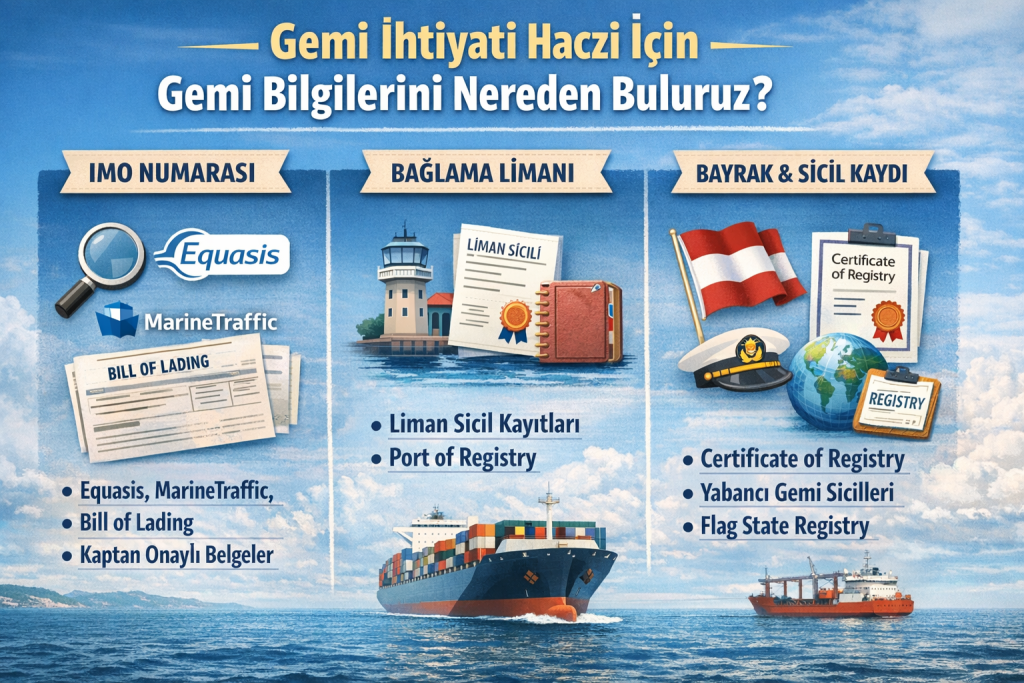
One of the most common mistakes made in ship arrest requests is the submission of incomplete or incorrect identification details for the vessel. However, from the courts’ perspective, the most critical point is the unambiguous identification of the ship subject to the arrest. In this article, we practically and applicably address where and how to access the ship’s name, IMO number, port of registry, flag, and registration information that must be included in the application for provisional arrest.
Where to Find Ship Name and IMO Number?
In ship provisional arrest, the most critical identification information is the IMO number. Because a ship’s name can change; however, the IMO number remains unchanged throughout the ship’s life and is a unique identifier. For this reason, courts consider the IMO number indispensable for the definitive identification of the ship.
Most reliable sources:
International ship query systems
Equasis
IHS / Sea-Web
MarineTraffic
Bill of Lading
Charter parties or carriage contracts
Documents signed by the ship’s captain (bunker delivery note, work order, service forms)
The IMO number must be included in the application along with the ship’s name. There are numerous examples of arrest requests being rejected in files where the IMO number was not provided.
How to Determine the Port of Registry?
The port of registry is one of the most commonly confused concepts in practice. The port of registry is not the port where the vessel is actually located; it is the port where it is registered.
The port of registry can be learned from the following sources:
Ship registration records (Turkish or foreign)
Port authority records
The “Port of Registry” information found in Equasis / MarineTraffic systems
Ship certificates (Certificate of Registry)
If the port of registry is stated incorrectly, the court may encounter issues in assessing jurisdiction. Therefore, the actual port and the port of registry must be clearly distinguished.
Where to Learn the Ship’s Flag?
The ship’s flag is of great importance, especially in the precautionary attachment of foreign-flagged vessels. This is because the provisions of the Turkish Commercial Code also apply to foreign vessels, but flag information plays a decisive role in legal assessment.
Flag information is included in the following documents:
Ship registration certificate (Certificate of Registry)
Equasis, IHS, MarineTraffic records
Bills of lading and freight contracts
In petitions where flag information is missing, doubts may arise regarding the applicability of the attachment to a foreign vessel.
Where to Find the Port of Registry and Registry Number?
For Turkish-Flagged Vessels:
Ship Registry Directorates
Records of the Registry of Vessels
Ministry of Transport and Infrastructure systems
For Foreign-Flagged Vessels:
Foreign ship registries (flag state registry)
Equasis / Sea-Web reports
Certificate of Registry
Register extract (registry summary)
It may not always be possible to obtain the registry number for foreign vessels. In such cases, the phrase “registry number, if available” should be used in the petition, and IMO number + vessel name + flag information should be written together, and this situation should be clearly explained.
Can Missing Information Be Completed During the Enforcement and Port Authority Stage?
The situation frequently encountered in practice is as follows: When a request for attachment is made, all registry information is not available, but the vessel is physically in a Turkish port. In this case:
Provisional attachment can be requested with IMO number + vessel name + flag information
During the enforcement stage, missing information is completed through the port authority and enforcement directorate
Courts avoid excessive formalism in cases where the vessel can be unequivocally identified by its IMO number
Conclusion: What is Essential in Vessel Information?
The fundamental principle in ship arrest is the identification of the vessel subject to arrest in an unmistakable manner.
Therefore:
The IMO number must be stated
The vessel’s name, flag, and port of registry must be specified together
Missing information must be justified
This approach significantly increases the likelihood of arrest applications being accepted in practice.
Why is Expert Legal Support Necessary?
Requests for ship arrest are processes that involve high sums, very short deadlines, and technical maritime trade rules, allowing no room for error. A single omission or error in the vessel’s name, IMO number, flag, or registration details can lead to the procedural rejection of the arrest request or the swift lifting of the arrest. Especially, the correct characterization of a maritime claim, accurate determination of whether it falls within the scope of Turkish Commercial Code (TTK) Article 1352, the selection of evidence meeting the approximate burden of proof threshold, and the simultaneous coordination among the court–enforcement–port authority require expertise.
Since, in practice, a vessel can depart from port within hours, a wrong court selection, insufficient security calculation, or an incorrectly drafted petition can result in the claim not being actually collected. Therefore, in ship arrest processes, working with an expert lawyer who is proficient in maritime commercial law practice, familiar with port procedures, and experienced in urgent arrest cases plays a decisive role in both obtaining and protecting the arrest.
Frequently Asked Questions
Gemi ihtiyati haczi dilekçesinde IMO numarası mutlaka yazılmalı mı?

Evet. IMO numarası, geminin en güvenilir ve değişmez kimlik bilgisidir. Gemi adı zaman içinde değişebilse de IMO numarası geminin ömrü boyunca sabit kalır. Mahkemeler, hacze konu geminin tereddütsüz şekilde teşhis edilebilmesi için IMO numarasının dilekçede yer almasını kritik görmektedir. IMO numarasının bulunmadığı veya eksik yazıldığı dosyalarda ihtiyati haciz taleplerinin reddedildiği uygulamada sıkça görülmektedir.
Bağlama limanı ile geminin fiilen bulunduğu liman aynı şey midir?
Hayır. Bağlama limanı, geminin siciline kayıtlı olduğu limanı ifade eder; geminin fiilen bulunduğu veya haczin uygulandığı limanla karıştırılmamalıdır. Bu ayrım, hem mahkemenin yetkisinin belirlenmesi hem de gemi bilgilerinin doğru sunulması açısından önemlidir. Dilekçede bağlama limanı yanlış yazıldığında, yetki itirazları ve usulden ret riskleri ortaya çıkabilmektedir.
Yabancı bayraklı gemilerde sicil numarası bulunamazsa haciz talebi reddedilir mi?
Hayır. Yabancı bayraklı gemilerde sicil numarasına her zaman ulaşmak mümkün olmayabilir. Bu durumda, dilekçede IMO numarası, gemi adı ve bayrak bilgisi birlikte yazılır ve sicil numarasına neden ulaşılamadığı kısaca açıklanır. Uygulamada mahkemeler, IMO numarası ile geminin tereddütsüz şekilde teşhis edilebildiği dosyalarda şekilci davranmamakta ve haciz taleplerini kabul etmektedir.