
Review of the File, Hearing Requirement, and Conversion to Security Processes
Among the most frequently wondered topics in ship arrest applications are whether the court will hold a hearing, how objections will be examined, and by what procedure the process of converting the attachment into security is carried out. When judicial decisions are examined, it is seen that different and binding procedural rules are applied at every stage of these processes. Decisions rendered with incorrect procedure, however, are frequently in appeal or cassation
1. Procedure for Issuing a Ship Arrest Order
When judicial decisions are examined, it is observed that ship arrest orders are generally issued after an examination of the file (based on documents). In accordance with Article 258/2 of the Enforcement and Bankruptcy Law (İİK), the court examining the provisional attachment request is at liberty to hear both parties or not. In this context:
In the decisions of the Istanbul Regional Court of Justice, 14th Civil Chamber (2024/1067 and 2024/1068 ), it has been stated that ship arrest requests are decided ex parte (based on the file) without notifying the opposing party, by examining documents such as invoices, order slips, and delivery notes appended to the petition.
The Izmir Regional Court of Justice, 14th Civil Chamber, in its decision (2023/1806 K), also found that the decision to place a provisional attachment on a ship by reviewing the file within the framework of İİK Article 258 was in accordance with procedure and law.
The 9th Civil Chamber of the Supreme Court (2013/5611 K) noted in its decision that the provisional attachment order on the boat was issued after an examination of the file.
2. Objection to Provisional Attachment Order and Procedure for Annulment of the Order
It is considered a legal requirement to hold a hearing when examining objections to provisional attachment orders and requests for their annulment. In accordance with Article 265/4 of the EBL, the court must summon both parties upon objection and hear those who attend. However, if neither party appears, the examination can be conducted based on the file.
In the decisions of the 11th Civil Chamber of the Supreme Court (2013/10557 K, 2014/18429 ), the 15th Civil Chamber (2013/5869) and the 14th Civil Chamber (2009/10962), the resolution of an objection to a provisional attachment order based on the file without a hearing was deemed to violate the right to a fair hearing and Article 265/4 of the EBL, thus constituting a ground for reversal.
The 13th Civil Chamber of the Istanbul Regional Court of Justice (2021/1325) emphasized that it is legally mandatory to examine an objection to a provisional attachment order issued based on the file by holding a hearing.
In concrete practices, it is observed that in cases before the 14th Civil Chamber (2024/1067 2024/1068, 2020/1336) and the 43rd Civil Chamber (2024/481 , 2020/2041) of the Istanbul Regional Court of Justice, the courts of first instance held hearings to evaluate objections and heard the parties.
3. Procedure for Converting Provisional Attachment into Security
Decisions regarding the conversion of a ship’s provisional attachment into security (or its transfer onto security) are usually made through additional decisions rendered on the file in judicial rulings.
In the decisions of the Istanbul Regional Court of Justice, 14th Civil Chamber (2024/1067 K, 2024/1068, 2020/1336 ), it was stated that upon the debtor’s attorney’s application, the provisional attachment was decided to be transferred to cash or a bank letter of guarantee on the file, in accordance with Article 1371 of the Turkish Commercial Code (TCC).
The Istanbul Regional Court of Justice, 43rd Civil Chamber (2023/1567 ) noted that the process of transferring the provisional attachment to security upon the submission of a letter of guarantee was carried out through an interim decision on the file.
The Izmir Regional Court of Justice, 14th Civil Chamber (2023/1806), in one of its decisions, indicated that although it found the initial decision to convert to security made on the file to be procedurally deficient, this deficiency could be remedied by a subsequent objection review conducted with a hearing.
4. Review Procedure of Higher Courts
As a rule, appeal and cassation reviews carried out by Regional Courts of Justice and the Court of Cassation are conducted on the file.
In the decisions of the Istanbul Regional Court of Justice, 14th Civil Chamber (2024/1067 ), 43rd Civil Chamber (2024/481 Source) and 12th Civil Chamber (2023/604 ), it was clearly stated that the appeal review was conducted on the file in accordance with Articles HMK 353/1-b and İİK 265/final.
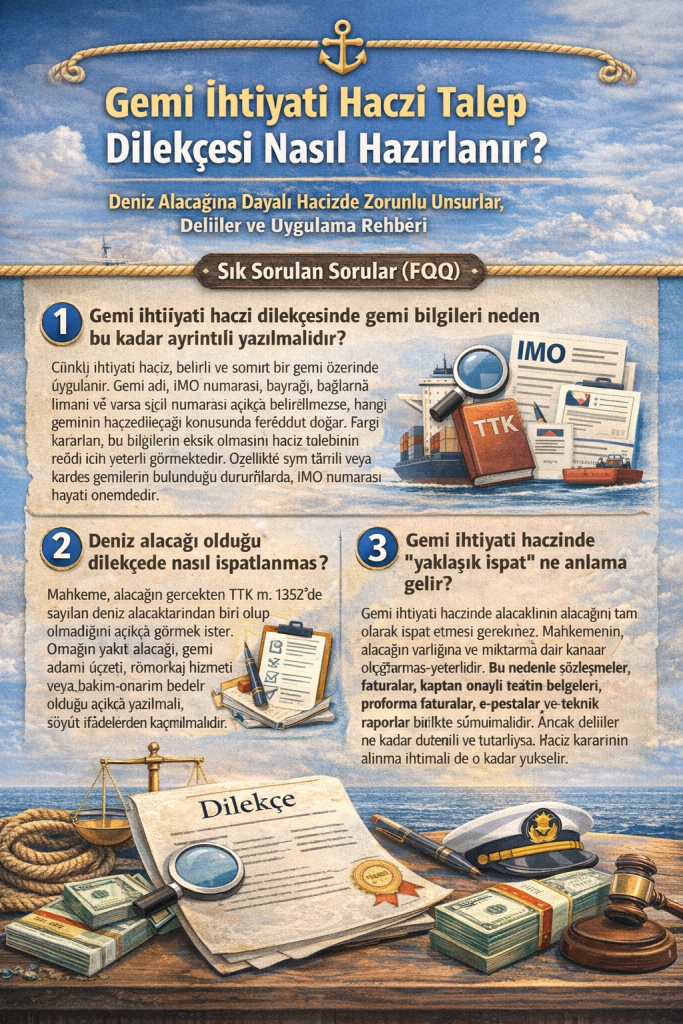
Frequently Asked Questions
Gemi ihtiyati haczi kararı duruşma yapılmadan verilebilir mi?

Evet. Gemi ihtiyati haczi kararları, kural olarak dosya (evrak) üzerinden verilmektedir. İcra ve İflas Kanunu m. 258/2 uyarınca mahkeme, tarafları dinleyip dinlememe konusunda serbesttir. Uygulamada mahkemeler; fatura, sipariş fişi, irsaliye, sözleşme ve kaptan onaylı belgeleri inceleyerek, karşı tarafa önceden bildirim yapmaksızın haciz kararı verebilmektedir. Bölge Adliye Mahkemeleri ve Yargıtay kararları, bu yöntemi usule uygun kabul etmektedir.
İhtiyati hacze itiraz edilirse mahkeme duruşma açmak zorunda mı?
Evet. İhtiyati hacze itiraz edilmesi halinde duruşma açılması zorunludur. İİK m. 265/4 açık hüküm içermekte olup, mahkeme itiraz üzerine tarafları davet ederek dinlemek zorundadır. Yargıtay ve Bölge Adliye Mahkemeleri, itirazın duruşma yapılmaksızın dosya üzerinden karara bağlanmasını hukuki dinlenilme hakkının ihlali saymakta ve bu durumu kesin bozma nedeni olarak değerlendirmektedir.
Gemi haczi teminata kaydırılırken duruşma yapılır mı?
Uygulamada çoğunlukla hayır. Gemi ihtiyati haczinin teminata dönüştürülmesi talepleri, genellikle dosya üzerinden verilen ara kararlarla sonuçlandırılmaktadır. Borçlu tarafından yeterli nakit veya banka teminat mektubu sunulması halinde, mahkemeler TTK m. 1371 uyarınca haczi gemi üzerinden kaldırarak teminata kaydırabilmektedir. Ancak bazı yargı kararlarında, bu işlemin sonradan yapılan duruşmalı itiraz incelemesiyle denetlenmesi gerektiği de vurgulanmaktadır.
Why is Expert Legal Assistance Necessary?
Ship arrest procedures are one of the areas most prone to procedural errors. Determining at what stage a hearing should be held, in which decisions an examination can be made based on the file, and how the process of converting to security will be managed are entirely technical and heavily case-law dependent matters. A decision obtained through incorrect procedure or inadequately defended can lead to the lifting of the attachment, the return of the security, or the annulment of the case.
Especially in maritime trade disputes;
The combined application of the provisions of the EBL–TCC–CPC,
Close monitoring of the jurisprudence of the Regional Courts of Justice (BAM) and the Court of Cassation (Yargıtay),
Determining the correct procedural strategy during the objection and security stages,
The simultaneous management of port, enforcement, and court procedures requires expertise. Therefore, in ship arrest cases, working with an expert lawyer who is proficient in maritime commercial law practice, familiar with jurisprudence, and capable of managing urgent attachment processes is of critical importance for the protection of the claim.