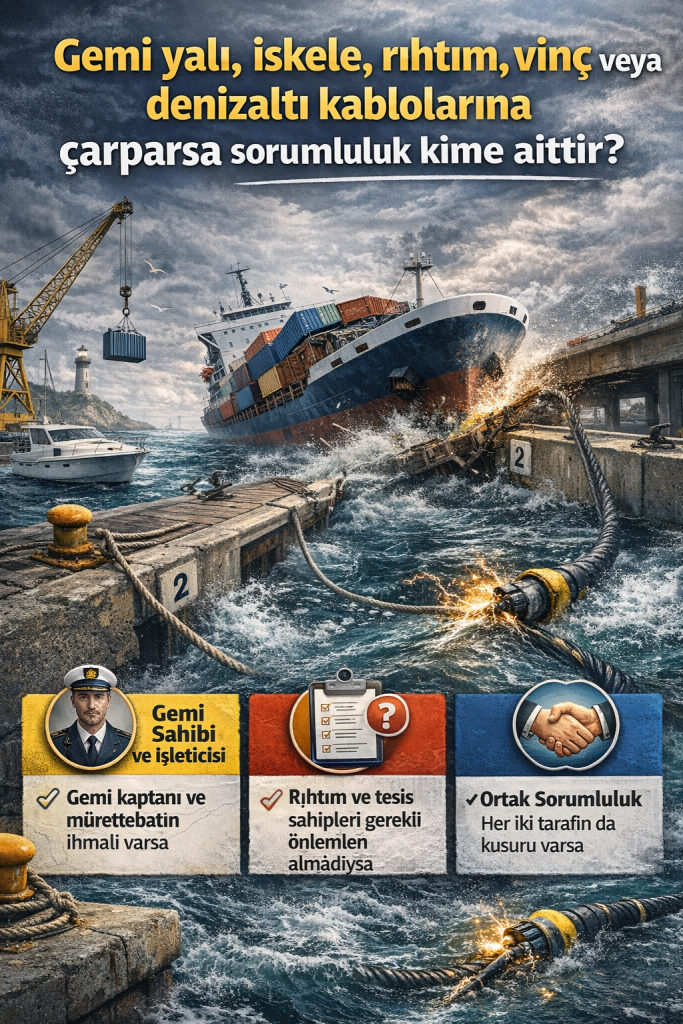
1. Legal Nature of the Damage and its Qualification as a “Maritime Claim”
Damages incurred as a result of a ship colliding with coastal structures (waterside mansions, piers, docks, cranes, or submarine cables) due to currents in the strait, engine failures, or the captain’s fault in navigation and management (erroneous maneuvering, anchoring errors, etc.) are qualified as “maritime claims” in accordance with the Turkish Commercial Code (TTK) and international conventions.
TTK Art. 1352/1-a and d: Material loss or damages caused by the operation of a ship, as well as damages to the environment and the coastal strip, are clearly defined as maritime claims.
TTK Art. 1320/1-e: It is accepted that claims arising from material loss and damages based on tortious acts caused by the operation of a ship grant the creditor a “maritime lien” (statutory lien right).
International Legislation: In accordance with Article 2/1/a of the 1976 LLMC Convention, damages suffered by structures such as port facilities, docks, and waterways are maritime claims subject to limitation of liability.
2. Responsible Parties (Standing to Sue)
In damages caused to coastal structures, the parties against whom the lawsuit will be directed are determined according to the fault in the occurrence of the damage and the capacity of operation:
Shipowner (Vessel Owner): According to Article 1062 of the Turkish Commercial Code (TCC), the shipowner is liable to third parties for faults committed by crew members while performing their duties (such as the captain’s error in navigation and management).
Captain: Due to erroneous maneuvers causing damage or navigation and management decisions contrary to maritime practices, the captain can be held jointly and severally liable with the shipowner.
Operator/Charterer/Manager: Persons operating the vessel on their own behalf or vessel managers can also be held liable according to the specifics of the concrete case.
Agent: According to TCC Article 105/2, a lawsuit can only be filed against the agent representing (on behalf of) the shipowner; the agent generally does not have personal (primary) liability.
3. Competent and Authorized Court
Specialized courts are competent in such compensation disputes arising from ship operations and based on maritime commercial provisions:
Competent Court: Maritime Specialization Courts (in places where these courts do not exist, Commercial Courts of First Instance acting as Maritime Specialization Courts) are competent. Whether the dispute is based on tort or is commercial in nature does not change this rule of competence.
Authorized Court: Lawsuits can generally be filed in the port court where the ship is registered, in the court of the place where the accident occurred, or at the defendant’s domicile. Specifically in Istanbul, these lawsuits are usually heard in the Maritime Specialization Courts at the Istanbul (Çağlayan) or Istanbul Anadolu (Kartal) Courthouses.
4. Types of Lawsuits and Legal Process
Compensation Lawsuit: Lawsuits demanding material damages and, if any, loss of profit (gain) can be filed based on tortious acts or the special provisions of the Turkish Commercial Code (TTK) concerning maritime trade.
Provisional Attachment and Prohibition of Sailing: To secure a maritime claim, a provisional attachment order can be obtained for the vessel under Article 1353 of the Turkish Commercial Code (TTK), and the vessel can be prohibited from sailing.
Annulment of Objection: If an objection is raised against enforcement proceedings initiated for the collection of damages, a lawsuit for the annulment of the objection is filed in Maritime Specialized Courts.
Limitation of Liability (Fund Establishment): The shipowner has the right to initiate a lawsuit for the establishment of a fund to limit their liability under the 1976 LLMC Convention.
5. Statutes of Limitations and Periods for Filing Lawsuits
There are different classifications regarding time limits in decisions:
Tortious Act Statute of Limitations: In some decisions, the 2-year statute of limitations for tortious acts concerning damages resulting from ship collisions has been discussed; however, it has been implied that if the incident gives rise to a “maritime claim” or “maritime lien,” special periods in the Turkish Commercial Code (TTK) (usually 1 year) may apply.
Contractual Relationship: If the damage occurred during the performance of a contract (e.g., a maintenance-repair or transport contract), the statute of limitations period may vary depending on the type of contract (e.g., 5 years for a contract for work).
Maritime Lien: In accordance with Article 1327 of the Turkish Commercial Code (TTK), maritime liens are, as a rule, subject to a 1-year forfeiture period.
6. Information Obtained from Secondary Sources
Secondary source decisions provide the following additional contexts regarding the matter:
Environmental Pollution and Analysis Costs: In case of leakage or pollution originating from the vessel, it has been emphasized that expenses such as analysis fees are also considered a maritime claim arising from the operation of the vessel and fall within the jurisdiction of the Maritime Commercial Court.
Threat of Damage and Survey Costs: Even if no actual damage occurred, the inspection/survey costs incurred due to the “threat of damage” resulting from the vessel being dragged by the current and anchoring over infrastructure facilities (natural gas pipelines, etc.) have also been evaluated as a maritime claim within the scope of Article 1352/1-d of the Turkish Commercial Code (TTK).
Force Majeure Defense: Although severe storms or extraordinary weather conditions were put forward by the defendants as force majeure, the captain’s navigation and management decisions (not dropping anchor, not calling a tugboat, etc.) taken despite these conditions are at the center of the fault examination during the trial.r.
Frequently Asked Questions
Geminin iskeleye, rıhtıma veya kıyı yapısına çarpması deniz alacağı mıdır?
Evet. Geminin işletilmesi sırasında kıyı yapılarına, liman tesislerine veya deniz altyapısına verilen zararlar, Türk Ticaret Kanunu m.1352 ve 1976 LLMC Sözleşmesi uyarınca deniz alacağı olarak kabul edilmektedir. Bu nitelendirme, alacaklıya gemi üzerinde kanuni rehin ve ihtiyati haciz gibi güçlü hukuki imkanlar tanır.
Geminin yalı, iskele, rıhtım, vinç veya denizaltı kablolarına verdiği zarardan kim sorumlu tutulur?
Zarardan kural olarak donatan (gemi maliki) sorumludur. Kaptanın hatalı sevk ve idare kararları, yanlış manevra veya demirleme kusurları bulunması halinde kaptan da donatanla birlikte müteselsilen sorumlu tutulabilir. Ayrıca gemiyi fiilen işleten kiracı veya yönetici şirketlerin sorumluluğu da somut olayın özelliklerine göre gündeme gelebilir.
Donatan sorumluluğunu sınırlayabilir mi?
Evet. Donatan, 1976 LLMC Sözleşmesi kapsamında sorumluluğunu sınırlamak amacıyla fon tesisi davası açabilir. Ancak bu hak mutlak değildir; kaptanın ağır kusuru veya bilinçli ihmalinin ispatı halinde sorumluluğun sınırlanması reddedilebilir.
Why is Expert Lawyer Support Necessary?
Damages caused to coastal structures as a result of a ship collision are subject to the special regime of maritime commercial law, unlike a classical tort case. The legal qualification to be made in such disputes directly affects whether the damage will be considered a maritime claim, whether a statutory lien and precautionary attachment can be applied to the vessel, and which court will hear the case.
In accidents occurring in areas with strong currents, narrow maneuvering spaces, and high traffic risks, especially in regions like the Istanbul Strait; defenses of force majeure, the captain’s navigation and management decisions, whether a tugboat was called, and the compliance of anchoring preferences with maritime rules are meticulously examined. These technical evaluations can only be accurately made with a legal perspective that is well-versed in maritime practice and Supreme Court precedents.
Furthermore, there are serious risks concerning statutes of limitation and peremptory periods. Incorrectly assessing whether the damage constitutes a tort, a maritime claim, or a claim giving rise to a maritime lien can lead to missing the 1-year peremptory period and the complete loss of the claim.
At this point, 2M Hukuk Law Firm strategically manages the process from the outset in cases of ship collision, damage to coastal structures, determination of maritime claims, provisional attachment, and limitation of liability under LLMC; with practical experience specific to disputes arising along the Istanbul Strait, Haydarpaşa, Ambarlı, Pendik, and Tuzla line.
Processes conducted without expert legal support in disputes related to maritime accidents often result in the rejection of even seemingly strong claims due to procedural or qualification errors.