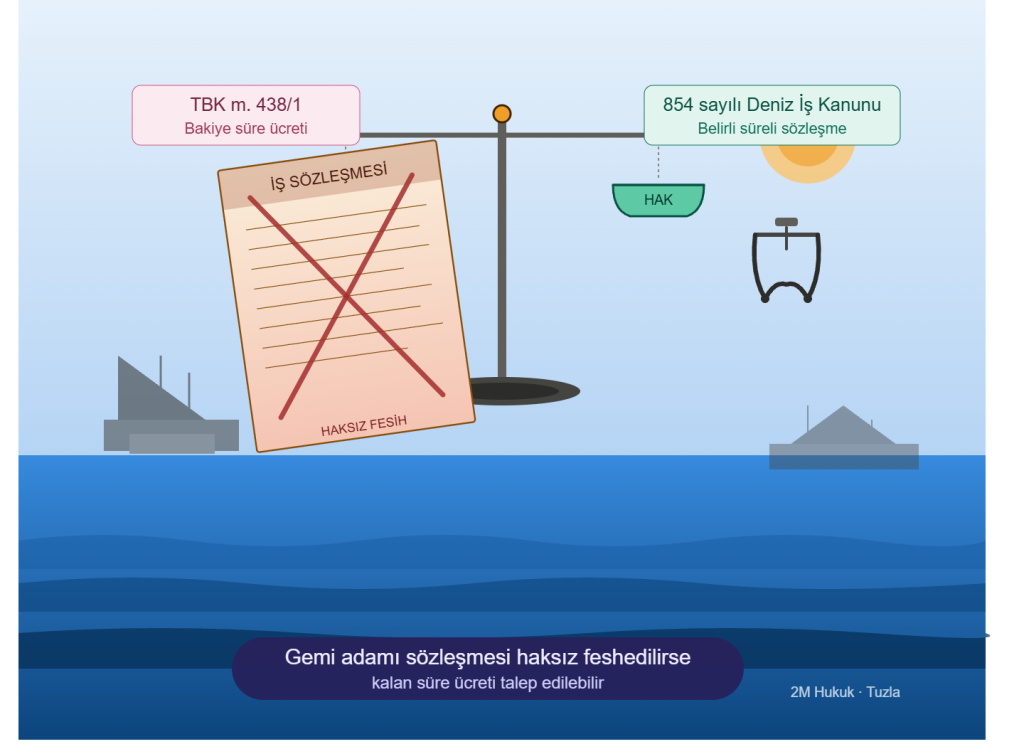
Thousands of seafarers in centers like Tuzla, Yalova (Altınova), Gebze (Dilovası) and Karadeniz Ereğli, where the heart of the Turkish maritime sector beats, work under fixed-term employment contracts in shipyards, dry cargo ships, tankers, yachts, and special-purpose marine vessels. If this contract is terminated prematurely and unlawfully by the employer, one of the critical rights a seafarer can claim is the remaining contract term payment (compensation for the remaining term). The rights of seafarers are discussed in detail within the framework of the 854 Maritime Labor Law, the 6098 Turkish Code of Obligations (TBK), and current Supreme Court precedents.
1. Guarantee of Flexible Fixed-Term Employment Contracts Made with Seafarers
While the existence of objective reasons is sought for the establishment of fixed-term employment contracts under the general labor regime, the provisions concerning seafarers have been made an important exception to this rule. According to the decision of the Supreme Court’s 9th Civil Chamber dated 17.02.2015, numbered 2013/10445 E. and 2015/6930 K., a fixed-term employment contract can be made with seafarers under Article 7 of the 854 Maritime Labor Law, and “Under the Maritime Labor Law, an objective reason is not sought for the first-time establishment of an employment contract.”
For this reason, the first fixed-term employment contract made with seafarers is considered valid, and in case of unlawful termination before its term, seafarers acquire the right to claim the remaining contract term payment.
Important distinctions: in cases where the grounds for termination (or breach) are renewed multiple times, the existence of the true underlying reason is sought; Otherwise, the contract transforms into an indefinite-term contract, and this time, claims for various rights such as compensation and severance pay arise. In contracts tied to a voyage (containing a voyage record), it is mandatory to explicitly state the voyage.
2. Calculation of Remaining Term Wages in Case of Unjustified Termination
In the event of an employer’s unjustifiable premature termination of a flexible-term employment contract, the employee may claim their wages for the remaining term as compensation, in accordance with Article 438/1 of the Turkish Code of Obligations No. 6098 (repealed Article 325 of the former Code of Obligations No. 818). According to the Supreme Court’s jurisprudence, after specific regulations regarding remaining term wages were made in the Maritime Labor Law, the normative basis is directly the TCO.
Concrete Calculation Examples from Court Decisions
Example 1 — Captain’s Remaining Wages: In the decision of the Istanbul Regional Court of Justice 13th Civil Chamber, dated 29.09.2021, numbered 2019/1901 E. and 2021/1286 K.; the remaining wages claimable for a period of 2 months and 7 days for a ship captain, who had signed a 4-month contract with a monthly salary of 11,000 USD and whose contract was terminated contrary to its terms after working for 1 month and 23 days, was calculated as net 24,567.00 US Dollars.
Example 2 — Engine Bosun: In the decision dated 15.04.2019, numbered 2016/104 E. and 2019/191 K. of the Istanbul 17th Commercial Court of First Instance; for an engine bosun working on a 6-month contract with a monthly salary of 1,600 USD, an amount of 6,320.99 USD was calculated for the remaining 117-day period after unfair termination.
These examples demonstrate that seafarers, regardless of their circumstances and contract duration, have a concrete, calculable claim in cases of unfair termination.
3. Deductions from Remaining Contract Period Wages: Savings Deduction and Income from Other Employment
Turkish Code of Obligations (TBK) article 438/2 remains, due to the employee’s failure to perform work, from the remaining period’s wages:
Amounts of savings achieved (e.g., travel, food, provisions, accommodation)
Income earned from other employment or income intentionally forgone must be deducted. This is a critical issue in the maritime sector, and the manner in which courts apply it is extremely important.
a) Proportional/Discretionary Deduction Application
In the decision numbered 2019/1901 E., 2021/1286 K. of the 13th Civil Chamber of the Istanbul Regional Court of Justice, referencing the precedents of the Supreme Court, it was stated that “a discretionary deduction of 35% may be applied”, taking into account the seafarer’s savings during the period of non-employment; consequently, a sum of 15,743 USD was awarded after a 35% deduction from the 24,220 USD claim.
b) Obligation for Concrete Investigation
The Supreme Court emphasizes that deductions should not be arbitrary or merely due to a lack of distinction, but must be **based on concrete grounds**. In the decisions of the **9th Civil Chamber of the Supreme Court dated 23.02.2021, numbered 2021/892 E. and 2021/4707 K.**, and **dated 07.12.2021, numbered 2021/8864 E. and 2021/16270 K.**; the employee’s working in another job after termination, the investigation of earned income and saved amounts, were considered a **reason** for the annulment of the decision.
c) Cancellation of Duplicate and Erroneous Deductions
In the **decision of the 9th Civil Chamber of the Supreme Court dated 08.12.2022, numbered 2022/15900 E. and 2022/16315 K.**, an additional 65% deduction was made after the income obtained from another source was offset.
In the **decision of the 22nd Civil Chamber of the Supreme Court dated 02.02.2015, numbered 2013/29324 E. and 2015/2033 K.**, the court’s direct application of a **”50% deduction in compensation”** from the remaining period’s wages resulted in an annulment.
However, in the **decision of the 9th Civil Chamber of the Supreme Court dated 21.03.2017, numbered 2017/277 E. and 2017/4600 K.**, it was stated that the **2/3 deduction** made by the local court was found to be too high, and a more reasonable deduction should be applied.
d) Limits of Hypothetical Deductions
In the decisions of the 9th Civil Chamber of the Court of Cassation dated 04.11.2025 (2025/6832 E., 2025/8430 K. and 2025/7450 E., 2025/8476 K.) and in the decision dated 25.03.2021 (2020/9011 E., 2021/6982 K.); courts made hypothetical reductions of 30%, 40% or 50%. The Court of Cassation, while accepting that a reduction can be made for unknown future periods, emphasized that if the period of unemployment becomes knowable as of the date of the decision, whether the worker obtained income from another job and the amounts saved are combined with concrete evidence.
4. Contract Provisions, Interest and Other Receivable Items
Invalidity of Restrictive Provisions in the Contract
According to the decision of the 9th Civil Chamber of the Court of Cassation dated 22.11.2022, numbered 2022/12798 E. and 2022/14978 K.; clauses regarding the termination of the system’s contract without compensation, such as ” cancellation of cancellation “, ” owner’s waiver ” or ” termination of the charter contract “, cannot be considered valid as to whether they are contrary to the mandatory provision of Article 438/1 of the TCO. Even if included in the contract, such provisions do not maintain the employer’s protection.
Interest on Foreign Currency Receivables
The issue of interest is of great importance for seafarers who receive wages in USD or Euro:
According to the decision of the 9th Civil Chamber of the Court of Cassation, numbered 2022/12798 E., 2022/14978 K., the remaining period fee awarded based on foreign currencies must be calculated “with the highest interest rate applied to a one-year term deposit in USD, unless otherwise specified by the state”.
However, in the decision of the 9th Civil Chamber of the Court of Cassation, dated 13.12.2016, numbered 2015/7361 E. and 2016/22080 K., following the regulation of deposit interest in the Maritime Labor Law, the reserved interest needs to be re-regulated. This difference in jurisprudence mandates instructions from an expert lawyer on the correct claim formula, according to the specific circumstances of the case.
Notice Pay
According to the decision of the 9th Civil Chamber of the Court of Cassation, dated 17.02.2015, numbered 2013/10445 E. and 2015/6930 K., compensation is only applicable in cases of termination of indefinite-term contracts, and compensation cannot be awarded for fixed-term contracts. However, if the contract is renewed multiple times and continues to be modified indefinitely, a claim for compensation can be made.
Contacting You
According to the decision of the 9th Civil Chamber of the Court of Cassation, dated 09.11.2020, numbered 2016/31624 E. and 2020/15354 K.; to be entitled to annual leave under Article 40/1 of the Maritime Labor Law, a minimum of 6 months of actual work is required. Unjust termination of the contract does not grant the seafarer the right to vacation pay for the remaining days not actually worked.
Employee Resignation Scenario
According to the decision of the 9th Civil Chamber of the Supreme Court of Appeals dated 08.01.2025, numbered 2024/14452 E. and 2025/94 K., in case the employment contract is terminated by the individual employee (seafarer) (resignation), the remaining term fee and unfair termination compensation should not be deducted within the scope of Article 438 of the Turkish Code of Obligations (TBK). For this reason, the fine line between resignation and justified termination determines the fate of the file.
5. Employer’s Defenses Contrary to the Rule of Good Faith
In practice, employers, in order not to pay the remaining term fee claimed by the lawsuit, may resort to the defense that “the object was not present in the contract, and the contract was indefinite-term from the beginning.” However
The decision of the General Assembly of Civil Chambers of the Supreme Court of Appeals dated 27.01.2022 (2021/778 E., 2022/65 K.),
The decision of the 9th Civil Chamber of the Supreme Court of Appeals dated 27.01.2021 (2019/907 E., 2021/2498 K.)
evaluated this defense as being contrary to the rules and an abuse of right under Article 2 of the Turkish Civil Code. In other words, the employer cannot evade paying compensation by unilaterally portraying the contract as “invalid”.
6. Minimum Term Protection in the Maritime Labor Law
In its decision dated 08.04.2013 (2012/21256 E., 2013/11389 K.), the 9th Civil Chamber of the Supreme Court of Appeals stated that even in permanent continuous contracts, the contract should not be terminated before six months have passed since the seafarer’s employment, and in unfair terminations made before this minimum term expires, the seafarer can demand the remaining term’s wages. This is an additional protection specific to seafarers.
7. Determination of Applicable Law — Foreign-Flagged Vessels
In the decision of the Civil General Assembly of the Court of Cassation dated 24.05.2023 (2022/549 E., 2023/527 K.), an important principle has been adopted regarding employees/seafarers working on the high seas or abroad:
If a valid choice of law is made in the contract between the parties (e.g., Russian, Marshall Islands, Liberian, Panamanian legislation),
The usual place of business being in a foreign country,
amounts such as the balance, overtime wages, and those contained in the contract must be resolved according to the chosen foreign law when reserved under Article 27 of the PILPA (Private International Law Act). This is the situation determined in cases involving Turkish seafarers working on foreign-flagged vessels (Liberia, Panama, Marshall Islands, Malta, etc.), and generally, instead of the Maritime Labor Law no. 854, the Turkish Code of Obligations no. 6098 or the designated foreign law is applied.
WHY IS THE SUPPORT OF A SPECIALIST SEAFARER LAWYER ESSENTIAL?
2M Law Office in your search for Istanbul seafarer lawyer, Tuzla seafarer lawyer, Tuzla lawyer, Yalova seafarer lawyer, Gebze seafarer lawyer
The Court of Cassation jurisprudence, which we have explained in detail above, reveals a very clear truth: Maritime labor law is a technical field, completely different from ordinary labor laws, with its own unique principles and jurisprudence. To protect the rights of seafarers, it requires knowledge of shipyard areas, shipping agencies, charter agreements, MLC 2006 standards, and international maritime law.
1. The Density of Shipyard Areas and the Requirement for Sector-Specific Knowledge
Tuzla Shipyards Region is the center of Turkey’s shipbuilding and solutions industry. There are over 30 shipyards (such as Sedef, Desan, RMK Marine, Anadolu, Dearsan, Gemak TGE, İstanbul Shipyard) and thousands of seafarers concentrated around Postane Mahallesi, Evliya Çelebi Mahallesi, and Tersaneler Caddesi. The adjacent Yalova-Altınova Shipyards Region (with major shipyards like Cemre, Sefine, Sanmar, Gemak, Beşiktaş, Tersan, Düzgit) has become a center of attraction for shipbuilding and repair-maintenance methods in the last 20 years. Gebze-Dilovası is a critical region for both the auxiliary industry and Marmara Ports.
There are critical lawyers with local and sectoral experience for seafarers working in this community. 2M Hukuk Avukatlık Ofisi — fully shipyard-registered — is located to serve maritime clients in Istanbul, Tuzla, Yalova, Gebze, and Kocaeli.
2. Contract Review is a Specialization in Itself
In a seafarer’s contract:
Is the voyage record clearly stated?
is it for a definite period, an indefinite period, or renewed?
Is there a choice of law clause, and is it valid?
Does the arbitration/jurisdiction clause refer to Turkish Courts?
Is the provision for termination without compensation contrary to Article 438 of the TCO?
There are dozens of critical questions like: Is the twin flag Turkish or foreign? Which law will apply? If these are answered incorrectly, the rights of thousands of cases can be lost.
3. Supreme Court Case Law is Constantly Changing
Supreme Court decisions in 2025 and 2026 (e.g., rulings numbered 2025/8430 K. and 2025/8476 K.) have made the application of hidden discounts much stricter. It is mandatory to provide concrete evidence that the worker is employed elsewhere. An attorney unaware of this new information could cause their client to lose 30-50% of the amount at hand under the guise of an unnecessary discount.
4. Legal Complexity on Foreign-Flagged Vessels
The number of Turkish seafarers working on foreign-flagged vessels such as those from the Marshall Islands, Liberia, Panama, Malta, and St. Vincent is quite considerable. In this situation:
Is Turkish law applicable?
Is the choice of foreign law under Article 27 of the MÖHUK valid?
Are the mandatory provisions of foreign law contrary to Turkish public policy?
Do ITF (International Transport Workers’ Federation) agreements come into play?
These questions can only be properly addressed by an attorney specializing in maritime labor law.
5. Evidence Collection and Burden of Proof
Proof of other receivables such as a seafarer’s overtime, weekly rest, national holiday-public holiday wages, requires specific information such as daily logs, shift records, and seafarer lists. A lawyer’s guidance is indispensable for determining the content of how, through which court, and from whom these details of the ship should be requested. A lawsuit filed in the wrong court (e.g., labor court instead of commercial court of first instance, or another) leads to a loss of time — Pursuant to Article 5/a of Law No. 7036 on Labor Courts, disputes of seafarers subject to Maritime Labor Law No. 854 fall within the jurisdiction of Labor Courts.
CONCLUSION
The remaining period’s wage in case of unfair termination of a seafarer’s contract is the seafarer’s most powerful legal weapon. However, for the collection of this right in a complete and correctly calculated manner, the following are necessary: Correct determination of whether the contract is for a definite or indefinite period, determining the ship’s flag and operating rules, controlling for reductions due to savings and other employment income, verification of interest type and commencement dates, requesting the latest precedents of the Court of Cassation for the 2024-2026 period, and the correct decision by the competent court are mandatory. For shipowners operating in the regions of Istanbul, Tuzla, Yalova, Altınova, Gebze, Dilovası, Kocaeli, and Karadeniz Ereğli, obtaining support from a lawyer specialized in maritime labor law is the only safe way to prevent loss of rights.
2M Law Office — Legal Solution Partner of Tuzla Shipyards Region
2M Law, centrally located in the Tuzla Shipyards Region, serves clients from Istanbul, Tuzla, Yalova, Gebze, and the entire Marmara region in the fields of seafarer claims, remaining contract period wage lawsuits, seniority and notice pay, overtime compensation, annual leave pay, employment compensation claims, foreign-flagged vessel compensation, and maritime trade.
📍 Address: Postane Neighborhood, Seher Street, No: 18/2, Tuzla / Istanbul
📞 Phone: 0505 390 25 48 — 0551 280 25 48
📧 E-mail: info@2mhukuk.com
🌐 Foreign Clients (International Customers): +90 554 199 39 52 — English / French / العربية