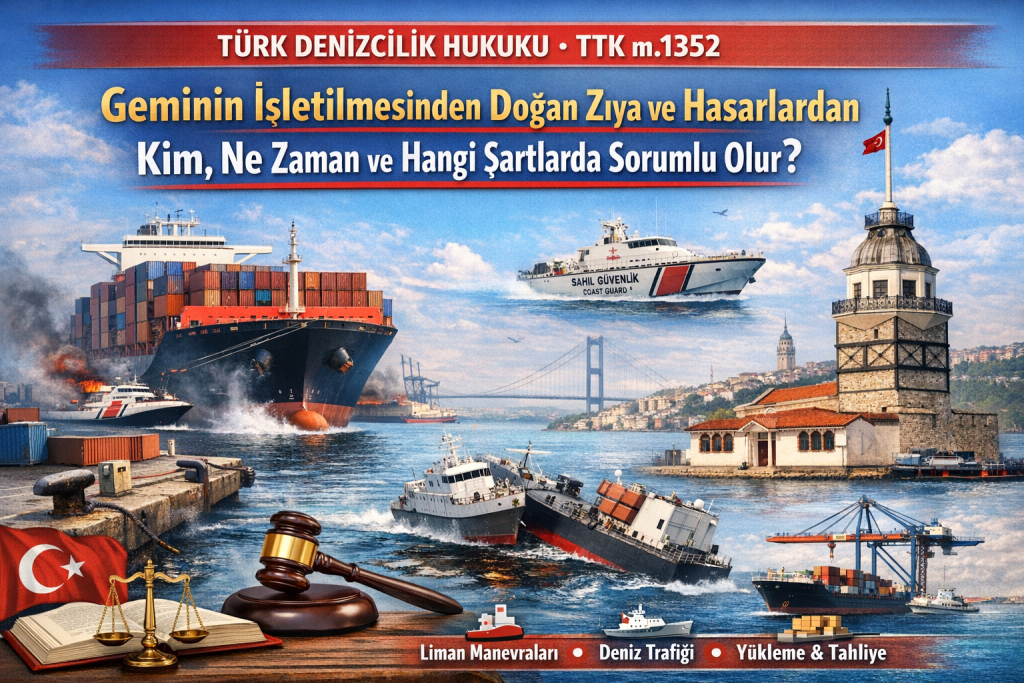
(Port Maneuvers, Maritime Traffic, and Loading-Unloading Damages under TCC Art. 1352)
This article explains in which cases material damages arising from the operation of a ship under Article 1352/1-a of the Turkish Commercial Code are attributed to the shipowner, operator, and master, in light of Supreme Court and Regional Court of Appeals decisions.
Introduction
According to Article 1352/1-a of the Turkish Commercial Code (TCC), losses or damages caused by the operation of a ship; include material damages inflicted upon the ship itself, the cargo, or third parties (such as piers, quays, other ships, etc.) during ship operation activities. The following analysis examines these damages based on concrete court decisions concerning port maneuvers, maritime traffic, and loading-unloading processes.
1. Losses and Damages Arising from Port Maneuvers
Collisions and cracks occurring during a ship’s berthing, departure from the quay, or entry to a mooring point are the most common ship operational faults encountered in court decisions.
Damages to Docks and Piers: The 11th Civil Chamber of the Court of Appeals (2012/14912 E., 2014/4299 K K.) has deemed the damage caused by a ship colliding with a concrete dock during a berthing maneuver as a risk arising from ship operation. Similarly, a tanker damaging pier piles during berthing (Court of Appeals 7th Civil Chamber 2012/1795 E. K), a ship damaging a waterfront mansion’s pier and lighting system due to rapid berthing (Court of Appeals 11th Civil Chamber 2015/7972 E. ), and the fenders on the pier being torn apart during maneuvering (Court of Appeals 11th Civil Chamber 2011/3479 E. K) have been evaluated within this scope.
Damages to Port Equipment: Ship operation activities can cause damage not only to fixed structures but also to vehicles within the port. In the decision of the 11th Civil Chamber of the Court of Appeals (2011/10687 E. ), a ship making an erroneous maneuver colliding with a loader on the dock; and in another decision (2015/2399 E. ), a ship leaning against and damaging a port crane during berthing were accepted as the responsibility of the shipowner. Particularly, in the decision numbered 2023/1262 E., the incident that caused two giant cranes (CB-4 and CB-5) to overturn and the port’s carrying system to suffer severe damage during a maneuver to depart from the port, is an example of a very large-scale material damage caused by ship operation.
Damages Caused to Other Vessels: This also includes collisions with other vessels moored in the port during maneuvering. In the decisions of the 11th Civil Chamber of the Supreme Court (2019/213 E. ) and (2016/14147 E. ), damages resulting from the vessel “Gagarin” colliding with the “Sea Mild” vessel moored at the pier during an erroneous docking maneuver were subject to compensation. Additionally, a motor yacht colliding with another yacht due to its engine stalling while entering its mooring spot in the marina was also deemed a fault in vessel operation (BAM 12. HD 2022/1705 E.).
2. Damages Arising from Maritime Traffic and Navigation Activities
Damages occurring during the vessel’s navigation or its activities in high-traffic areas such as strait passages are categorized under this heading.
Collision and Environmental Pollution: In the incident that was the subject of the 11th Civil Chamber of the Supreme Court’s decisions (2015/7089 E. and (2020/6988 E. ), the vessel “Gotia” collided with Emirgan Pier during its passage through the Istanbul Strait, resulting in both material damage to the pier and environmental pollution caused by fuel leaking into the sea after the vessel’s fuel tank was punctured. The court accepted this situation as damage arising from the operation of the vessel and held the owner and captain jointly and severally liable.
Navigation Errors: Damages caused to coastal structures (such as mansion piers, etc.) due to currents in the strait or the captain’s fault in command and control are considered a direct result of vessel operation (11th Civil Chamber of the Supreme Court 2011/311 E. ).
3. Damages Arising from Loading and Unloading Processes
Damages resulting from the ship’s stability being disturbed or equipment being used incorrectly during loading and unloading operations are covered by this.
Damages to the Ship’s Structure: In the decision of the Supreme Court 11th Civil Chamber (2014/9068 E. ) damage to the ship caused by the rolled sheet cargo rapidly striking the hold ceiling plate during unloading was evaluated within the scope of the ship’s personnel’s duty of supervision and care. In the decision of Istanbul 17th Commercial Court (2021/23 E.), the cargo inside the container falling into the sea and the ship’s hull being damaged during unloading was associated with ship operating activity.
Stability and Ballast Errors: In the decision of Istanbul 17th Commercial Court (2015/21 E. ) the ship listing to one side and damaging the rubber coatings of the fenders on the pier due to the ship’s captain incorrectly adjusting the ballast during cargo unloading was recorded as a specific type of damage arising from ship operation.
Cargo Damages: Damage to commodities during loading and unloading processes, such as getting wet or water leaking from hold bilge wells, is considered loss and damage within the scope of the carrier’s (operator’s) duty of care (Istanbul 17th Commercial Court 2020/69 E.).
4. Secondary Sources
The following points have been evaluated as secondary sources due to limited information in the decision texts or because they have not been finalized for procedural reasons:
Damages Caused by Port Operations to the Ship: In some incidents, the damage does not stem from the ship’s operation but from the faulty maneuver of a port crane operator. For example, liability can be attributed to the port authority in cases where a port crane collides with a ship’s crane during discharge (Supreme Court 11th Civil Chamber 2018/129 E.) or a port forklift damages cargo (Supreme Court 11th Civil Chamber 2011/11590 E.).
Force Majeure Defenses: Ship operators attempt to avoid liability by citing situations such as storms or strong winds as force majeure (Supreme Court 11th Civil Chamber 2016/14252 E. ). However, courts meticulously examine the impact of such conditions on the accident’s occurrence through expert reports.
Jurisdiction and Authority Disputes: In many port maneuver damage cases, courts find the Maritime Specialized Courts to have jurisdiction on the grounds that the dispute is subject to “Maritime Trade” provisions (İzmir 3rd Specialized Maritime Court 2025/962 E.; Istanbul 2nd Specialized Maritime Court 2023/230 E. K).
Accidents During Loading: In an incident where pipes rolled and damaged the quay and the sea during loading onto a ship, it became a matter of dispute whether the liability lay with a defect in the ship’s equipment (stanchions/bitts) or the fault of the stevedoring company (Supreme Court 11th Civil Chamber 2017/2383 E.).
Conclusion Court decisions consider all kinds of damages caused by collision, capsizing, leakage, and stability issues during port berthing/unberthing maneuvers, strait transits, and loading-unloading operations within the scope of “losses or damages caused by the operation of the vessel”. In determining liability, the fault of the crew in navigation and management, the condition of technical equipment, and operational errors stand out as decisive criteria.
Frequently Asked Questions
Limana yanaşma sırasında rıhtıma veya vinçlere verilen zarar geminin işletiminden sayılır mı?
Evet. Yargıtay içtihatlarına göre, geminin yanaşma-ayrılma manevraları doğrudan gemi işletim faaliyeti kabul edilir. Bu sırada rıhtım, iskele, vinç, yükleyici veya diğer liman ekipmanlarına verilen zararlar TTK m.1352 kapsamında donatanın sorumluluğundadır.
Boğaz geçişinde meydana gelen çarpma ve çevre kirliliğinden kim sorumlu olur?
Boğaz geçişleri, yüksek dikkat ve özen gerektiren seyir faaliyetleridir. Navigasyon hatası, sevk-idare kusuru veya teknik yetersizlik sonucu oluşan çarpma ve yakıt sızıntıları, geminin işletilmesinden doğan zarar sayılır ve donatan ile kaptan müteselsilen sorumlu tutulabilir.
Yükleme veya tahliye sırasında geminin stabilitesinin bozulması hasar doğurursa sorumluluk kime aittir?
Balast ayarının hatalı yapılması, yükün yanlış istiflenmesi veya gözetim eksikliği sonucu meydana gelen hasarlarda, gemi personelinin özen ve gözetim yükümlülüğü esas alınır. Somut olayın özelliklerine göre donatan, işleten veya yükleme firmasının sorumluluğu değerlendirilir.
Why is Expert Lawyer Support Necessary? (Istanbul)
Losses and damages arising from ship operations are not in the nature of an ordinary compensation lawsuit. Such disputes require;
Maritime Commercial Law,
Maritime claims and lien rights,
Provisional attachment – arrest of the vessel,
Expert reports (captaincy, maneuvering, stability, ballast, AIS records),
Port authority, coast guard, and traffic service records require multi-layered technical and legal evaluation. Especially in disputes observed in the Istanbul and Tuzla regions;
Strait transits,
Heavy port traffic,
Shipyards and dock areas,
Due to foreign-flagged vessels, cases often come before the Maritime Specialization Courts. At this point, 2M Law Firm highlights the importance of structuring the process correctly from start to finish, with İstanbul-based and Tuzla-focused practical experience in cases of loss and damages arising from ship operations, ship claims, and provisional attachment processes.
Incorrect legal qualification;
Initiating a lawsuit in the wrong court,
Loss of the right to a ship claim,
Rejection or lapse of provisional attachment,
may lead to inability to collect high-value material damages.