
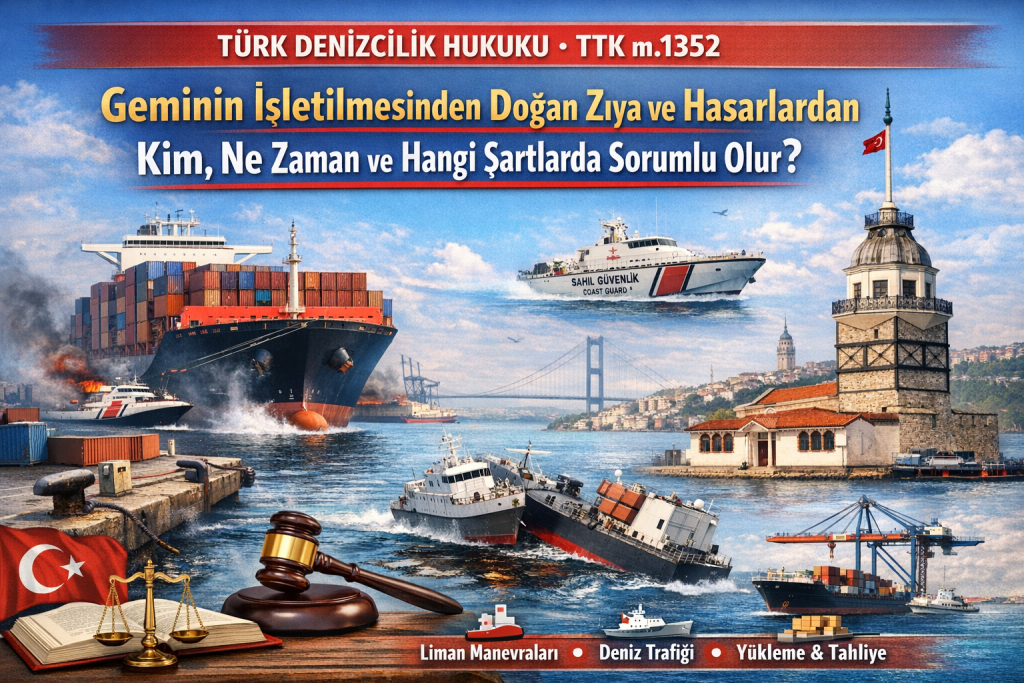
(Salvage Remuneration, Statutory Lien, and Provisional Attachment within the Scope of TCC Art. 1352/1-c)
This article discusses, in light of court decisions, why and under what conditions claims arising from salvage operations are considered a “maritime claim” under Article 1352/1-c of the Turkish Commercial Code No. 6102, as well as the associated statutory lien, provisional attachment, and forced execution mechanisms.
1. Legal Basis and Nature of Maritime Claim
Pursuant to Article 1352/1-c of the Turkish Commercial Code (TCC) No. 6102; the salvage of a ship or goods on board, salvage operations related to a ship or goods posing a threat of environmental damage, and special compensation claimed as a result of these activities are considered a “maritime claim”. These activities encompass not only the protection of property but also the prevention of environmental risks such as oil spills. Court decisions (e.g., Istanbul 17th Commercial Court of First Instance – 2014/1419 ) emphasize that the salvage service fee grants a “ship creditor’s right” under TCC Art. 1320/1-c and that this claim gives rise to a statutory lien on the ship.
Salvage remuneration is not an ordinary claim but **a strong real security right arising from law, in the nature of a “maritime claim”**. Salvage remuneration, in accordance with the Turkish Commercial Code, provides **a legal lien right that arises automatically without the need for registration**, and this right **follows the vessel** even if its ownership has changed. In other words, even if a maritime salvage claim arose against the vessel’s previous owner, this does not prevent the claim from being asserted **even if the subsequent owner acquired the vessel in good faith**. Salvage remuneration is **preferential** to all other claims, whether secured by pledge or mortgage or not, and can also be asserted against third parties in possession of the vessel. In this respect, salvage remuneration is not merely a service fee; it is considered **a type of claim with a strong public order aspect, providing a direct and superior right over maritime property**.
2. Collection and Security Methods Available to the Creditor
A. Provisional Attachment and Demand for Security The most frequently used method to secure the collection of a claim arising from salvage operations is the provisional attachment of the vessel.
Example of Application: In one case, the plaintiff institution requested provisional attachment for 9,000,000 USD; the court ordered attachment for 1,560,000 USD, and this decision was later transferred to a letter of guarantee (Istanbul 17th Commercial Court of First Instance-2014/1419).
Conditions: According to Article 1362 of the TCC, the creditor must prove that the claim is a maritime claim and provide evidence (prima facie proof) that convinces the court about its monetary value (Istanbul Regional Court of Justice 12th Civil Chamber-2021/181
B. Statutory Lien and Right of Retention
Pursuant to Articles 1315 and 1321 of the TCC, the salvor is entitled to a “statutory lien right” over the salvaged vessel and a “right of retention” over the salvaged goods.
Establishment of Lien Right: Courts can decide on the establishment of a statutory lien right over the vessel, limited to the determined amount of the claim and its ancillaries (Istanbul 17th Commercial Court – 2014/723
Priority: This right can be asserted against anyone in possession of the vessel, is a right acquired without registration, and takes precedence over many other claims (Supreme Court 17th Civil Chamber – 2010/3790
C. Action for Debt and Annulment of Objection The creditor may directly file an action for the determination and collection of salvage remuneration, or, in case of an objection to the enforcement proceedings initiated by them, may file an action for annulment of objection.
Determination of Remuneration: The Court, based on the criteria of TCC Article 1305 (or former TCC Article 1226) (value of salvaged property, degree of danger, effort expended, success rate), commissions an expert examination.
Collection Order: It is decided that the determined amount shall be collected with the highest interest rate applied by state banks on USD, in accordance with Article 4/a of Law No. 3095, effective from the date of the event or lawsuit (Istanbul 17th Commercial Court – 2021/446 A publication suggestion.
3. Liable Parties and Scope of Collection
Shipowner and Bareboat Charterer: According to TCC Art. 1306, the primary debtor for salvage remuneration is the shipowner. However, the bareboat charterer can also be held liable according to TCC Art. 1321/5.
Consignee: According to TCC Art. 1307/1, if the consignee knows that salvage remuneration will be paid when taking delivery of the goods, they will be liable for the portion corresponding to their share (Istanbul 17th Commercial Court – 2014/1419
Joint and Several Liability: In some cases, it is ruled that the bareboat charterer and the cargo owner are jointly and severally liable for the claim (Istanbul 17th Commercial Court – 2023/436
4. Forced Execution and Liquidation
The creditor can use the judgment obtained from the court to initiate an execution proceeding based on a judgment through the method of “liquidation of movable pledge” (TCC Art. 1380, EBL Art. 150/h). Holders of maritime liens receive a preferential share from the ship’s sale price. In the priority list, salvage claims generally rank as first-degree legal pledge creditors (Istanbul 17th Commercial Court – 2016/289
5. Secondary Sources and Additional Context According to information obtained from secondary sources;
The competent court for disputes arising from salvage operations is exclusively the Maritime Specialized Courts (such as Istanbul 17th Commercial Court). Cases filed in a court without jurisdiction are procedurally dismissed (Istanbul Anatolian 9th Commercial Court – 2016/745
In cases where the salvage fee is claimed recourse from the insurer, it is mandatory that the salvage operation has been reported to the official authorities and proven with concrete evidence (logbook entries, port documents); otherwise, claims may be rejected on the grounds that the burden of proof has not been met (Istanbul Regional Court of Justice 13th Civil Division-2019/154
In cases involving environmental pollution risk, public institutions (e.g.: Ministry of Environment) can collect intervention costs and compensation from the guarantees obtained by detaining the ship, based on the principle of strict liability in accordance with Article 28 of the Environmental Law (Istanbul 17th Commercial Court-2020/2
In malfunctions caused by shipyard fault, it is possible to file a recourse lawsuit against the shipyard for the salvage fee paid (Istanbul Anatolian 1st Commercial Court-2023/569
Frequently Asked Questions
Kurtarma faaliyeti her durumda deniz alacağı sayılır mı?
Hayır. Kurtarma faaliyetinin geminin veya gemideki eşyanın kurtarılmasına yahut çevre zararı tehdidinin önlenmesine yönelik olması gerekir. Bu şartlar mevcutsa, kurtarma ücreti TTK m.1352/1-c kapsamında açıkça deniz alacağı olarak kabul edilir.
Kurtarma ücreti için gemi ihtiyaten haczedilebilir mi?
Evet. Kurtarma ücretinden doğan deniz alacağı, gemi hakkında ihtiyati haciz talebine elverişlidir. Mahkeme, alacağın yaklaşık ispat edilmesi hâlinde hacze karar verebilir ve uygulamada bu haciz çoğu zaman teminat mektubuna kaydırılmaktadır.
Kurtarma alacağı gemi satışında öncelikli midir?
Evet. Kurtarma alacakları, kanuni rehin hakkı doğurduğundan, geminin cebri icra yoluyla satışında üst sıralarda yer alır. Uygulamada çoğu kez I. derece kanuni rehin alacağı olarak sıra cetveline yazılmaktadır.
Kurtarma ücreti, gemi satıldıktan sonra yeni gemi sahibine karşı da talep edilebilir mi?
Kurtarma ücreti, sıradan bir alacak olmayıp “gemi alacağı” niteliğinde, kanundan doğan güçlü bir aynî teminat hakkıdır. Kurtarma ücreti, Türk Ticaret Kanunu uyarınca tescile gerek olmaksızın kendiliğinden doğan bir kanuni rehin hakkı sağlar ve bu hak, geminin mülkiyeti el değiştirmiş olsa dahi gemiyi takip eder. Başka bir ifadeyle, gemi kurtarma alacağı, geminin eski malikine karşı doğmuş olsa bile, sonraki malik gemiyi iyi niyetle edinmiş olsa dahi bu alacağın ileri sürülmesine engel olmaz. Kurtarma ücreti, rehinle veya ipotekle teminat altına alınmış ya da alınmamış diğer tüm alacaklara önceliklidir ve gemiye zilyet olan üçüncü kişilere karşı da ileri sürülebilir. Bu yönüyle kurtarma ücreti, yalnızca bir hizmet bedeli değil; deniz serveti üzerinde doğrudan ve üstün bir hak sağlayan, kamu düzeni ağırlıklı bir alacak türü olarak kabul edilmektedir.
Why is Expert Lawyer Support Necessary? (Istanbul )
Claims arising from salvage operations are not a classic debt-credit relationship. These claims involve;
Correct determination of the nature of a maritime claim,
Joint application of the chain of Turkish Commercial Code Art. 1352 – 1320 – 1315 – 1321,
Approximate standard of proof,
Ship-specific precautionary attachment procedure,
Substitution with a letter of guarantee,
Priority disputes in the schedule of distribution,
Jurisdiction and security for foreign-flagged vessels,
It covers highly technical and error-intolerant areas such as parallel processes with public administrations in incidents involving environmental pollution risk. Especially in the Istanbul and Tuzla regions;
port salvage operations,
emergency interventions during strait transits,
salvage costs after shipyard-related malfunctions,
incidents involving environmental pollution risk are frequently brought before the Specialized Maritime Courts. At this point, 2M Law Firm emphasizes that providing specialized legal support is critical for salvage claims in terms of:
correct legal classification,
effective protection of the statutory lien right,
timely attachment of the vessel,
preventing the insufficient determination of security,
preventing the loss of priority of the claim during the sale and ranking list stage. A wrong strategy;
can lead to the rejection of provisional attachment,
insufficient determination of security,
the vessel being disposed of,
the claim falling to lower ranks in the ranking list, and ultimately the inability to collect million-dollar salvage remunerations.