Legal Framework and Definition of Maritime Claim
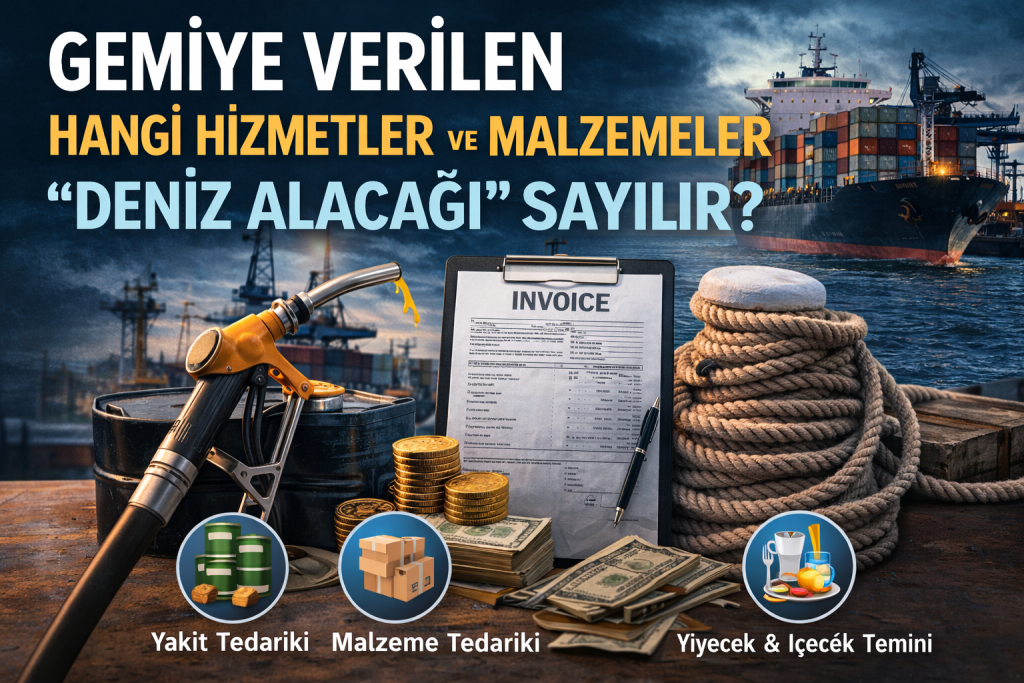
In accordance with Article 1352/1-l of the Turkish Commercial Code (TCC) numbered 6102; claims arising from goods, materials, provisions, fuel, equipment including containers, provided for the operation, management, protection, or maintenance of a ship, and from services rendered for these purposes, are considered “maritime claims”. Judicial decisions, addressing the scope of this provision across a wide range, evaluate all types of goods delivery and service performance made to enable the ship to continue its commercial activities in a seaworthy, voyage-ready, and cargo-worthy manner within this scope.
2. Concrete Applications Based on Service and Equipment Types
Provisions and Necessities: In the decisions of Istanbul Anatolian 2nd Civil Court of Commerce (2025/713 E. K) and Istanbul Anatolian 9th Civil Court of Commerce (2016/745 E. K); provision supply services such as fruit, vegetables, meat, food, and durable consumer goods delivered to the ship have been directly classified as a maritime claim under Article 1352/1-l of the TCC (Turkish Commercial Code). Istanbul 2nd Civil Court of Commerce (2016/710 E. K) also evaluated the catering service provided to the crew within this scope.
Fuel and Bunkering Supply: In the decisions of Istanbul Anatolian 5th Civil Court of Commerce (2020/418 E. K) and Istanbul Regional Court of Justice 17th Civil Chamber (2018/384 E. K), it has been confirmed that the costs of fuel and petroleum products supplied for the operation of the vessel constitute a maritime claim, and these claims can give rise to a maritime lien. The Supreme Court 11th Civil Chamber (1998/8202 E.) also stated that even in vessels subject to financial leasing, a fuel claim constitutes a maritime claim and gives rise to a statutory lien.
Maintenance, Repair, and Spare Parts: The Samsun Regional Court of Justice 3rd Civil Chamber (2024/1905 E.) and İzmir Regional Court of Justice 14th Civil Chamber (2023/1806 E.) have accepted maintenance, repair, and overhaul services provided in the shipyard as a maritime claim. Istanbul Anadolu 2nd Commercial Court of First Instance (2017/949 E. K) considered spare parts supplied to the ship, and Istanbul Anadolu 3rd Commercial Court of First Instance (2024/683 E.) evaluated special equipment and systems such as “towing pins” manufactured for the ship under Article 1352/1-l of the Turkish Commercial Code.
Mooring, Protection, and Port Services: Istanbul 14th Commercial Court of First Instance (2025/894 E.) deemed services under a yacht mooring contract as maritime claims within the scope of ship protection and maintenance. Istanbul 17th Commercial Court of First Instance (2019/435 E.) ruled that pier rental, electricity supply, occupational safety personnel, fire prevention, and mooring services provided while the ship was moored in the shipyard were essential services for the safe protection of the ship and ordered payment for them. A decision by the Competition Board (20-48/666-291) also emphasized that services such as towing, pilotage, and waste reception are essential for the safe navigation of the ship.
3. Competent Court and Procedural Considerations
In the vast majority of the reviewed decisions (e.g.: Istanbul 1st Commercial Court (ATM) 2018/408 E. Source, Istanbul 18th Commercial Court (ATM) 2020/247 E. ), in cases where the dispute constitutes a maritime claim under Article 1352/1-l of the TCC, it was emphasized that the case should be heard in the Commercial Courts acting as a Specialized Maritime Court, and decisions of lack of jurisdiction were rendered. However, the 45th Civil Chamber of the Istanbul Regional Court of Appeals (2023/1415 E.), by viewing the claim for compensation for damage occurring in a shipyard as falling under a general “contract for work” rather than maritime trade, indicated that the general courts were competent.
4. Responsibility and Exceptions
Owner and Charterer Distinction: In the decisions of Bandırma 1st Civil Court of First Instance (2014/596 E. Source) and the 11th Civil Chamber of the Court of Cassation (2018/5342 E. decisions), it was ruled that in cases where the charterer, not the owner, is responsible for repair, maintenance, and personnel expenses pursuant to agreements such as the “Gencon Charter Party”, these claims might not give rise to a maritime claim/lien against the owner.
Condition of Necessity: In some decisions of the 11th Civil Chamber of the Court of Cassation (2014/17666 E. 2023/556 E. ), it was stated that for expenses incurred by the captain to qualify as a ship claim, there must be a state of “necessity” and that these expenses must be essential for the preservation of the ship or the completion of the voyage, and that materials for daily consumption or preparation for a new voyage might not be considered within this scope.
Concrete Context: Antalya 4th Civil Court of Commerce (2023/23 E.) did not consider a dispute concerning merely a “sale of an engine block,” which was not specific to the vessel, within the scope of the vessel’s maintenance or preservation, and therefore did not deem it a maritime claim.
5. Secondary Sources Secondary sources provide the following additional contexts when there is limited information in the judgment texts:
TUGS and Tax Exemption: In a private ruling (08.01.2018), the importance of the tenant covering fuel, oil, maintenance-repair, and personnel expenses in bareboat charter agreements was emphasized in the context of operating profit and tax exemption.
Scope of Services: In the cases of Istanbul 17th Civil Court of Commerce (2017/344 E.) and the 6th Civil Chamber of the Supreme Court of Appeals (2021/1382 E.), it was argued that items such as electricity, water, fire watch, dry-docking, and quay waiting fees were essential for the preservation of the vessel; however, these cases were not concluded on their merits due to procedural reasons (deemed not filed or deficiencies in the expert report).
Post-Breakdown Expenses: The 11th Civil Chamber of the Supreme Court of Appeals (2009/3591 E.) accepted the tugboat, engine service, and survey report expenses incurred after a main engine breakdown as mandatory expenditures that the shipowner must pay, but made different assessments regarding whether these granted a legal lien right, depending on the evidentiary situation.
This report has been prepared within the framework of the presented court decisions and responses, and indicates that claims under Article 1352/1-l of the Turkish Commercial Code (TCC) cover a broad range of services and materials, but that contract terms and the state of necessity are meticulously examined by the courts regarding liability and the right of lien.
Gemiye verilen kumanya, yakıt ve günlük ihtiyaçlar deniz alacağı mıdır?
Evet. Yargı kararlarında; gemiye teslim edilen gıda, kumanya, meyve–sebze, et ürünleri, mürettebat yemek hizmeti, ayrıca yakıt ve akaryakıt tedariki açık şekilde deniz alacağı kabul edilmiştir. Hatta finansal kiralama konusu gemilerde dahi yakıt alacağı için gemi alacaklısı hakkı ve kanuni rehin tanınmıştır.
Why is Expert Legal Support Necessary?
Maritime claim files generate very technical disputes specifically concerning ports such as Istanbul, Tuzla, Tuzla Shipyard, Haydarpaşa, Ambarlı, Pendik, Aliağa.
If an incorrect legal classification is made:
The competent court is incorrectly chosen,
While there is a maritime claim, the right of lien is lost,
Provisional attachment and security processes become futile,
Debt collection is delayed for years. For this reason, working with a legal team that is proficient in maritime trade practices, understands port-shipyard operations, and closely follows jurisprudence is critically important. Especially in maritime disputes centered in Istanbul and Tuzla, 2M Law Firm ensures the correct management of the process with its specialized approach in maritime claims, provisional attachment of ships, and shipyard-related disputes.