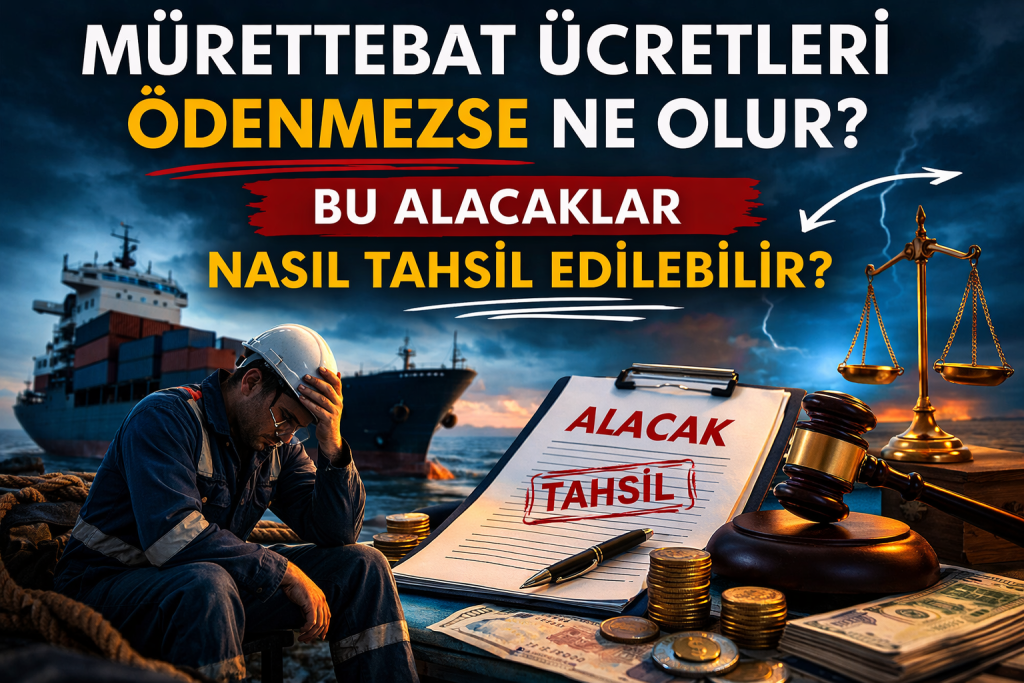
Despite seafarer wages, repatriation costs, and social security contributions being among the maritime claims with the strongest protection under the Turkish Commercial Code; in practice, these claims are frequently delayed or cannot be collected at all. The reason for this, despite the strong legal status, lies in critical errors such as the contract structure, the proof regime, and the incorrect identification of the responsible party.
1. Legal Framework and Definition of Maritime Claim
According to Article 1352/1-o of the Turkish Commercial Code (TCC) no. 6102; wages payable to seafarers for their work on board, repatriation expenses to their countries, and social security contributions payable on their behalf have been accepted as a “maritime claim.” These claims are also listed among the claims that grant a “maritime lien right” within the scope of TCC Article 1320/1-a, and they establish a statutory lien right on the ship.
2. Scope and Limits of Crew Claims
Judicial decisions limit the scope of the maritime claim concept to actual work and related legal obligations:
Wages and Other Payments: Seafarers’ salaries, bonuses, and other monetarily measurable rights related to working on board are included in this scope (Istanbul 17th Commercial Court – 2019/284 Decision).
Repatriation and Social Security: Repatriation expenses to their countries and social security contributions are explicitly included in the definition of a maritime claim (Supreme Court 9th Civil Chamber-2022/6018 D).
Exclusions: In the decision of Adana Regional Court of Justice 9th Civil Chamber (2022/1376 D), it was ruled that “wage claims related to the unworked months” after the unfair termination of the employment contract cannot be considered a maritime claim under Article 1352/1-o of the TCC and therefore cannot be subject to a precautionary attachment. Similarly, claims requiring litigation, such as annual leave pay, can be rejected on the grounds that they do not meet the condition of “prima facie evidence” at the precautionary attachment stage (Istanbul Regional Court of Justice 12th Civil Chamber-2019/207 Source).
3. Precautionary Attachment and the Prima Facie Evidence Condition
Crew wages, which constitute a maritime claim, allow for the precautionary attachment of the vessel (TCC Article 1353). At this stage, courts seek “prima facie evidence” instead of “full proof”:
Means of Proof: The “List of Sum Which Owner Must to Pay” (List of Amounts the Owner Must Pay), “Crew List”, employment contracts, and service documents, prepared by the ship’s master and bearing the ship’s seal, are considered sufficient for prima facie evidence (Court of Appeals 11th Civil Chamber-2015/12940 K, Istanbul Regional Court of Appeals 14th Civil Chamber-2022/221 K).
Master’s Authority: Pursuant to Article 1109/1 of the Turkish Commercial Code (TCC), receivable confirmation documents signed by the master on behalf of the shipowner are considered binding on the shipowner (Istanbul Regional Court of Appeals 43rd Civil Chamber-2022/275 K).
Sister Ship Arrest: For crew claims, pursuant to Article 1369/2 of the TCC, a precautionary arrest may also be placed on “sister ships” belonging to the debtor (Istanbul Regional Court of Appeals 43rd Civil Chamber-2022/267 K).
4. Liability and the Shipowner’s Status
As a rule, the shipowner is responsible for the wages of the crew members. However, the contractual relationships in the specific case may alter this situation:
Bareboat Charter: Pursuant to Article 1127 of the TCC, in the case of a bareboat charter, the debts arising from the employment of the crew belong to the charterer. In this case, the shipowner (if they do not hold the title of disponent owner) cannot be held liable for wage claims (Istanbul Regional Court of Appeals 43rd Civil Chamber-2020/1498 K, Istanbul 17th Civil Court of Commerce-2018/51
Ship Management Contractor: In ship management agreements (Shipman98 etc.), if the operator does not have personnel management authority and the service contract is made directly with the owner, the operator is not held responsible for the fees (Court of Cassation 11th Civil Chamber-2012/361
5. Distinction Between Competent Court and Flag State
The court where the dispute will be resolved is determined according to the flag of the ship and the scope of the law:
Turkish Flagged Vessels: Under the Maritime Labour Law No. 854 (vessels over 100 gross tons), disputes are heard in Labour Courts (Istanbul Regional Court of Justice 43rd Civil Chamber-2024/481
Foreign Flagged Vessels: The Maritime Labour Law does not apply; the dispute is subject to general provisions within the framework of a service contract. According to the decisions of the Court of Cassation 11th Civil Chamber and 17th Civil Chamber, since these receivables are in the nature of ship claims/maritime claims, Maritime Specialized Courts (or Commercial Courts of First Instance in this capacity) are competent (Court of Cassation 17th Civil Chamber-2014/14640 , Court of Cassation 11th Civil Chamber-2013/13472. However, in some recent Regional Court of Justice decisions, there are also evaluations that the service relationship on foreign-flagged vessels falls within the scope of the Code of Obligations and that Labour Courts are competent (Adana Regional Court of Justice 9th Civil Chamber-2024/278
Conclusion: Pursuant to Article 1352/1-o of the Turkish Commercial Code, crew wages, repatriation costs, and social security contributions are undeniably maritime claims. These claims provide a statutory lien on the vessel and form the basis for the provisional attachment of the vessel (or sister vessels) under the condition of approximate proof. However, the transfer of responsibility to the charterer in bareboat charter agreements and the variability of the competent court based on the vessel’s flag are critical factors that need to be considered in practice.
Yabancı bayraklı gemide çalışan mürettebat alacağı nerede takip edilir?

Yabancı bayraklı gemilerde en sık yapılan hata yanlış mahkemede dava açılmasıdır. Türk Bayraklı gemilerde Deniz İş Kanunu ve İş Mahkemeleri gündeme gelirken; yabancı bayraklı gemilerde uyuşmazlık çoğu zaman deniz alacağı niteliğiyle Denizcilik İhtisas Mahkemelerinde görülür. Ancak bazı BAM kararları Borçlar Kanunu–İş Mahkemesi yönünde değerlendirme yapabildiğinden, görev hatası davanın usulden reddine neden olabilir.
Mürettebat maaşı deniz alacağıysa neden hâlâ ödenmiyor?
TTK m. 1352/1-o uyarınca mürettebat ücretleri açıkça deniz alacağıdır ve TTK m. 1320 kapsamında gemi alacaklısı hakkı (kanuni rehin) verir. Ancak uygulamada sorun, alacağın varlığından değil; kimin sorumlu olduğunun yanlış tespit edilmesinden kaynaklanır. Özellikle çıplak gemi kira sözleşmelerinde (bareboat charter), maaş borcu donatanda değil kiracıda olabilir. Yanlış kişiye yöneltilen talepler, alacağın fiilen sonuçsuz kalmasına yol açar.
Why is Expert Lawyer Support Necessary?
Although crew claims are among the strongest claims in theory, in practice, they are among the fastest to diminish. This is because in these claims:
Wrong distinction between owner / charterer
Incomplete approximate proof
Incorrect provisional attachment strategy
Choosing the wrong competent court alone can render the claim completely fruitless.
Especially in Istanbul, Tuzla, Tuzla Shipyard, Ambarlı, Pendik and other major ports; ships’ stays in port are short, personnel changes are rapid, and flag-company structures are complex. For this reason, crew claims should not be pursued with the logic of classic labor claims, but with reflexes specific to maritime commercial law.
At this point, 2M Hukuk Law Firm, which has extensive practical experience in maritime claims, provisional ship arrest, and crew wages, stands out among law firms in the Istanbul and Tuzla port regions for the rapid securing and collection of such claims.