Legal Basis: Law No. 6306, Article 6/3, 7/6 | Implementation Regulation, Article 13, 16/7
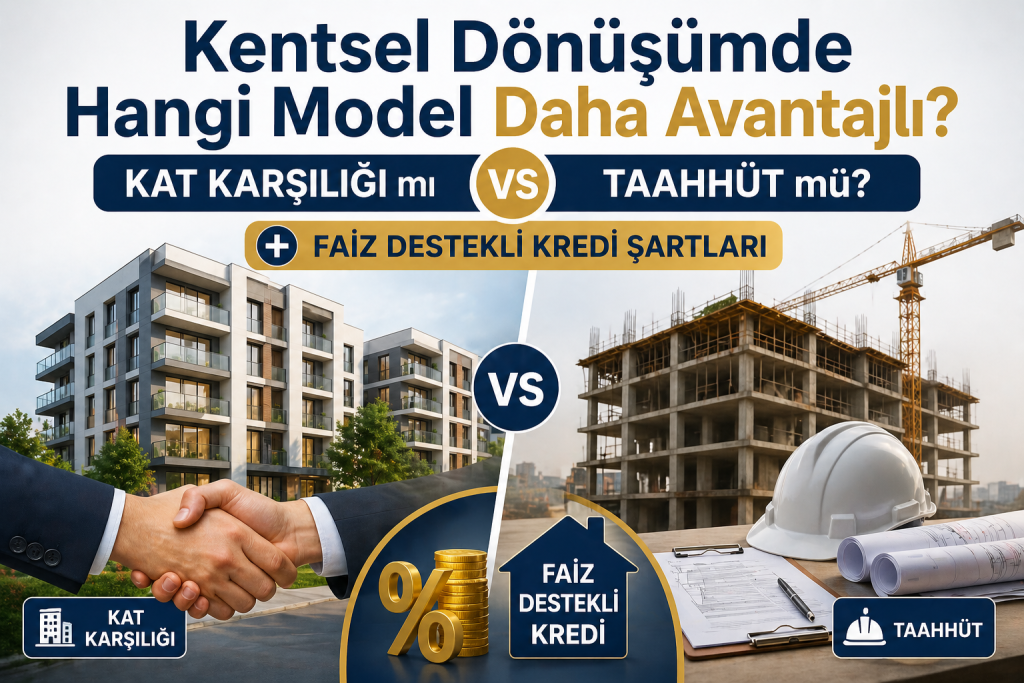
Every property owner undergoing urban transformation has two fundamental construction financing models: Revenue-Sharing Construction Contract and Reconstruction by Direct Contract. These two models are not merely technical construction choices; they are two distinct legal and financial paths that fundamentally differ from each other in terms of title deed transfer, right to rent assistance, use of interest subsidy, risk distribution, and contract guarantee. If this choice is made incorrectly, it can lead to irreversible consequences. This article comprehensively addresses the differences between the two models, which one is more advantageous for whom, and the conditions, procedures, and current figures for 2026 of the interest-subsidized loan offered by the state. (Law Art. 6/3, 7/6 — Reg. Art. 13, 16/7)
First Model: Revenue-Sharing Construction Contract
In a flat-for-land-share construction contract (land share for construction contract), the owner transfers a certain portion of their land or land share in an existing independent section to the contractor; the contractor undertakes the construction in exchange for this land share and profits by selling the independent sections falling to their share after completing the project. (K. Art. 6 — Y. Art. 13)
In this model, the owner does not need to pay cash for construction; the contractor covers the construction costs. In return, the owner loses a certain “share” of their land but obtains their apartment in the new building without spending cash. The vast majority of urban transformation in Istanbul is realized with this model.
The main advantages of the flat-for-land-share model are: The owner has no construction financing problem; the contractor covers all costs. During the transformation process, one is exposed to the least cash burden. After the contract is signed, expenses such as municipal fees, notary fees, and stamp duty are within the scope of exemption. As there is no need to use interest-supported loans, rental assistance can be preferred.
The risks are: There is a risk of losing the title deed in case of contractor bankruptcy or abandonment; the obligation of building completion insurance is critically important here. The land share is lost; if an increase in zoning cannot be achieved, the area the owner will possess in the new building may decrease. Contractor quality and contract assurance are decisive. (K. Art. 6/6 — Y. Art. 13/9ğ)
Second Model: Reconstruction by Contract (Commitment Method)
In the contracting method, the owner personally covers the construction costs; pays a construction company for the work and, upon completion of the building, receives all independent sections without losing their land share. No title deed transfer is made to the contractor. (Y. Art. 13)
The main advantages of this model are: The land share is not forfeited; when construction is completed, the entire building belongs to the owners. The title deed risk arising from the contractor’s bankruptcy is much more limited; a progress payment system can be established based on payment stages. This model can be preferred in smaller projects or when existing contractor offers are insufficient. The project can proceed more transparently and under control.
Its risks, however, are: Serious cash financing is required; the state’s interest-subsidized loan mechanism is designed precisely to meet this need. Costs may be higher because the contractor prices their own profit margin. The coordination burden lies with the apartment owners.
Comprehensive Comparison of the Two Models
| Criterion | Revenue Sharing Model | Contracting Method |
|---|---|---|
| Construction financing | Contractor covers | Owner covers |
| Land share transfer | A specific percentage is transferred | No transfer is made |
| Cash requirement | None (or very little) | High |
| Need for interest-subsidized loan | Generally not required | Generally required |
| Rent assistance | Can be preferred | Interest subsidy or rent assistance |
| Contractor bankruptcy risk | Medium-high (title deed transfer exists) | Lower (no title deed transfer) |
| Building completion insurance | Mandatory | Less critical |
| If there is no zoning increase | Contractor may request an additional fee | No loss of land share |
| Contract complexity | High | Medium |
| Property guarantee | Riskier | Safer |
| Suitable situation | Projects with increased development rights | Small projects where land share is desired to be preserved |
State’s Interest-Subsidized Loan: Legal Basis
Paragraph 6 of Article 7 of Law No. 6306 has stipulated that interest support can be provided by the Ministry of Environment, Urbanization and Climate Change for loans to be used from banks by those who wish to construct or acquire their residence or workplace with their own means. The procedures and principles regarding interest support are determined by Presidential Decree; the Ministry implements this support through public banks with which it has signed protocols within this framework. (Law Art. 7/6 — Reg. Art. 16/7)
Article 16 of the Implementing Regulation clearly stipulates that interest support and rent assistance cannot be received together: Those who benefit from rent assistance cannot benefit from interest support, and those who benefit from interest support cannot benefit from rent assistance. (Reg. Art. 16/7)
Who Can Use the Loan? Eligibility Conditions
The persons who can benefit from the interest-supported urban transformation loan are as follows: (Law Art. 7/6 — Reg. Art. 16/7)
Real or legal person owners holding any share in a building located in a risky area or identified as a risky structure; tenants residing in the said building for at least 1 year; and squatter house rights holders may also be evaluated within the scope determined by the Ministry.
Eviction by agreement is a prerequisite. It is mandatory that the building has been identified as a risky structure by a technical report. The loan application must be made no later than one year from the date of eviction; if this period is exceeded, the right to benefit from interest support is lost. (Law Art. 7/6 — Reg. Art. 16/7)
Banks Where Applications Can Be Made
The main banks that have signed a protocol with the Ministry and provided interest-subsidized urban transformation loans as of 2026 are as follows:
Ziraat Bank, Halkbank, Vakıfbank, Ziraat Participation Bank, Vakıf Participation Bank, Emlak Participation Bank. For a complete and up-to-date list, it is recommended to review the list of protocol banks on the official page of the Urban Transformation Presidency at altyapi.csb.gov.tr; the Ministry may sign protocols with new banks. (Law Art. 7/6)
2026 Interest Support Rates, Loan Limits, and “Half from Us” Campaign — Istanbul Current Table
A) Standard 6306 Interest-Subsidized Loan (All of Turkey)
| Loan Type | Maximum Loan Amount (Per Independent Unit) | Maximum Total (Up to 5 Units) | Maximum Term |
|---|---|---|---|
| Housing construction / acquisition | 1.250.000 TL | 3.000.000 TL | 120 months (10 years) |
| Housing reinforcement | 320.000 TL | 1.600.000 TL | 120 months (10 years) |
| Workplace loan | Determined per unit | Variable | 84 months (7 years) |
Repayment: Starts 2 years after the building permit. No interest in the first year; in subsequent years, an update is made equal to half of the CPI. Income and credit score requirements are not sought.
B) Half From Us Campaign — Only Istanbul 39 Districts (Last Application: December 31, 2026)
Within the scope of the Half From Us campaign, a total of 1,875,000 TL support is offered for each residence, with amounts updated in April 2025, comprising an 875 thousand TL grant, an 875 thousand TL loan, and 125 thousand TL relocation support. E
| Support Item | Residence (Per Independent Unit) | Workplace (Per Independent Unit) |
|---|---|---|
| Grant (non-repayable) | 875.000 TL | 437.500 TL |
| Loan (repayable, CPI/2 updated) | 875.000 TL | 437.500 TL |
| Relocation / Evacuation Support (one-time) | 125.000 TL | 125.000 TL |
| Total Support Package | 1.875.000 TL | 1.000.000 TL |
An additional loan opportunity of 1,750,000 TL is also offered for each additional residence of the entitled person. A
C) Area-Based Transformation (TOKİ / Emlak Konut — Site Model)
In large-scale area-based transformations, while TOKİ or Emlak Konut undertakes the construction, each right-holder is provided with a grant of 875 thousand TL and relocation support of 125 thousand TL. The grant amount is deducted from the building cost; the remaining debt is paid in long-term installments. M
| Support Item | Amount |
|---|---|
| Grant | 875.000 TL |
| Relocation Support | 125.000 TL |
| Loan | Installments based on building cost |
D) Eviction Support for Tenants under the “Half from Us” Program
Tenants cannot directly benefit from grant and loan support; however, in case of evacuation of a risky structure, they can benefit from 125,000 TL eviction support.
E) Campaign Latest Status (2026)
With the Presidential Decree of February 27, 2026, the requirement for establishing floor servitude has been lifted; all independent sections for which risky building identification has been completed by December 31, 2026, will be able to benefit from the campaign. Although no official decision regarding the extension of the campaign has been announced as of April 2026, the deadline of December 31, 2026, remains valid.
Summary Difference Table: Standard Loan vs. Half from Us
| Criterion | Standard 6306 Interest-Subsidized Loan | Half From Us (Istanbul) |
|---|---|---|
| Grant component | None | 875,000 TL (non-repayable) |
| Loan limit | 1,250,000 TL | 875,000 TL |
| Relocation support | None | 125,000 TL |
| Total support | Loan only | 1,875,000 TL |
| Geographical scope | All of Turkey | Only Istanbul 39 districts |
| Application deadline | Within 1 year of evacuation | 31.12.2026 |
| Tenant relocation | Under Standard Article 16/3 | 125,000 TL additionally |
| Additional energy identity support | Available (A: +1%, B: +0.5%) | Not Applicable |
2026 Interest Subsidy Rates and Loan Limits
Interest subsidy rates and maximum loan amounts are determined by Presidential Decree and are subject to updates. The figures valid as of 2026 are as follows:
| Loan Type | Maximum Loan Amount (Per Independent Unit) | Maximum Total (Multiple Units) | Maximum Term |
|---|---|---|---|
| Housing construction / acquisition | 1.250.000 TL | 3.000.000 TL (up to 5 units) | 120 months (10 years) |
| Retrofit loan | 320.000 TL | 1.600.000 TL (up to 5 units) | 120 months (10 years) |
| Commercial property loan | Determined per independent unit | Varies according to multiple units | 84 months (7 years) |
Interest Support Rates (Halkbank 2026):
| Residential Unit Number | Ministry Interest Support (Annual) |
|---|---|
| First housing unit | %8,4 |
| Second and subsequent housing units | %7,2 |
| Additional for buildings with B-class energy identity certificate | +%0,5 (50 basis points) |
| Additional for buildings with A-class energy identity certificate | +%1,0 (100 basis points) |
These supports reduce the net loan cost for the beneficiary by being deducted from the market interest rate applied by the bank. The state does not pay the interest support directly to the beneficiary; it lowers the installments by reflecting it to the bank.
Loan Repayment Schedule: Significant Advantage
The most critical advantage of interest-subsidized urban transformation loans is the deferment of repayments. Loan repayments begin 2 years after the construction permit is obtained. During this 2-year deferment period, both the new construction is completed and the temporary accommodation expenses of the rightful owner are alleviated. No interest is applied in the first year repayments begin. In subsequent years, an adjustment equal to half of the CPI rate is made. (Law Art. 7/6)
To illustrate this with figures: A 1,250,000 TL loan is repaid with monthly installments over a 10-year term, starting 2 years after the permit date. Compared to market interest rates, the difference in monthly installments due to Ministry support varies depending on the bank and conditions, and this difference can reach hundreds of thousands of liras in the long term.
Step-by-Step Application Process
The procedure for using interest-subsidized loans consists of several stages and requires coordination between the Ministry and the bank.
The first stage is the finalization of the hazardous structure determination. To apply for a loan, a hazardous structure annotation must be registered in the land registry, and the determination must be finalized. (Law Art. 3/1 — Regulation Art. 7/4)
The second stage is eviction by agreement. It is mandatory for the structure to be evicted by agreement. Difficulties may be encountered in loan applications for structures vacated through forced eviction. (Regulation Art. 16/7)
In the third stage, the rightful owner applies individually to the protocol bank they have chosen. The bank evaluates the application within the framework of the protocol provisions and its own lending regulations. The bank does not require income or credit score; however, it reserves the right to assess repayment capacity. (Law Art. 7/6)
In the fourth stage, the bank notifies the Ministry of the list of beneficiaries it deems eligible for a loan. The Ministry evaluates the application under the scope of 6306 and informs the bank who will benefit from interest support.
In the fifth stage, the loan is released after Ministry approval. Payment stages occur gradually according to construction progress: at the start of construction, when the load-bearing system is completed, at the plastering stage, and when the occupancy permit is obtained.
Required Documents for Application
Protocol banks generally request the following documents: Valid identity document; risk assessment report for the building and a document showing the annotation in the land registry; title deed (land registry document); document indicating eviction by agreement or eviction record; construction permit or application document (for housing construction loans); income statement or declaration of ability to pay; project and contract document (for commitment-based procedures). Additional documents may be requested from bank to bank; it is recommended to obtain an updated document list from the relevant bank branch before applying.
Energy Performance Certificate Advantage: Additional Interest Support
The energy performance class of the new building directly affects the amount of interest support. If an A-class energy performance certificate is obtained, the Ministry adds an additional support of 100 basis points (one percent) to the interest support; for B-class, this additional support is 50 basis points. To benefit from this advantage, it is essential that the building design meets energy saving requirements during the project phase. Therefore, energy performance certificate consultancy gains importance during the project process.
Two Models and Government Support: Combined Decision Matrix
| Situation | Recommended Model | Rent Assistance or Interest Support? |
|---|---|---|
| There is an increase in Floor Area Ratio, zoning conditions are good | Flat-for-Land Agreement | Rent assistance |
| No increase in Floor Area Ratio, small land share | Commitment-based (Fixed-Price) Method | Interest support |
| Low contractor reliability | Commitment-based (Fixed-Price) Method | Interest support |
| Sufficient cash reserve | Both models | Rent assistance |
| There are multiple independent units | Flat-for-Land Agreement | Rent assistance (for each unit) |
| Large plot, significant increase in Floor Area Ratio | Flat-for-Land Agreement | Rent assistance |
| Small building, few owners | Commitment-based (Fixed-Price) Method | Interest support |
| Construction period estimated to be short | Commitment-based (Fixed-Price) Method | Interest support |
| Risky area (48 months rent) | Flat-for-Land Agreement | Rent assistance |
Frequently Made Mistakes
Attempting to change the model preference after the contract is signed: Switching from a flat-for-land agreement to a commitment-based method after the flat-for-land contract is signed creates major legal complications. It is essential to clarify the model preference before contractor selection.
Applying for interest support and then requesting rent assistance: The two supports are mutually exclusive; having applied for interest support eliminates the right to rent assistance. (Reg. Art. 16/7)
Applying for a loan one year after the eviction date: In this case, the right to benefit from interest support is lost; the loan must be utilized under market conditions.
Determining a low land share ratio in a land-for-flat agreement: The higher the share transferred to the contractor, the less area the owner can obtain from the new building. Agreements signed without market research lead to long-term grievances.
Signing a contract without building completion insurance: In the land-for-flat model, it is mandatory for the contractor to obtain building completion insurance before receiving a construction permit. Signing a contract without this guarantee means being completely vulnerable to contractor bankruptcy. (Law Art. 6/6 — Reg. Art. 13/9g)
Practical Advice
Do not choose a model before learning your zoning status. Be aware that neither the model nor the contractor’s offer can be realistically evaluated without knowing your building’s current and potential new construction conditions — such as precedent, floor height, and parcel size.
Consult multiple offers. In the land-for-flat model, compare land share ratios by obtaining offers from different contractors; in the commitment method, obtain square meter price offers from different construction companies.
Have the contract reviewed by a lawyer. Contracts for both models are extremely complex. The land share ratio, delivery date, penalty for delay, building completion insurance, allocation of independent sections, payment schedule, and termination conditions must definitely be reviewed by an urban transformation lawyer.
Apply for interest support immediately after evacuation. To avoid missing the one-year period, initiate the application process as soon as the evacuation occurs; also, factor in the additional time required for the energy performance certificate during the planning phase.
Why is Expert Lawyer Support Necessary?
The choice of model and financing decision is the most crucial step in the urban transformation process and forms the basis of all subsequent legal relations. As 2M Hukuk Avukatlık Ofisi, in the urban transformation consultancy process we conduct throughout Istanbul, especially in Tuzla, we observe the following:
Construction for land share agreements often contain provisions against the owner: low penalty clauses applied in case of delay, broad termination rights granted to the contractor, ambiguities in the allocation of independent sections. An urban transformation lawyer can review these agreements before they are signed, ensuring the addition of clauses that protect the owner’s interests or identifying and correcting erroneous provisions.
The payment certificate system in the commitment method, the agreement between you and the bank, and the contract to be made with the contractor each require separate legal evaluation. For tracking the interest support application with the bank, monitoring the Ministry’s approval process, and effectively utilizing the appeal process in case of application rejection, the support of an Istanbul urban transformation lawyer plays a decisive role.
Legal mechanisms to be activated in case of contractor delay or bankruptcy in the flat-for-land model — building completion insurance application, administrative termination request, title deed return — should also be managed in a coordinated manner by the same urban transformation lawyer. 2M Law Office, which accompanies you through all these stages as part of urban transformation consultancy, provides services throughout Istanbul as a Tuzla lawyer.
Conclusion
The choice between flat-for-land and commitment-based models in urban transformation construction is shaped by factors such as zoning status, land share size, contractor reliability, and cash needs. In the flat-for-land model, cash is not required, but the land share is lost; in the commitment-based model, there is no land loss, but construction financing is needed, and at this point, the state’s interest-subsidized loan comes into play. Interest support is provided with a Ministry contribution ranging from 7.2% to 8.4% annually, for up to 1,250,000 TL per independent unit, with a 120-month maturity; payments start 2 years after the building permit. Rent assistance and interest support cannot be used simultaneously; this choice must be made before evacuation. (Law Art. 6/3, 7/6 — Reg. Art. 13, 16/7)
This article has been prepared based on Law No. 6306 (Art. 6/3, 7/6) and its Implementing Regulation (Art. 13, 16/7), as well as the current loan pages of the Urban Transformation Presidency, Ziraat Bank, Halkbank, and Vakıfbank, and open-source data as of April 2026. Interest support rates and loan limits can be determined and updated by Presidential Decree; please confirm the current conditions with the relevant bank before applying.