Introduction
This study presents an analysis of the decisions of the Constitutional Court, Council of State, Regional Administrative Courts, and the Court of Jurisdictional Disputes concerning the detention periods of foreigners held under administrative supervision in repatriation centers (GGM), their fundamental rights during this process, conditions for release, alternative measures to administrative supervision, and procedures for the notification of decisions. The study aims to provide a holistic perspective by compiling the relevant legal framework and judicial precedents for lawyers to use in their legal research.
Detention Period: The period of administrative supervision cannot exceed six months as a rule. However, this period can be extended for a maximum of six additional months due to reasons such as the foreigner’s lack of cooperation or failure to provide accurate information about their country.
Periodic Review: The Governorship is obliged to regularly evaluate each month whether administrative supervision should continue. Foreigners for whom continued supervision is not deemed necessary are immediately released.
Fundamental Rights: Persons under administrative detention have fundamental rights guaranteed by law, such as access to a lawyer, free legal aid, an interpreter, free emergency and basic healthcare services, and meeting with family and consular officials. However, in some decisions, it has been determined that the living conditions, especially, amounted to “treatment incompatible with human dignity.”
Release and Alternative Measures: Administrative detention can be terminated by a governorate’s assessment or a decision of the Criminal Judgeship of Peace. For persons released, alternative measures to administrative detention such as “residing at a specific address”, “reporting (signature obligation)”, “security”, and “electronic monitoring” can be applied.
Notification Procedure and Seeking Redress: It is mandatory to notify the foreigner or their lawyer of all decisions (administrative detention, extension, monthly assessment) along with their justifications. It is essential that the notification be made in a language the person understands and through an interpreter, and include information about appeal procedures and deadlines. An irregular or unmade notification prevents the commencement of preclusive application periods.
1. Period of Detention at Removal Centres, Extension, and Assessment
Judicial decisions clearly define the framework for administrative detention periods, with reference to Law No. 6458 on Foreigners and International Protection. As a rule, “The period of administrative detention in removal centres cannot exceed six months.” (Court of Jurisdictional Disputes, 2022/385; Constitutional Court, 2/5/2019). Exceeding this period is only possible in exceptional circumstances.
Conditions for Extension: The extension of the period is not arbitrary and is subject to specific conditions. This situation is explained in decisions with the provision, “…in cases where deportation procedures cannot be completed due to the foreigner’s lack of cooperation or failure to provide accurate information or documents regarding their country, it can be extended by a maximum of six months.” (Court of Jurisdictional Disputes, 2023/625; Constitutional Court, 16/1/2020). This indicates that the total period can be a maximum of twelve months.
Monthly Assessment Requirement: Whether the continuation of administrative detention is a necessity must be assessed by the governorship “regularly every month” (Council of State, 16.11.2020; Court of Jurisdictional Disputes, 2022/225). Failure to perform this assessment or to notify the individual of its results constitutes a ground for the annulment of the administrative detention decision. Indeed, a decision by the Constitutional Court cited the Criminal Judgeship of Peace’s decision to “…annul the detention decision… as it was understood that there was no decision regarding its extension… despite the requirement to extend administrative detention every month from the date of the administrative detention decision…” (Constitutional Court, 7/2/2019).
2. Fundamental Rights Under Administrative Detention
The decisions detail the fundamental rights of individuals under administrative detention.
Right to Lawyer, Interpreter, and Information: The foreigner’s “right to access and meet with relatives, a notary public, legal representative, and a lawyer” is a fundamental guarantee (Constitutional Court, 2/5/2019). Additionally, legal aid is provided upon request to those who cannot afford legal fees (Court of Jurisdictional Disputes, 2022/225). The right to an interpreter is critically important, especially during the processes of taking statements and serving decisions.
Healthcare Services and Humane Accommodation Conditions: For foreigners who cannot afford the cost, “emergency and essential healthcare services are provided free of charge” (Constitutional Court, 2/6/2020). However, especially in decisions regarding the period before Law No. 6458, the inadequacy of accommodation conditions has been severely criticized. The Constitutional Court has ruled that detention conditions, due to reasons such as overcrowding, lack of hygiene, and limited access to open air, constitute “treatment incompatible with human dignity” (Constitutional Court, 20/1/2016; Constitutional Court, 17/2/2016).
Communication and Visitation Rights: Access to telephone services, and the opportunity to meet with family members, consular officials, and a United Nations High Commissioner for Refugees officer are also among the rights recognized by law (Constitutional Court, 6/10/2022).
3. Release and Alternative Measures to Administrative Detention
Administrative detention is a measure that should be applied as a last resort. Release is possible both as a result of monthly evaluations by administrative authorities and by court order. In many decisions, the Magistrate Criminal Court is observed to have lifted the administrative detention decision upon objection and released the person (Constitutional Court, 20/4/2020; Constitutional Court, 29/12/2021).
When administrative detention is terminated or never applied, alternative obligations may be imposed on the foreigner. These measures include;
Residing at a specific address,
Reporting in the manner and periods to be determined (signature obligation),
Depositing security (bail/guarantee),
Electronic monitoring
such practices are included (Court of Jurisdictional Disputes, 2020/651; First Instance, 2020/359).
4. Notification of Decisions and Protection of the Right to Seek Justice
The notification procedure is the most fundamental guarantee for the exercise of the right to seek justice. Judicial decisions show sensitivity regarding the form and content of the notification.
Language and Comprehensibility: It is not sufficient for the notification to be only in the person’s native language. As emphasized in a decision by the Izmir Regional Administrative Court, regarding the consequences of the sanction, appeal procedures, and deadlines, it was stated that a notification “made solely in their own language without being informed in a language they understand… is contrary to the method of additionally informing the foreigner in a language they understand” (Izmir RAMC, 06.04.2017).
Results of Notification: Peremptory periods, such as those for filing a lawsuit, do not begin to run without proper notification. Courts have ruled that in cases of improper notification, the period for filing a lawsuit should commence from the date the person learned of the situation through their lawyer (Izmir Administrative Court, 06.04.2017; Constitutional Court, 03.12.2020). This principle prevents the administration from obstructing an individual’s right to seek legal redress through improper procedures.
Conclusion
The judicial decisions reviewed reveal the legal limits, oversight mechanisms, and fundamental rights granted to individuals under the administrative detention regime in removal centers in Turkey. The limitation of administrative detention to a 6+6 month rule and subjecting it to mandatory monthly evaluations aims to prevent arbitrary and indefinite detentions. It is important that fundamental rights such as access to a lawyer, interpreter, healthcare, and communication are guaranteed by law. However, past Constitutional Court decisions, particularly concerning accommodation conditions, indicate that there can be discrepancies between legal guarantees and actual practice. Judicial precedents, by adopting the principle that notification must be made in a language the person understands and include all their legal rights, ensure the effective exercise of the freedom to seek legal redress. An article suggestion.

Why is Expert Legal Support Necessary?
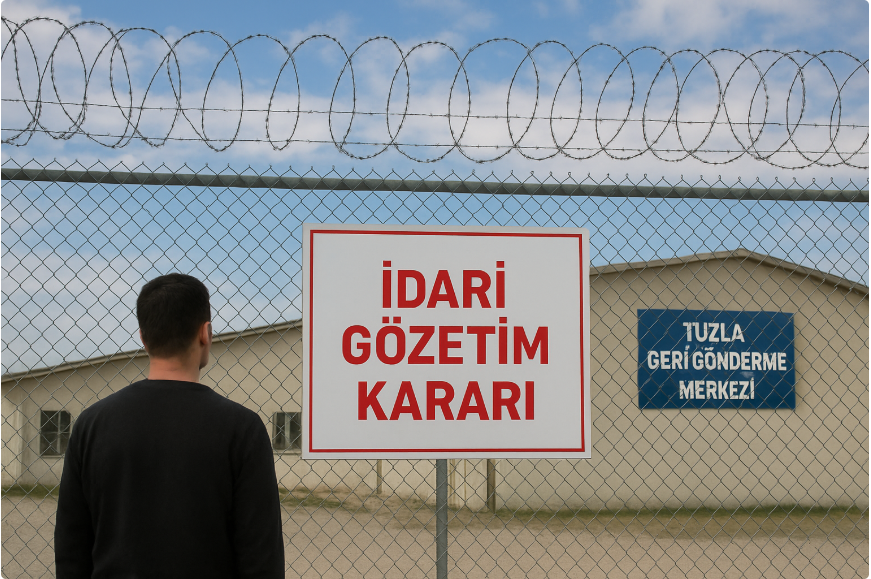
It is vital for foreigners held under administrative detention in removal centers to be able to protect their rights and to pay attention to deadlines and appeal procedures. Especially the Tuzla Removal Center located in Istanbul and its vicinity stands out as a center where a large number of foreigners are held. Failure to appeal decisions made here within the deadline and correctly can lead to individuals being deprived of their freedom for a long time.
At this point, the support of an expert lawyer plays a critical role in effectively managing the process. Lawyers check whether administrative detention decisions comply with the law, identify irregular notifications, and make necessary objections in a timely manner. Furthermore, they take legal initiatives to ensure that foreigners can effectively exercise their fundamental rights such as access to a lawyer, free legal aid, health services, and interpreters.
It should not be forgotten that the processes in removal centers are complex and time-sensitive. Incorrect or incomplete applications can lead to loss of rights. Therefore, legal support for foreigners held at Tuzla Removal Center is not merely an option but often a necessity to utilize legal safeguards.