Introduction
This article has been prepared by analyzing various first instance court, regional court of justice, and Supreme Court decisions presented as an answer to the question “What is vehicle depreciation?”. The article aims to reveal how the concept of vehicle depreciation is defined in judicial decisions, which criteria are sought for compensation of this damage, and the courts’ approach to calculation methods. The examined decisions show that the concept is accepted as a well-established “actual damage” item in Turkish legal practice and constitutes a significant subject of compensation lawsuits.
In light of the examined judicial decisions, the main findings regarding vehicle depreciation are as follows:
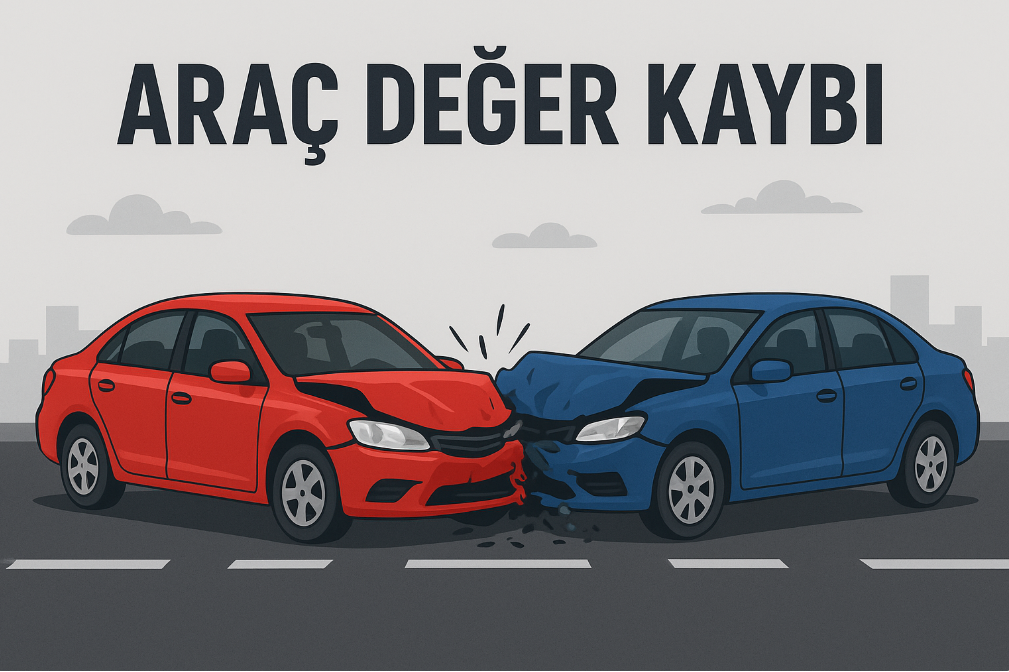
Definition: In court decisions, vehicle value depreciation is consistently defined as the difference between the market value of a vehicle damaged in a traffic accident after it has been repaired and its pre-accident undamaged market value. The established precedents of the Supreme Court form the basis of this definition. For example, in a decision by the Istanbul 5th Civil Court of Commerce, with reference to the Supreme Court, it is stated that “depreciation loss is the difference between the vehicle’s damage value on the date of the incident and the value it would fetch after the damage has been rectified (in its repaired state)”.
Legal Nature: Vehicle value depreciation is accepted by courts as an item of “actual damage”. As stated by the Ankara 13th Civil Court of Commerce, “The loss of value resulting from parts replaced or repairs made to the vehicle due to the accident is counted among the items of actual damage.” Due to this nature, it is subject to compensation lawsuits arising from torts and and is evaluated within the scope of traffic insurers’ liability.
Calculation Criteria: In determining the loss of value, courts consider a series of criteria according to the specific characteristics of the incident. These criteria include: the vehicle’s make, model, age, mileage, the nature and extent of the damage, the originality of the parts used in repair, and the vehicle’s accident history. The decision numbered 2018/1270 of the 17th Civil Chamber of the Supreme Court emphasizes that all these elements must be evaluated by an expert witness through a detailed, reasoned, and auditable report.
Role of the Expert Witness: The determination of the amount of diminished value, being a technical matter, is based on expert witness reports in almost all decisions. In line with Supreme Court precedents, courts base their rulings on reports that consider free market conditions, compare the fair market values of the vehicle before and after the accident, and justify the conclusions reached.
1. Judicial Interpretation of the Concept of Vehicle Diminished Value
Court decisions acknowledge that vehicle diminished value is an economic loss in the exchange value of the vehicle in the second-hand market, which cannot be remedied solely by physical repair. This situation was expressed as follows in the decision numbered 2025/133 of the Istanbul 7th Civil Court of Commerce: “…even if the vehicle is fully repaired, due to the advancement of technology, even if no part replacement has been made, it can be easily determined that vehicles have been involved in an accident, and that the bodywork has undergone repair and paint, which causes the vehicle to lose a certain percentage of its value, varying according to the nature of the accident.” This interpretation is based on the acceptance that even if the repair restores the vehicle to its previous state, market perception is negatively affected due to the loss of its “originality”, and this creates a reduction in assets.
2. Method and Discussions in Diminished Value Calculation
The decisions contain important details on how depreciation loss should be calculated. Specifically, the decision numbered 2024/588 of the Ankara 12th Civil Court of Commerce states that, with the Constitutional Court’s annulment of certain phrases in the relevant articles of law, the calculation of depreciation loss can no longer be made according to the formulas in the annex to the General Conditions of Compulsory Financial Liability Insurance (CFLI). This situation has directed the courts towards the Supreme Court’s former practices based on the principle of “actual damage”. This point was emphasized as follows in the decision numbered 2024/297 of the Ankara 13th Civil Court of Commerce: “…the depreciation loss should be determined based on the difference between the vehicle’s value before the accident and its value after repair, according to free market conditions at the time of the accident, taking into account the Supreme Court’s practices before the General Conditions came into force.” This approach necessitates that each case be evaluated within its specific circumstances, in accordance with market realities.
3. Circumstances Limiting or Eliminating Depreciation Loss Claims
The examined decisions also reveal that not every accident automatically creates a diminution in value. Particularly, the vehicle’s existing damage history stands out as an important defense argument in diminution in value claims. In the decision numbered 2025/209 of the Ankara 5th Civil Court of Commerce, it was stated that a new diminution in value would not occur if previously damaged parts were damaged again: “…even if equivalent parts were used in the last accident or all parts were original, since the parts in question were previously damaged, the vehicle would not suffer a second diminution in value.” Similarly, the decision numbered 2018/1357 of the Istanbul 18th Civil Court of Commerce also rejected the claim on the grounds that “a diminution in value cannot be calculated again for a vehicle that has previously lost value,” due to the vehicle’s model, mileage, and especially its comprehensive damage history. These decisions are based on the logic that diminution in value arises from the impairment of a vehicle’s “originality,” and this damage may not occur in a vehicle that has already lost its originality.
Conclusion
When judicial decisions are examined holistically, it is concluded that vehicle diminution in value is an economic loss, characterized as “actual damage”, occurring in a vehicle’s second-hand market value due to its damage history, despite being repaired after an accident. Judicial practice accepts that this damage is compensable and that the liability belongs to the at-fault party and their traffic insurer.
The determination of value loss, rather than being dependent on rigid formulas, is based on a concrete and reasoned assessment made by expert appraisers, taking into account dynamic factors such as the vehicle’s characteristics, the nature of the damage, and current market conditions, as outlined by the Court of Cassation. Factors such as the vehicle’s existing damage history are reflected in decisions as important elements that can limit or completely negate value loss claims. Consequently, in the Turkish legal system, vehicle value loss continues to exist as an established compensation item, shaped by precedents, aimed at fair and actual damage compensation. An article suggestion.
🔹 Why is Expert Legal Support from Tuzla Necessary?
Vehicle depreciation compensation lawsuits involve many complex technical and legal elements. Accurate calculations, effective use of expert reports, and details such as the existing damage history are critically important for the proper conduct of the process. At this point, obtaining support from an experienced lawyer in Tuzla is important for preventing injustice and protecting the right to compensation.
With the help of legal support:
Expert reports and market data can be effectively used in determining the amount of value loss,
The legal process is managed in cases of unfair limitation or rejection by insurance companies,
Evidence for or against the case, such as existing damage history or the technical specifications of the vehicle, is correctly submitted to the file,
Procedural errors are prevented during the court process, and the scope of the compensation claim is protected in the best possible way,
In the face of conflicting or incomplete expert reports, effective objections and requests for additional reports can be made.
Especially in areas with high traffic and accident risk, such as Istanbul, Tuzla lawyer, Pendik lawyer, Kartal lawyer, Maltepe lawyer, Gebze lawyer, Aydınlı lawyer, Orhanlı lawyer, Tepeören lawyer, Darıca lawyer, Bayramoğlu lawyer or Çayırova lawyer, Şekerpınar lawyer, Güzelyalı lawyer, Postane lawyer and Akfırat lawyer, proceeding without the support of an expert lawyer can lead to loss of rights and insufficient compensation payments. Therefore, in vehicle depreciation compensation cases, working with an expert lawyer in Tuzla is of great importance for a fair and effective solution.