Introduction
This study was prepared by analyzing the decisions of the first instance court, regional court of appeal, and the Supreme Court of Appeals, which were presented in response to the question “how is the fault ratio determined in traffic accidents?”. The study examines the methodology followed in determining the fault ratio, the evidence referred to, the legal grounds, and the role of judicial authorities in this process. The analyzed decisions reveal that the fault determination process is a complex one, requiring special and technical knowledge, based on expert examination, but with the final discretion belonging to the judge.
Necessity of Expert Examination: In all examined decisions, it is observed that courts invariably resort to expert reports for the determination of the fault ratio. In this process, reports are obtained from experts such as Forensic Traffic Experts, Mechanical Engineers, and the Forensic Medicine Institute (ATK) Traffic Specialization Department/Board. ATK is considered the most competent institution, especially in contradictory situations.
Legal Grounds: Fault determination is primarily carried out in accordance with the provisions of the Highway Traffic Law No. 2918 (KTK) and the Highway Traffic Regulation (KTY) based on this law. In particular, Article 84 of the KTK, titled “Determination of Driver Faults in Traffic Accidents and Cases Considered as Primary Fault” forms the main reference point for expert reports and court decisions.
Evidence Evaluated: In determining the fault rate, not only the expert report but also all evidence in the file, such as the traffic accident investigation report, witness statements, crime scene investigation findings, camera recordings, on-site inspections, and the criminal case file, are evaluated as a whole. The compatibility of the reports with this evidence is an important criterion for them to be used as a basis for judgment.
Judge’s Discretionary Power: Although expert reports present technical findings, the final assessment of the fault’s rate and severity rests with the judge. The judge evaluates the expert report together with other evidence in the file, checks whether the report complies with legal regulations and the file content, and decides on the final fault distribution.
1. The Place and Importance of Expert Reports in the Process
Judicial decisions indicate that fault determination requires special and technical knowledge beyond legal expertise, and therefore, an expert examination is inevitable under Article 266 of the Code of Civil Procedure. As stated by the Istanbul 1st Commercial Court of First Instance, “…since the determination of the fault rate is a situation requiring special and technical knowledge beyond legal expertise, this matter is determined by expert examination.” (2018/647 E., 2021/796 K.).
Courts generally tend to regard the Forensic Medicine Institute’s Traffic Specialization Department as the most competent institution. The İzmir 2nd Civil Court of Commerce, while resolving the conflict between different expert reports, confirmed this situation by stating, “Due to ATK being the most competent institution, our Court has relied on its findings, and the fault ratios stated in the ATK report regarding the accident’s occurrence have been taken as the basis for the judgment.” (2021/981 E., 2024/480 K.). The Court of Appeals, on the other hand, emphasizes that if there is a conflict between reports, a new report suitable for review must be obtained to resolve this conflict (17th Civil Chamber, 2015/9232 E., 2018/8290 K.).
2. Legal Norms and Evidence Used in Determining Fault
The main legal framework for determining fault ratios is constituted by the Highway Traffic Law (KTK) and the Highway Traffic Regulations (KTY). Specifically, the “Primary Fault Cases” listed in Article 84 of the KTK are frequently referenced in judgments. The prominent primary fault cases in the examined judgments are:
Rear-end Collision (KTK art. 84/d): In numerous judgments, the driver who caused a rear-end collision was deemed 100% at fault. For instance, in a decision by the Bursa 3rd Civil Court of Commerce, it was ruled that “…the driver was 100% (one hundred percent) at fault for violating Article (84/d) titled ”rear-end collision” under the same law’s ”determination of driver faults in traffic accidents and cases considered primary fault”…” (2023/304 E., 2024/469 K.).
Lane Violation (KTK art. 84/g): Lane violation is also considered a reason for full fault. In a decision by the Bursa 2nd Civil Court of Commerce, it was stated that the driver was found 100% at fault for violating this rule (2023/785 E., 2024/741 K.).
Non-compliance with General Conditions Governing Maneuvers (HTL art. 84/j): Faulty maneuvers are also considered a primary fault. Konya 4th Civil Court of Commerce based its decision on an expert report stating that the driver who violated this rule was 100% primarily at fault (2023/240 E., 2024/615 K.).
Experts and courts consider the evidence of the concrete case holistically when applying these legal norms. This process was summarized as follows in the decision of Bakırköy 2nd Civil Court of Commerce: “the accident report, vehicle registration records, damage records, insurance file, service records related to the repair of the vehicle, and other information and documents related to the accident were subpoenaed and added to the file, witnesses were heard, and party evidence was collected.” (2023/491 E., 2024/782 K.).
3. Distribution of Fault Ratios and Its Impact on Liability
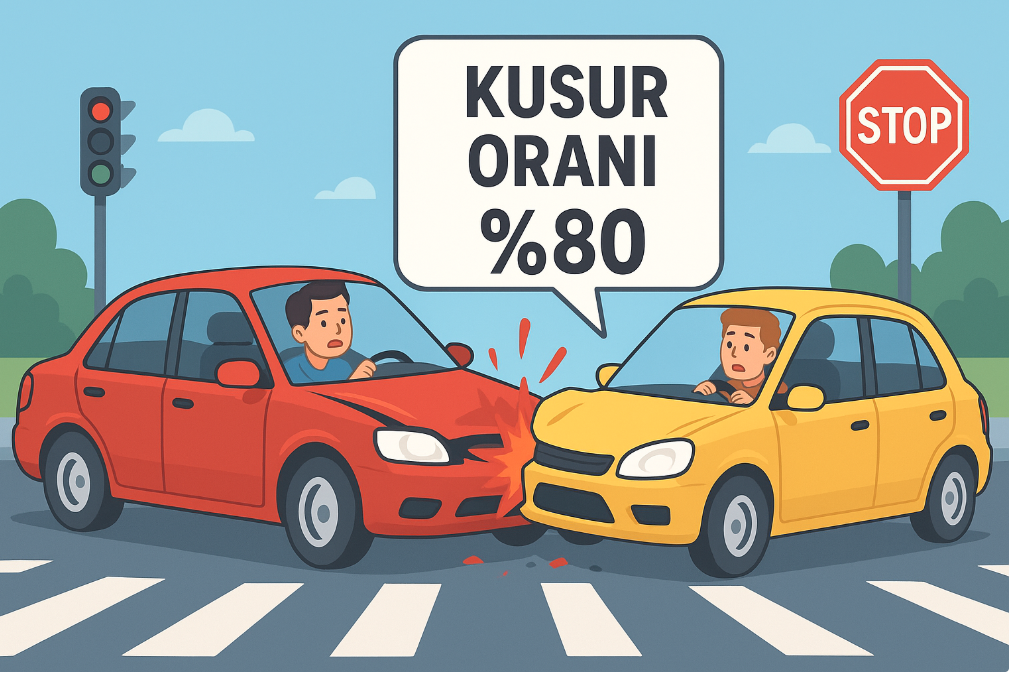
Fault is not always attributed to a single party; it can be distributed by considering all factors that contributed to the occurrence of the accident. In addition to 100% unilateral fault, decisions also include findings of contributory negligence (joint fault) at ratios such as 75%-25% (Bursa 1st Civil Court of Commerce, 2022/564 E., 2024/814 K.), 80%-20% (Ankara 8th Civil Court of Commerce, 2020/290 E., 2022/33 K.), and 70%-30% (Istanbul 14th Civil Court of Commerce, 2016/92 E., 2019/771 K.). In some cases, fault can even be distributed among drivers, pedestrians, and the institution responsible for the road (Samsun Civil Court of Commerce, 2016/1019 E., 2019/508 K.).
This determined fault ratio defines the limits of compensation liability. As highlighted by Bursa 1st Civil Court of Commerce, “determining the faulty actions and fault ratios of those involved in the accident is important for establishing the liability of the driver, operator, and insurance company.” (2018/415 E., 2023/853 K.).
4. Judge’s Final Assessment
Expert reports are not binding on the court. The judge is obliged to check whether the report is consistent with other evidence in the file (accident report, witness statements, etc.) and with legal regulations. The İzmir 2nd Civil Court of First Instance clearly stated this: “The determination of the rate and severity of fault is exclusively within the authority of the judge. The action taken by the expert is merely to determine the traffic rules violated by the parties… and the apportionment of fault must be made by the judge.” (2021/345 E., 2022/28 K.). If the court finds the report to be in accordance with the scope of the file, it bases its judgment on it.
Conclusion
In light of the judicial decisions examined, the determination of the fault rate in traffic accidents is;
Firstly, based on the technical examination of expert witnesses appointed by the court,
This examination is conducted within the framework of Highway Traffic Law No. 2918, especially Article 84 regulating primary fault cases, and the relevant regulation,
Supported by concrete evidence such as accident reports, witness statements, and camera recordings,
And finally, it is a multi-stage process where all these technical findings and evidence are filtered through a legal lens and ultimately assessed by the judge.
The determined fault rate plays a decisive role in the apportionment of material and moral compensation liability arising from the accident among the parties. A writing suggestion.
📌 Why is Tuzla Lawyer Support Necessary?
Accurately determining the fault ratio in traffic accidents requires not only legal but also technical expertise. The fault ratio is of critical importance because it directly affects the amount of compensation, the liability of insurance companies, and the criminal liability of the parties. However, in practice, conflicts can arise between expert reports, deficiencies may occur in the collection of evidence, and insurance companies often try to keep compensation payments limited.
At this point, obtaining support from an expert lawyer in Tuzla is vital for protecting the rights of both the victim and the opposing party. With the support of a lawyer:
The process of objecting to expert reports is carried out effectively,
Discrepancies regarding the fault ratio are resolved,
Loss of rights in compensation negotiations with insurance companies is prevented,
Criminal and civil cases are handled in parallel,
Evidence to be presented to the court is collected comprehensively.
Especially in regions such as Istanbul, lawyer in Tuzla, lawyer in Pendik, lawyer in Kartal, lawyer in Maltepe, lawyer in Gebze, lawyer in Aydınlı, lawyer in Orhanlı, lawyer in Tepeören, lawyer in Darıca, lawyer in Bayramoğlu, or lawyer in Çayırova, lawyer in Şekerpınar, lawyer in Güzelyalı, lawyer in Postane and lawyer in Akfırat, proceeding without proper legal representation can lead to serious loss of rights. Therefore, in cases involving the determination of fault ratios in traffic accidents, working with an experienced lawyer in Tuzla is of great importance for the process to conclude fairly, quickly, and in favor of the victim.