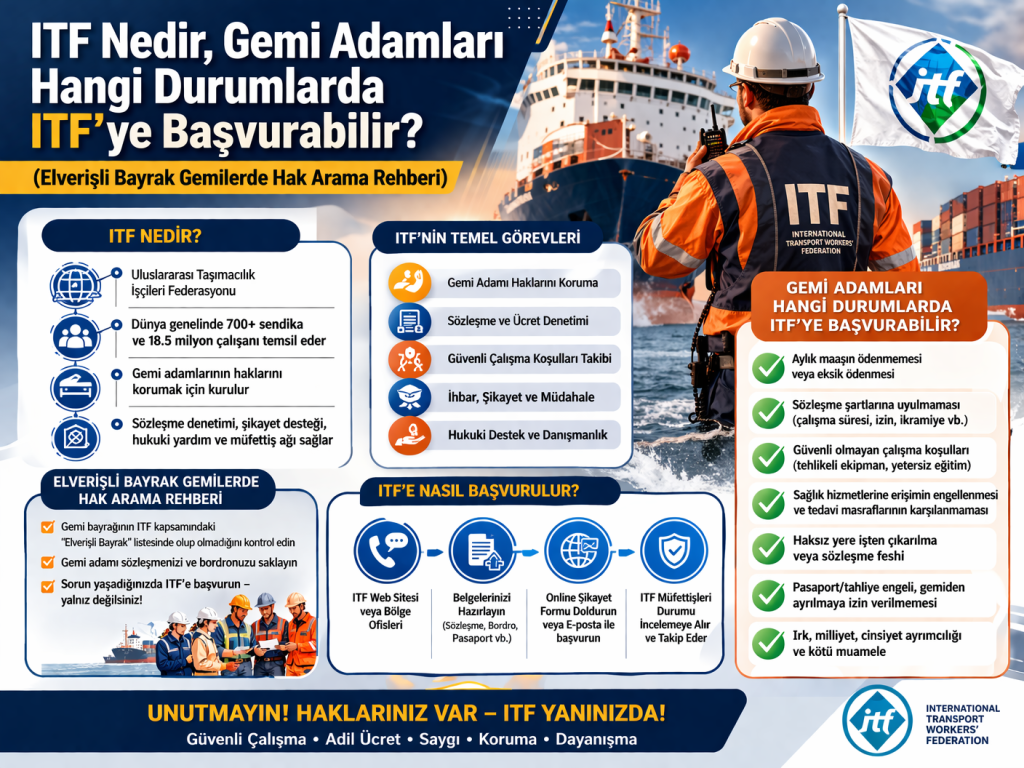
What is ITF? (International Transport Workers’ Federation Acronym)
The acronym for ITF is International Transport Workers’ Federation (International Transport Workers’ Federation) and it is one of the largest international trade union structures representing workers in the transport sector worldwide. Founded in 1896, this organization currently encompasses hundreds of unions and advocates for the rights of millions of workers. ITF plays an active role, particularly in the maritime sector, to ensure the protection of seafarers in fundamental areas such as wages, working conditions, occupational safety, and contractual rights. Working in coordination with the International Labour Organization (ILO) and the International Maritime Organization (IMO), ITF is de facto recognized as a powerful oversight and pressure mechanism in maritime labor law.
What is a Flag of Convenience?
A Flag of Convenience (FOC) means that a ship is registered under the flag of a country that has no direct connection with the vessel’s actual owner. This system is generally preferred to benefit from lower tax burdens, more flexible labor policies, and weaker oversight mechanisms. However, this situation often brings serious problems for seafarers such as low wages, long working hours, inadequate safety measures, and contractual violations. ITF actively campaigns globally against human rights violations occurring on such ships and closely monitors these vessels.
Legal Nature of ITF’s Intervention
The ITF’s intervention is not a public authority action in the classical sense, nor does it constitute a directly binding administrative sanction. However, through its international trade union power and its influence over port operations, it effectively creates an extremely powerful pressure mechanism. The core elements of this process include inspections carried out on vessels by ITF inspectors, the identification of deficiencies, and the exertion of commercial pressure on employers. Furthermore, Collective Bargaining Agreements (CBAs) signed under the ITF framework create legal obligations for the parties involved. For this reason, ITF intervention is generally regarded in doctrine as “a quasi-legal mechanism with high de facto enforcement power.”
Who Can Apply to the ITF?
The process of applying to the ITF is usually conducted not as an individual application, but through trade unions or ITF inspectors. However, seafarers can initiate the process by contacting the ITF if their wages are unpaid, contract terms are violated, or they are exposed to poor working conditions. Particularly, the collective action of the crew ensures a faster and more effective ITF intervention. Additionally, national seafarers’ unions, port workers, and even agents can be involved in this process under certain circumstances. Thanks to its global inspection network, the ITF makes it possible for seafarers to reach the nearest inspector.
For Which Vessels Can One Apply to the ITF?
While ITF applications are most concentrated on ships flying flags of convenience, they are not limited to these vessels. All ships without an ITF agreement, applying wages below international standards, or violating the fundamental rights of seafarers can be considered within this scope. Such applications are more frequently observed on vessels operating under flags like Panama, Liberia, and the Marshall Islands. However, when situations such as unpaid wages, overtime violations, or obstruction of a seafarer’s right to repatriation arise, the ITF process can be initiated regardless of the ship’s flag.
What Are the Reasons for ITF Applications?
Situations in which seafarers apply to the ITF generally stem from violations concerning wages and working conditions. The main reasons for these applications include unpaid or underpaid wages, excessive working hours, violation of rest periods, being assigned duties outside the contract, and undignified living conditions on board the vessel. Furthermore, obstruction of a seafarer’s right to repatriation or failure to provide insurance and social rights are also significant situations requiring ITF intervention. In such cases, the ITF sends an inspector to conduct an investigation, negotiates with the employer, and, when necessary, can exert significant operational pressure on the vessel.
How Does the ITF Process Work?
The ITF process typically begins with a complaint from a seafarer or crew member, followed by an ITF inspector’s visit to the ship for an inspection. During this inspection, contracts, wage records, and working conditions on board are thoroughly evaluated. If deficiencies are found, a negotiation process with the employer is initiated, and in most cases, the issue is resolved by signing new contracts that comply with ITF standards. If deemed necessary, serious sanctions such as preventing the ship from leaving port or suspending its commercial activities may also be considered. In this respect, the ITF process stands out as an effective mechanism that often achieves results without the need for litigation.
Is ITF Intervention Legally Valid?
An ITF intervention itself is not considered an unlawful act. However, the legal nature of payments made as a result of such intervention varies according to the specific circumstances of the case. If the payment made is genuinely based on a claim that the seafarer is entitled to, this payment is considered valid and cannot be reclaimed later. Conversely, if it can be proven that the payment was made under explicit threat or coercion, a legal dispute may arise. Therefore, the ITF process cannot be considered either a fully binding public act or a completely ineffective intervention; it is rather regarded as an international mechanism with significant de facto enforcement power.
Conclusion: Why is ITF Critical for Seafarers?
The ITF is one of the most important means of seeking justice for seafarers, especially those working on foreign-flagged vessels who do not adequately benefit from state protection. The ITF mechanism, which provides fast and effective solutions for rights violations occurring on vessels operating in international waters, often makes it possible to collect receivables without the need for a lawsuit. In today’s widespread flag of convenience system, the ITF effectively ensures the implementation of international labor standards by creating a serious element of supervision and pressure on employers.
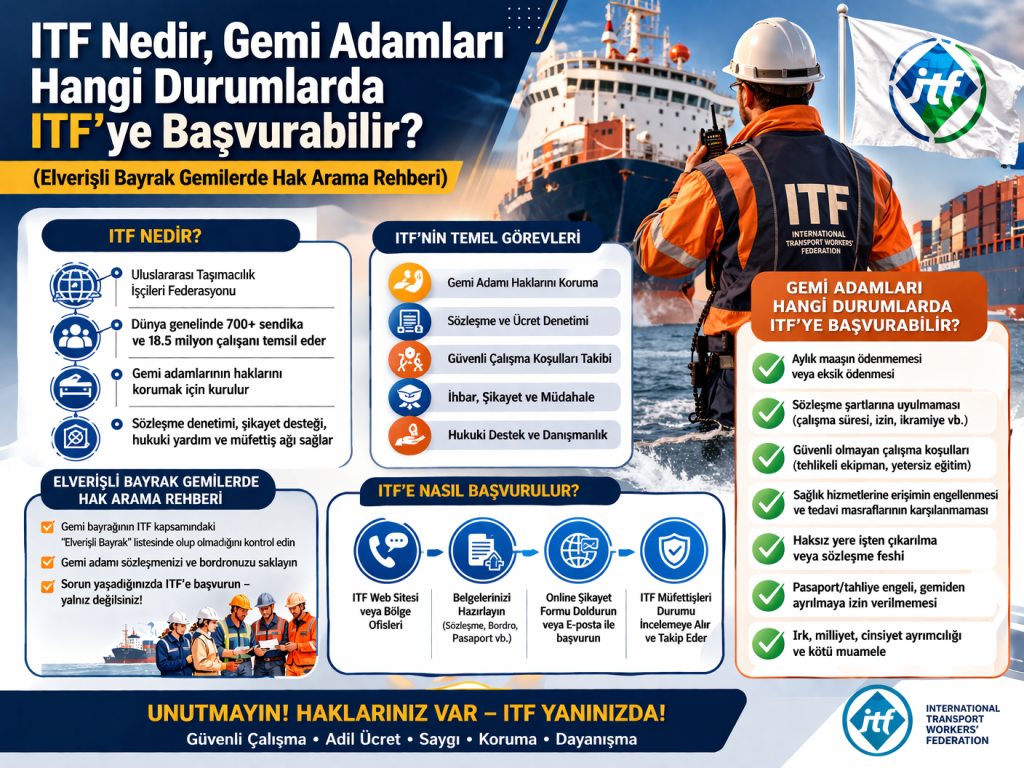
Why is Expert Legal Support Necessary?
Although the ITF process offers a practical and fast solution, the legal assessment of each specific case varies. Risks such as incorrect ITF applications, payments made becoming subject to future refund requests, or issues of jurisdiction and applicable law may arise. Therefore, it is of great importance to manage the process from the beginning with an Istanbul maritime law attorney. Especially working with an experienced seafarer lawyer in seafarer disputes and a Tuzla lawyer familiar with shipyard area practices ensures the prevention of rights losses. 2M Hukuk Law Office, with its team of Istanbul lawyers operating in Istanbul, provides effective and reliable legal support to its clients with an expert approach in maritime law and ITF processes.