One of the most serious problems faced by seafarers in the maritime sector is not receiving the wages they are entitled to. This situation sometimes manifests as outright non-payment of wages, while at other times it is implemented through a much more covert and systematic method. One of these methods, specifically highlighted by the ITF (International Transport Workers’ Federation), is the “double accounting” system. This system is a serious fraudulent practice that deprives seafarers of their legal wage entitlements.
What is Double Accounting?
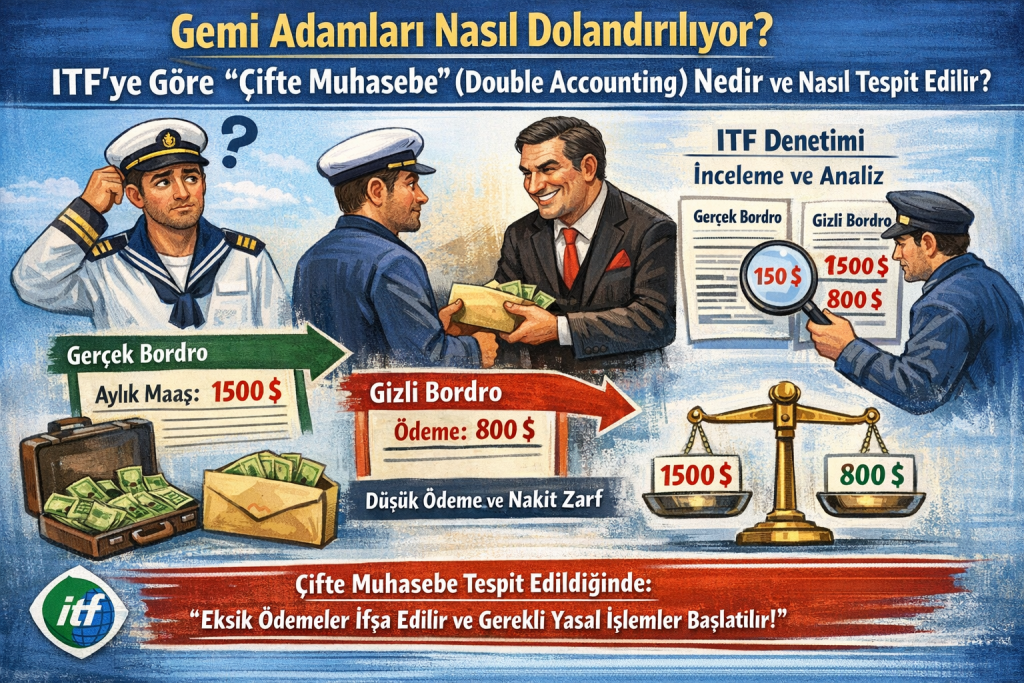
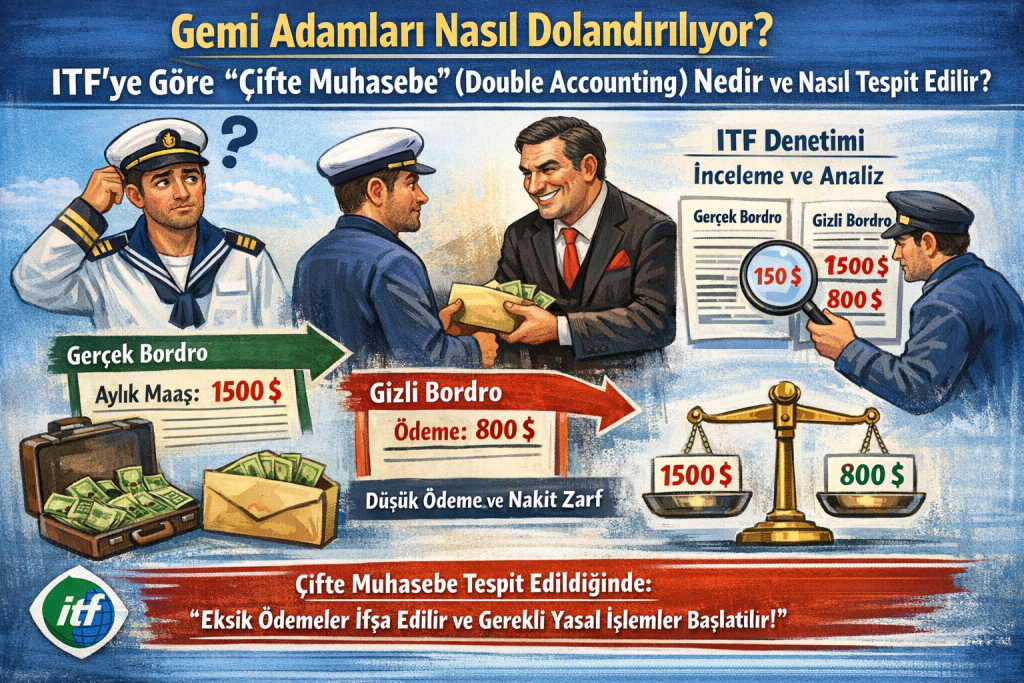
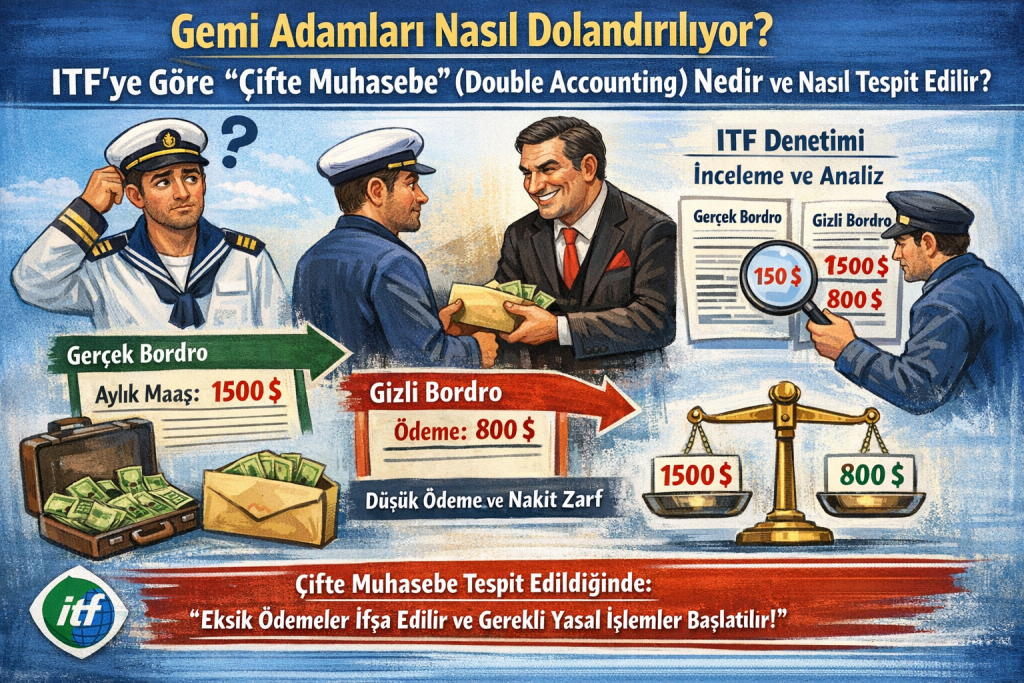
Double accounting is an illegal practice where seafarers are forced to sign two different contracts or wage records simultaneously. In this system, there are significant discrepancies between the documents officially presented to authorities and the wages actually paid to the seafarer.
On one side, there are official payrolls and contracts prepared in accordance with the ITF-approved Collective Bargaining Agreement (CBA). These documents are presented to ITF inspectors and Port State Control (PSC) authorities during ship inspections. On paper, everything appears to be compliant with the rules.
On the other side, there is a second system that shows the actual wages received by the seafarer. In this system, the seafarer is paid a lower salary, overtime wages are undercalculated, and some payments are not made at all. However, these actual records are not shown to the authorities. Thus, while everything appears legal on paper, a serious violation of rights occurs in practice.
Why is Double Accounting Illegal?
This practice clearly violates both ITF collective bargaining agreements and the Maritime Labour Convention (MLC) 2006. Because a seafarer has the right to receive contractually agreed wages, and any waiver or effective deprivation of these rights is legally invalid.
The ITF defines double accounting as one of the most serious problems it has been fighting for years. This system not only leads to a loss of individual rights but also creates unfair competition in the maritime industry and causes standards to decline.
How Does the Double Accounting Practice Work in Practice?
To understand how this system works, it needs to be explained through a typical example. A seafarer signs a contract to work on a ship under an ITF Uniform Collective Bargaining Agreement for a monthly wage of 1,836 USD. This contract is entirely legal and compliant with ITF standards.
However, after joining the ship, the seafarer is subjected to an imposition: they are told that to keep their job, they must sign payslips showing the ITF wages. But in reality, they will only be paid 1,400 USD. The difference of 436 USD is never given to them; despite this, this amount is recorded in the ship’s logs as ‘cash advance paid’.
These fake payroll records are then presented to ITF inspectors or PSC inspections. If the seafarer does not complain about this situation, the fraud often goes undetected. In practice, there are also different versions of this, and the methods are quite varied.
Why Is This Fraud Not Easily Detectable?
The most dangerous aspect of the double accounting system is that it is difficult to detect and especially to prove. This is because documents usually appear correct on paper. Moreover, seafarers are often under economic pressure and cannot object to this situation for fear of losing their jobs.
Many seafarers are forced to sign a second contract imposed by the employer to avoid losing their jobs or to be able to find employment again in the future. For this reason, the system often continues in silence.
How to Detect Double Accounting?
There are some critical indicators for detecting this type of fraud. First, a discrepancy between bank account transactions and payrolls signed on board is an important sign. Furthermore, showing money on the payroll as “cash advance” that was not actually paid is also a common method.
A seafarer’s keeping a copy of the documents they sign, regularly checking bank records, and tracking overtime records play a critical role in uncovering such situations. It is also important to learn whether similar situations have been experienced by talking among the crew.
What is the ITF Doing About This and What Does It Expect from Seafarers?
The ITF is actively fighting to expose the extent of double accounting practices and to eliminate this system. However, the ITF clearly states: The support of seafarers is essential for this system to be uncovered.
Therefore, the ITF asks seafarers to report such practices they have experienced or are aware of. Because without information from seafarers, it is not possible to determine the full extent of this system.
The ITF’s approach is clear: If seafarers remain silent, this system will continue. If reports are made, the system will collapse.
Frequently Asked Questions
1. What exactly is double accounting and how is it implemented?
Double accounting is an illegal system implemented by having seafarers sign two different contracts or payroll records. While official documents show a high salary in line with the ITF collective bargaining agreement, a lower wage is actually paid. The difference is usually covered by fictitious entries such as “cash advance.” With this method, the seafarer suffers significant losses in terms of both overtime and basic wages.
2. What is the difference between double accounting and regular underpayment of wages?
In cases of regular underpayment, there is a single contract, and payment is made contrary to this contract. Double accounting, however, involves systematic fraud; official documents are falsified and hidden from inspection. Therefore, double accounting is considered a much more severe violation.
3. Can the ITF detect this situation?
ITF inspectors examine payrolls and contracts during inspections; however, double accounting usually cannot be detected without a seafarer’s complaint. This is because the documents shown on board appear “proper.” Therefore, the ITF particularly urges seafarers to report.
4. What happens to companies that implement double accounting?
This situation is a violation of the ITF agreement and MLC. If detected, the company:
Is reported by ITF
Suffers damage to its international reputation
Is subjected to inspections in ports
Its contracts may be cancelled
Additionally, in some cases, legal and criminal proceedings may also arise.
5. If I signed in such a situation, do I lose my rights?
No. Second contracts signed under employer pressure are generally not considered legally valid in most cases. Especially if there is a difference between the actual payment and the payroll, this situation can be used as evidence, and a claim for rights is possible.
6. How can I prove double accounting?
The following evidence is critically important for proof:
Bank account statements
Payroll slips
Employment contracts
WhatsApp / email correspondence
Witness statements
Especially the difference between bank records and payroll is the strongest evidence.
7. If I apply to ITF, will I lose my job?
This risk might exist in some cases; however, ITF applications are often handled confidentially. Furthermore, in collective applications, it becomes more difficult for the employer to exert pressure. Therefore, it is safer to act as a crew, if possible, rather than individually.
8. Does this situation only occur on foreign-flagged vessels?
No. However, it is more common on vessels carrying a “flag of convenience.” This is because inspections on these vessels are weak, and the employer’s responsibility is more limited.
9. How much can I claim in case of double accounting?
The seafarer can claim all fees they should have received according to the actual contract. This includes:
Difference in underpaid salary
Overtime claims
Holiday pay
Compensation may be included. Therefore, the total claim is often quite high.
10. Is an ITF application sufficient, or is it necessary to file a lawsuit?
The ITF process often ensures payment is received; however, for high-value claims, a lawsuit must be filed. The most effective method is to run the ITF process and the legal process concurrently.
Why is Expert Legal Support Necessary?
Situations like double accounting are not merely wage disputes; they are also processes that constitute a serious legal violation and fraud. In such cases, simply making an ITF application may not be sufficient. Especially the calculation of underpaid wages, the discovery of false records, and the initiation of legal proceedings require expertise.
At this point, professional execution of the process with the support of an Istanbul seafarer lawyer and a Tuzla seafarer lawyer provides a significant advantage. Because in such cases, evidence collection, payroll analysis, examination of bank records, and filing a lawsuit when necessary are critically important.
2M Hukuk Law Office, specializing in maritime labor law, integrates ITF processes with legal avenues regarding double accounting and seafarer claims, thereby most strongly protecting the rights of its clients.