
1. Legal Nature of the Receivable
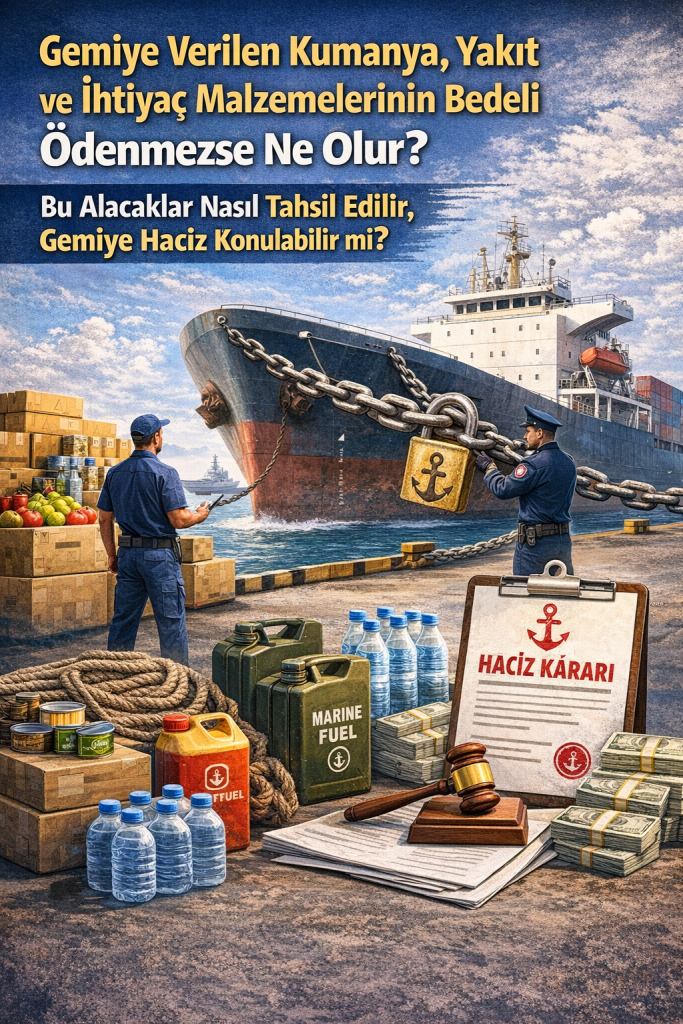
According to Article 1352/1-l of the Turkish Commercial Code (TCC) no. 6102; goods, materials, provisions, fuel, and services provided for these purposes for the operation, management, protection, or maintenance of the ship are directly considered a “maritime claim”. In court decisions (İstanbul Anadolu 5th Commercial Court – 2020/418 E. ; İstanbul 2nd Commercial Court – 2016/710 E. K), fruits, vegetables, meat, food, and durable consumption goods delivered to the ship, as well as catering services provided to the crew, have been evaluated within this scope. In some decisions, these types of receivables have also been described as “ship claims” and it has been discussed that they may give rise to a statutory lien right under TCC Article 1320 et seq. (Bursa 1st Commercial Court – 2018/1560 E.
2. Competent and Authorized Court
In disputes arising from maritime claims, the competent courts are the Maritime Specialized Courts. In Istanbul, the Istanbul 17th Commercial Court of First Instance and the specialized courts within the Istanbul Anadolu courthouses have been assigned for these cases. Cases filed in an incompetent court are procedurally dismissed due to lack of a condition for suit, and the file is sent to the competent specialized court (Istanbul Anadolu 2nd Commercial Court – 2017/949 E. Istanbul 14th Commercial Court – 2025/894 E.
3. Legal Avenues and Lawsuits for the Collection of the Receivable
Creditors wishing to collect the cost of provisions and supplies may resort to the following methods:
Enforcement Proceedings and Action for Annulment of Objection: The creditor can initiate enforcement proceedings without a judgment against the debtor. In case of the debtor’s objection, an “Action for Annulment of Objection” must be filed within the scope of Article 67 of the EBL (Enforcement and Bankruptcy Law) (Court of Cassation 17. Civil Chamber – 2014/10935 E.; Istanbul Anatolian 2. Commercial Court – 2025/713 E.).
Debt Collection Lawsuit: It is possible to file a debt collection lawsuit directly within the framework of general provisions (Court of Cassation 11. Civil Chamber – 2013/15215 E.).
Provisional Attachment: Pursuant to Articles 1353 and 1362 of the TCC (Turkish Commercial Code), a provisional attachment may be requested on a ship to secure a maritime claim. For this method, evidence convincing the court of the existence of the claim and its nature as a maritime claim must be presented, and a guarantee of 10,000 Special Drawing Rights (SDR) must be provided (Istanbul Regional Court of Justice 12. Civil Chamber – 2022/782 E.; Denizli Regional Court of Justice 4. Civil Chamber – 2024/36 E.).
Enforcement through Realization of Pledge: In cases where the claim is a maritime claim, enforcement proceedings can be initiated through the realization of the movable pledge (Istanbul Anatolian 2. Commercial Court – 2025/713 E).
Request for Recognition of Statutory Lien: The plaintiff may request the establishment of a statutory lien on the ship pursuant to Article 1320 et seq. of the TCC. However, in some decisions, if the element of “necessity” in the procurement of provisions cannot be proven, the request for a lien has been rejected, and only the collection of the claim has been decided (Court of Cassation 11. Civil Chamber – 2010/6726 E.).
4. Potential Claims and Defenses
By the Creditor: It must be asserted that the supplies were essential for the operation of the vessel, ordered by the captain or the owner’s agent, the products were delivered completely, and the receivable is liquid (determinable). Furthermore, the risk of the vessel departing abroad or absconding with goods can be presented as grounds for a precautionary attachment.
By the Debtor: It can be argued that the provisions were not essential for the continuation of the voyage, the order was placed by unauthorized persons, payment was made to the agent, or the owner is not liable due to the vessel being chartered under a bareboat charter agreement (Turkish Commercial Code art. 1127) (Court of Cassation 11th Civil Chamber – 2011/8125 File No. Decision; Istanbul Regional Court of Appeals 13th Civil Chamber – 2019/1313 File No.
5. Evidence to be Presented The primary evidence accepted by courts includes:
Invoices and Delivery Notes: Documents showing the quantity and price of the delivered products.
Delivery Documents: Goods delivery lists or goods delivery receipts bearing the vessel’s stamp and captain’s signature (Bursa 1st Commercial Court – 2018/1560 File No.
Commercial Books and Records: Properly maintained commercial books and current account statements of the parties.
Correspondence: Email correspondence containing order requests.
Expert Reports: Technical examinations conducted on the amount of the receivable and its nature as a maritime claim.
Bank Records: Receipts or transfer instructions showing partial payments, if any.
6. Additional Information from Secondary Sources
The following points were highlighted in decisions considered secondary sources:
Statute of Limitations: The statute of limitations for these types of receivables is generally accepted as 10 years according to Article 146 of the TCO (Turkish Code of Obligations) (Istanbul 17th Commercial Court – 2021/72 M.R.
Standard of Proof: At the provisional attachment stage, “approximate proof” is considered sufficient; documents signed by the captain and proforma invoices can be considered convincing evidence at this stage (Samsun Regional Court of Appeals 3rd Civil Chamber – 2024/1905 M.R.
Liability: In cases of an organic link or economic identity between the shipowner and its operator, it has been stated that liability can be extended by piercing the corporate veil (Istanbul 17th Commercial Court – 2021/72 M.R.
Frequently Asked Questions
Gemiye kumanya veya ihtiyaç malzemesi verdim, param ödenmedi. Bu bir deniz alacağı mı?
Evet. TTK m. 1352/1-l uyarınca geminin işletilmesi, yönetimi, korunması ve bakımı için sağlanan kumanya, yakıt ve ihtiyaç malzemeleri doğrudan deniz alacağıdır. Yargı kararlarında meyve, sebze, et, gıda ürünleri ve mürettebata verilen yemek hizmetleri açıkça bu kapsamda kabul edilmiştir. Bu nedenle alacak, sıradan ticari alacaklardan daha güçlü hukuki korumaya sahiptir.
Bu tür alacaklarda hangi mahkeme görevlidir?
Kumanya ve ihtiyaç malzemesi alacakları deniz alacağı niteliğinde olduğundan, görevli mahkeme Denizcilik İhtisas Mahkemesi sıfatıyla Asliye Ticaret Mahkemesidir. İstanbul’da özellikle İstanbul 17. Asliye Ticaret Mahkemesi ve Anadolu yakasındaki ihtisas mahkemeleri görevlidir. Yanlış mahkemede açılan davalar usulden reddedilerek dosya görevli mahkemeye gönderilir; bu da ciddi zaman kaybına yol açar.
Gemiye kumanya veya ihtiyaç malzemesi verdim, param ödenmedi. Alacağımı tahsil etmek için hangi yolları kullanabilirim?
Alacaklı, somut duruma göre birden fazla hukuki yolu birlikte veya ayrı ayrı kullanabilir:
İlamsız icra takibi ve borçlu itiraz ederse itirazın iptali davası,
Doğrudan alacak davası,
İhtiyati haciz yoluyla geminin seferden alıkonulması (10.000 SDR teminatla),
Alacak gemi alacağı niteliğindeyse rehnin paraya çevrilmesi yoluyla takip,
Şartları varsa kanuni rehin hakkı tanınması talebi.
Bu yolların hangisinin seçileceği, geminin limandaki durumu ve delillerin gücüne göre belirlenir.
Why is Expert Lawyer Support Necessary for Maritime Claims?
Although claims for provisions, fuel, and supplies may appear “strong” on paper, in practice, they are among the most frequently uncollectible maritime claims. The main reason for this is the incorrect choice of legal path and the insufficient presentation of evidence.
Expert legal support is crucial in the following aspects: A lawsuit filed in the wrong court can cause months of delays.
Despite being a maritime claim, lawsuits filed in general courts are procedurally dismissed; meanwhile, the ship may have already left the port. The opportunity for preliminary attachment is a one-time chance. If attachment cannot be placed while the ship is in Tuzla, Ambarlı, or Aliağa port today, it might be in another country under a foreign flag tomorrow. Managing this risk in a timely manner requires expertise. The right of lien does not always arise automatically. If the “necessity” element cannot be proven for supply claims, the statutory lien request may be denied. This distinction can only be correctly structured by a lawyer proficient in case law practice. The distinction between owner – charterer – agent is critically important. Directing hostility towards the wrong party can lead to the dismissal of the case before its merits are examined. Therefore, working with an expert team in maritime law, particularly one familiar with practices concerning Istanbul ports, Tuzla Shipyards Region, and foreign-flagged vessels, is an absolute necessity for the collection of receivables. In such disputes, 2M Hukuk Law Firm stands out with its Istanbul-based practical experience in matters of claims for provisions and necessities, preliminary attachment of ships, and the collection of maritime claims.