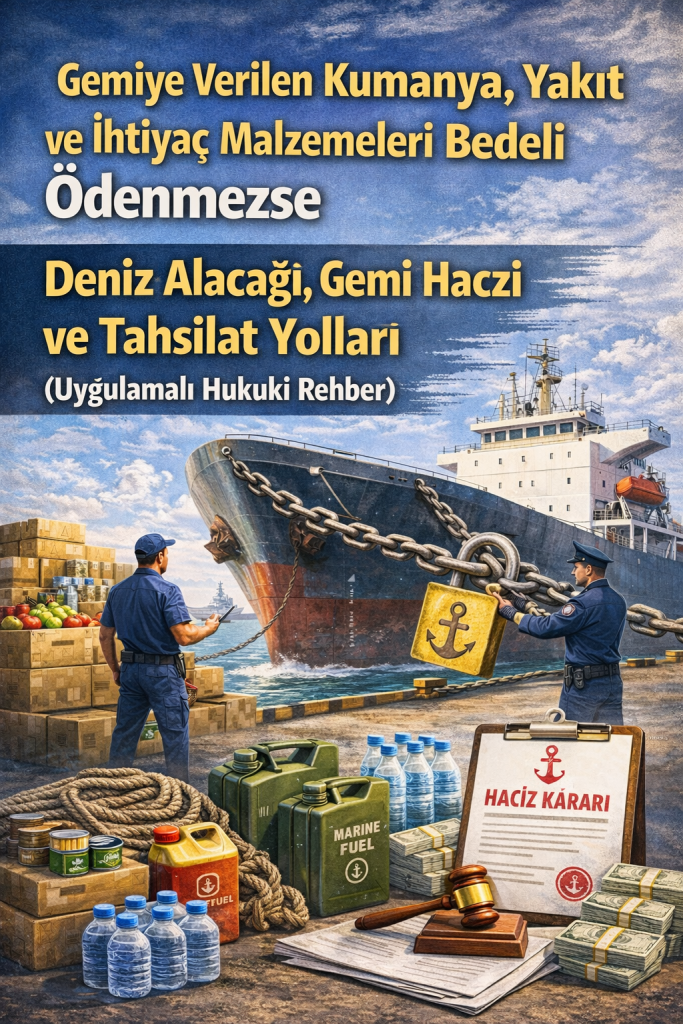
Maritime Claims, Ship Arrest, and Collection Methods (Practical Legal Guide)
This guide has been prepared for suppliers of provisions, fuel, and ship supplies operating in Istanbul ports, particularly in the Tuzla shipyards region, and Kocaeli ports.
1. Legal Nature of the Claim
Claims arising from fruits, vegetables, meat, food, and durable consumer goods (provisions) delivered to the vessel, as well as meal services provided to the crew, are considered within the scope of “goods, materials, provisions, fuel, equipment including containers, and services provided for the operation, management, preservation, or maintenance of the vessel” in accordance with Article 1352/1-(l) of the Turkish Commercial Code No. 6102 (TCC). From a legal technical perspective, such claims are in the nature of a “Maritime Claim”. Furthermore, the delivery of such goods meeting the voyage needs of the crew may grant the creditor a statutory lien (maritime lien) on the vessel pursuant to TCC Art. 1235 and 1236.
2. Legal Avenues for Collection In light of judicial decisions, the most effective ways to collect these amounts are as follows:
Provisional Attachment: Pursuant to TCC Art. 1353/4, the fact that the claim is a maritime claim is a direct ground for provisional attachment. This is the most effective temporary legal protection method for placing the vessel under debt collateral. However, in this method, the vessel cannot be prevented from sailing; only a provisional attachment order can be issued.
Enforcement Proceedings: The creditor can initiate summary enforcement proceedings against the debtor (owner, operator, or agent) based on invoices and waybills. In some cases, “Enforcement by Way of Converting Movable Pledge into Money” (Example 8) is also preferred.
Action for Annulment of Objection: This is a lawsuit filed to ensure the continuation of enforcement proceedings by proving the existence of the debt, in case of an objection to the proceedings.
Sister Ship Attachment: In accordance with Article 1369/2 of the Turkish Commercial Code (TTK), it is also possible to place a precautionary attachment on other ships (sister ships) belonging to the principal debtor.
3. Competent and Authorized Court
Since these types of disputes are regulated in the 5th book of the Turkish Commercial Code (TTK) titled “Maritime Commerce”, exclusively Maritime Specialized Courts are competent.
In Istanbul: The Istanbul 17th Commercial Court of First Instance (acting as a Maritime Specialized Court) is authorized.
In Other Provinces: In places where no maritime specialized court has been established, Commercial Courts of First Instance appointed by the HSK (Council of Judges and Prosecutors) in this capacity are competent (For example; the relevant courts in Mersin or Ünye).
Jurisdiction: For a precautionary attachment, an application must be made to the competent court in accordance with Articles 258 and 50 of the Enforcement and Bankruptcy Law (İİK).
4. Application Periods and Procedure
Precautionary Attachment Enforcement Period: After a precautionary attachment decision is made, its enforcement must be requested from the enforcement office within 3 business days from the date of the decision.
Filing Period (After Provisional Attachment): In maritime claims, after a provisional attachment and upon notification of an objection to enforcement proceedings, a lawsuit for the removal of the objection or the annulment of the objection must be filed within 1 month, in accordance with Article 1376 of the TCC. This period is peremptory (a forfeiture period), and if it is missed, the attachment becomes void.
Period for Annulment of General Objection: In cases where there is no provisional attachment, a lawsuit must be filed within 1 year from the date of notification of the objection.
After Decision of Incompetence: If the court renders a decision of incompetence (lack of jurisdiction), the transfer of the file to the competent court must be requested within 2 weeks from the date the decision becomes final; otherwise, the lawsuit is deemed not to have been filed.
Security Requirement: When provisional attachment is requested for maritime claims, it is generally mandatory to deposit security in the amount of 10,000 Special Drawing Rights (SDR), in accordance with Article 1363/1 of the TCC.
5. Additional Context and Assessments from Secondary Sources The following points should be considered as secondary source information, as they appear as limited information or party allegations in the decision texts:
Complexity of Liability: If the ship has been leased under a “bareboat charter agreement” (bareboat charter), the charterer, not the owner/shipowner, may be responsible for operating expenses (including provisions). In this case, direct collection of the claim from the shipowner may become difficult.
Means of Proof: Delivery notes, invoices, delivery records, and email correspondence, sealed and signed by the ship’s captain or authorized representative, were of critical importance for proving delivery.
Mediation: The completion of the mediation process before filing a lawsuit is a prerequisite for litigation.
Notarized Notice: Sending a notarized notice to the debtor before a lawsuit or enforcement proceeding is a common practice to establish default and prove good faith.
Gemiye verilen kumanya ve yakıt bedeli gerçekten “deniz alacağı” sayılır mı?
Evet. Gemiye teslim edilen kumanya, yakıt ve ihtiyaç malzemeleri, TTK m. 1352 kapsamında deniz alacağıdır. Bu nitelik sayesinde alacaklı, gemi hakkında ihtiyati haciz talep edebilir ve alacağını güçlü teminat altına alır.
Gemi satılırsa veya el değiştirirse kumanya alacağı yanar mı?
Hayır. Gemi satılsa dahi, ihtiyati haciz veya haciz yerine yatırılan teminat korunur. Yeni gemi maliki, eski borçtan sorumlu olmasa bile teminat iade edilmez; alacak sonuçlanıncaya kadar güvence devam eder.
Why is Expert Maritime Law Attorney Support Necessary?
Provisions and fuel claims;
Distinction between maritime claim and commercial claim,
Shipowner / bareboat charterer / charterer liability,
Sister ship arrest,
Practical enforcement in Istanbul, Tuzla, and Kocaeli ports,
It contains technical details such as time-barring periods and security conditions. Especially in the Tuzla region, even a one-day delay for vessels undergoing maintenance/repair or preparing for voyage in shipyards can lead to the vessel leaving the port and the claim not being able to be actually collected. Therefore, the process must be handled by an expert lawyer knowledgeable in maritime trade and ship arrest practice;
The fastest method of arrest being chosen,
Actions being taken in the correct court,
Ensures that the receivable is secured by collateral and eliminates the risk of loss of rights.