Legal Basis: Law No. 6306 Article 6/1 | Implementing Regulation Article 15/2
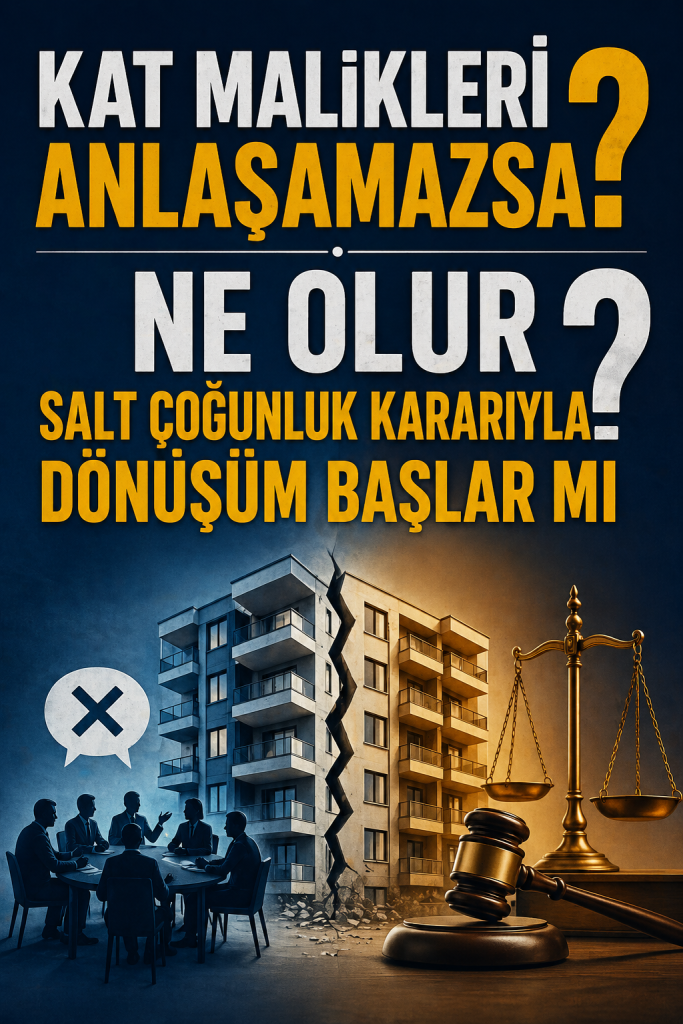
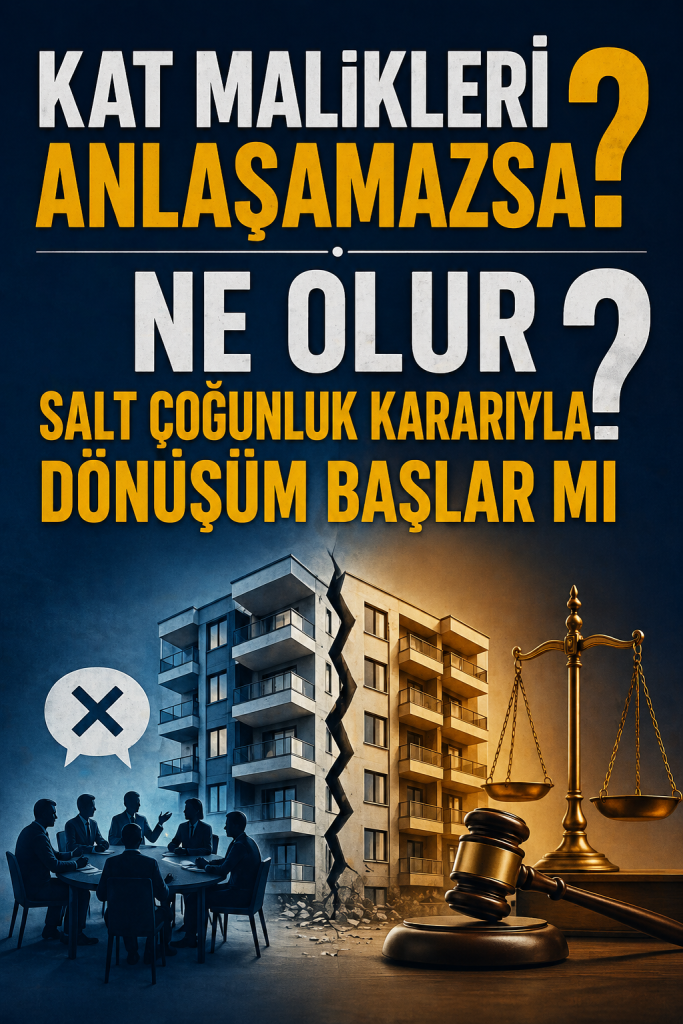
In an apartment building with 20 units, fifteen people said “yes” to urban transformation, five people said “no.” So, in this situation, does the transformation process begin? Can the objection of five people halt the project? Article 6/1 of Law No. 6306 and Article 15/2 of the Implementing Regulation clearly answer these questions. On the other hand, the regulation amendment dated February 4, 2026, removed the previously required two-thirds majority threshold, deeming a simple majority sufficient for all these procedures. This article thoroughly examines what the new regulation means, how the meeting process works, which decisions are covered by a simple majority, and the safeguards protecting the rights of minority owners, in light of the updated 2026 legislation. (Law Art. 6/1 — Reg. Art. 15/2)
Before 2026: Why Was the Two-Thirds Majority a Problem?
In the initial version of the law and the regulation valid until the 2023 amendments, a decision for urban transformation in risky structures required the approval of at least a two-thirds majority of the owners, proportionate to their shares. This threshold was found to cause serious problems in practice: a single stubborn owner or a small minority group, if holding more than thirty percent of the land shares, could effectively block transformation projects affecting thousands of people. The Constitutional Court also closely examined the balance of property rights in individual applications regarding the two-thirds majority condition; during this process, the importance of protecting minority owners with sufficient guarantees was emphasized.
February 4, 2026 Amendment: Principle of Simple Majority
With the regulation amendment published in the Official Gazette dated February 4, 2026, and numbered 33158, Article 15/2 of the Implementation Regulation was radically revised. (Reg. Art. 15/2 — OG. 04.02.2026/33158)
According to the new regulation, decisions regarding the following transactions in parcels where risky structures are located can be made by a simple majority of shareholders proportionate to their shares: consolidation of parcels, individual or combined development, or development based on an urban planning island, subdivision, partition, abandonment, creation, and registration procedures with the land registry, rebuilding, sale of shares, flat-for-land or revenue sharing agreements, and reassessment through other methods. (Reg. Art. 15/2)
What does a simple majority mean? A simple majority of shareholders proportionate to their shares is a majority exceeding fifty percent of the land shares. In other words, a decision made by owners holding fifty percent plus one of the land shares is binding on all owners. This calculation is not based on the number of owners, but on the size of the land share.
To explain with a practical example: Let’s assume that in an apartment building with 10 flats, each flat has an equal share of the land. Since each owner’s share is ten percent, the approval of at least 6 owners (whose total land shares amount to sixty percent) is required for a simple majority. If the land shares are not equal, it is possible for owners with larger shares to form a majority despite being fewer in number.
Obligation to Call a Meeting: The Innovation Brought by 2026
The most important procedural innovation brought by the February 4, 2026 amendment is the reintroduction of the meeting obligation. While under the previous practice, decisions could be made with the signature of a simple majority without holding a meeting, with the new regulation, upon the request of at least one of the owners, calling all owners to a meeting has been made mandatory. (Reg. Art. 15/2)
The meeting invitation is made using ANNEX-12 form located in the appendix of the Regulation. The invitation is delivered to the owners through the following channels: announcement at the relevant headman’s office, announcement on the building’s notice board in cases where risky structures have not yet been demolished — for a period of fifteen days in both cases —, or individual notification via a notary. In notifications made by announcement, the last day of the announcement is deemed to be the date of notification to all owners; this day constitutes the start of the period required for the meeting to be held. (Reg. Art. 15/2)
The meeting is held with the participation of at least a simple majority of the owners, proportionate to their shares. Decisions at the meeting are also made by a simple majority and recorded in the minutes. The signing of the minutes is one of the conditions for the decision’s validity.
Different Rule for Risky Areas and Reserve Building Areas
Article 15/2 of the Regulation covers risky areas and reserve building areas, along with parcels containing risky structures; however, the decision-making procedure works slightly differently for these two areas. In risky areas and reserve building areas, the fact that structures have not yet been demolished in the implemented phase or block does not prevent new decisions from being made; decisions can be taken by a simple majority. For risky structure parcels, the obligation to invite all owners to the meeting remains valid. (Reg. Art. 15/2)
What is the Scope of a Decision Made by Simple Majority?
Decisions that can be made by a simple majority within the framework of Article 15/2 of the Regulation have a very broad scope and are capable of managing the entire transformation process. These decisions may include: construction of a new building and contractor selection, determining the principles of a floor-for-share or revenue-sharing agreement, merging or dividing parcels, sale of shares, and transfer of development rights. (Reg. Art. 15/2)
However, there are also areas in risky building transformation where a simple majority is not sufficient. If it is decided to completely sell the immovable property that becomes a plot of land after demolition, this sale must first be offered to the Presidency or the affiliated or related institutions of the Ministry, the Administration (İdare), or TOKİ. Furthermore, although a simple majority is sufficient for the consolidation of multiple parcels or the transfer of development rights to another parcel, unanimity is still required for owners of vacant parcels if a vacant parcel is involved in these transactions. (Reg. Art. 15/2, 15/5, 15/8)
Is a Simple Majority Sufficient for a Strengthening Decision?
No. If the owners choose the strengthening method after the risky building determination becomes final, Article 19/2 of the Condominium Law comes into effect, and a 4/5 qualified majority is required for the strengthening decision. The strengthening decision is taken under the special provision of the Condominium Law (KMK), not under Article 15/2 of Law 6306; therefore, it cannot benefit from the simple majority guarantee. (KMK Art. 19/2 — Reg. Art. 8/7)
What Happens to Owners Who Do Not Participate in the Decision?
The decision taken by simple majority is notified to the owners who did not participate in the decision. Notification is made using ANNEX-13 form in the appendix of the Regulation and is announced for fifteen days on the bulletin board via the Directorate/Administration’s publication channels, as well as being notified to all owners via the e-Government Gateway. (Reg. Art. 15/3 — Reg. Art. 15/A)
The notification explicitly states the following to the owner who did not participate in the decision: that the decision and the offer containing the terms of the agreement have been communicated to them, that they must accept the decision within fifteen days from the date of notification, and if they do not accept it within this period, their land share will be sold by open auction to other shareholders who have agreed, for a price not less than the fair value to be determined or arranged by the Presidency, and that in risky buildings, if the sale cannot be realized, the processes will continue.
Procedural Safeguards for Minority Owners
While the February 4, 2026 amendment introduced the principle of simple majority, some procedural safeguards to protect minority owners have also been regulated. These safeguards are important: the notification of the decision and offer to owners via notary or electronically; a fifteen-day objection period; the sale of the land share by paying a price not less than the fair value; the right to object to the share sale. (Art. 6/1 of the Law — Art. 15/A of the Regulation)
If minority owners believe the decision is unlawful, they reserve the right to file an annulment lawsuit in the administrative court within 30 days from the date of notification. Non-compliance with the meeting call procedure, the decision not being taken by a simple majority, or an error in the land share calculation could be the main grounds for such a lawsuit. (Art. 6/9 of the Law — Art. 7 of the Administrative Procedure Law)
Valuation: The Cornerstone of the Decision
Article 6/1 of the Law stipulates that if a decision cannot be made unanimously, the value of the risky building will first be determined by licensed valuation institutions registered with the CMB, and the meeting decision will be made considering this value. (Art. 6/1 of the Law)
The appraisal report serves two critical functions: it enables owners to know the market value of their properties before making a decision, and it subsequently forms the basis for determining the land share sale price for owners who did not participate in the decision. If there is a significant discrepancy between the independent appraisal report and the valuation committee’s value, this difference can be challenged. (Art. 12 of the Regulation)
Building Permit Application: Procedural Order Introduced by the 2026 Amendment
Before the 2026 amendment, share sale transactions did not need to be completed for a building permit application. With the new regulation, it is now mandatory for the decision taken by simple majority to be sufficiently documented and for share sale transactions to have been initiated. In the building permit application to be submitted to the administration, documents proving that the owners were invited to the meeting, and minutes confirming that the meeting was held and the decision was taken by simple majority, must also be appended to the application documents. (Art. 15/2 of the Regulation)
Practical Tips
Absolutely keep in mind that the simple majority calculation is based on the land share. The land share is decisive, not the number of owners. A numerous but small minority group in terms of land share may not reach a simple majority; conversely, a small number of owners with a large land share can form the majority on their own.
Properly make the meeting invitation using EK-12 form. Decisions based on an improper meeting invitation can easily be annulled later through a cancellation lawsuit. Strictly adhere to the fifteen-day announcement period at the headman’s office or in the building; document the start and end dates of the announcement with official minutes.
Have the appraisal report prepared before the decision. Even when a simple majority is reached, the objection of minority owners that “the value was incorrectly determined” can prolong the process. An independent, CMB-licensed appraisal report prevents this objection and secures the land share sale price.
Keep the content of the decision as detailed as possible. Clearly stating the contractor’s name, project principles, delivery schedule, and terms regarding entitlement in the meeting minutes reduces future disputes.
Why is Expert Legal Support Necessary?
Making a transformation decision by a simple majority legally initiates the process; however, procedural errors made at this stage can collapse the entire project. As 2M Hukuk Law Office, during the urban transformation consultancy we provide throughout Istanbul, especially in Tuzla, we observe the following:
The amendment of February 4, 2026, introduced a new legal equation; neither the majority owners nor the minority owners often fully know the new procedural rules. Errors made in procedural matters, such as how the EK-12 meeting invitation should be made, how the fifteen-day notice period should be calculated, and what formal requirements the minutes should meet, strengthen the hand of minority owners in future annulment lawsuits. With the support of an urban transformation lawyer, these procedural deficiencies are prevented from the outset.
When the calculation of land share, appraisal, and the terms of the contractor agreement are considered together, the process becomes extremely complex. As an Istanbul urban transformation lawyer, we provide legal support to both majority owners in establishing their decision-making process on a solid legal ground and to minority owners in protecting their rights and receiving the true fair market value.
In the event of entering into a share sale process based on a simple majority decision, together with contractors or new buyers, the contract terms must be meticulously negotiated. Within the scope of urban transformation consultancy, it is possible for us to be with you during these negotiations and collectively structure contract provisions that protect and enhance your rights. 2M Hukuk Avukatlık Ofisi, serving as a Tuzla lawyer, provides legal support throughout the process across Istanbul.
Conclusion
Within the framework of Article 6/1 of Law No. 6306 and Article 15/2 of the Implementing Regulation, which came into force with the regulation amendment dated February 4, 2026, urban transformation decisions in risky buildings can now be made with a simple majority based on land shares. It is mandatory for all owners to be invited to the meeting, for the decision to be duly announced with the Annex-12 form, and for it to be recorded in minutes. If owners who do not participate in the decision do not accept it within a fifteen-day period, their land shares may be put up for auction at fair market value. The rights of minority owners to file a lawsuit and object to the valuation within 30 days are always open. (Law Art. 6/1 — Reg. Art. 15/2)
This article has been prepared based on Law No. 6306 (Art. 6/1), the Implementing Regulation (Art. 15/2), and the Regulation amendment published in the Official Gazette dated February 4, 2026, and numbered 33158. As each specific situation may vary, it is recommended to seek support from an expert urban transformation lawyer for legal processes.