Introduction
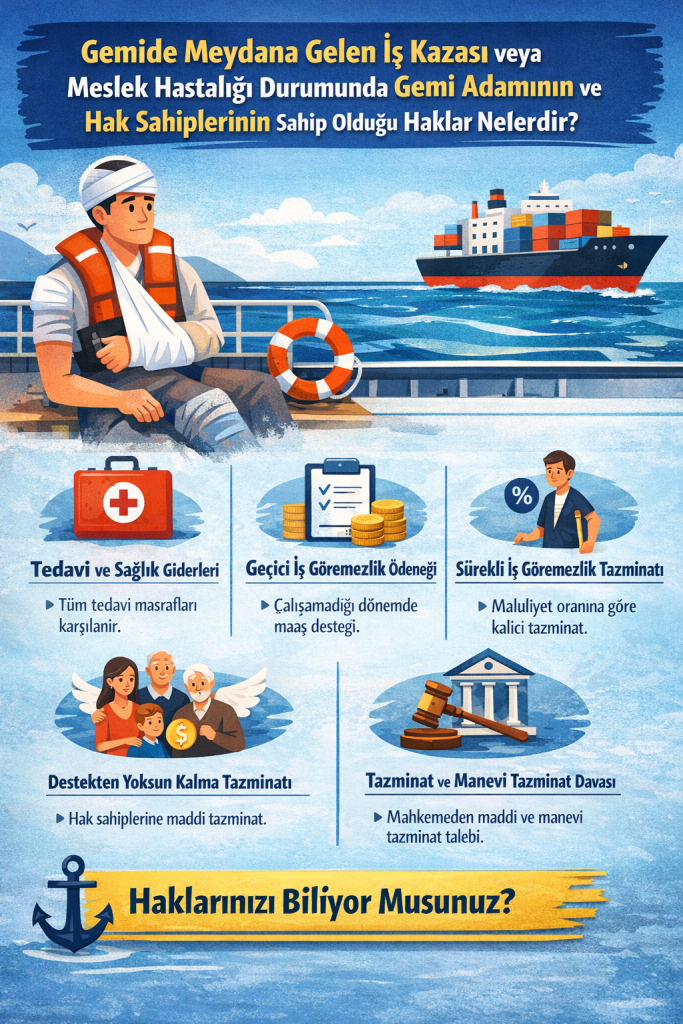
Sources in the literature address the rights of seamen and their beneficiaries in the event of an occupational accident or occupational disease occurring on a ship under three main headings: Social Security Institution (SGK) provided rights, compensation rights that can be claimed against the employer, and rights related to the termination of the employment contract. The legal basis for these rights is established by the Social Insurance and General Health Insurance Law No. 5510 and the Maritime Labor Law. An occupational accident is defined as “an event occurring at the workplace or due to the performance of work, causing death or physically or mentally disabling the body’s integrity”; while an occupational disease is defined as “a temporary or permanent illness, physical or mental disability suffered by the insured person due to a repeated cause arising from the nature of the work performed or due to the conditions under which the work is carried out.” The fundamental difference between the two concepts is that an occupational accident occurs as a result of a sudden event, while an occupational disease emerges after a certain process.
1. Rights Provided by the Social Security Institution (SGK)
A seafarer who has an horrific accident or contracts an occupational disease on board is considered insured under Law No. 5510 and primarily benefits from the rights provided by the SSI (Social Security Institution). These rights are valid for the insured person themselves or their beneficiaries in case of death. Law No. 5510, which came into force in 2008, actually regulates the legal consequences of occupational accidents and diseases in terms of the social security system. These regulations include provisions such as the payment of temporary or permanent incapacity benefits to the insured, coverage of treatment expenses, and the payment of income to beneficiaries in case of death. The purpose of this branch of insurance is “to directly protect insured persons in the event of an accident that can be classified as an occupational accident, and to determine the institution that will provide assistance to those who suffer harm as a result of the accident.“
2. Compensation Rights That Can Be Asserted Against the Employer
The assistance provided by the SSI may not cover the entirety of the damage suffered by the seafarer. In this case, the seafarer or their beneficiaries have the right to file a lawsuit for material and moral damages against the employer for the damages not covered by the SSI.
Pecuniary and Non-Pecuniary Damages: In other words, an employee who has suffered an occupational accident or occupational disease may sue the employer for damages not covered by the Social Security Institution. The employer’s liability is generally based on their fault stemming from not taking occupational health and safety measures. In calculating pecuniary damages resulting from an occupational accident or occupational disease, the aim is to place the employee in the same financial position they would have been in had the accident or disease not occurred. This includes loss of earnings due to incapacity for work, treatment expenses, and damages arising from the disruption of economic future. Additionally, non-pecuniary (moral) damages may be claimed due to physical or psychological suffering.
Employer’s Liability: At the core of the employer’s liability lies the obligation to protect the employee’s health and safety. In Turkey, it is accepted that the employer is responsible for damages arising if an employee contracts an occupational disease or experiences an occupational accident at the workplace due to the employer’s failure to take the necessary measures to protect the employee’s interests and health.”
3. Right to Terminate the Employment Contract
An occupational accident or occupational disease may permanently affect the seafarer’s health, preventing them from working on board the vessel. In such a case, both the seafarer and the employer are granted the right to immediately terminate the employment contract.
Termination Under the Maritime Labour Law: For employees subject to the Maritime Labour Law and qualified as “seafarers,” this right is specifically regulated in Article 14 of the law. According to this regulation, the employment contract may be terminated immediately in cases where “… b) The seafarer contracts a disease that permanently prevents them from working on board the vessel for any reason or becomes disabled…”
Conditions for the Right of Termination: The illness must be of a nature that prevents working on the ship and this condition must be permanent. Whether the illness originates from an occupational accident or occupational disease, or whether it occurs on board or off the ship, is not important for the right of termination. What is important is that the resulting health problem constitutes a permanent impediment to working on the ship.
Distinction Between Occupational Accident and Occupational Disease Literature frequently emphasizes the fundamental distinction between an occupational accident and an occupational disease. The striking distinguishing factor between an occupational disease and an occupational accident is that an occupational disease occurs ‘due to a repeated cause’; while an occupational accident occurs ‘suddenly’. Although this distinction is important for the detection and investigation of the incident, it is generally accepted “in doctrine that there is no difference between an occupational accident and an occupational disease in terms of insurance rights and compensation rights to be received from the employer.”
Regulations Specific to Maritime Labor Law Occupational accidents and diseases occurring on board are subject to special protection not only under general provisions but also within the scope of Maritime Labor Law and international conventions. The MLC 2006 Convention regulates the employer’s liability and the conditions of this liability in case of illness, injury, or death of seafarers. According to the second article of the Convention, it is stated that the employer is responsible for deaths resulting from illness and injury occurring between the date specified in the articles of the employment contract as the start date of employment and the date on which the employment ends…” This offers an additional guarantee mechanism for seafarers.
Scope of Employer’s Responsibility The employer’s responsibility is not limited solely to compensation liability after an accident or illness occurs. The primary responsibility is to prevent such incidents by taking occupational health and safety measures. Work accidents and occupational diseases stem from the production conditions in the workplace, which, in a sense, are the conditions provided by the employer. The employer’s failure to take these measures forms the basis of their legal and criminal liability.
Conclusion
A seafarer who suffers a work accident or contracts an occupational disease on board a ship benefits from multi-layered legal protection. This protection includes;
social security rights provided by the SSI in accordance with Law No. 5510,
material and moral compensation lawsuits to be filed based on the employer’s fault for damages not covered by the SSI,
the right to immediately terminate the employment contract in accordance with Article 14 of the Maritime Labor Law, if the health condition permanently prevents working on board.
The employer’s responsibility is regulated by both national legislation (Law No. 5510, Maritime Labor Law, Code of Obligations) and international conventions such as MLC 2006, and it is fundamentally based on the obligation to ensure the health and safety of the worker.
Frequently Asked Questions
Gemide iş kazası geçiren gemi adamı hangi haklara sahiptir?
Gemide iş kazası geçiren gemi adamı, öncelikle SGK kapsamında tedavi giderlerinin karşılanması, geçici veya sürekli iş göremezlik ödeneği gibi haklardan yararlanır. Ayrıca uğradığı zarar SGK tarafından tam karşılanmazsa, işverene karşı maddi ve manevi tazminat davası açabilir.
Meslek hastalığı ile iş kazası arasında haklar açısından fark var mı?
Hayır. İş kazası ani bir olay sonucu, meslek hastalığı ise zaman içinde oluşur. Ancak her iki durumda da gemi adamının sosyal güvenlik hakları ve işverene karşı tazminat hakları aynıdı
Gemi adamı iş kazası sonrası iş sözleşmesini feshedebilir mi?
Evet. Eğer gemi adamının sağlık durumu sürekli olarak gemide çalışmasına engel hale gelmişse, Deniz İş Kanunu kapsamında iş sözleşmesini haklı nedenle derhal feshedebilir.
Why is Expert Seafarer Lawyer Support Necessary?
Occupational accidents and diseases occurring on board, unlike classic labor law disputes, is a technical field that requires the combined evaluation of maritime labor law, international conventions (MLC 2006), SSI legislation, and employer responsibility. In this process, determining which damages will be covered by the SSI, which compensation items can be claimed from the employer, and how fault rates will be determined requires serious expertise.
Especially in cases involving foreign-flagged vessels, international conventions, and different legal systems, mishandling the process can lead to significant loss of rights. Therefore, working with an experienced seafarer’s lawyer in this field is critically important for the proper management of the process.
At this point, 2M Law Office, providing services with its expert staff in the field of maritime labor law and occupational accidents, offers effective and results-oriented legal support to its clients in compensation processes arising from occupational accidents and diseases for seafarers.