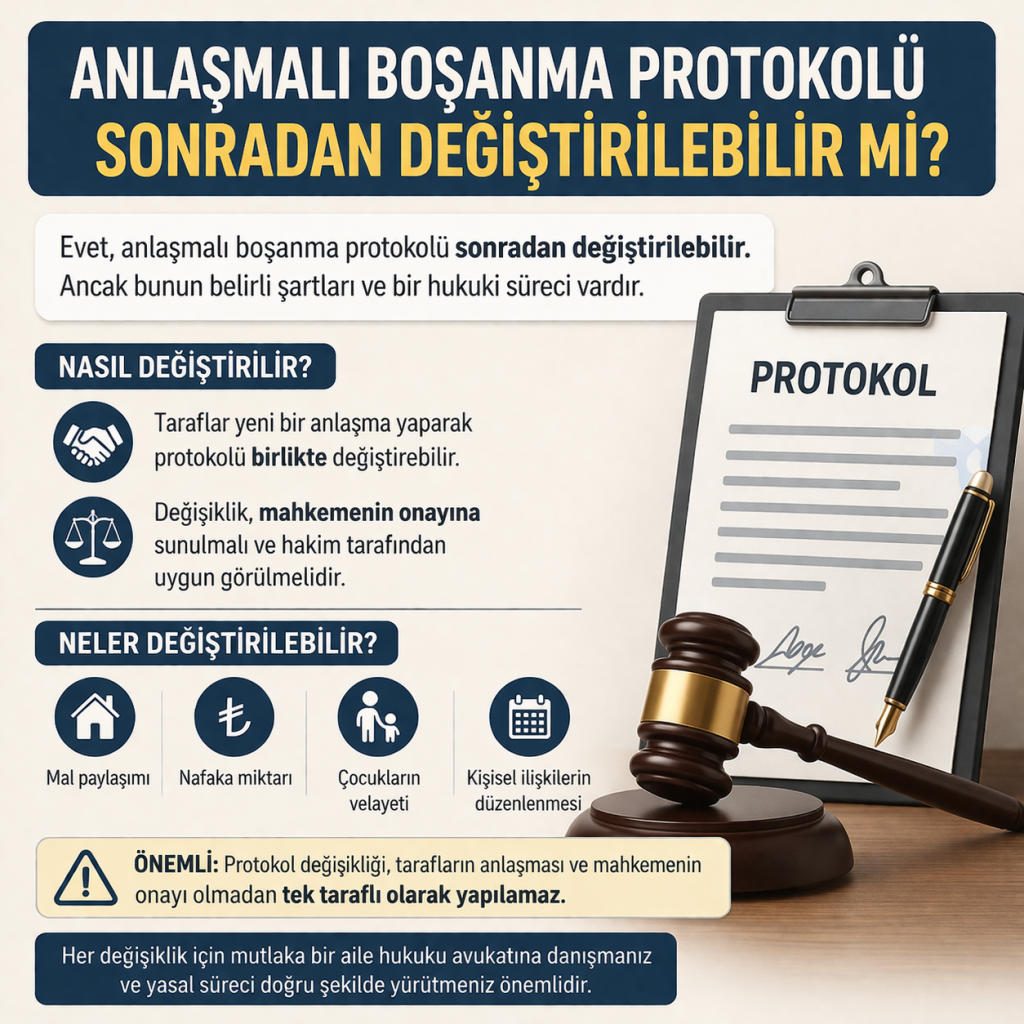
Can an Uncontested Divorce Protocol Be Changed Later? (Comprehensive Guide)
The uncontested divorce process allows parties to end their marriage quickly by agreeing on many legal issues. However, one of the most frequently asked questions in practice is: “Can an uncontested divorce protocol be changed later?”
The answer to this question is too comprehensive to be given in a single sentence. This is because the protocol yields different results at different legal stages: while the divorce case is ongoing, before the decision becomes final, and after the decision becomes final.
In this guide, we address the process holistically, in line with the principles accepted in both practice and Supreme Court decisions. Specifically, with the experience of a 2M Hukuk Avukatlık Bürosu (2M Law Office), the following critical issues will be examined in detail:
1. General Principle and Scope
The agreed divorce protocol is subject to different legal regimes concerning the divorce lawsuit process and the period after the divorce decision becomes final. After the divorce decision becomes final; matters concerning public order and requiring continuity, such as custody, alimony, and personal relations, depending on changing circumstances, can always be rearranged through litigation. Decisions made in these matters do not constitute “res judicata” (final judgment).
2. Modification of the Protocol Before the Divorce Decision Becomes Final
According to Supreme Court precedents, there is no legal provision preventing the parties from withdrawing their declarations of will in the protocol until the agreed divorce decision becomes final.
Withdrawal of Will: The parties may withdraw from the arrangements they accepted regarding the financial consequences of the divorce or the situation of the children until the decision becomes final. In this case, the lawsuit transforms into a “contested divorce” (Turkish Civil Code art. 166/1-2) procedure.
New Agreement at Appeal Stage: The parties, even at the appeal stage after the local court decision, can reach a new agreement on custody or other matters. The Supreme Court states that new protocols submitted during the appeal process must be evaluated by the court by personally summoning the parties.
3. Modification of the Protocol After the Divorce Decision Becomes Final
The modification of protocol provisions after the divorce decree becomes final is generally contingent on the existence of “changed circumstances” and the “best interest of the child.”
Custody and Personal Relationship: Even if custody was granted to the father in the consensual divorce protocol, changing circumstances such as the mother failing to fulfill her custody duties or the child actually residing with the father may be subject to a custody modification lawsuit. Personal relationship (contact) arrangements may also be reorganized by the court when the child’s benefit requires it or when the parties’ circumstances change (e.g., professional circumstances).
Alimony/Maintenance Arrangements: The child support or spousal support agreed upon in the protocol can be increased, decreased, or abolished if the parties’ financial situations change or if equity requires it (Turkish Civil Code Art. 176/4). The principle of adherence to the contract may be limited within the framework of the rule of honesty in cases of extraordinary changes in circumstances.
Financial Obligations and Adjustment: Obligations such as rent, maintenance fees, or education expenses included in the protocol may be subject to an adjustment lawsuit due to payment difficulties or unforeseen changes in the parties’ economic situation (e.g., the woman remarrying). However, in such requests, it must be proven that the balance between the performances has been disrupted to an unbearable extent.
4. Limitations and Procedure in Modification Requests
Time Factor: Modification lawsuits filed very shortly after the finalization of the divorce decree (e.g., 1 month or 7 months), without proving any change in circumstances, are rejected in accordance with the principle of “adherence to the contract”.
Enforcement and Release Protocols: The provisions of a finalized court order cannot be directly altered by external protocols made between the parties (e.g., release protocols revising the amount of alimony). For such changes, it is mandatory to file a lawsuit for the reduction or termination of alimony in the competent court.
5. Secondary Source Considerations
The following points provide additional context in light of the limited information in the decision texts:
Judge’s Power to Intervene: While a divorce case is ongoing, the judge may amend the protocol, considering the interests of the children and the parties. However, for these amendments made by the judge to be valid, it is a condition that the parties explicitly accept this new arrangement before the court. Protocol amendments made ex officio by the judge without the parties’ consent are grounds for reversal.
Future Increases: If the protocol specifies the rate of alimony increase for future years (e.g., 15%), this provision retains its binding nature. This rate can only be changed by a new court decision.
Personal Belongings: Unless there is an “explicit” statement in the protocol that personal belongings will not be claimed, general phrases do not prevent claims for personal belongings; as these claims are not incidental to the divorce.
Frequently Asked Questions
Anlaşmalı boşanma protokolü kesinleştikten sonra tamamen değiştirilebilir mi?

Evet, ancak her hüküm için aynı durum geçerli değildir. Özellikle velayet, nafaka ve kişisel ilişki gibi kamu düzenini ilgilendiren konular, şartların değişmesi halinde dava yoluyla yeniden düzenlenebilir. Buna karşılık mal paylaşımı gibi kesinleşmiş mali hükümler kural olarak değiştirilemez; ancak istisnai durumlarda uyarlama davası açılabilir.
Boşanma kararı kesinleşmeden protokol değiştirilebilir mi?
Evet. Karar kesinleşinceye kadar taraflar protokoldeki irade beyanlarından dönebilir. Bu durumda anlaşmalı boşanma davası çekişmeli boşanmaya dönüşebilir. Ayrıca temyiz aşamasında dahi taraflar yeni bir anlaşma yapabilir ve bu protokol mahkemece değerlendirilir.
Nafaka ve velayet sonradan nasıl değiştirilir?
Nafaka, tarafların ekonomik durumunun değişmesi halinde artırılabilir, azaltılabilir veya kaldırılabilir. Velayet ise çocuğun üstün yararı gerektiriyorsa değiştirilebilir. Ancak bu değişiklikler ancak dava yoluyla ve mahkeme kararı ile mümkündür; tarafların kendi aralarında yaptığı anlaşmalar tek başına yeterli değildir.
Why is Expert Legal Support Necessary?
The preparation and subsequent modification of a consensual divorce protocol is a much more technical and risky process than commonly perceived. Especially, the statements included in the protocol can lead to binding results that may cause loss of rights in the future. Therefore, it is of great importance to work with a 2M Hukuk Avukatlık Bürosu from the very beginning of the process.
An expert Istanbul divorce lawyer or Tuzla divorce lawyer ensures that the protocol is prepared correctly and protects your rights in future disputes. Especially with the support of a Tuzla consensual divorce lawyer;
You can manage the process without suffering any loss of rights
You can arrange the protocol articles in a future-proof manner
You can create the right strategy regarding alimony, custody, and financial matters
You can file the correct type of lawsuit in situations requiring subsequent changes. It should not be forgotten that; a wrongly or incompletely prepared protocol can lead to new lawsuits lasting for years and significant financial losses. Therefore, obtaining professional legal support at every stage of the process is the safest way.