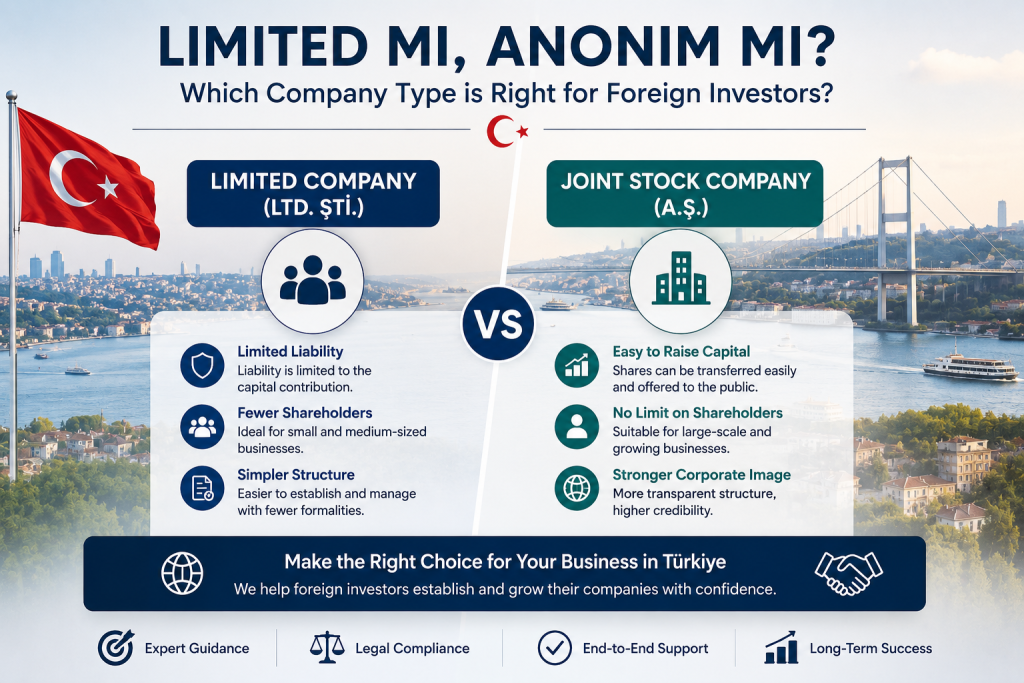
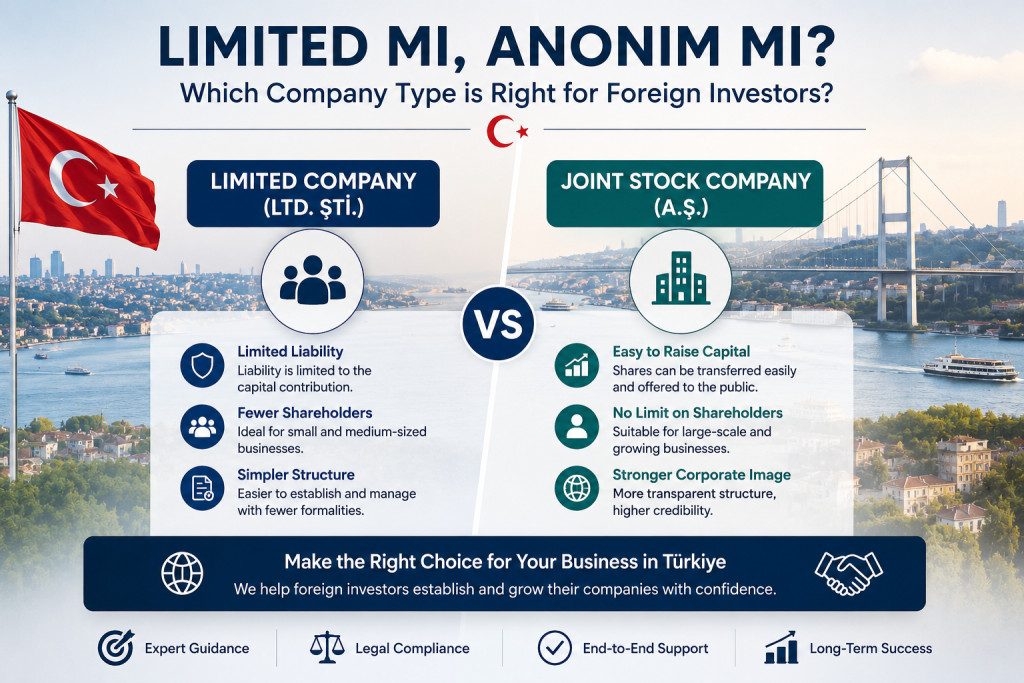
Every foreign investor who decides to establish a company in Turkey must answer this first question before establishment: Limited Company (Ltd. Şti.) or Joint Stock Company (A.Ş.)? This choice is not just a formality; it directly determines the tax you will pay in the future, whether your personal assets are at risk, the ease of transferring your shares, and your company’s capacity for attracting investors/going public.
In this guide, in light of 2026 regulations and current practices, we compare two company types focusing on capital, liability, share transfer, and tax; and clarify which one a foreign investor should choose in which scenario.
Short answer: For a small/medium-sized service, consulting, or trade business with few partners, a limited company is fast and economical. However, if it’s about protecting personal assets against public debts, being able to transfer shares tax-free, attracting investors, or aiming for prestige/going public, a joint stock company is often more advantageous.
Key Distinction: Which One for Whom?
Limited Company (Ltd. Şti.): Easy and inexpensive to establish; low capital; ideal for SMEs, sole proprietorships, consulting, e-commerce, and family businesses.
Joint Stock Company (A.Ş.): More corporate; flexible management and capital structure; tax advantage in share transfers; opportunity to attract investors, issue stocks/bonds, and go public; preferred for high turnover and personal protection in risky operations.
In both types, a foreigner can own 100%, it can be established with a single partner, and the process can be completed remotely by power of attorney; in this respect, there is no difference between them. The difference emerges under the following four headings.
Comparison Table
| Criterion | Limited Company (Ltd. Co.) | Joint Stock Company (JSC) |
|---|---|---|
| Minimum capital (as of 2024) | 50,000 TL | 250,000 TL (registered capital system 500,000 TL) |
| Number of partners/shareholders | 1–50 | Minimum 1, no upper limit |
| Partner’s/Shareholder’s liability for public (tax/SSI) debts | Personally liable in proportion to shareholding | Not liable (unless a board member) |
| Share/stake transfer method | Notary + partners’ board approval + share ledger + registration/announcement | Written transfer + delivery of share certificate (notary not required) |
| Share transfer tax | Always capital gains (income tax) | Capital gains exempt for shares held for 2 years |
| Management | Manager(s) — at least one partner must be a manager | Board of directors — external professionals can be appointed |
| Capital/investor flexibility | Limited | High (shares, bonds, public offering) |
| Prestige / corporateness | Medium | High |
| Mandatory contracted lawyer | None | Required above a certain capital (Law on Attorneyship Art. 35) |
| Administrative burden | Light | Heavier (general assembly, audit, etc.) |
| Corporate tax rate (2026) | 25% (same) | 25% (same) |
1) Liability: Is Your Personal Property at Risk?
This is the most critical difference that most investors overlook. In both types of companies, partners are generally liable for commercial debts only up to the amount of capital they invested. However, when it comes to public (state) receivables — tax and SSI (Social Security Institution) debts — the situation changes:
In a limited liability company (LLC): Pursuant to Article 35 of Law No. 6183 on the Procedure for the Collection of Public Receivables, partners are personally and directly liable for tax and SSI debts that cannot be collected from the company, in proportion to their capital shares. This means that even if you don’t have signing authority or are not in management, the state can claim its receivables from your personal assets.
In a joint-stock company (JSC): A partner who has paid their capital contribution has no personal liability for public debts. This liability applies only to board members/representatives (in their capacity as legal representatives). A JSC partner who is not on the board of directors is protected from this risk.
Conclusion: If you are planning high turnover, a risky sector, or debt/financing-intensive operations, a joint-stock company is significantly safer for protecting your personal assets. Indeed, in practice, many limited liability companies convert to joint-stock companies through a change of type when they grow and their risk increases.
2) Share Transfer and Tax: The Importance of the “2-Year Rule”
If you are considering selling your company or taking on a partner in the future, this section could make a difference of millions of liras.
The transfer of shares in a limited company is both formally burdensome (the transfer agreement must be notarized, approved by the board of partners, recorded in the share ledger, registered, and announced) and disadvantageous from a tax perspective: Since the share cannot be linked to a share certificate, the profit obtained no matter when you sell the share (whether after 1 month or 20 years) is subject to income tax as a capital gain (Income Tax Law, Repeated Article 80/4).
The transfer of shares in a joint-stock company is much simpler (a written transfer declaration and delivery of the certificate; no notary requirement). The main advantage is in tax: If share certificates (or temporary share certificates) have been issued and held by the real person partner for at least 2 years (730 days), the profit obtained from the sale is completely exempt from income tax (Income Tax Law, Repeated Article 80/1).
Practical note: In companies that transition from limited to joint-stock status through a change in type, the time the partner spent in the limited company is taken into account for the calculation of the 2-year period; however, it is mandatory to issue share certificates after the transformation. Therefore, for an investor with an exit plan, a joint-stock company, when structured correctly, provides a significant tax advantage.
3) Capital, Management, Prestige, and Going Public
Capital: A limited company is established with 50,000 TL, a joint-stock company with 250,000 TL (500,000 TL for non-public joint-stock companies adopting the registered capital system). A limited company offers a lower entry threshold.
Management: In a limited company, it is managed by the company manager(s) and at least one partner must be a manager. In a joint-stock company, it is managed by the board of directors; partners are not obliged to take part in management, an external professional manager can be appointed — this is suitable for investors/corporate structures.
Capital market: Only a joint-stock company can issue shares and bonds, go public and is suitable for venture capital/investment rounds.
Prestige and contracted lawyer: A joint-stock company is perceived as more corporate; in return, joint-stock companies with a registered capital above a certain amount must employ a contracted lawyer (Attorneys at Law Act Art. 35) and its obligations such as general assembly/audit are more burdensome.
Equality in taxation: The corporate tax rate is the same for both types (25% in 2026). The difference arises at the shareholder level (share transfer and dividend).

Decision Guide for Foreign Investors
A limited company is suitable for you: Single-person or with few partners; consulting, engineering, software, e-commerce, or service business; low startup cost is your priority; no plans for share sales/investors in the near future.
A joint-stock company is suitable for you: High turnover or risky operations (personal protection); future share sale/exit (2-year tax exemption); investor rounds, shares/bonds, or going public; multiple partners, corporate structure, and prestige.
Remember: the decision is not irreversible. A limited company can later be converted into a joint stock company through a change of type; however, planning it correctly from the start is much more efficient in terms of both time and tax.
Why is Expert Legal Support Necessary?
Although the choice between a limited and joint stock company may seem simple at first glance, it is a strategic decision made within the triangle of tax, liability, and exit strategy. Choosing the wrong type can lead to your personal assets being exposed to public debts in the future, unnecessary tax burdens on share sales, or structural obstacles during investor rounds.
As 2M Law Office, with our Istanbul-based corporate law and consultancy team, we offer end-to-end support to foreign investors, from choosing the correct company type to structuring the articles of association according to investor/exit scenarios, from issuing shares/interim receipts, to changes in company type and share transfer agreements (SPA). Our Istanbul lawyer team plans your structure according to 2026 tax advantages, prepares your contracts bilingually, including English and Arabic, and works in coordination with your financial advisor.
Let’s determine together which structure is suitable for you. Contact us for a free preliminary assessment.
Frequently Asked Questions (FAQ)
Is a limited company or a joint stock company better for a foreign investor? For a single/few partner, low-cost start, a limited company is better; if there is a goal of personal protection, tax-free share transfer, attracting investors, or going public, a joint stock company is more advantageous.
Is a limited company partner personally liable for the company’s tax debt? Yes. For tax and SSI debts that cannot be collected from the company, the limited partner is directly and personally liable in proportion to their capital share (Law no. 6183, Art. 35). However, in a joint-stock company, a partner who is not on the board of directors is not liable for this debt.
Why can share sales in a joint-stock company be tax-exempt? If share certificates (or temporary certificates) have been issued and the individual partner has held them for at least 2 years (730 days), the gain from the sale is exempt from income tax (Income Tax Law, Art. 80/1, Additional). There is no such exemption for limited liability share transfers.
Can both types of companies be established with a single partner and foreign ownership? Yes. Both limited and joint-stock companies can be established remotely with 100% foreign ownership by a single foreign individual partner, via power of attorney.
Is the corporate tax rate different for limited and joint-stock companies? No. In 2026, the general corporate tax rate for both types is 25%. The difference lies in the taxation of share transfers and profit distribution at the partner level.
Can I later convert a limited company into a joint-stock company? Yes. Conversion of type (change of legal form) is possible; the period spent as a limited company is taken into account for the 2-year share exemption calculation, but share certificates must be issued after the conversion.
This content is for general informational purposes only and does not constitute legal advice. Regulations and amounts may change; before making your company type decision, please contact 2M Hukuk Avukatlık Ofisi to receive a specific assessment for your situation.