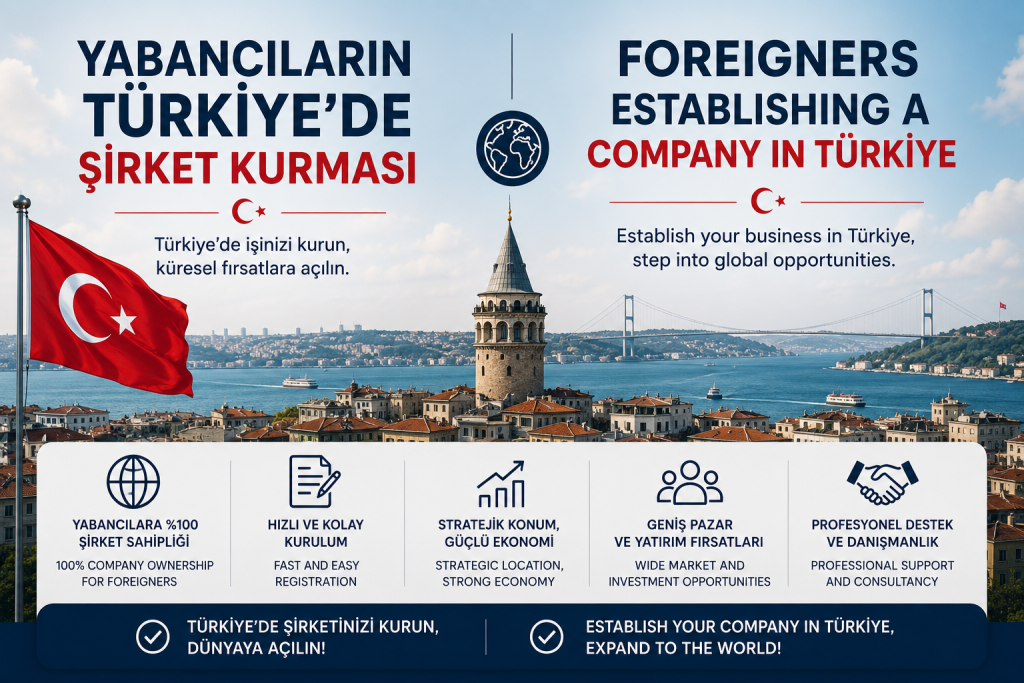
Turkey, with its strategic location at the intersection of Europe, the Middle East, and Central Asia, a young market exceeding 85 million people, and a customs union with the EU, is one of the most practical gateways for foreign investors. The good news is: a foreigner can own 100% of a company in Turkey, does not need a Turkish partner for this, and can complete the entire process remotely by proxy without ever coming to the country.
In this guide, in light of current legislation and Ministry regulations as of 2026; we have explained everything you need to know, from company type selection to the step-by-step establishment process, from costs to taxes and new investment incentives.
Short answer: Foreign natural and legal persons can establish companies under the same conditions as Turkish citizens, in accordance with the principle of equal treatment in the Foreign Direct Investments Law No. 4875. The most common choice is the limited company (Ltd. Şti.), which can be established with a single partner and low capital. The establishment process is usually completed within a few business days to 2 weeks.
Can Foreigners Establish a Company in Turkey?
Yes. The Foreign Direct Investments Law No. 4875 considers foreign investors equal to domestic investors. The practical consequences of this are:
There is no local partner requirement. The entire company (100%) can be owned by a foreigner.
Can be established with a single person. The Turkish Commercial Code allows for the establishment of both limited and joint-stock companies with a single partner; this partner can be a foreign natural person.
Physical presence in Turkey is not required. With a duly prepared power of attorney (POA), notary, commercial registry, and banking transactions can be carried out by your local representative/lawyer.
The director can also be a foreigner. Only the foreigner who will actually manage the company (working as a director) also needs to obtain a work permit.
Only for reasons of national security and public order are there restrictions or permit requirements in some sectors (e.g., certain defense, aviation, media areas); otherwise, almost all fields of activity are open to foreigners.
Which Company Type Should You Choose? Limited or Joint Stock?
The vast majority of foreign investments are established with one of two structures: Limited Company (Ltd. Şti.) and Joint Stock Company (A.Ş.).
| Criterion | Limited Company (Ltd.) | Joint Stock Company (JSC) |
|---|---|---|
| Minimum capital (as of 2024) | 50,000 TL | 250,000 TL |
| Number of partners/shareholders | 1–50 | At least 1 |
| Liability | Limited to capital | Limited to capital |
| Share transfer | Notary + registration + announcement (more burdensome) | Easier (especially for bearer shares) |
| Going public / Attracting investors | Not suitable | Suitable |
| Administrative burden | Light | Heavier |
| Ideal for whom? | SME, consulting, service, e-commerce, startup | Large scale, multiple partners, plan to go public |
Practical advice: For a one-person or small/medium-sized service, consulting, technology, or trade business, a limited company is generally the most appropriate choice. If you plan to attract investors, transfer shares, or go public in the future, a joint-stock company can be considered; a limited company can be converted to a joint-stock company later.
Step by Step: Company Formation Process in Turkey (2026)
Obtaining a tax identification number. A potential tax number is obtained from the interactive tax office for foreign partner(s) and, if applicable, foreign director(s). A notarized (and apostilled, if necessary) copy of the passport is prepared.
Preparation of the articles of association and MERSİS application. The company’s title, field of activity and codes, capital, and partnership structure are determined; the articles of association are prepared via MERSİS (Central Registry System). A title availability check is performed at this stage.r.
Power of attorney / signature procedures. If you are abroad, a notarized/consular approved power of attorney is prepared for your representative who will carry out the procedures.
Commercial registry registration and announcement. The articles of association are registered with the relevant Commercial Registry Office and announced in the Turkish Commercial Registry Gazette. At this stage, the company acquires legal personality.
Chamber of commerce/industry registration and ledger approvals. Legal ledgers are approved during establishment; chamber registration is completed.
Tax office and SSI registration. The company’s tax liability is opened; if employees will be hired, an SSI workplace file is opened.
Opening a corporate bank account and capital procedures. A bank account is opened in the company’s name. Important: In a limited company, it is not mandatory to block the capital in the bank at the time of establishment; the committed capital can be paid within 24 months after registration.
e-Notification, e-invoice/e-ledger and activation. Mandatory electronic systems are defined and the company becomes ready for operation.
How Long Does It Take?
Company establishment (registration): If documents are complete, usually between a few business days and 2 weeks.
Bank account, tax/SSI activation: A few extra days.
Work and residence permit (if required): Usually 4–8 weeks.
Therefore, establishing the company on paper is fast; the part that requires actual planning is the permit and financial setup phase.
Establishment Cost (2026, Approximate)
The cost varies depending on the province, capital amount, and scope of services. Main items:
Minimum capital: Limited company 50,000 TL (not blocked, payable within 24 months).
Notary (articles of association, signature declaration, ledger certification, power of attorney): approximately 4,000–6,500 TL.
Trade registry registration + announcement + chamber registration: approximately 14,000 TL and above (varies by province).
Competition Authority share: 4 per ten thousand of the establishment capital according to Law No. 4054 (e.g., ~20 TL for 50,000 TL capital).
Financial advisor establishment service fee and monthly accounting fee.
Attorney / legal consultancy fee (contract, documents, permit follow-up).
Pay attention to promises like “Company in 1 day, without documents”; these are high-risk and unlawful methods. In Turkey, it is mandatory to work with a licensed financial advisor and submit regular declarations; neglect will cause serious problems in future residence permit renewals and tax audits.
Taxation of Foreign Companies and 2026 Investment Incentives
General framework: The general corporate tax rate in Turkey is 25% in 2026. Additionally, VAT, withholding tax, and SSI premiums are applied where necessary. Withholding tax applies to profit distribution (dividends) to foreign partners; this can be reduced by the double taxation avoidance agreement between your country and Turkey.
2026’s game-changing development — Turkey Century Strong Center Program for Investment. The package, announced on April 24, 2026, and enacted by Law No. 7582 (Repeated Article 20/D added to the Income Tax Law; Official Gazette dated June 4, 2026, and numbered 33270), brought significant advantages for foreign investors:
20-year tax exemption for foreign-sourced income: For individuals who have not been taxpayers in Turkey for the last 3 years and who settle in Turkey, foreign-sourced earnings are exempt from income tax for 20 years; only domestic income in Turkey is subject to tax.
Reduced corporate tax for exporters: The rate has been reduced to 9% for manufacturing exporters, and to 14% for other exporters.
Full exemption in service exports: In fields such as software, engineering, architecture, and design, a full exemption was provided by increasing the deduction rate to 100% for earnings from services rendered abroad.
Istanbul Finance Center (IFC): For transit trade and intermediation in international sales, corporate tax is 0% within the IFC, and 1.25% for the same business outside the IFC.
Asset amnesty-like regulation: Bringing money, gold, and securities from abroad to Turkey with low taxes; a commitment that no tax audit will be conducted for these assets.
These incentives make Turkey extremely attractive, especially for consultancy, engineering, and technology companies that will export services from Turkey abroad. However, the details of the implementation (activity code selection, exemption conditions, documentation) should be structured in consultation with a sworn financial advisor.
Work and Residence Permit: Who Will Manage the Company?
If you will personally manage the company (as a manager/employee), first a short-term residence permit is obtained, followed by a work permit from within the country; the work permit replaces the residence permit for its duration. For foreign company partners, the rule of “5 Turkish personnel for every foreign national” applies from the 7th month of the permit; however, if your capital share is 100,000 USD or more, these employment and financial criteria are completely removed.
If you do not want to manage the company personally, a Turkish citizen can be appointed as a manager; in this case, as a passive/non-resident partner, you do not need a work or residence permit (provided that the representation rules in company law are observed).
Most Common Mistakes Made by Foreigners
Randomly choosing activity codes and missing out on the service export exemption.
Establishing a company “solely for residence” and leaving it inactive — this is a risk of refusal during residence permit renewal; the administration seeks a company that is genuine and active.
Neglecting accounting and declaration obligations; penalties are severe.
Not drafting contracts (lease, partnership, supply) in compliance with Turkish law and in a bilingual format.
Drafting the power of attorney with insufficient/incorrect scope, thereby blocking transactions.
Why is Expert Lawyer Support Necessary?
Establishing a company in Turkey is technically possible and fast; however, establishing the correct structure, optimizing tax, and avoiding future problems requires expertise. The wrong company type, incorrect activity code, an incomplete power of attorney, or a neglected declaration can lead to the loss of time, money, and even your residence permit.
As 2M Hukuk Law Office, with our Istanbul-based team, we offer end-to-end legal consultancy to foreign investors, from company establishment to permit processes and commercial dispute management. Our Istanbul lawyers team structures your articles of association and activity codes according to 2026 incentives, manages your work/residence permit applications, prepares your contracts bilingually including English and Arabic, and works in coordination with your financial advisor throughout the process. Our goal is not just to complete the establishment quickly; it is to provide you with a long-term compliant, protected, and tax-efficient structure.
Our office, offering services in English and Arabic, acts as the sole point of contact in Turkey for investors coming from abroad, handling all bureaucracy on your behalf.
Contact us for a free preliminary assessment. Let’s jointly determine the most suitable company type, capital level, and permit path for your situation.
Frequently Asked Questions (FAQ)
Can a foreigner establish a company in Turkey alone (with a single partner)? Yes. Both limited liability and joint-stock companies can be established with a single partner, and this partner can be a foreign natural person; there is no obligation for a Turkish partner.
Can I establish a company remotely without coming to Turkey? Yes. With a duly prepared power of attorney, notary, trade registry, and banking transactions can be carried out by your local representative; the entire process can be completed remotely.
What is the minimum capital and do I need to block it in the bank? In a limited liability company, the minimum capital is 50,000 TL. In a limited liability company, the capital is not blocked at establishment; it can be paid within 24 months after registration. (In a joint-stock company, 25% of the cash capital is blocked before registration.)
Does establishing a company automatically grant me a residence permit? No. Company ownership forms a basis for a residence/work permit; however, the permit is obtained through a separate application, and the company is expected to be real/active.
What is the corporate tax rate in Turkey? In 2026, the general rate is 25%. Significant reductions and exemptions have been introduced with the 2026 incentive package for exporters (manufacturers 9%, others 14%) and software/engineering/architecture/design companies providing services abroad.
How long does company establishment take? If the documents are ready, registration is usually completed within a few business days to 2 weeks; if a work/residence permit is required, an additional 4–8 weeks should be anticipated.
Am I obliged to employ local Turkish personnel? If you obtain a work permit as a company partner, the “5 Turkish personnel” rule applies from the 7th month of the permit; however, if your capital share is 100,000 USD or more, this obligation is completely removed.