
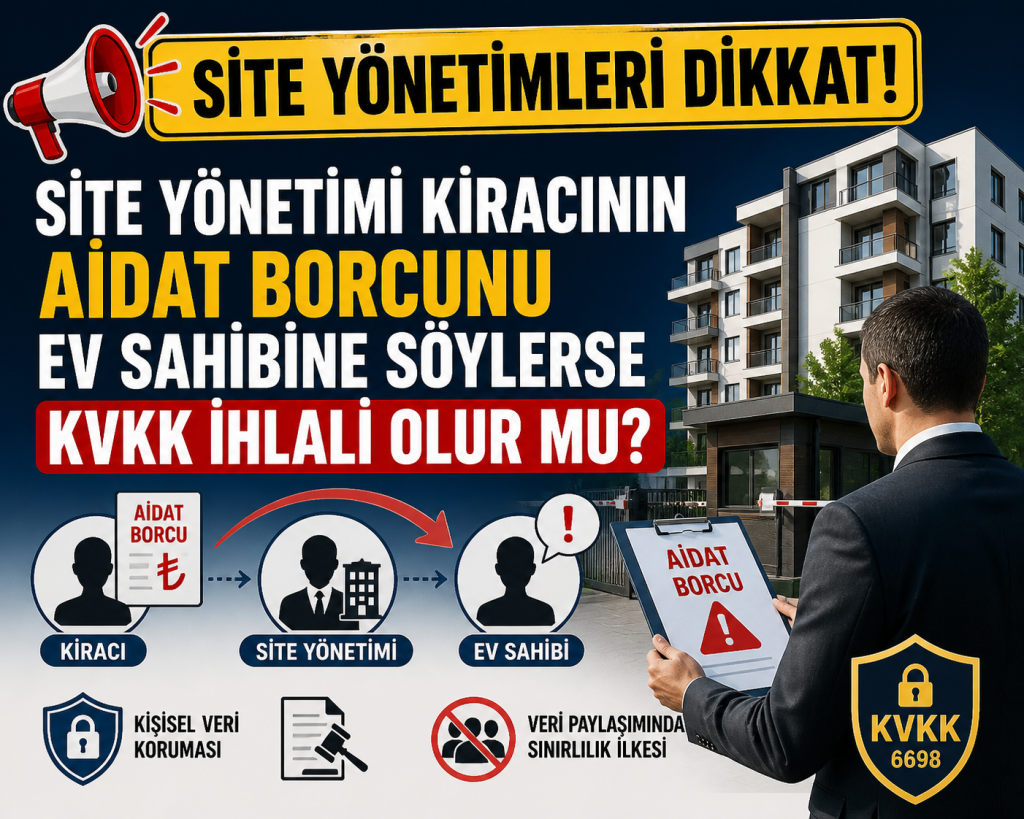
Introduction: The Balance Between Tenant’s Maintenance Fee Debt and Personal Data Protection
In condominium law, the collection of common expenses (maintenance fees) frequently becomes a subject of dispute among site managements, flat owners, and tenants. In this process, the question of whether the sharing of information regarding a tenant’s unpaid maintenance fee debt by the site management with the landlord (flat owner) constitutes a violation under the Personal Data Protection Law No. 6698 (KVKK) is critical for determining the boundary between property rights and data privacy. The Personal Data Protection Board (KVKK Board) and Supreme Court jurisprudence shape the legal basis of this sharing within the framework of the principles of “joint and several liability” and “establishment of a right.”
1. KVKK Board’s Fundamental Approach: Analysis of Decision No. 2020/755
The Personal Data Protection Board’s decision dated 29.09.2020 and numbered 2020/755 provides the most concrete and binding assessment on this matter. In the incident subject to the decision, a tenant claimed that the transmission of their maintenance fee debt information to the landlord by the site management without their consent constituted a KVKK violation.
In its examination, the Board made the following fundamental determinations:
Joint and Several Liability: According to Article 22 of the Condominium Law No. 634 (KMK); those who continuously benefit from the independent section based on a lease agreement or another reason are also jointly and severally liable for the common expenses and advance payments debt of the flat owner.
Legal Interest: The landlord has a direct interest in knowing whether their tenant has paid their dues, both in terms of their own responsibility and the site management’s interest in collecting its receivables.
Reason for Lawfulness: The Board determined that this sharing falls within the scope of “processing of personal data is necessary for the establishment, exercise or protection of a right” under subparagraph (e) of paragraph (2) of Article 5 of the KVKK, and decided that no action would be taken regarding the complaint.
2. Condominium Law Article 22 and the Principle of Joint and Several Liability
Article 22 of the Condominium Law, which is the main legal basis in the KVKK Board’s decision, is consistently emphasized in Supreme Court rulings. Supreme Court jurisprudence, considered a secondary source, details this “chain of liability” between landlord and tenant as follows:
Scope of Liability: As stated in the ruling of the 20th Civil Chamber of the Supreme Court dated 16.10.2017, numbered 2017/4360 E. and 2017/7767 K., those who continuously benefit from the independent section (tenants) are jointly liable with the flat owner for common expenses. This situation allows the manager to sue both parties to collect the receivables.
Limitation by Rent Amount: In the decision dated 21.06.2011, numbered 2011/3632 E. and 2011/7507 K. of the 18th Civil Chamber of the Supreme Court, it was reminded that the tenant’s joint and several liability is “limited to the rent amount they are obliged to pay” and that the payment made would be deducted from the rent debt.
Condition of Use: In the decision dated 09.11.2017, numbered 2017/7160 E. and 2017/9135 K. of the 20th Civil Chamber of the Supreme Court, it was emphasized that the person actually using the independent section (tenant or co-owner) could be held responsible for the entire debt according to Article 22 of the Condominium Law (KMK).
3. Evaluation of Data Sharing within the Scope of “Protection of Rights” (Secondary Source Analysis)
The sharing of tenant data is not limited to maintenance fees but also has a broad application in terms of debt collection and the execution of legal processes.
Debt Collection and Data Processing: In the decision of the KVKK Board dated 07.07.2022 and numbered 2022/655, it was stated that the fact that a debt is demandable constitutes a data processing reason in itself, and that the processing of contact information by the creditor for the purpose of protecting their rights is lawful under KVKK Article 5/2(e).
Assignment of Receivables and Collection: In the KVKK Board’s decision dated 27.04.2021 and numbered 2021/424, it has been confirmed that the transfer of data for the purpose of collecting receivables is necessary for “the establishment and protection of a right”. This situation is analogously consistent with the site management informing the apartment owner while pursuing collection of unpaid dues.
Judicial Activity Exception: In the KVKK Board’s decision dated 27.01.2020 and numbered 2020/59, the processing of data for the purpose of submitting it as evidence to court or seeking legal rights has been considered an exception related to judicial activity under KVKK article 28/1(d).
4. Other Important Decisions of the Supreme Court of Appeals Regarding Joint and Several Liability
The following decisions reinforce the grounds of “joint and several liability” which legitimizes sharing information about a tenant’s due debt with the landlord:
Supreme Court of Appeals 5th Civil Chamber, 07.05.2024, 2024/3682 E., 2024/5534 K.: It confirmed that individuals who continuously use an independent section (spouse, tenant, etc.) are jointly and severally liable for the debt.
Supreme Court of Appeals General Assembly of Civil Chambers, 26.01.1994, 1993/666 E., 1994/3 K.: Stating that KMK article 22 should be interpreted broadly, otherwise, there would be a risk of disruption to common services, and, in principle, accepted the tenant’s liability.
Court of Cassation 18th Civil Chamber, 06.04.2016, 2015/9305 E., 2016/5763 K.: Accepting the joint and several liability of tenants for common expenses (dues) limited by the rental amount, it was emphasized that this relationship constitutes a legal liability independent of the internal relationship between the landlord and the tenant.
Conclusion and Evaluation
In light of the Personal Data Protection Board’s decision numbered 2020/755 and numerous Court of Cassation precedents supporting this decision, sharing a tenant’s common expense (dues) debt information with the landlord is not considered a KVKK violation.
The fundamental reasons for this legality are as follows:
Legal Basis: According to Article 22 of the Condominium Law (KMK), the landlord and tenant are jointly (and severally) liable for the debt.
Data Processing Condition: The sharing must be necessary for “the establishment, exercise, or protection of a right” (e.g., for the landlord to be relieved of the debt or for the site management to collect its receivables) according to KVKK Article 5/2(e).
Legitimate Interest: The landlord’s legal and financial interest in monitoring the payment status of a debt item (dues) for which they are primarily responsible.
However, it should not be forgotten that if this sharing exceeds its purpose (for example, if the debt information is announced to all residents) a risk of violation may arise within the framework of data minimization and proportionality principles. Current judicial decisions find sharing lawful, provided that the information remains directly among the relevant parties (management-owner-tenant).
For the Personal Data Protection Authority’s decision on this matter, see.
Frequently Asked Questions
Site Yönetimi Kiracının Aidat Borcunu Ev Sahibine Söylerse KVKK İhlali Olur mu?

Hayır, her somut olayın şartları ayrıca değerlendirilmekle birlikte, 634 sayılı Kat Mülkiyeti Kanunu m.22 gereği kiracı ve kat maliki ortak giderlerden müteselsilen sorumlu olduğundan, aidat borcunun tahsili amacıyla malik ile paylaşım çoğu durumda hukuka uygun kabul edilmektedir.
Kiracı Aidat Ödemezse Site Yönetimi Doğrudan Ev Sahibine İcra Takibi Başlatabilir mi?
Evet. Kat maliki ortak giderlerden asli sorumlu olduğundan, site yönetimi kiracıya gitmeden doğrudan kat malikine karşı icra takibi başlatabilir; malik daha sonra kiracıya rücu edebilir.
Site Yönetimi Aidat Borcunu WhatsApp Grubunda veya Panoda Paylaşırsa KVKK Cezası Doğar mı?
Evet, borç bilgisinin ilgisiz üçüncü kişilerle, site WhatsApp gruplarında, ilan panolarında veya toplu mesajlarla paylaşılması veri minimizasyonu ve ölçülülük ilkelerine aykırılık oluşturabilir ve KVKK ile tazminat sorumluluğu gündeme gelebilir.
Why is Expert Lawyer Support Necessary?
Site management, and the collaborations between apartment owners and tenants, constitute a very flexible legal area that ensures the joint consideration of the provisions of the Condominium Law, Personal Data Protection Law, Turkish Code of Obligations, and Turkish Civil Code. Harmonious interpretation of KVKK Board decisions and Supreme Court precedents, especially delineating violations of data sharing, determining the duration of the data minimization principle, and the correct scope of joint and several liability, is quite difficult without professional legal advice.
2M Law Firm, with its condominium law, KVKK compliance, and site management departments, offers detailed legal support to site managements, apartment owners, and individuals with many years of experience. Our team of Istanbul condominium lawyers provides a wide range of services, from aid collection lawsuits to KVKK violation complaints, and from preparing management plans to rental agreements.
As Tuzla lawyers, Pendik lawyers, Kurtköy lawyers, and Kartal lawyers, we can provide on-site services to residential complex managements and flat owners in the densely populated residential complex districts of the Anatolian Side. Within the scope of our Residential Complex Management services; we offer support for the lawful utilization of collected maintenance fees, presentation of data processing inventory under KVKK, preparation of disclosure texts and explicit consent documents, updating of management plans, and developing defense strategies and technological support against potential professional disengagement issues.
It should not be forgotten that potential administrative fines by the KVKK Board can reach high amounts. To ensure your residential complex management fully complies with legal regulations, or to protect your rights if your personal data is unlawfully shared, you can formulate a legal strategy tailored to the specific case with 2M Law Office to find a solution.