
Below is an analysis of judicial decisions regarding the obligation of a spouse residing abroad to physically appear in court in divorce cases filed in Turkey and the procedural rules in this process:
1. Divorce Case: Obligation of Physical Attendance and Possibility of Representation
The examined judicial decisions do not contain a provision stating that it is an absolute necessity for a spouse living abroad to personally attend divorce hearings in Turkey. On the contrary, the decisions indicate that parties can exercise their right to defense through a representative (lawyer) or that the case can proceed in their absence (in absentia) if they do not attend the hearing despite proper notification.
Representation by Proxy: In a decision by the 2nd Civil Chamber of the Supreme Court (2023/4309 E.), it was observed that the female defendant abroad did not attend the hearings but appealed through her representative. Similarly, in a recognition decision regarding a case heard in Russia (2023/4533 E.), it was stated that the party presented their defense through their attorney, who acted as their representative, without physically appearing in court, and this was deemed sufficient for exercising the right to defense.
Evidence Collection via Letters Rogatory: When statements from a party or witnesses abroad need to be taken, the procedure of international judicial assistance (letters rogatory) can be used instead of physical attendance. In the decision of the General Assembly of Civil Chambers (2013/2225 E.), it was emphasized that the statements of witnesses located in the USA should be taken through US judicial authorities (via letters rogatory).
2. Notification Procedure and the Priority of the Right to Defense
The vast majority of court decisions focus on the case being duly served to the spouse abroad, rather than the spouse appearing in court. Pursuant to Article 27 of the Civil Procedure Code (HMK) No. 6100, within the scope of the “right to a fair hearing,” conducting proceedings without serving notice to the spouse abroad is a ground for reversal.
International Service Channels: Pursuant to Articles 25 and 25/a of the Notification Law, service of process to Turkish citizens abroad must be made through a consulate or embassy, and to foreign nationals through the competent authorities of that country (2009/827 E., 2012/17326 E.).
Consequences of Improper Service: For a spouse residing abroad, notifications made to their old address in Turkey or to relatives they do not live with are considered invalid (2014/15109 E., 2011/12270 E.). Judgments rendered without proper service are overturned by the Court of Cassation on the grounds of restricting the right to defense.
3. Consequences of Non-Appearance at the Hearing
If the spouse abroad has been duly served and given sufficient time to prepare their defense, the spouse’s non-appearance at the hearing does not prevent the case from being heard.
In Absentia Proceedings: The 2nd Civil Chamber of the Court of Cassation (2013/935 E.) stated that a decision can be rendered in the absence of a party who failed to appear despite being duly summoned, and that this situation alone is not considered a violation of the right to defense. However, this is contingent on the service being made in accordance with the “procedure of the court rendering the judgment” (Lex fori).
Secondary Source Data
The following points contain additional contexts obtained from secondary sources due to limited information in the decision texts:
Recognition and Enforcement Cases: Some of the presented decisions are not directly related to divorce cases filed in Turkey, but rather to the recognition of judgments rendered abroad in Turkey. In these decisions, it is examined whether the foreign court properly summoned the defendant (MÖHUK Article 54). This situation confirms that summoning (serving notice to) the spouse abroad is the most critical stage for the validity of cases to be filed in Turkey.
Address Notification: It is emphasized that if the spouse abroad declares an address in Turkey, notifications can be made to this address; however, if it is determined that the spouse is actually abroad, international notification procedures must be followed (2022/10551 E.).
In conclusion; in a divorce case filed in Turkey, the spouse abroad is not required to appear physically in court. Provided that the case is duly served upon the spouse, they can be represented by a lawyer, or if they fail to participate despite notification, the case can be concluded in absentia. However, proper notification and recognition of the right to defense are essential for the legal validity of the case. A paper suggestion.
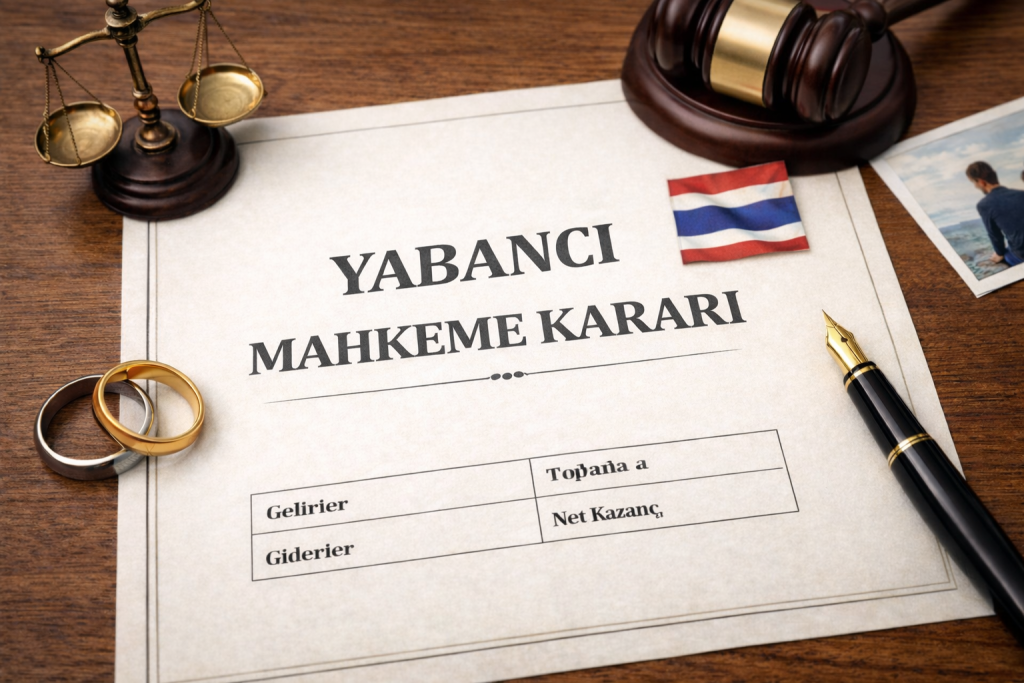
Why is Expert Lawyer Support Necessary? (Spouse Abroad – Divorce Cases)
Divorce cases filed in Turkey against a spouse residing abroad are among the types of cases where the most procedural errors are made in practice. These cases require expertise due to their technical nature, involving areas such as international notification procedures, representation by proxy, in absentia proceedings, gathering evidence through letters of request, and the protection of the right to defense. Especially in densely populated areas with high international mobility, such as Istanbul, Tuzla, Pendik, Kartal, Maltepe, Kadıköy, and Kurtköy, these types of cases are frequently filed; even a minor procedural error can lead to the case being overturned years later.
The most common problems encountered in practice are notifying the spouse residing abroad via their old address in Turkey, proceeding with the trial without utilizing consular or judicial assistance (letters of request), or automatically deeming the spouse’s failure to appear in court as a waiver of their right to defense. However, Supreme Court precedents clearly show that decisions made regarding a spouse abroad without proper notification constitute a definite ground for annulment. These risks, even if unnoticed in the court of first instance, lead to serious consequences at the appeal and cassation stages.
Therefore, in divorce cases filed against a spouse living abroad, centered in Tuzla and throughout Istanbul (including Pendik, Kartal, Maltepe, Kadıköy, and Kurtköy), it is of vital importance to proceed with **an experienced lawyer in the field of international private law and family law** from the very beginning of the process. **2M Law Firm** offers effective legal consultancy **throughout Tuzla and the Anatolian Side** in divorce cases filed against spouses residing abroad, concerning the determination of the correct notification strategy, ensuring proper representation by power of attorney, collecting evidence through letters rogatory if necessary, and concluding the trial **without incurring any loss of rights**.
In conclusion; regardless of the country where the spouse residing abroad is located, for **a divorce case filed in Turkey to be legally valid and sustainable**, it is only possible by proceeding from the beginning of the process with **expert lawyer support and a correct procedural strategy**. Otherwise, even if the case is won, the risk of **annulment or reversal of the decision due to procedural errors** is always present.