
Economic fluctuations, sharp increases in exchange rates, and supply chain issues disrupt the financial balance of many businesses, temporarily weakening their debt repayment capacity. In this situation, concordat is the most effective legal protection mechanism, allowing the debtor to continue operations and creditors to collect at a higher rate. However, the success of the concordat process depends on the accurate, complete, and strategic preparation of the application petition, which is the first step of the process. Below, in light of the experience gained in practice and judicial decisions by 2M Hukuk Avukatlık Bürosu (2M Law Office), all elements that should be included in an example concordat application petition are explained in detail.
1. Realistic Presentation of the Company’s Financial Status and Operations
The concordat request must be based on a sincere intention for recovery, in accordance with the rule of honesty (Turkish Civil Code art. 2). In the petition;
The company’s year of establishment, field of activity, economic contribution, and number of employees should be clearly stated.
The economic difficulties faced by the company must be explained with concrete data: reasons such as exchange rate increase, rise in raw material prices, bankruptcy of a major customer, and unexpected project cancellations must be realistically justified.
It should be stated that the company is not insolvent but is only experiencing a temporary liquidity shortage. This constitutes sufficient grounds for a concordat. The aim is to convince the court that the concordat request is not malicious, but rather belongs to an economically salvageable business.
2. Legal Nature and Purpose of the Concordat Request
A concordat is not merely a means of escaping enforcement proceedings, but a public oversight process that protects the interests of creditors. Therefore, the petition must clearly state the following:
Basis of the request: provisions of EBL (Enforcement and Bankruptcy Law) articles 285–309, as well as the relevant regulations of CPC (Code of Civil Procedure) and TCC (Turkish Commercial Code),
that the purpose of the concordat is to protect creditors and ensure the sustainability of the business,
that the process will be conducted transparently and under court supervision,
that creditors will recover their receivables under more advantageous conditions compared to bankruptcy,
that the application was made in accordance with the rule of good faith.
3. Concordat Preliminary Project and Success Criteria
The preliminary concordat project is the core of the petition. It is considered by courts not merely as a declaration of intent, but as a viable “financial recovery plan.” Therefore, as stated in the decision of **Istanbul BAM 45. HD – 2020/1450 E.**, the project “must make the possibility of continuous and permanent improvement credible.”
Elements that the project must include:
Transparent Declaration of Financial Status: All debts, sureties, and guarantees must be fully declared. Incomplete or misleading information invalidates the concordat request.
Funding Sources: Sources such as capital increase, sale of idle assets, investor contribution, or new financing loans must be supported by documents.
Capital Increase: Capital amounts committed by partners must be stated in the petition, and commitment documents must be attached.
Asset Sale: The plan for the sale of real estate or equipment that will not affect the company’s operations must be explained with fair values and the status of encumbrances.
Payment Plan: The discount rate to be applied to the claims of unsecured creditors, the number of installments, the start date, and periods must be clearly specified. The plan must be consistent with financial projections.
4. Documents Required to be Submitted Pursuant to EBL Article 286
Documents required to be attached to the concordat request constitute a **condition precedent for litigation**. If they are submitted incompletely, the court will directly reject the concordat request. These documents are as follows:
Pre-Concordat Project, Independent Audit Report and Supporting Documents, Balance Sheet, Income and Cash Flow Statements, Commercial Ledger Opening/Closing Confirmations or e-Ledger Approval Certificates, Creditor List, Debt Amounts and Privilege Statuses, Concordat Project and Comparative Table in Case of Bankruptcy, Tangible and Intangible Fixed Asset Lists, Tax Plate, Trade Registry Gazette, Signature Circular, etc.
These documents ensure that the company’s financial situation is presented to the court in a complete, accurate, and auditable manner.
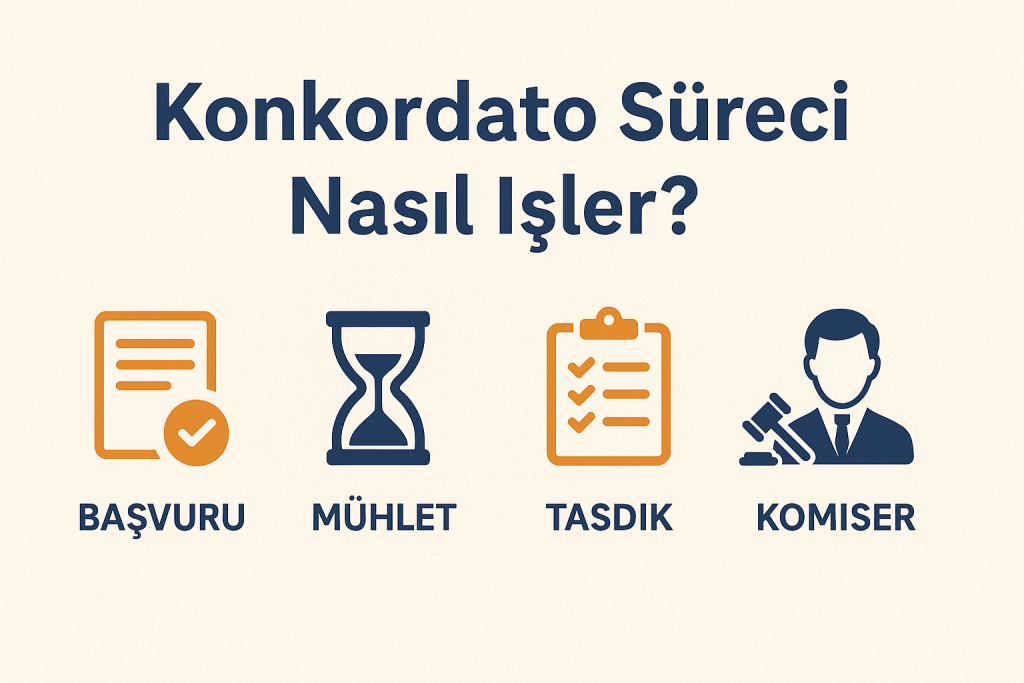
5. Request for Provisional Moratorium and Appointment of Commissioner
The concordat petition must absolutely include a request for a provisional moratorium decision.
According to Article 287 of the EBL (Enforcement and Bankruptcy Law), if the court sees the possibility of the request succeeding, it grants the debtor a three-month provisional moratorium. During this period:
No new enforcement proceedings can be initiated against the debtor,
Ongoing proceedings are suspended,
The debtor’s assets are taken under protection,
The court appoints one or more provisional concordat commissioners.
The commissioner oversees the process as the court’s “extended arm”; controls the debtor’s commercial activities, facilitates communication with creditors, and submits their report to the court. Therefore, the necessity of appointing a commissioner, along with its legal justifications regarding the transparency of the process and the protection of assets, must be explained in the petition.
6. Confirmation Process and Success Criterion
During the definitive grace period, a creditors’ meeting is held based on the report prepared by the commissioner.
If the project is approved by the majority stipulated in the Enforcement and Bankruptcy Law (İİK) in terms of the number of creditors and the amount of claims, the court conducts a confirmation hearing. The court;
Whether the proposed payment rate is greater than the amount creditors would receive if the debtor were to go bankrupt,
Examines ex officio whether the project is proportionate to the debtor’s resources.
If the conditions are met, the concordat is confirmed, and the decision becomes binding for all creditors.
7. Matters to Be Requested in the Petition
At the end of the application petition, the following decisions should be requested from the court:
Acceptance of the ordinary concordat request,
Immediate granting of a 3-month provisional grace period,
Suspension of enforcement and bankruptcy proceedings and non-application of provisional attachments during the provisional grace period,
Appointment of one or more concordat commissioners,
Conversion of the provisional grace period to a definitive grace period and confirmation of the concordat project,
Publication of the decision in the Trade Registry Gazette and on the Press Advertisement Agency portal.
Stating these requests completely and systematically demonstrates the seriousness of the petition and the professionalism of the preparation from the court’s perspective. An article suggestion.
Result: A Successful Composition (Concordat) Begins with a Meticulously Prepared Petition
The composition (concordat) process is a complex structure where financial, legal, and administrative elements are intertwined. Therefore, success depends not only on the financial plan, but also on the strategic integrity of the petition being correctly constructed. Every statement, every document, and every reference must reinforce the court’s trust.
2M Law Office, provides expert legal consultancy for both debtors and creditors in composition (concordat) application, moratorium, commissioner, and approval processes in the regions of Istanbul, Tuzla, Pendik, Kartal, Maltepe, Çayırova, Darıca, Gebze, and Tepeören. Our experienced composition (concordat) lawyers work meticulously in each case to maintain financial balance, fully meet judicial requirements, and ensure the sustainability of the business.