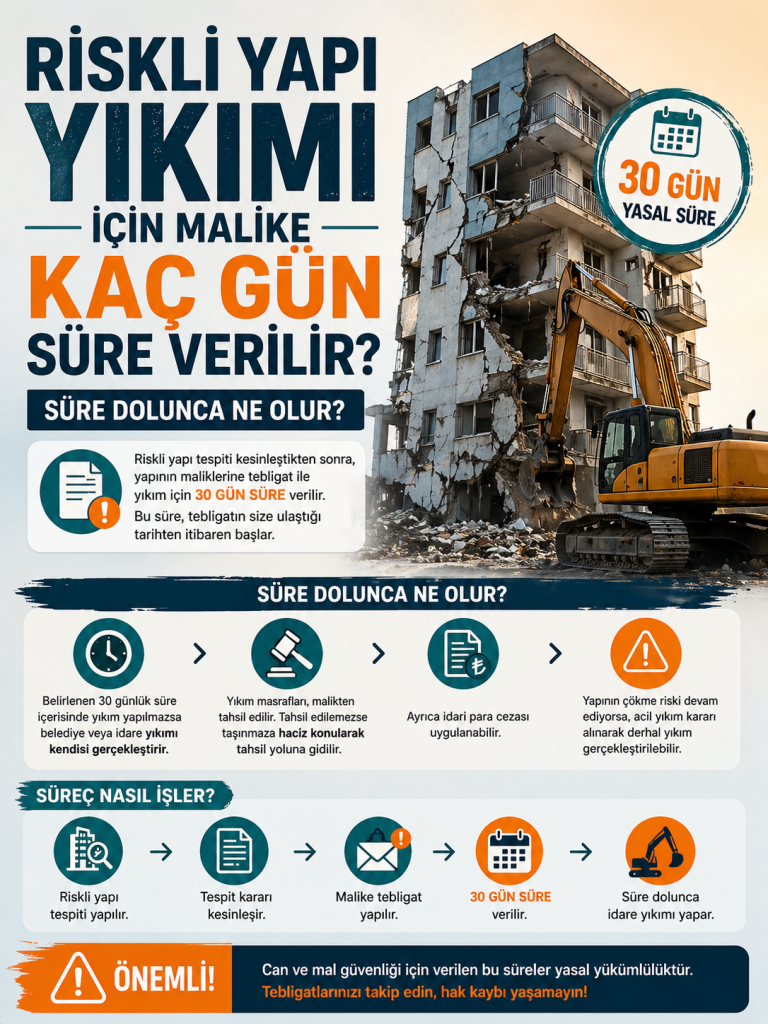
Legal Basis: Law No. 6306 Article 5/3 | Implementing Regulation Article 8/3a
You have received a notification of risky building identification for your building, and the demolition process has now begun. So, how much time do you actually have? What will happen when the period expires, who covers the demolition costs, and can your electricity and water be cut off? This article addresses all stages of the demolition process, along with timelines and legal consequences, based on updated information for 2026, within the framework of Article 5/3 of Law No. 6306 and Article 8/3a of the Implementing Regulation. (L. Art. 5/3 — R. Art. 8/3a)
When Does the Demolition Process Begin?
The demolition process begins when the risky building identification becomes final. The identification can become final through two ways: (L. Art. 3/1 — R. Art. 7/4-5)
The 15-day objection period expiring without being used, starting from the date of notification
The objection made being rejected by the technical committee
Once the identification becomes final, the Urban Transformation Directorate requests the Administration to issue the necessary notifications and to have the risky building demolished. Upon this request, the Administration issues the demolition and evacuation notifications simultaneously through three channels: (R. Art. 8/2)
The evacuation and demolition report is posted on the building
Owners are sent notifications via the e-Government Portal
It is announced for 15 days at the relevant headman’s office (muhtarlık)
On the last day of the muhtarlık announcement, all holders of real and personal rights are deemed to have been notified. The demolition period begins to run from this date. The obligation for notification by post has been lifted; “I did not see the notification” is not a valid excuse. (Law Art. 5/5 — Reg. Art. 8/2)
Warning: Regularly follow the announcement of the demolition notification at the muhtarlık. Keep e-Government notifications active. Calculate day by day when the period starts and ends.
How Many Days Are Given to the Owner? Gradual Period System
The Law and Regulation do not directly grant the owner 90 days. The demolition process proceeds in a gradual manner: first the initial period, then an additional period if demolition is not carried out. (Law Art. 5/3 — Reg. Art. 8/3a)
First Period: At Least 60, At Most 90 Days
The Administration grants the owners of the structure a period for its evacuation and demolition not exceeding ninety days. The Regulation has also determined the lower limit of this period: It cannot be less than 60 days. (Law Art. 5/3 — Reg. Art. 8/3a)
This means the Administration’s discretionary power is between 60 and 90 days. In practice, mostly 60 days are given; however, this period can be extended up to 90 days depending on the size of the structure, the number of residents, or the specifics of the implementation.
What the owner must do during this period:
To completely evacuate the building (people and belongings)
To cancel electricity, water, and natural gas subscriptions
To obtain a demolition permit
To carry out or have the demolition carried out
Second Period: 30 Days Additional Time
If it is determined by the Administration during an on-site inspection that the building has not been demolished by its owners at the end of the first period, an additional period of not less than thirty days is granted, by stating that “the building will be demolished by administrative authorities”. (Law Art. 5/3 — Reg. Art. 8/3a)
This additional period is stipulated in the law as “one-time only”. In other words, there is no second additional period.
Total maximum period: 90 days (first) + 30 days (additional) = 120 days
However, the most common scenario in practice is 60 + 30 = 90 days.
How to Obtain a Demolition Permit?
If the owner wishes to demolish the building themselves, it is mandatory to obtain a demolition permit. The demolition permit is issued within six business days upon application by one or more of the owners or their representatives, by submitting the following documents: (Reg. Art. 8/3b)
Document obtained from relevant institutions indicating that the building has been evacuated or the evacuation being officially recorded by the Administration
Documents obtained from relevant institutions indicating that electricity, water, and natural gas services have been shut off
Important: Consent from other owners is not required for the issuance of a demolition permit. An application from a single owner is sufficient. (Reg. Art. 8/3b)
In structures where the building height exceeds 21.50 meters, it is also mandatory to appoint a static technical supervisor as the person responsible for demolition.
What Happens When the Period Expires? Phased Sanction Chain
Even if the second period has expired and demolition has not been carried out, the Law and Regulation implement a series of successive sanctions:
1. Discontinuation of Services (Law Art. 4/3 — Reg. Art. 8/3c)
The Administration requests from the relevant institutions and organizations that electricity, water, and natural gas not be supplied to the risky structure and that existing services be stopped. It is mandatory for the relevant institutions and organizations to comply with this request. This step aims to accelerate evacuation by rendering the structure practically uninhabitable.
2. Notification to the Senior Administrative Officer and Administrative Demolition (Law Art. 5/3 — Reg. Art. 8/3ç)
Risky structures not demolished by their owners are reported to the senior administrative officer. The evacuation and demolition procedures for these structures are carried out or commissioned by the Administration with the support of law enforcement provided by the senior administrative officers.
3. Written Notification by the Presidency to the Administration (Law Art. 5/4 — Reg. Art. 8/4)
The demolition of risky structures determined not to have been demolished within the given period is notified in writing by the Presidency to the Administration, and these structures are demolished/caused to be demolished by the Administration. If deemed necessary by the implementation, the Presidency may also personally carry out the demolition works and procedures.
4. Forced Evacuation (Law Art. 5/4 — Reg. Art. 8/5)
In case the evacuation is prevented; if requested by the Presidency/Administration, the evacuation shall be carried out by opening or having opened closed doors/areas with sufficient law enforcement force, based on a written permit issued by the local administrative authority.
Who Bears the Demolition Costs?
All costs of demolition carried out by the Administration are collected from the owners. Owners are responsible for the costs of demolition operations carried out by the Administration or the Presidency, proportionate to their shares, because the demolition was not carried out by the owners. (Law Article 5/4 — Regulation Article 8/8)
The costs are paid by the Presidency or the Administration within one month following the notification to the owners. Costs not paid on time are collected by the following methods:
If the demolition was carried out by the Presidency → by the tax office, following the Presidency’s notification to the tax office
If the demolition was carried out by the Administration → by the Administration according to the provisions of Law No. 6183 on the Procedure for the Collection of Public Receivables
This means that the state can collect them through enforcement, attachment, and follow-up methods, just like a tax receivable. (Regulation Article 8/8)
Criminal liability also arises for those who obstruct demolition. A criminal complaint is filed with the Public Prosecutor’s Office against those who obstruct detection, evacuation, and demolition works and procedures, in accordance with the relevant provisions of the Turkish Penal Code (TCK). For public officials who fail to perform their duties, penal and disciplinary provisions are applied. (Law Article 8/3 — Regulation Article 8/6)
Does a Mortgage or Foreclosure Prevent Demolition?
No. The presence of a mortgage, lien, or usufruct right on a risky building does not prevent its demolition. According to the law, all kinds of annotations in the registry of risky buildings that restrict or prohibit real and personal rights, as well as the right of assignment, **continue on the shares** after the risky building is demolished; it does not mean renunciation of rights. (K. Md. 6/1)
Can You Stop the Process? Legal Avenues
It is extremely difficult to physically stop the demolition process. An annulment lawsuit can be filed in the Administrative Court **within 30 days** from the date of notification, in accordance with Article 6/9 of Law No. 6306, against the demolition decision. (K. Md. 6/9 — İYUK Md. 7)
However, filing a lawsuit alone does not stop the demolition. To stop the demolition, it is mandatory to obtain a **stay of execution (YD) decision** from the court. If the court issues a YD decision, the demolition and evacuation procedures will stop; if it does not, even if the lawsuit continues, there will be no obstacle to the administrative demolition process. (İYUK Md. 27)
The alternative of strengthening can also affect the period. If owners choose the strengthening option within the demolition period, they must have it determined that strengthening is technically possible, obtain the written consent of 4/5 of the condominium owners, have the project prepared, and obtain a license. Obtaining a strengthening license stops the demolition process. (Y. Md. 8/7)
When Do Tenants Have to Move Out?
The demolition period covers not only the owners but also tenants residing in the building and holders of limited real rights. Within the given period, tenants must also evacuate the buildings. (K. Md. 5/1 — Y. Md. 17/1)
Landlords are obliged to provide an eviction notice to their tenants. If the landlord fails to provide this notice, the notice will be issued by the Administration. If the tenants do not vacate the property within the given period, forced eviction procedures will also be initiated for them.
State support for tenants: Tenants who vacate by agreement receive a one-time relocation assistance. According to current figures for 2026, this support ranges from 18,000–21,000 TL for Istanbul. (Art. 5/1 of the Law — Art. 16/3 of the Regulation)
Process Summary: Timeline
| Stage | Duration | Legal Basis |
|---|---|---|
| Notification of risky structure determination | — | Law Art. 3/2 — Reg. Art. 7/4 |
| Objection period | 15 days | Law Art. 3/1 — Reg. Art. 7/5 |
| Determination becomes final | — | Reg. Art. 8/1 |
| Demolition-evacuation notification | 15 days (headman’s office announcement) | Law Art. 5/5 — Reg. Art. 8/2 |
| First demolition period (to owner) | 60–90 days | Law Art. 5/3 — Reg. Art. 8/3a |
| Inspection — if not demolished | — | Reg. Art. 8/3 |
| Electricity-water-gas cut-off | — | Law Art. 4/3 — Reg. Art. 8/3c |
| Additional period (final warning) | 30 days | Law Art. 5/3 — Reg. Art. 8/3a |
| Administrative demolition + police support | — | Law Art. 5/3-4 — Reg. Art. 8/3ç |
| Collection of expenses from the owner | Payment period within 1 month | Reg. Art. 8/8 |
| Period for filing annulment lawsuit | 30 days (from notification) | Law Art. 6/9 |
Practical Warnings: Critical Errors Made During the Process
Do not miss notification channels. Notification is deemed to have been made on the last day of the headman’s announcement, and periods begin from that moment. Keep e-Government notifications active. (Law Art. 5/5 — Reg. Art. 8/2)
Obtain the demolition permit early. Do not wait for the period to expire; the permit will be issued within six business days once all documents are ready. Starting early both speeds up the rental assistance application process and eliminates the risk of potential administrative demolition. (Reg. Art. 8/3b)
Do not underestimate administrative demolition costs. The administrative demolition cost of a large apartment building can be very high. These costs can be collected from each owner through enforcement proceedings in proportion to their land share. (Reg. Art. 8/8)
Attempting to obstruct will lead to serious consequences. Obstructing evacuation, not opening the door, or threatening the technical team constitutes a crime under the Turkish Penal Code (TCK), and forced entry can be made with the support of law enforcement. (Law Art. 8/3 — Reg. Art. 8/6)
If you are filing an annulment lawsuit, do not forget the stay of execution request. Filing a lawsuit alone does not stop the demolition. If demolition occurs without a stay of execution order, even if you win the case, the demolished building will not be restored. (Administrative Procedure Law Art. 27)
Do not delay your rental assistance application. To benefit from rental assistance, which must be applied for within 1 year from the eviction date, opt for eviction by agreement. (Reg. Art. 16/4)
Why is Expert Legal Support Necessary?
The process of demolishing a risky building is a complex one, consisting of successive short periods and difficult-to-reverse decisions. As 2M Law Firm, we observe the following during the consulting process we provide in the field of urban transformation law in all districts of Istanbul, especially Tuzla:
The deadlines are extremely short and consecutive. 15 days to object to the determination, 30 days for an annulment lawsuit, 60-90 days for the demolition process… Knowing when to take which step within these deadlines can be managed much more safely with the support of an urban transformation lawyer.
A stay of execution decision is of vital importance. Legal experience is essential for filing an annulment lawsuit with a request for a stay of execution, presenting it with sound justifications, and for the court to accept this request. An Istanbul urban transformation lawyer helps you structure both the petition and the technical justifications correctly during this process.
The reinforcement option should be evaluated correctly. Choosing the reinforcement option during the demolition period requires serious technical and legal conditions. Getting urban transformation consultancy to evaluate in advance whether this option is suitable for you prevents loss of rights.
Representation is required in cost and compensation lawsuits. Objecting to the collection of costs after demolition by the administration or demanding compensation due to unlawful demolition can only be effectively pursued through an expert lawyer.
Strategically manage the rental assistance and agreement process. You can apply to 2M Hukuk Law Office, which provides urban transformation consultancy in Tuzla and throughout Istanbul, to reach an agreement before demolition, apply for rental assistance, and negotiate the most advantageous agreement terms for the new structure. As a Tuzla lawyer, with the service we provide, we are by your side to protect your rights from the beginning to the end. For n we are by your side.
Conclusion
Within the framework of Article 5/3 of Law No. 6306 and Article 8/3a of the Regulation, the owner of a risky structure is granted a primary period of 60 to 90 days for demolition, and an additional period of 30 days if demolition is not carried out. The total maximum period is 120 days. When the period expires, electricity, water, and gas services are successively cut off, a notification is made to the administrative authority, and administrative demolition is carried out with police support; all expenses are collected from the owners through enforcement proceedings in proportion to their shares. Stopping the demolition process is only possible with a stay of execution decision obtained from the court. (K. Art. 5/3 — Y. Art. 8/3a)
This article has been prepared based on the official sources and current open data of the Urban Transformation Presidency, in accordance with Law No. 6306 (Art. 5/3) and the Implementing Regulation (Art. 8/3a) as of April 2026. Since each specific situation may vary, it is recommended to seek support from an expert urban transformation lawyer for legal processes.