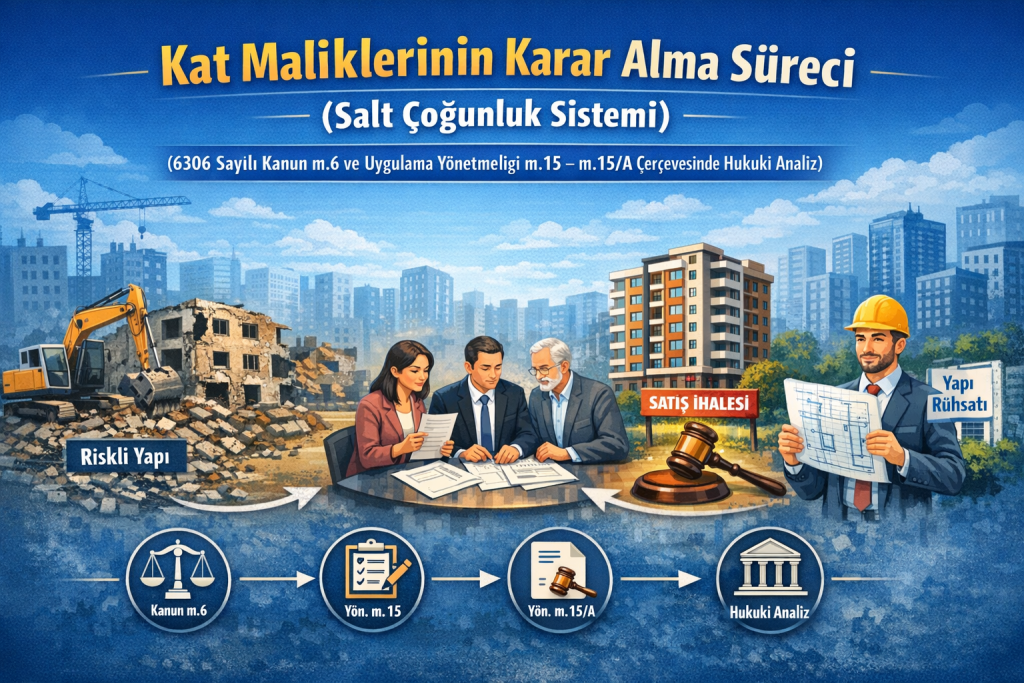
One of the most debated topics in urban transformation practices is, what majority is required for the redevelopment of the land after the demolition of risky structures and the legal validity of the decisions taken with this majority.
In Turkey, this process is primarily regulated by Law No. 6306 on the Transformation of Areas Under Disaster Risk. Decisions regarding the redevelopment of immovables that become land after the demolition of risky structures can be taken with the shareholders’ simple majority according to their land share ratio.
However, in practice, a mere mathematical majority is not sufficient. The decisions of the Court of Cassation and the Council of State examine in detail how the decision was made, whether its content complies with the law, and according to which land shares the majority was calculated.
1. Basic Quorum for Decision-Making in Urban Transformation:
Simple Majority Rule and its Relationship with the Condominium Law Within the scope of Law No. 6306 on the Transformation of Areas Under Disaster Risk, in the processes of redeveloping immovables that become land after the demolition of risky structures (such as rebuilding, share sale, floor-for-share arrangement, or revenue sharing, etc.), the basic rule is for shareholders to make decisions with a simple majority of at least one-third of the shares they hold.
The 20th Civil Chamber of the Supreme Court of Appeals (Case No. 2018/3580, Decision No. 2018/7187 and Case No. 2018/1455, Decision No. 2018/7186) has clearly ruled that, with the amendment made to Article 6 of Law No. 6306, the “unanimity” condition stipulated in Article 45 of the Condominium Law (KMK) No. 634 would not be sought for the demolition and reconstruction of risky structures, and that at least a simple majority would be sufficient (new ratio after the amendment) .
Indeed, the 18th Civil Chamber of the Supreme Court of Appeals (Case No. 2013/13457, Decision No. 2013/14301) clarified this distinction by stating that in normal situations outside the scope of Law No. 6306 , the unanimity of all condominium owners is mandatory for the termination of condominium ownership and the demolition and reconstruction of the building in accordance with the KMK.
Bakırköy 1st Civil Court of Commerce (Case No. 2021/540, Decision No. 2024/50) determined that obtaining a 1/2 land share majority is a legal condition, that contracts signed until this quorum is met will not yet be legally valid according to Article 170 et seq. of the Turkish Code of Obligations, and that once the majority is achieved, they will be binding for the signatories.
2. Nature of the Decision-Making Process, Content Review, and Implicit Acceptance
The decision-making process is not merely about achieving a mathematical majority; the manner in which the decision is made and its content are also subject to judicial review.
Joint Decision-Making: The Konya Regional Administrative Court 2nd Administrative Litigation Chamber (Case No. 2019/1716, Decision No. 2020/38) emphasized that the term 1/2 majority in the law does not mean the administration agreeing individually with the owners, but rather refers to the owners coming together to “make a joint decision.”
Content Review: The 5th Civil Chamber of the Supreme Court (2025/6759 E., 2025/13064 K.) ruled that even if a 1/2 majority is achieved, the content of the decision taken (for example, the conversion of a residential apartment building into a single-volume shopping center and its lease for 157 months) and its compliance with the purpose of Law No. 6306, as well as cases of absolute nullity/non-existence, must be examined on the merits by the courts.
Implicit Acceptance: The 3rd Civil Chamber of the Supreme Court (2022/5267 E., 2023/1448 K.) stated that owners who did not sign the meeting minutes but allowed the building to be demolished and rebuilt within the scope of urban transformation implicitly accepted the contract and that this situation would prevent them from filing a lawsuit.
3. The Effect of Administrative Actions (Parceling/Consolidation) on Decision-Making Majority
The validity of decisions made by apartment owners with a 1/2 majority is directly dependent on the legal outcome of administrative actions that determine the land shares on which this majority is calculated.
The 4th Chamber of the Council of State (2024/879 E., 2025/1689 K. and 2023/13912 E., 2025/1687 K.) ruled that in the event an administrative action for the parceling of a property through zoning implementation is annulled, the joint decision protocol signed based on the share ratios resulting from the parceling would become invalid, and the majority should be re-evaluated according to the situation prior to parceling.
However, the 4th Chamber of the Council of State (2023/13780 E., 2024/1815 K.) has stated that in cases where the consolidation process was cancelled but a construction servitude was established on the immovable property and sales were made to third parties (indicating a de facto impossibility), the construction contract based on a 1/2 majority will retain its validity, but the value of the sold share must be recalculated.
Kentsel dönüşümde oybirliği gerekir mi?
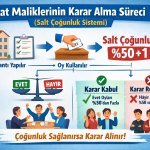
Hayır. Riskli yapıların 6306 sayılı Kanun kapsamında yeniden yapılması için oybirliği aranmaz. Kat maliklerinin arsa payına göre salt çoğunluğu yeterlidir. Ancak kentsel dönüşüm kapsamı dışında kalan normal durumlarda Kat Mülkiyeti Kanunu gereği oybirliği gerekebilir.
Salt çoğunluk sağlanmadan yapılan müteahhit sözleşmesi geçerli midir?
Mahkeme kararlarına göre salt çoğunluk sağlanmadan yapılan sözleşmeler hukuken askıda sayılır. Yani sözleşme henüz kesin olarak yürürlüğe girmez. Salt çoğunluk sağlandığında ise sözleşme imzalayan malikler açısından bağlayıcı hale gelir.
İmar işlemleri salt çoğunluk hesaplamasını etkiler mi?
Evet. Arsa paylarını değiştiren ifraz veya tevhit gibi imar işlemlerinin iptal edilmesi, salt çoğunluk hesabını doğrudan etkileyebilir. Böyle bir durumda çoğunluk yeniden hesaplanmak zorundadır.
Why is Expert Legal Support Necessary?
Urban transformation projects are not merely a technical construction process; they are also a highly complex legal process where administrative law, real estate law, and contract law intersect.
In this process, especially;
simple majority calculation
preparation of joint decision protocols
establishment of contractor agreements
cancellation of administrative acts
legality of share sales
serious legal disputes can arise in matters such as these.
Therefore, working with an expert Istanbul urban transformation lawyer or Istanbul urban transformation consultant is of great importance in urban transformation projects. Especially in projects carried out in Istanbul and its surroundings, lawyers with regional experience, such as a Tuzla urban transformation lawyer, contribute to the correct execution of the process.
At this point, 2M Hukuk Law Office provides comprehensive legal consultancy in urban transformation projects, including contract preparation, land share majority calculations, owner disputes, and litigation processes. With expert legal support, both the rights of the owners are protected, and the urban transformation projects are ensured to proceed in accordance with the law.