
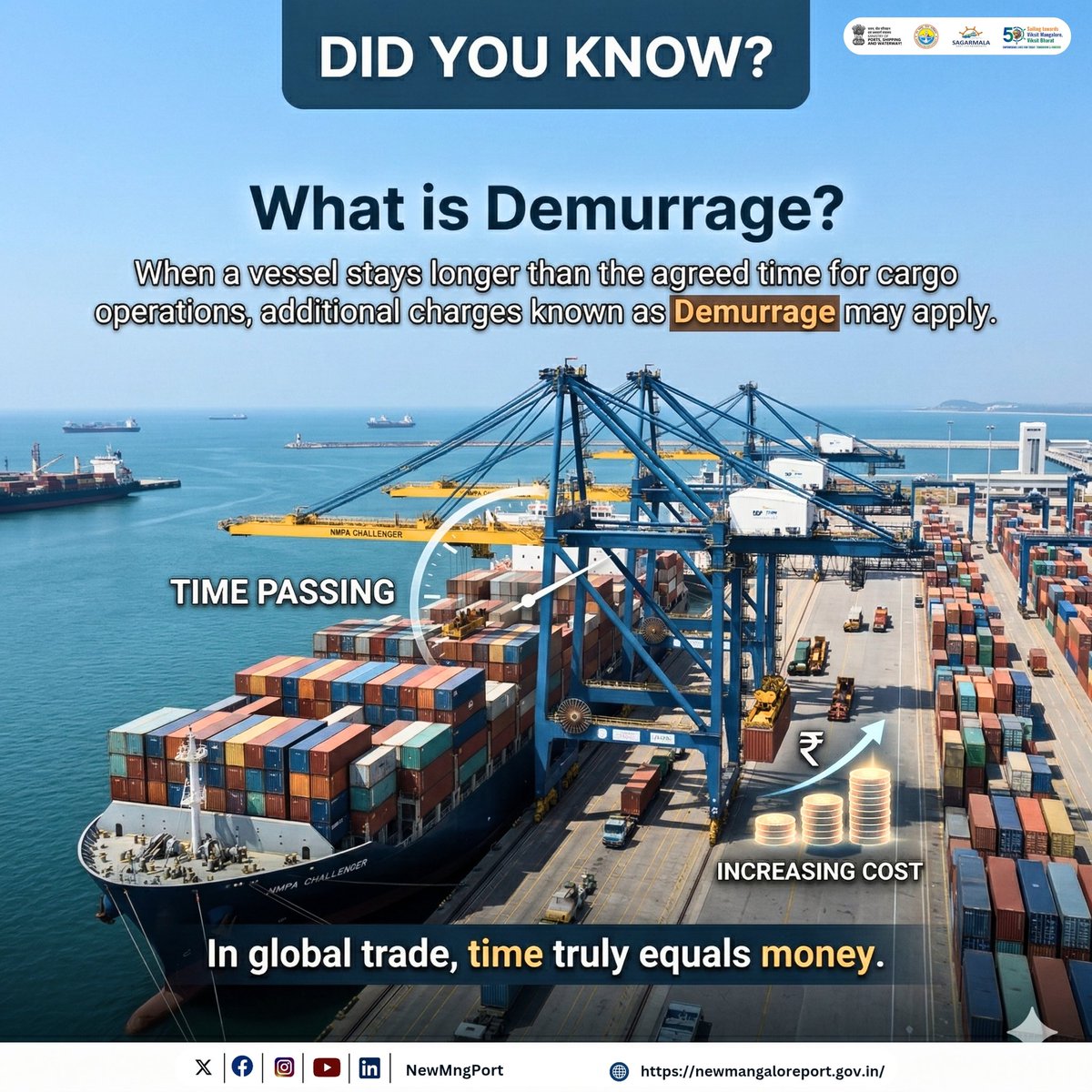

One of the most frequent dispute topics in maritime trade is the calculation of laytime (free time) and demurrage (delay charge). Particularly in bulk cargo and container transport, significant disputes arise between parties due to delays, port congestion, weather conditions, or customs procedures.
When Turkish judicial decisions are examined, it is observed that these disputes have different legal dynamics in voyage charter agreements and container transport agreements. In this article, the concepts of laytime and demurrage are examined in detail in light of the decisions of the Supreme Court and regional courts of appeal.
What are Laytime and Demurrage Concepts?
In maritime transport contracts, laytime refers to the contractual free time granted to the carrier for the completion of loading or unloading operations. This period is determined by the parties’ charter agreement or bill of lading provisions and is usually calculated taking into account the port’s operational capacity, cargo type, and vessel characteristics..
If loading or unloading operations cannot be completed within the laytime period, demurrage (demurrage) comes into question. Demurrage is an additional delay fee paid to the carrier when the laytime period is exceeded due to the ship waiting in port. Court decisions emphasize that this fee aims to compensate for the commercial loss incurred by the carrier due to the inability to use the vessel.
In container shipping, the concept of demurrage usually appears as a “container occupation fee”. In this case, a certain free time (free period) is granted to the consignee, and an additional fee is charged if the container is kept at the port or yard beyond this period.
Laytime Calculation in Voyage Charterparty Agreements
Laytime calculation in voyage charterparty agreements is mostly performed based on the event schedule called Statement of Facts (SOF) and port records. Courts particularly accept SOF records signed by the ship’s captain as strong evidence.
For example, in the decision numbered 2022/655 E. of the 14th Civil Chamber of the Istanbul Regional Court of Justice, it was accepted that the laytime period begins with the completion of the draft measurement. In the same decision, it was stated that delays due to reasons such as port congestion, waiting for instructions, or weather conditions can be considered within the laytime period.
In the decision numbered 2015/8017 E. of the 11th Civil Chamber of the Court of Appeals, it was emphasized that when calculating laytime in contracts with a “weather working day” clause, the SOF records of the vessel subject to the dispute should be taken as a basis, rather than the records of comparable vessels.
1. Introduction and Basic Concepts
In line with the judicial decisions reviewed, disputes regarding laytime (free time) and demurrage (detention fee / late fee) in maritime transport contracts have different dynamics depending on the type of contract (voyage charter or container shipping). In the decisions, laytime is defined as the loading/unloading period legally expected or contractually agreed upon; and demurrage is defined as the additional waiting fee paid to the carrier if this period is exceeded (in container shipping, “container detention charge”).
2. Laytime and Demurrage Calculation in Charterparty (Voyage Charter) Disputes
In bulk cargo and voyage charter contracts, the commencement of laytime, its interruptions, and its conversion to demurrage have been made subject to strict formal requirements and concrete evidence (Statement of Facts – SOF, meteorological records) by the courts.
Commencement of the Period and Exceptions (Weather Conditions and Port Congestion):
In the decision no. 2022/655 E. of the 14th Civil Chamber of the Istanbul Regional Court of Justice (BAM), it was accepted that the laytime commenced with the draft measurement; and port congestion, waiting for instructions, weather conditions such as rain and fog, and shore-originated delays were considered within the laytime period. However, in the decision no. 2015/8017 E. of the 11th Civil Chamber of the Court of Cassation, it was ruled that in contracts stipulating a “weather working” condition, the Statement of Facts (SOF) signed directly by the captain of the vessel in dispute shall be taken as a basis, instead of records of comparable vessels.
“Once on Demurrage, Always on Demurrage” Rule: In the decision numbered 2018/4053 E. of the 11th Civil Chamber of the Supreme Court, it was clearly stated that weather conditions such as rain and snow occurring after the laytime has expired and the vessel has entered demurrage will not interrupt the demurrage period, and these periods will also be included in the calculation.
Carrier’s Fault and Deduction from Period: In the same Supreme Court decision (2018/4053 E.), a delay of 6 days and 19 hours, which occurred due to Russian authorities not granting permission because the vessel was over 30 years old, was accepted as the fault of the plaintiff carrier, and this period was deducted from the demurrage calculation.
Contract Breaches and Dead Freight: In the decision numbered 2014/13825 E. of the 11th Civil Chamber of the Supreme Court, in addition to a 13-day and 5-hour demurrage claim due to the cargo not being brought within the laytime, dead freight corresponding to 2/3 of the full freight was also awarded.
3. Demurrage (Free Time) Disputes in Container Shipping In container shipping, demurrage, in accordance with Article 1207 of the Turkish Commercial Code, is considered an “accessory to the freight” and arises when the period from the discharge of a full container to its empty return exceeds the “free time.”
Free Time and Tariff Disputes: Standard tariffs in bills of lading often conflict with email correspondence between parties. In the decisions numbered 2018/329 E. of the Istanbul 17th Civil Court of Commerce (ATM) and 2021/39 E. of the Regional Court of Justice (BAM) 13th Civil Chamber, although the bill of lading stated a free time of 7 days, the plaintiff’s granting of 25 days free time via email and the defendant’s payment accordingly were accepted as binding, and the carrier’s subsequent request to reduce the period to 21 days, claiming “system error,” was rejected.
Right of Recourse and Prohibition of Profit Margin: Freight forwarders or contractual carriers may claim recourse from the consignor/consignee for demurrage fees paid to the actual carrier. However, as emphasized in the decision numbered 2020/419 E. of the Istanbul 17th Commercial Court (ATM), it is unlawful for the contractual carrier to pass on a demurrage invoice received from the actual carrier to the defendant by adding a “profit margin”; only the amount actually paid can be claimed.
Grace Period (Payment-Free Period): In the decision numbered 2020/446 E. of the Istanbul 17th Commercial Court (ATM), the “grace period 48 hrs” (48 hours free time) stipulated in the freight contract was deducted from the total waiting period, and it was stated that delays in freight payment alone would not accrue demurrage.
4. Exception Clauses, Force Majeure and Reasons for Delay
Force Majeure (War and Port Closure): In the decisions numbered 2015/524 E., 2015/521 E. and 2015/520 E. of the Istanbul 17th Commercial Court (ATM), the closure of Libya’s Benghazi port due to civil war before the expiration of the 10-day free time granted for containers discharged there was considered “force majeure,” and the shipper’s demurrage liability was thus extinguished.
Customs, Embargo and Seizure Processes: Shippers often present customs delays or seizure orders as a defense. However, in the decision numbered 2021/452 E. of the Istanbul 17th Commercial Court (ATM), demurrage liability was imposed on the defendant on the grounds that the carrier was not at fault for the seizure of the goods by the customs and the criminal court of peace. Similarly, embargo defenses were also rejected under the principle of “prudent merchant” (Istanbul 17th ATM 2023/119 E.).
Joint Fault: In the decision numbered 2022/824 E. of the 14th Civil Chamber of the Regional Court of Appeals, the demurrage invoice was reduced by half, as the plaintiff agent’s erroneous submission of the summary declaration and the defendant’s delays in customs registration were accepted as “joint negligence”.
5. Additional Contexts Obtained from Secondary Sources Regarding certain matters where there is limited information in the decision texts, the additional contexts obtained from decisions categorized as [İkincil Kaynak] are as follows:
Impact of Past Commercial Practices: [İkincil Kaynak] According to the decision numbered 2015/265 E. of the Istanbul 17th Commercial Court, the fact that demurrage was not charged between the parties in previous years by oral agreement does not invalidate demurrage claims based on the current bill of lading tariff.
Lack of Dangerous Goods (IMO) Notification: [İkincil Kaynak] In the decision numbered 2022/143 E. of the Istanbul 17th Commercial Court, the shipper was held responsible for the demurrage incurred as a result of the containers waiting at the port, due to the shipper’s failure to notify the carrier of the cargo’s dangerous goods status (violation of TCC article 1145). This situation is a concrete example of shipper’s fault in laytime exceptions.
Extension of Customs and Testing Procedures: [İkincil Kaynak] In the decision numbered 2021/484 E. of the Istanbul 17th Commercial Court, the fact that customs, laboratory, and testing procedures took 60 days did not exempt the shipper from paying demurrage; the risk of delay arising from post-port official procedures was borne by the shipper.
Competent Court: [İkincil Kaynak] The decision of the 11th Civil Chamber of the Supreme Court of Appeals, numbered 2015/326 E., emphasizes that demurrage disputes arising from the late arrival of goods at the loading port fall within the scope of maritime trade contracts under Article 1119 et seq. of the Turkish Commercial Code and are within the jurisdiction of Maritime Specialized Courts, not Commercial Courts of First Instance.
Lack of Active Standing: [İkincil Kaynak] The decision of the 13th Civil Chamber of the Regional Court of Appeals (BAM), numbered 2020/1299 E., established as a procedural rule that agents cannot directly file lawsuits in their own name for demurrage claims arising on behalf of the carrier, and that the lawsuit must be filed “in representation of” the carrier.
Frequently Asked Questions
Laytime (starya) nedir?
Laytime, geminin yükleme veya boşaltma işlemlerini tamamlayabilmesi için sözleşme ile belirlenen serbest süredir. Bu süre geminin limana varmasından sonra başlar ve sözleşmede belirtilen süre boyunca devam eder. Laytime süresi içinde yükleme veya boşaltma işlemlerinin tamamlanması halinde taşıtan herhangi bir gecikme ücreti ödemez.
Demurrage (sürastarya) nasıl hesaplanır?
Demurrage, laytime süresinin aşılması halinde geminin limanda beklemesi nedeniyle oluşan gecikme ücretidir. Hesaplama yapılırken genellikle SOF kayıtları, liman operasyon kayıtları ve meteoroloji verileri dikkate alınır. Laytime süresi dolduktan sonra gemi demuraja düşer ve gecikme süresi günlük demuraj tarifesi üzerinden hesaplanır.
Konteyner taşımacılığında demuraj nedir?
Konteyner taşımacılığında demuraj, dolu konteynerin tahliye edilmesinden sonra boş konteynerin belirlenen free time süresi içinde iade edilmemesi halinde ödenen gecikme ücretidir. Bu ücret genellikle liman tarifeleri veya konşimento şartlarına göre hesaplanır.
Gümrük işlemleri demuraj sorumluluğunu ortadan kaldırır mı?
Genellikle hayır. Mahkeme kararlarına göre gümrük işlemleri veya test süreçleri nedeniyle yaşanan gecikmeler çoğu zaman taşıtanın sorumluluğunda kabul edilmektedir. Bu nedenle gümrük işlemleri çoğu durumda demuraj sorumluluğunu ortadan kaldırmaz.
Demuraj davalarında hangi mahkeme görevlidir?
Deniz taşıma sözleşmelerinden doğan demuraj uyuşmazlıkları deniz ticareti sözleşmesi kapsamında değerlendirilir ve genellikle Denizcilik İhtisas Mahkemelerinde görülür.
Why is Expert Maritime Trade Law Attorney Support Necessary?
Maritime transport disputes are quite complex from both a technical and legal perspective. Laytime and demurrage calculations often require the combined evaluation of SOF records, port operation data, meteorological records, and charter party provisions.
Therefore, in maritime transport cases, working with an expert maritime trade law attorney is of great importance. Especially for shipowners, carriers, freight forwarders, and logistics companies, such cases can pose serious financial risks.
At this point, 2M Law Firm provides professional legal support in laytime and demurrage disputes with its experience in maritime trade law. Especially for companies looking for an **Istanbul maritime trade law lawyer**, an **Istanbul maritime trade lawyer**, a **Tuzla maritime law lawyer**, a **Gebze maritime trade lawyer**, and a **Yalova maritime law lawyer**, effective consultancy and litigation services are provided in disputes arising from maritime transport contracts.
In maritime trade cases, determining the correct legal strategy, correctly interpreting contract provisions, and properly presenting technical evidence can directly affect the outcome of the case. Therefore, in disputes arising in the field of maritime transport, acting with an expert maritime trade law lawyer is of critical importance to prevent loss of rights.

What Are the Concepts of Laytime and Demurrage?
In maritime transport contracts, laytime refers to the contractually agreed free time granted to the charterer for completing loading or discharge operations. This period is determined by the parties through the charterparty agreement or bill of lading provisions and is generally calculated by taking into account the operational capacity of the port, the type of cargo, and the characteristics of the vessel.
If loading or discharge operations cannot be completed within the laytime period, demurrage arises. Demurrage is the additional delay fee paid to the carrier for the time the vessel remains at the port beyond the laytime period. Court decisions emphasize that this fee aims to compensate the carrier for the commercial loss resulting from the vessel being unable to operate elsewhere during the waiting period.
In container transportation, the concept of demurrage usually appears as “container detention or terminal storage charges.” In such cases, the consignee is granted a certain free time, and if the container remains at the terminal or yard beyond this period, additional charges are imposed.
Calculation of Laytime in Voyage Charter Agreements
In voyage charter agreements, the calculation of laytime is generally based on the Statement of Facts (SOF) and port records. Courts consider the SOF, especially when signed by the vessel’s master, as a strong evidentiary document.
For instance, in the decision of the 14th Civil Chamber of the Istanbul Regional Court of Appeal (BAM), File No. 2022/655, it was accepted that the laytime period commenced upon the completion of draft survey measurements. The same decision stated that delays caused by port congestion, waiting for instructions, rainfall, fog, and other weather conditions or shore-related delays may be considered within the laytime period.
Similarly, in the decision of the 11th Civil Chamber of the Court of Cassation, File No. 2015/8017, it was emphasized that in contracts containing a “weather working day” clause, the laytime calculation should be based not on records of comparable vessels but on the Statement of Facts signed by the master of the vessel involved in the dispute.
1. Introduction and Fundamental Concepts
Based on the examined court decisions, disputes concerning laytime (free time for loading/discharge) and demurrage (delay compensation) in maritime transport contracts have different dynamics depending on the type of contract, particularly whether the contract is a voyage charter or involves container transportation.
Court decisions define laytime as the legally expected or contractually agreed period for loading and unloading, whereas demurrage is defined as the additional waiting fee payable to the carrier if this period is exceeded (referred to as “container detention charges” in container transportation).
2. Calculation of Laytime and Demurrage in Charterparty (Voyage Charter) Disputes
In voyage charter contracts for bulk cargo transportation, the commencement of laytime, interruptions to laytime, and its transition into demurrage are evaluated by courts based on strict procedural requirements and concrete evidence, particularly the Statement of Facts (SOF) and meteorological records.
Commencement of Laytime and Exceptions (Weather Conditions and Port Congestion)
In the decision of the 14th Civil Chamber of the Istanbul Regional Court of Appeal (File No. 2022/655), it was held that laytime begins with the draft survey measurement. Delays due to port congestion, waiting for instructions, rainfall, fog, and other weather conditions, as well as shore-related delays, were considered to fall within the laytime period.
In another decision of the 11th Civil Chamber of the Court of Cassation (File No. 2015/8017), it was ruled that where the contract includes a “weather working day” clause, the laytime calculation must rely on the Statement of Facts signed by the master of the vessel concerned, rather than records of comparable vessels.
The Rule: “Once on Demurrage, Always on Demurrage”
According to the decision of the 11th Civil Chamber of the Court of Cassation (File No. 2018/4053), once the laytime period has expired and the vessel has entered into demurrage, subsequent weather interruptions such as rain or snow do not suspend the demurrage period, and such periods are also included in the calculation.
Carrier’s Fault and Deduction from Demurrage
In the same decision (File No. 2018/4053), the vessel being over 30 years old resulted in Russian authorities refusing permission for the vessel to operate. The resulting delay of 6 days and 19 hours was considered the fault of the carrier, and therefore this period was deducted from the demurrage calculation.
Breach of Contract and Deadfreight
In the decision of the 11th Civil Chamber of the Court of Cassation (File No. 2014/13825), where the cargo was not delivered within the laytime period, the court awarded 13 days and 5 hours of demurrage in addition to deadfreight amounting to two-thirds of the full freight.
3. Demurrage (Free Time) Disputes in Container Transportation
In container transportation, demurrage is considered an accessory to freight under Article 1207 of the Turkish Commercial Code (TCC) and arises when the time between the discharge of the loaded container and the return of the empty container exceeds the granted free time.
Free Time and Tariff Disputes
Bills of lading often contain standard tariffs, but these may conflict with email correspondence between the parties. In the decisions of the Istanbul 17th Commercial Court of First Instance (File No. 2018/329) and the 13th Civil Chamber of the Istanbul Regional Court of Appeal (File No. 2021/39), although the bill of lading indicated a 7-day free time, the claimant had granted 25 days of free time via email, and the defendant had made payment accordingly. The court held that the carrier could not later reduce the period to 21 days by claiming a “system error.”
Right of Recourse and Prohibition of Profit Margin
Freight forwarders or contractual carriers may seek recourse from the shipper or consignee for demurrage amounts paid to the actual carrier. However, the Istanbul 17th Commercial Court (File No. 2020/419) ruled that the contractual carrier cannot add a profit margin to the demurrage invoice issued by the actual carrier, and may only claim the amount actually paid.
Grace Period
In the decision of the Istanbul 17th Commercial Court (File No. 2020/446), a contractual 48-hour grace period was deducted from the total waiting time, and it was held that delays in freight payment alone do not automatically trigger demurrage.
4. Exceptions, Force Majeure, and Causes of Delay
Force Majeure (War and Port Closure)
In the decisions of the Istanbul 17th Commercial Court (Files No. 2015/524, 2015/521, and 2015/520), containers discharged at the port of Benghazi in Libya were granted 10 days of free time, but the port ceased operations due to civil war before the free time expired. The court accepted this situation as force majeure and ruled that the shipper was not liable for demurrage.
Customs, Embargoes, and Seizure
Shippers often argue that customs delays or seizure decisions should exempt them from demurrage. However, in the Istanbul 17th Commercial Court decision (File No. 2021/452), demurrage liability was imposed on the defendant because the seizure of goods by customs authorities and the criminal court did not involve any fault of the carrier. Similarly, embargo defenses were rejected under the principle of the prudent merchant (Istanbul 17th Commercial Court, File No. 2023/119).
Contributory Fault
In the decision of the 14th Civil Chamber of the Istanbul Regional Court of Appeal (File No. 2022/824), the claimant\u2019s agent submitted an incorrect summary declaration while the defendant delayed customs registration. The court found joint negligence and reduced the demurrage invoice by 50 percent.
5. Additional Context from Secondary Sources
Due to limited information in some court decisions, additional context from secondary source decisions reveals the following:
Effect of Past Commercial Practices
According to the Istanbul 17th Commercial Court decision (File No. 2015/265), the fact that demurrage had not been charged in previous years based on verbal agreements does not invalidate current demurrage claims based on bill of lading tariffs.
Failure to Notify Dangerous Cargo (IMO)
In the Istanbul 17th Commercial Court decision (File No. 2022/143), the shipper’s failure to inform the carrier that the cargo was classified as dangerous goods (violation of TCC Article 1145) caused the containers to remain at the port. As a result, the shipper was held responsible for the demurrage.
Prolonged Customs and Testing Procedures
In the Istanbul 17th Commercial Court decision (File No. 2021/484), customs, laboratory, and testing procedures lasted 60 days, but this delay did not exempt the shipper from demurrage liability. The court ruled that delays caused by post-port official procedures fall within the risk of the shipper.
Competent Court
According to the Court of Cassation 11th Civil Chamber decision (File No. 2015/326), disputes arising from demurrage due to late delivery of cargo to the loading port fall under maritime transport contracts pursuant to TCC Articles 1119 et seq., and therefore fall within the jurisdiction of Specialized Maritime Courts rather than general Commercial Courts.
Lack of Active Standing
The 13th Civil Chamber of the Istanbul Regional Court of Appeal (File No. 2020/1299) held that shipping agents cannot file demurrage claims in their own name, but must file the lawsuit on behalf of the carrier, establishing an important procedural rule regarding standing.

