
Validity Conditions and Case Analyses of Exemption Clauses in Ship and Yacht Sales
1. Fundamental Validity Conditions of Exemption Clauses in Ship and Yacht Sales
“Exemption clauses” which remove or limit the seller’s liability for defects in ship and yacht sale contracts are subject to certain limitations within the framework of the provisions of the Turkish Code of Obligations (TCO) and the Turkish Commercial Code (TCC). In light of the judicial decisions examined, the validity of these clauses depends on the following fundamental conditions:
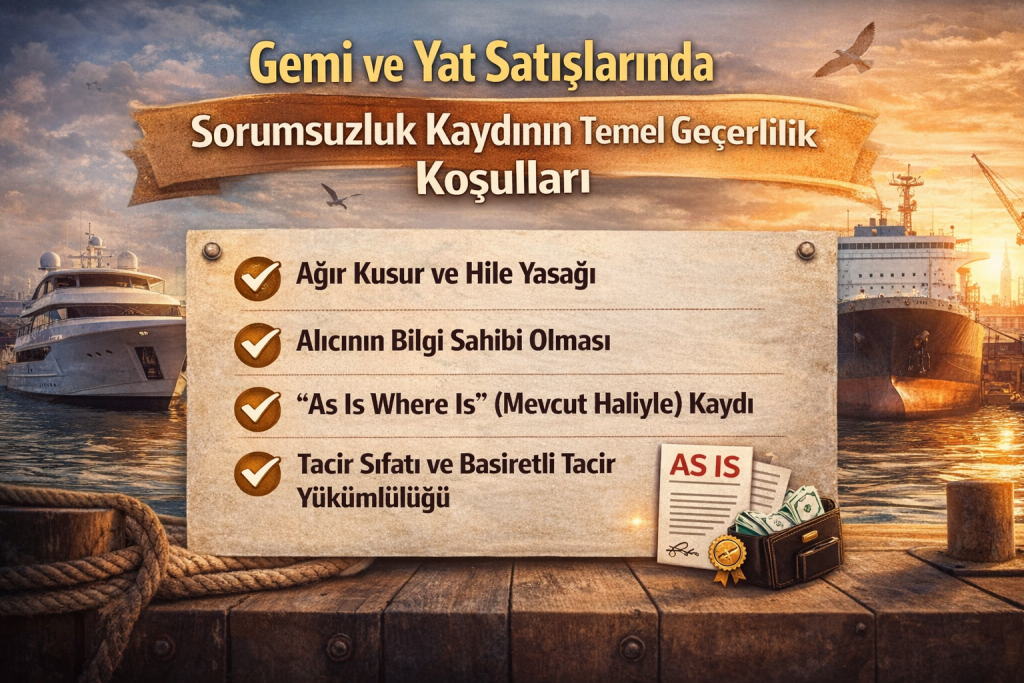
Prohibition of Gross Negligence and Fraud: According to TCO art. 221 (and repealed CO art. 196), if the seller is grossly negligent in transferring the defective goods or has concealed the defect from the buyer with fraud, any agreement that removes liability is absolutely null and void.
Buyer’s Knowledge: According to TCO art. 222, the seller cannot be held responsible for defects that the buyer knew or ought to have known at the time of sale. In this case, the exemption clause is considered valid for defects that the buyer previously knew or had the opportunity to observe.
“As Is Where Is” Clause: Commonly used in maritime trade, the “as is where is” (as is where is basis) clause is accepted by the judiciary as an exemption clause. This clause means that the sold vessel is purchased with all its defects.
Merchant Status and Duty to Act Prudently: In cases where the buyer is a merchant, the obligation to inspect the goods and review the contract terms by acting “as a prudent business person” in accordance with Article 18/2 of the TCC (Turkish Commercial Code) is a factor that strengthens the validity of the exemption clause.
2. Concrete Case Examples and Case-Based Analysis
A. Situation Where the Exemption Clause Was Deemed Valid (Ship Sale)
Istanbul 17th Commercial Court of First Instance (2018/467 E. – 2021/244 K.) and Istanbul Regional Court of Appeals 13th Civil Chamber (2022/987 E. – 2024/2054 RecordK.):
Case: In the sale of a Tanzanian-flagged vessel, clauses were added to the contract stating that the vessel would be delivered “as is” (as is where is) , that no drydocking would be performed upon delivery, and that the seller would not be liable for damages occurring after delivery. Additionally, in Article 19, the buyer was informed that the vessel needed to be drydocked for the renewal of its class certificates.
Analysis: The Court determined that the buyer purchased the vessel after inspection and technical survey, and was aware that the class certificate had expired. Since no gross negligence or fraud on the part of the seller could be proven, the exemption clauses in the contract were deemed valid, and the buyer’s lawsuit based on a hidden defect claim was rejected.
B. Situation Where the Exemption Clause Was Deemed Invalid (Ship Engine and Propeller Sale)
Istanbul Regional Court of Appeals 14th Civil Chamber (2018/1937 E. – 2019/145 K.):
Case: In the ship engine and propeller sales contract, a broad exemption clause (Article 14) stipulated that the seller would not be liable for loss of profit, loss of income, or indirect damages in any way.
Analysis: Upon examination, it was determined that the propeller system was grossly defective due to a manufacturing error and malfunctioned repeatedly within the warranty period. The court ruled that an exemption clause is void (pursuant to Articles 99 and 196 of the Turkish Code of Obligations) in cases where the seller is found to have acted with gross negligence, and therefore decided that the seller was responsible for loss of income and shipyard expenses.
3. Secondary Sources and General Commercial Principles (Secondary Information)
According to information obtained from secondary sources, although not directly constituting a precedent for ship/yacht sales, the following principles apply in general commercial sales:
Services Requiring Expertise: Pursuant to Article 115/3 of the TCO, in services requiring expertise and carried out with permission granted by law/competent authorities (e.g., towage/pilotage services), exclusion clauses are absolutely void. This situation gives rise to liability in maritime service contracts (such as towage), rather than ship sales, regardless of whether the negligence is gross or slight (Istanbul 17th Commercial Court, 2022/378 E.
Second-Hand Commercial Goods: In sales of second-hand machinery or vehicles, if the buyer is a merchant and accepts the goods “as is,” the exemption clause remains valid as long as the seller’s gross negligence is not proven. However, if there is a commitment to “deliver in working condition,” a breach of this commitment may constitute a contractual violation beyond the exemption clause (Istanbul Anatolian 9th Commercial Court, 2022/885 E.
Gross Negligence Review: The Supreme Court and Regional Courts of Justice, when evaluating disclaimers of liability, always review whether there is “gross negligence” or “fraud”. If a defect is known by the seller and deliberately concealed (fraudulent concealment), no limitation in the contract relieves the seller of liability (Izmir Regional Court of Justice 17th Civil Chamber, 2020/1935 E. )
4. Conclusion and Evaluation
In ship and yacht sales, the validity of disclaimers of liability is not absolute. Provisions limiting liability, such as “as is where is” or similar clauses included in the contract, are subject to the following:
The absence of gross negligence or fraud on the part of the seller,
The defect being known by the buyer or being discoverable through a diligent inspection,
And the contract terms not constituting general terms and conditions contrary to the rule of good faith, are the conditions under which they gain validity. Especially in cases constituting gross negligence, such as manufacturing defects, the limiting provisions in the contract are deemed invalid pursuant to Articles 115 and 221 of the Turkish Code of Obligations (TCO).
Frequently Asked Questions
Gemi veya yat satış sözleşmesindeki “as is where is” kaydı her durumda geçerli midir?
Hayır. “As is where is” (mevcut haliyle, olduğu gibi) kaydı, kural olarak satıcının ayıptan sorumluluğunu sınırlandıran bir hüküm olmakla birlikte mutlak geçerliliğe sahip değildir. Satıcının ayıbı bilmesine rağmen gizlemesi (hile) veya ayıbın ağır kusur teşkil etmesi hâlinde, bu tür sorumsuzluk kayıtları Türk Borçlar Kanunu m. 221 uyarınca kesin hükümsüz sayılmaktadır. Yargı kararlarında özellikle üretim hatası, ciddi makine arızaları ve klas sertifikasına etki eden teknik ayıplar bakımından bu kayıtların geçersizliği sıkça kabul edilmektedir.
Alıcı tacir ise sorumsuzluk kaydı satıcıyı tamamen korur mu?
Alıcının tacir olması ve TTK m. 18/2 uyarınca basiretli iş insanı gibi davranma yükümlülüğü, sorumsuzluk kaydının geçerliliğini güçlendiren bir unsurdur; ancak tek başına yeterli değildir. Alıcının gemiyi veya yatı fiilen görmesi, teknik inceleme yaptırması ve ayıpları bilerek kabul etmesi hâlinde satıcının sorumluluğu sınırlanabilir. Buna karşılık, alıcı tacir olsa dahi satıcının ağır kusuru veya ayıbı gizleme kastı varsa, sorumsuzluk kaydı yine geçersiz kabul edilir.
Sorumsuzluk kaydı varken gelir kaybı ve dolaylı zararlar talep edilebilir mi?
Evet, belirli şartlar altında talep edilebilir. Sözleşmede kar kaybı, gelir kaybı veya dolaylı zararlardan sorumluluk dışlanmış olsa bile, satıcının ağır kusurunun bulunması hâlinde bu kayıtlar geçerliliğini yitirir. Uygulamada özellikle gemi makinesi, pervane, ana sistemler gibi hayati unsurlardaki üretim veya imalat hatalarında; tersane masrafları, sefer kaybı ve ticari zararlar bakımından satıcının sorumluluğuna gidildiği görülmektedir.
Why is Expert Legal Assistance Necessary?
Unlike classic movable property sales, ship and yacht sales are technical and multi-dimensional transactions that encompass maritime law, commercial law, and international contract practice together. Especially the validity of disclaimers of liability requires a joint evaluation of many elements such as contract language, the capacity of the parties, the nature of the defect, classification status, delivery method, and actual use.
A large portion of disputes in ship and yacht sales conducted in Istanbul ports, Tuzla shipyard, and its vicinity revolves around; as is where is clauses, claims of latent defects, classification certificate issues, and discussions of severe faults. Pursuing an incorrect legal strategy in such disputes can result in the complete rejection of claims worth millions of liras.
For this reason, working with a law firm that has sectoral experience as an Istanbul maritime law lawyer and especially as a Tuzla maritime law lawyer is critically important. 2M Law Firm provides effective legal protection to its clients with its approach, which is proficient in Istanbul and Tuzla-based maritime trade practices, in the preparation of ship and yacht sale contracts, the lawful structuring of disclaimer clauses, and disputes that may arise thereafter.
Specifically;
Ship and yacht sales originating from Tuzla shipyard,
Marine vessels delivered via Istanbul ports,
Expert lawyer support for sale contracts of international flagged vessels prevents hard-to-remedy risks not only during the litigation phase but also when the contract is being established.