
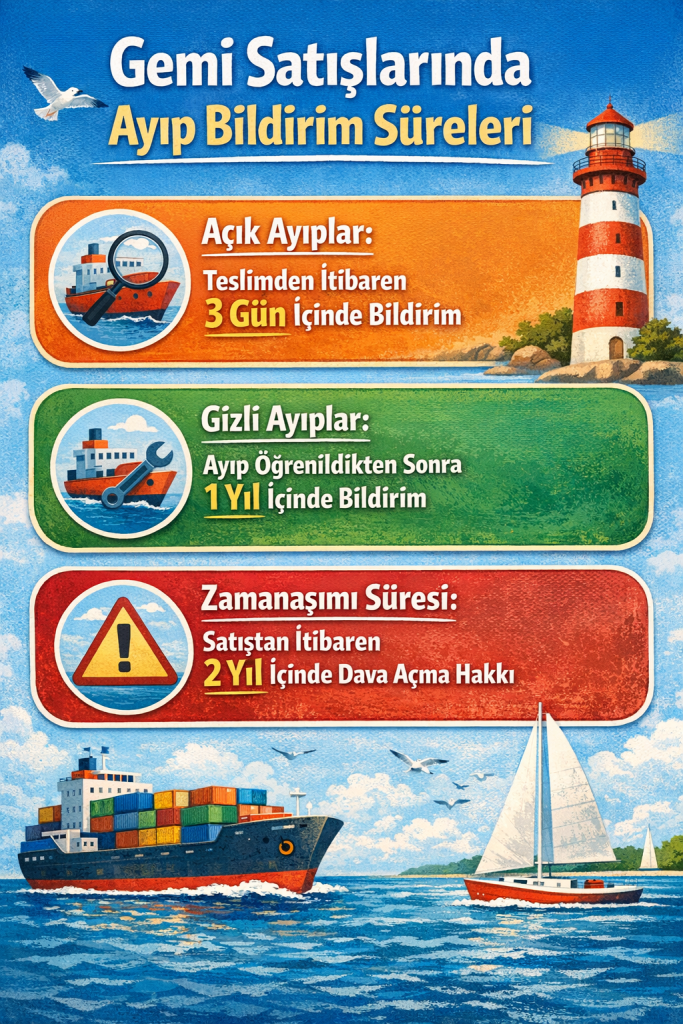
1. Defect Notification Periods in Ship Sales
Defect notification periods in ship sales are determined within the framework of the provisions of the Turkish Code of Obligations (TBK) and the Turkish Commercial Code (TTK) according to the commercial nature of the transaction and the type of defect (patent or latent defect):
General Periods (TBK art. 223): The buyer is obliged to inspect the condition of the purchased item as soon as circumstances permit, in the ordinary course of business, and if they find a defect that requires the seller’s liability, to notify the seller thereof within “an appropriate period”.
Periods in Commercial Sales (TTK art. 23/c):
Patent Defects: If the defect of the goods is clearly evident at the time of delivery, the buyer must notify the seller of the situation within 2 days .
Defects Revealed by Inspection: If the defect is not clearly evident at the time of delivery, the buyer is obliged to inspect or have the goods inspected within 8 days after receiving them, and if they detect a defect as a result of this inspection, to notify it within the same period.
Latent Defects: In the case of defects that cannot be discovered by an ordinary inspection, if such a defect is subsequently understood, it must be notified to the seller “immediately” or “without delay” (TBK art. 223/2).
Statute of Limitations: Unless the seller undertakes a longer period, lawsuits concerning liability arising from defects, even if the defect appears later, become time-barred 2 years after the transfer of the goods to the buyer (Istanbul Anatolian 3rd ATM-2020/288 K).
2. Cases Where Defect Notification is Deemed Invalid
According to judicial decisions, defect notifications made in the following situations are deemed invalid, and the buyer loses their optional rights:
Expiration of Period: Notifications made approximately two months after delivery (e.g., a warning letter issued on 08.06.2018 after the delivery date of 04.04.2018) have been deemed invalid on the grounds that they were not made within the period according to the ordinary course of business (Istanbul Regional Court of Appeals 13th Civil Chamber-2022/987
Disclaimer Clauses: Clauses in the contract such as “as is where is basis” (as is), “no pooling will be done upon delivery,” or “the seller is not responsible for damages detected in pooling after delivery” may invalidate the notification by eliminating the seller’s liability.
Buyer’s Prior Knowledge: The seller is not responsible for defects known by the buyer at the time the sales contract was concluded (Turkish Code of Obligations Art. 222).
Neglect of Inspection and Notification Obligation: If the buyer fails to fulfill their obligation to inspect and notify within a reasonable time, the goods are considered accepted in their defective condition.
Exception (Gross Negligence): In cases where the seller is grossly negligent or has made selling their profession (TBK Art. 225), the seller cannot be relieved of responsibility by claiming that the defect was not reported in time (Istanbul 17th Commercial Court-2019/347 Decision
3. Formal Requirement for Defect Notification
Validity Requirement: No specific formal requirement is stipulated for the validity of defect notification under TBK Art. 223. Any notification suitable for informing the seller of the defect, in terms of its content, may be deemed sufficient.
Proof Requirement (TCC Art. 18/3): In sales between merchants; notifications regarding placing the other party in default, terminating the contract, or rescinding the contract made via public notary, registered mail, telegram, or registered electronic mail (REM) system are important for ease of proof. Some court decisions have emphasized that this procedure is a “proof requirement” and that notifications that cannot be proven by written evidence may be considered invalid (Istanbul Anatolian 3rd Commercial Court-2020/288
4. Information Obtained from Secondary Sources
The following additional points have been emphasized in decisions categorized as secondary sources:
Burden of Proof: In transactions between merchants, the formal requirement in TCC Art. 18/3 is not considered a validity requirement but a “proof requirement.” If the notification cannot be proven by these means, a loss of rights may occur (Gaziantep 2nd Commercial Court-2023/309
De Facto Notice: The delivery of a vehicle or machine to an authorized service under warranty is, in some cases, considered a “de facto defect notification” and is deemed to have been made within the stipulated period (Istanbul Regional Court of Justice 13th Civil Division – 2020/303 k, Antalya 4th Commercial Court – 2018/6)
Flexibility: In some decisions citing Supreme Court precedents, it has been stated that defect notification is generally not subject to any specific form, and any type of notification (email, warning letter, etc.) that ensures the counterparty is informed of the defect may be sufficient (Ankara Regional Court of Justice 22nd Civil Division – 2021/940 K). However, it has been noted that WhatsApp or verbal notifications may be considered insufficient for evidentiary purposes unless it can be proven that they reached the recipient (Antalya 4th Commercial Court – 2022/640 K)
Gemi satışında ayıp ihbarı kaç gün içinde yapılmalıdır?

Ayıp ihbar süresi, satışın ticari olup olmamasına ve ayıbın niteliğine göre değişir. Ticari satışlarda açık ayıplar için 2 gün, muayene ile ortaya çıkan ayıplar için 8 gün, gizli ayıplarda ise ayıp öğrenilir öğrenilmez derhal bildirim yapılmalıdır. Bu süreler aşılırsa alıcı ayıptan doğan haklarını kaybedebilir.
“As is where is” kaydı ayıp ihbarını tamamen geçersiz kılar mı?
Çoğu durumda evet. Gemi satış sözleşmesinde yer alan “as is where is” (mevcut haliyle), havuzlama yapılmayacaktır veya teslim sonrası hasarlardan satıcı sorumlu değildir gibi kayıtlar, satıcının ayıptan sorumluluğunu önemli ölçüde sınırlar. Ancak satıcının ağır kusuru veya ayıbı bilerek gizlemesi hâlinde bu kayıtlar geçersiz sayılabilir.
Ayıp ihbarı yazılı yapılmak zorunda mıdır?
Türk Borçlar Kanunu’na göre ayıp ihbarı için zorunlu bir şekil şartı yoktur. Ancak tacirler arasındaki gemi satışlarında, TTK m.18/3 gereği ihbarın noter, taahhütlü mektup veya KEP ile yapılması ispat açısından büyük önem taşır. WhatsApp veya sözlü bildirimler, muhataba ulaştığı ispatlanamadıkça ciddi hak kaybına yol açabilir.
Why is Expert Legal Support Necessary?
In ship sales, defect notification; unlike a regular goods sale, is evaluated in conjunction with maritime trade, commercial sales provisions, contractual exemption clauses, class status, docking practices, and international maritime practice. An incorrect or late defect notification can lead to the buyer completely losing all their elective rights, such as reimbursement, repair, compensation, or withdrawal from the contract.
The most common mistakes in practice are:
Incorrect calculation of the defect notification period,
Making a notification through the wrong method of notification,
Disregarding the legal effect of “as is, where is” clauses,
Failure to correctly establish the distinction between gross negligence and hidden defect, and missing the statute of limitations.
Therefore, in disputes related to ship sales, working with a lawyer specialized in maritime trade and commercial law is of critical importance. 2M Law Firm provides effective legal protection to its clients, especially in defect disputes arising from Tuzla shipyards, Istanbul ports, and second-hand ship sales, through a correct notification strategy, strong evidence, and litigation management in accordance with judicial precedents.
In ship sales, a defect notification delayed by even one day can mean a loss of rights worth millions of liras. Therefore, managing the process with the support of an expert lawyer from the very beginning prevents irreparable damages.