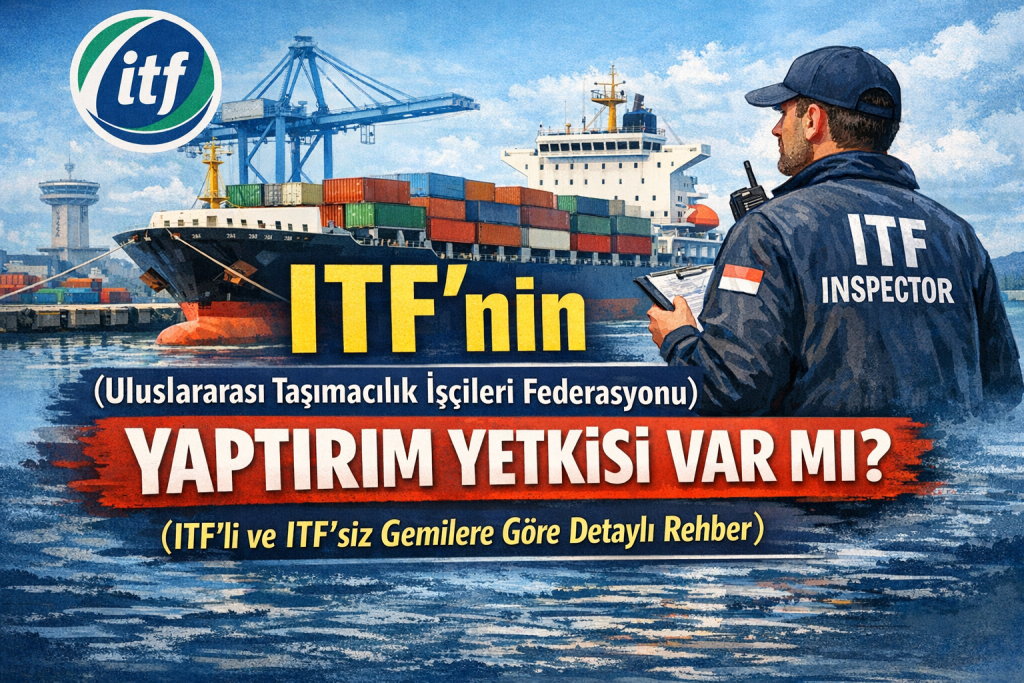
In the maritime sector, among the most common problems faced by seafarers are unpaid wages, unpaid overtime claims, and poor working conditions. At this point, the ITF (International Transport Workers’ Federation) stands out as one of the most powerful mechanisms protecting seafarers’ rights at an international level. However, the ITF’s power of intervention and its enforcement effect vary significantly depending on whether the ship is covered by an ITF agreement. In this article, we delve into the ITF’s true power, its practical impact, and what it means for seafarers.
What is the ITF (International Transport Workers’ Federation) Intervention Authority?
The ITF is not a government agency or an official regulatory authority; ahowever, due to being a powerful federation with hundreds of unions affiliated worldwide, its de facto enforcement power is quite high. ITF inspectors board ships in ports to meet with crew members, examine employment contracts, check wage payments, and monitor working conditions. In case of detected violations, the shipowner is directly contacted, and a resolution to the problem is requested. The ITF’s most significant power is that these interventions are followed up not only locally but also globally. This means that even if a ship leaves Turkey and goes to another country, monitoring can continue through the ITF network.
Enforcement Power on Ships Covered by ITF
On ships subject to an ITF agreement, ITF’s power of intervention is extremely high. The main reason for this is that the shipowner has signed a collective bargaining agreement (CBA) with the ITF and has accepted specific wage, working hour, and living standards. In such vessels, a violation detected by an ITF inspector directly constitutes a breach of contract. In this situation, the ITF demands that the shipowner immediately top up underpaid wages, calculate overtime dues, and make the necessary corrections. If payment is not made, the vessel can be reported internationally, its operations can be effectively hampered, and the shipowner can face significant reputational damage. In practice, there are numerous cases where ships have been forced to pay all outstanding dues before leaving port.
Intervention and Impact on Ships Not Covered by ITF
On ships not covered by the ITF, while there is no direct contractual sanction, the ITF still possesses significant influence. In such cases, ITF inspectors can board the ship to conduct inspections, listen to crew complaints, and engage in discussions with the shipowner. Furthermore, if necessary, they can notify port state control authorities and create indirect pressure on the vessel. Thanks to the ITF’s global network, the likelihood of the ship being inspected in other ports increases, which creates significant psychological and commercial pressure on the shipowner. Particularly, applications made while the ship is in port often yield positive results, ensuring that dues are paid.
Unions Affiliated with ITF and Their Structure
ITF is a large organization to which hundreds of unions operating in over 140 countries worldwide are affiliated. Thanks to this structure, ITF has established a strong coordination and inspection network in the international maritime sector. In Turkey, ITF activities are mainly carried out through the Turkish Seafarers’ Union. Through these unions, seafarers’ rights are protected, international standards are applied, and coordinated action is taken with ITF inspectors when necessary. ITF’s global structure enables seafarers to receive support wherever they are in the world.
👆 ITF affiliated unions and associations in Turkey:
What is ITF’s True Enforcement Power?
ITF’s enforcement power is based on the de facto pressure it creates at an international level, rather than a legal compulsion in the classical sense. A ship waiting in port, disruption of its operations, the risk of problems in other ports, and damage to the shipowner’s international reputation are ITF’s most powerful tools. For this reason, shipowners often prefer to pay seafarers’ outstanding dues to avoid confrontation with ITF or to prevent the situation from escalating. This makes ITF an extremely effective mechanism in the maritime sector.
Why is Expert Legal Support Necessary?
While an ITF application is a powerful means of seeking rights, there is a risk that the desired outcome may not be achieved if the process is not managed correctly. Particularly, correctly calculating claim items, supporting the application with legal grounds, and swiftly transitioning to litigation and enforcement processes when necessary are of great importance. At this point, the support of an Istanbul maritime lawyer and a Tuzla maritime lawyer ensures that the process is conducted professionally.
Specializing in maritime labor law, 2M Hukuk Law Firm strategically manages ITF applications and strengthens the process with precautionary attachments, ship arrest claims, and enforcement proceedings when necessary. Running the ITF process and the legal process concurrently ensures that the seafarer collects their receivables in the fastest and safest way.