1. Provisional Attachment Enforcement Procedure for Turkish-Flagged Vessels on Voyage
Article 1367/1-a of the Turkish Commercial Code (TCC) stipulates a special provisional attachment enforcement procedure for Turkish-flagged vessels on voyage. As stated in the judgment of the 12th Civil Chamber of the Supreme Court of Appeals dated 04.05.2015, numbered 2015/8798 E. – 2015/12110 K., and in the decision of the 11th Civil Chamber of the Supreme Court of Appeals dated 30.03.2023, numbered 2021/7470 E. – 2023/1969 K.; if the vessel has actually set sail or is on a voyage when the provisional attachment order is to be executed, the following steps are followed:
Notification and Warning: The provisional attachment order is served to the owner, the non-owner shipowner (bareboat charterer/operator), and the person personally liable for the debt.
Security Period: The relevant parties are warned to provide security within ten days for the maritime claim.
Delivery Obligation: If security is not provided, the vessel is requested to be delivered to the enforcement office on its next voyage.
Penal Sanction: If the vessel is not delivered, the responsible party is warned that criminal proceedings will be initiated against them in accordance with Article 289 of the Turkish Penal Code.
In the decision of the 12th Civil Chamber of the Istanbul Regional Court of Appeals dated 08.07.2021, numbered 2018/1258 E. – 2021/1125 K., it was emphasized that a Turkish-flagged vessel on a voyage cannot be interdicted if it is not in Turkish ports, but when the vessel returns to Turkey, proceedings can be initiated under Article 1367/1-a of the Turkish Commercial Code (TCC) and a period for providing security can be granted.
2. Differences in Execution Between Turkish-Flagged and Foreign-Flagged Vessels
As a general rule, in accordance with Article 1366 of the TCC, all vessels for which a precautionary attachment has been decided are interdicted from sailing and taken into custody by the enforcement officer, regardless of their flag and the registry they are recorded in (Turkish Supreme Court 12th Civil Chamber, 21.12.2022, 2022/5590 E. – 2022/13683 K.). However, concerning vessels on a voyage, there is a distinction specific to Turkish-flagged vessels:
Facility Specific to Turkish-Flagged Vessels: Article 1367/1-a of the TCC provides for a 10-day security period for Turkish-flagged vessels on a voyage and the possibility of the vessel’s delivery “on the next ensuing voyage”. In the decision of the 12th Civil Chamber of the Turkish Supreme Court dated 04.05.2015, numbered 2015/3161 E. – 2015/12109 K., it was stated that this procedure is specific only to Turkish-flagged vessels.
Foreign-Flagged Vessels: In the examined decisions, no similar special regulation providing for a 10-day security/waiting period for foreign-flagged vessels on a voyage, as is the case for Turkish-flagged vessels, was mentioned. In accordance with TCC Article 1366, foreign-flagged vessels can also be interdicted from sailing regardless of their flag.
3. General Principles of Enforcement and the Authority of the Enforcement Officer
The enforcement process for the provisional attachment of ships is based on the following fundamental principles:
Mandatory Prohibition of Departure: The prohibition of departure is one of the mandatory duties that the enforcement office must perform within the scope of enforcing the provisional attachment. There is no need for the phrase “prohibition of departure” to be explicitly stated in the court order; the enforcement officer carries out this action ex officio in accordance with Article 1366 of the Turkish Commercial Code (Turkish Court of Cassation 12th Civil Chamber, 18.01.2023, 2022/7245 E. – 2023/294 K.).
Condition of Actual Attachment: For the attachment of ships, merely entering an annotation in the registry or the Port State Control Register is not sufficient; the ship must be actually attached and prohibited from departure (Turkish Court of Cassation 12th Civil Chamber, 07.06.2022, 2022/2986 E. – 2022/6825 K.).
Time Limit: The creditor must request the enforcement of the provisional attachment decision (from the enforcement office in the location of the ship or within the jurisdiction of the court that issued the decision) within three business days from the date the decision was rendered (Turkish Court of Cassation 12th Civil Chamber, 19.12.2016, 2016/6938 E. – 2016/25597 K.).
4. Information Obtained from Secondary Sources
The decisions acting as secondary sources include the following additional details regarding the enforcement process:
Notification for Foreign-Flagged Ships: In the decision of İzmir 5th Civil Court of Commerce dated 21.02.2018, numbered 2016/385 E. – 2023/109 K., it is observed that in the attachment of a ship with foreign elements, the enforcement office notified the Consulate General to which the ship is affiliated and ensured actual seizure by writing a writ to the relevant port authorities (Customs, Coast Guard, Port Authority).
Restriction of Territorial Waters: In the decision dated 18.10.2023, numbered 2022/183 E. – 2023/409 K. of the Istanbul 17th Civil Court of Commerce, it was discussed that methods such as restricting the vessel’s voyage to Turkish territorial waters and entrusting it to a trustee were used in some measures applied to Turkish-flagged vessels in the past, however, if the vessel technically lacks the ability to leave the country, such severe measures could be deemed unfair.
Similarity to Final Attachment: Pursuant to TCC article 1382, the provisions of articles 1364 to 1368 regarding provisional attachment are also applied in the final attachment of all Turkish and foreign-flagged vessels (Supreme Court 5th Civil Chamber, 20.06.2022, 2022/6698 E. – 2022/11199 K.).
Frequently Asked Questions
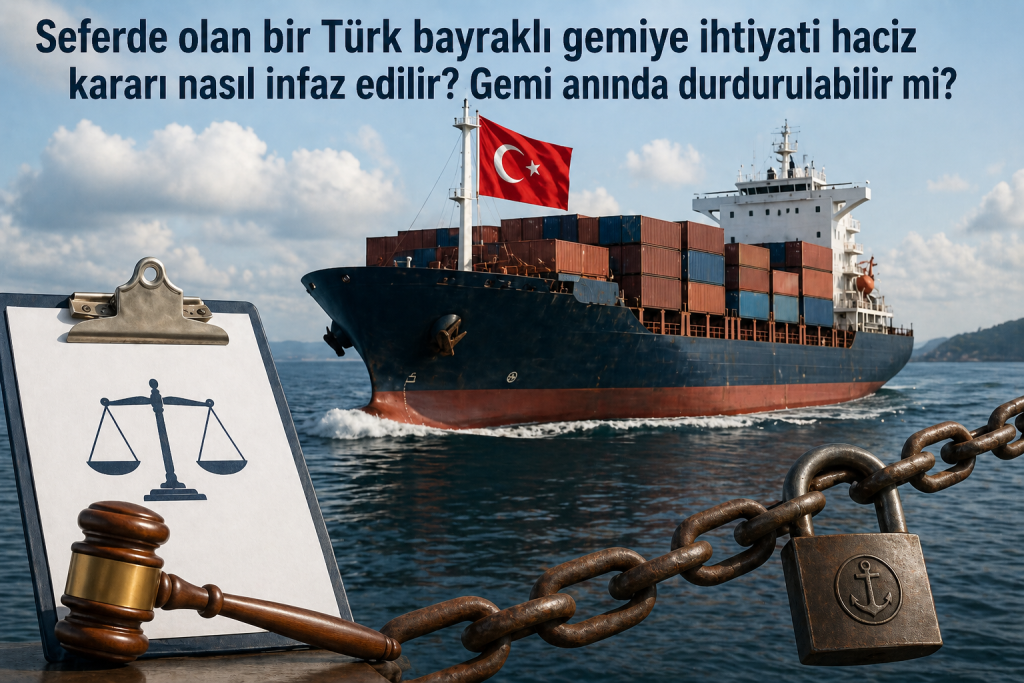
Seferde olan bir Türk bayraklı gemiye ihtiyati haciz kararı nasıl infaz edilir? Gemi anında durdurulabilir mi?

Seferdeki Türk bayraklı gemiler için TTK’nın 1367/1-a maddesi özel bir prosedür öngörmektedir. Gemi fiilen hareket halindeyse ihtiyati haciz kararı malike, donatan ve borçtan şahsen sorumlu kişiye tebliğ edilir; ardından on gün içinde teminat vermeleri ihtar olunur. Teminat verilmezse geminin izleyen ilk seferinde icra dairesine teslim edilmesi istenir. Teslim yükümlülüğüne uyulmaması halinde ise TCK’nın 289. maddesi uyarınca cezai işlem uygulanacağı ihtarı yapılır. Yargıtay 11. Hukuk Dairesi ve İstanbul Bölge Adliye Mahkemesi kararları da seferdeki Türk bayraklı geminin Türk limanlarında bulunmaması durumunda seferden men edilemeyeceğini, ancak Türkiye’ye döndüğünde bu prosedürün işletileceğini teyit etmektedir.
Yabancı bayraklı gemilere ihtiyati haciz uygulanması Türk bayraklı gemilerden farklı mı? Hangi ülkenin gemisi olduğu önem taşır mı?
Evet, önemli farklılıklar mevcuttur. TTK’nın 1366. maddesi uyarınca tüm gemiler bayrağına bakılmaksızın seferden men edilerek muhafaza altına alınabilir; ancak seferdeki gemiler söz konusu olduğunda Türk bayraklı gemilere tanınan 10 günlük teminat süresi ve “izleyen ilk seferde teslim” imkânı yabancı bayraklı gemiler için öngörülmemiştir. Yargıtay 12. Hukuk Dairesi de bu prosedürün yalnızca Türk bayraklı gemilere özgü olduğunu açıkça vurgulamaktadır. Yabancı bayraklı gemilerin haczinde icra müdürlüğü ilgili başkonsolosluğa bildirimde bulunmakta, Gümrük, Sahil Güvenlik ve Liman Başkanlığı’na müzekkere yazarak fiili el koyma sağlanmaktadır.
İhtiyati haciz kararı alındıktan sonra ne kadar sürede infaz edilmelidir? Sicile şerh vermek yeterli midir?
İhtiyati haciz kararının alınmasının ardından alacaklı, kararın verildiği tarihten itibaren üç iş günü içinde infazı talep etmek zorundadır; bu süre hak düşürücü nitelikte olup kaçırılması telafi edilemez sonuçlar doğurabilir. Öte yandan geminin yalnızca gemi siciline veya Bağlama Kütüğü’ne şerh verilmesi infaz için yeterli değildir. Yargıtay 12. Hukuk Dairesi, geminin fiilen haczedilmesi ve seferden men edilmesinin zorunlu olduğunu, seferden men işleminin mahkeme kararında ayrıca belirtilmesine gerek kalmaksızın icra müdürü tarafından re’sen gerçekleştirilmesi gerektiğini açıkça ortaya koymaktadır.
Why is Expert Legal Support Necessary?
Precautionary arrest procedures for ships is a highly technical field that requires the combined management of the special maritime law provisions of the Turkish Commercial Code (TTK), the procedures of the Enforcement and Bankruptcy Law, flag state distinctions, and international maritime law rules. Missing the three-business-day execution period, failing to carry out the actual attachment by merely registering an annotation in the registry, or disregarding procedural differences between Turkish and foreign-flagged vessels, can cause the claim to be entirely jeopardized. The maritime law expert lawyers of 2M Hukuk Law Office, serving as lawyers in Istanbul and Tuzla, provide effective legal support to both creditors and shipowners regarding obtaining precautionary arrest orders, managing the execution process, operations to prohibit sailing, and preparing defenses against possible objections. To avoid loss of rights in maritime claims, obtaining support from an expert lawyer at the very beginning of the process is of great importance.