
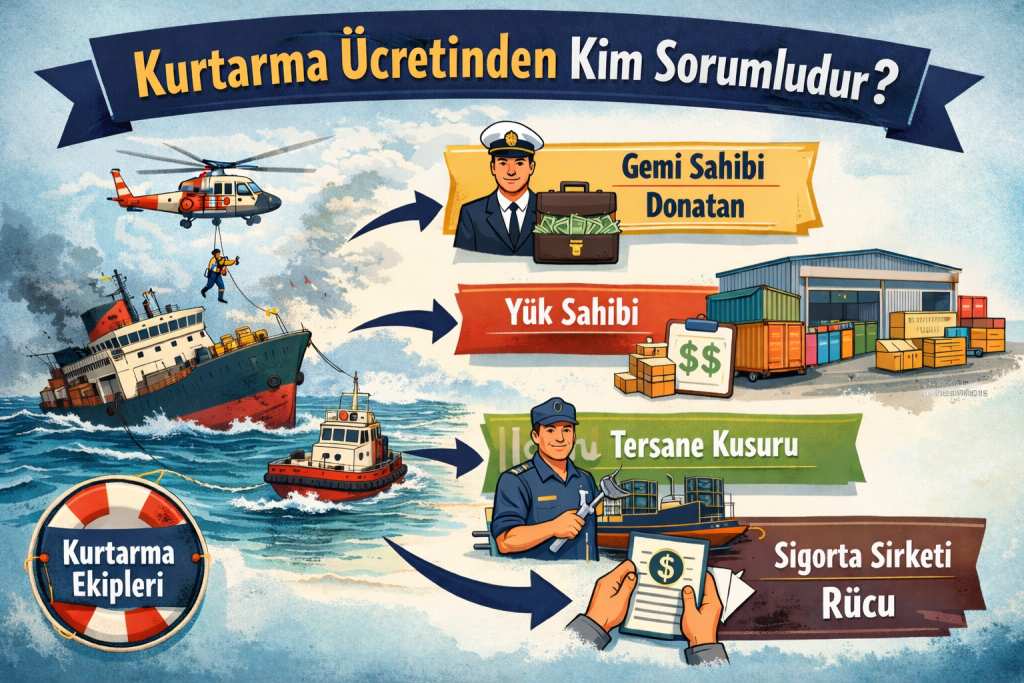
In maritime trade, salvage activity is not merely a technical and operational intervention, but a special legal institution that directly gives rise to strong financial and in rem consequences arising from law. The salvage fee demanded in return for salvage services is regulated as a “maritime claim” in the Turkish Commercial Code and placed under superior legal protection compared to many other claims. The decision of the Istanbul 17th Commercial Court of First Instance, dated 18.03.2022 and numbered E. 2016/289, K. 2022/132, is a comprehensive decision that details how this liability arises for the shipowner and cargo owner.
Legal Nature of the Salvage Fee: Maritime Claim and Statutory Lien
As explicitly emphasized in the court’s decision, the salvage fee is not an ordinary contractual claim. Claims arising from salvage and assistance services qualify as maritime claims under the Turkish Commercial Code, and for these claims, a statutory lien automatically arises without the need for registration. This nature makes the salvage fee:
Prioritized over ordinary claims,
Prioritized over contractual pledges,
Prioritized over most mortgaged claims. Therefore, the salvage fee is among the claims to be paid preferentially from the sale price even if the vessel is sold.
Shipowner’s Liability for Salvage Fee
In the incident subject to the decision, the Court clearly established the liability of the shipowner (donator). The salvage operation was carried out after the ship was in danger, and the ship was effectively secured. In this situation:
The salvaged ship is an essential element of maritime wealth. It is accepted that the shipowner derives a direct and objective benefit from the salvage service. Therefore, the shipowner is liable for the salvage remuneration without fault. The Court accepted the shipowner’s liability, limited to the salvage remuneration determined based on the salvaged ship’s value, and ruled that this claim should be covered from the ship’s sale price within the scope of a statutory lien.
Liability of the Cargo Owner for Salvage Remuneration
One of the most critical aspects of the decision concerns the liability of the cargo owner. The Court determined that as a result of the salvage operation, not only the ship but also the cargo was actually salvaged. At this point, the explicit regulation of the Turkish Commercial Code was relied upon. According to the Court:
If the cargo was salvaged while in danger,
If the cargo owner has directly benefited from the salvage operation,
Especially if the existence of salvage remuneration is known or ought to have been known when the cargo is being delivered, the cargo owner also becomes personally liable for the salvage remuneration. In the specific case, the cargo owner took delivery of the cargo after the salvage operation; and the court determined that this delivery occurred despite knowledge of the salvage remuneration. Therefore, it was accepted that the cargo owner was liable for the salvage remuneration proportionate to their share of the cargo.
Allocation of Liability Between Shipowner and Cargo Owner
Another noteworthy point in the decision is that the salvage remuneration is not treated as a single item, but rather allocated taking into account the values saved. Based on expert reports, the court ruled that the shipowner is liable for the salvage remuneration determined for the ship and its fuel (bunker), while the cargo owner is liable for the salvage remuneration calculated for the transported cargo. This approach is a direct reflection of the fundamental principle of salvage law, namely the principle of ‘liability proportionate to the value salved’.
The Place of Salvage Remuneration in the Table of Priorities
The relevant decision also clarifies the place of salvage remuneration in the table of priorities. Salvage claim:
Together with claims of seafarers,
Ranks among first-priority statutory maritime liens,
It is paid before contractual ship mortgages and ordinary claims. Therefore, it has been deemed lawful for the salvage fee claimant to be ranked highly in the order of priority established after the sale of the ship. A writing suggestion.
Conclusion: From Whom and To What Extent is the Salvage Fee Demanded?
To summarize in light of the decision dated 18.03.2022 by the Istanbul 17th Civil Court of Commerce:
The shipowner is responsible for the salvage fee with regard to the salvaged ship and its fuel.
The cargo owner is responsible for the salvage fee with regard to the salvaged cargo.
This liability arises not from a contract but directly from law.
Even if the salvage fee has not been legally enforced by a judgment, it constitutes a maritime claim and a legal lien.
Even if the ship is sold, the salvage claim follows the ship and is paid preferentially from the sale price. In this respect, the salvage fee emerges as a strong and privileged type of claim in maritime trade, requiring high risk awareness and careful consideration for both shipowners and cargo owners.
Kurtarma ücreti, gemi satıldıktan sonra da gemi sahibinden veya yeni malikten talep edilebilir mi?
Evet. Kurtarma ücreti, Türk Ticaret Kanunu uyarınca gemi alacağı niteliğindedir ve kanuni rehin hakkı sağlar. Bu hak tescile bağlı değildir ve gemiyi takip eder. Dolayısıyla gemi, kurtarma faaliyetinden sonra üçüncü bir kişiye satılmış olsa bile, kurtarma alacağı satış bedeli üzerinden öncelikle tahsil edilir. Yeni malikin gemiyi iyi niyetle iktisap etmiş olması, kurtarma alacağının ileri sürülmesine engel teşkil etmez.
Yük sahibi, kurtarma sözleşmesinin tarafı olmasa bile kurtarma ücretinden sorumlu tutulabilir mi?
Evet. Kurtarma faaliyeti sonucunda yük fiilen kurtarılmışsa ve yük sahibi bu kurtarmadan doğrudan menfaat sağlamışsa, kurtarma sözleşmesinin tarafı olmasa dahi yük sahibi sorumlu tutulabilir. Uygulamada, kurtarma sonrası yükün teslim alınması ve kurtarma ücretinin varlığının bilinmesi veya bilinmesinin beklenmesi hâlinde, yük sahibi yük payına düşen kurtarma ücretinden şahsen sorumlu kabul edilmektedir.
Why is Expert Legal Support Necessary?
Disputes concerning salvage fees are based on a completely different legal framework than classic debt-receivable relationships. In such cases, the issue is not merely “whether a service fee will be paid”; rather, highly technical and specialized issues such as whether it is salvage or assistance, whether the salvage claim is considered a maritime lien, whether a statutory lien right arises, how liability will be apportioned between the ship owner and the cargo owner, and at what rank it will be entered in the order of priority schedule are evaluated together.
Especially in salvage incidents occurring in areas with high maritime traffic and shipyard activities, such as the ports of Istanbul, Tuzla, Pendik, Gebze, and Dilovası; the nature of the service provided by the administration, the correct interpretation of expert reports, the lawful segregation of ship, cargo, and fuel values, and the simultaneous conduct of declaratory actions (negative declaratory actions) and collection (performance) actions are of great importance. Procedural errors made during this process can lead to the unnecessary seizure of the vessel, the prolonged blocking of letters of guarantee, or the erroneous imposition of high salvage fees.
Furthermore, the fact that a salvage fee, even if not finalized by a court order, constitutes a maritime lien and a statutory lien right, and that this claim follows the vessel even if it is sold, creates significant financial risks for ship owners and cargo interests. The proper management of these risks requires an approach that not only involves mastery of legislation, but also a close familiarity with the practices of the Court of Cassation (Supreme Court of Appeals) and Commercial Courts of First Instance, and the ability to interpret expert reports from both a technical and legal perspective simultaneously.
Therefore, the support of a lawyer specialized in maritime law is of vital importance to determine who will be responsible for the salvage fee and in what proportions, how the relationship between the shipowner and the cargo owner will be established, and to properly plan potential recourse processes. Working with an experienced team in maritime trade and salvage disputes in Istanbul and surrounding ports not only prevents loss of rights but also ensures that the process is carried out strategically and controlled from the very beginning.
In this context, 2M Law Office provides effective and expert legal support at all stages of the process for shipowners, cargo interests, insurance companies, and shipyards in disputes specific to maritime trade and ship salvage law.