
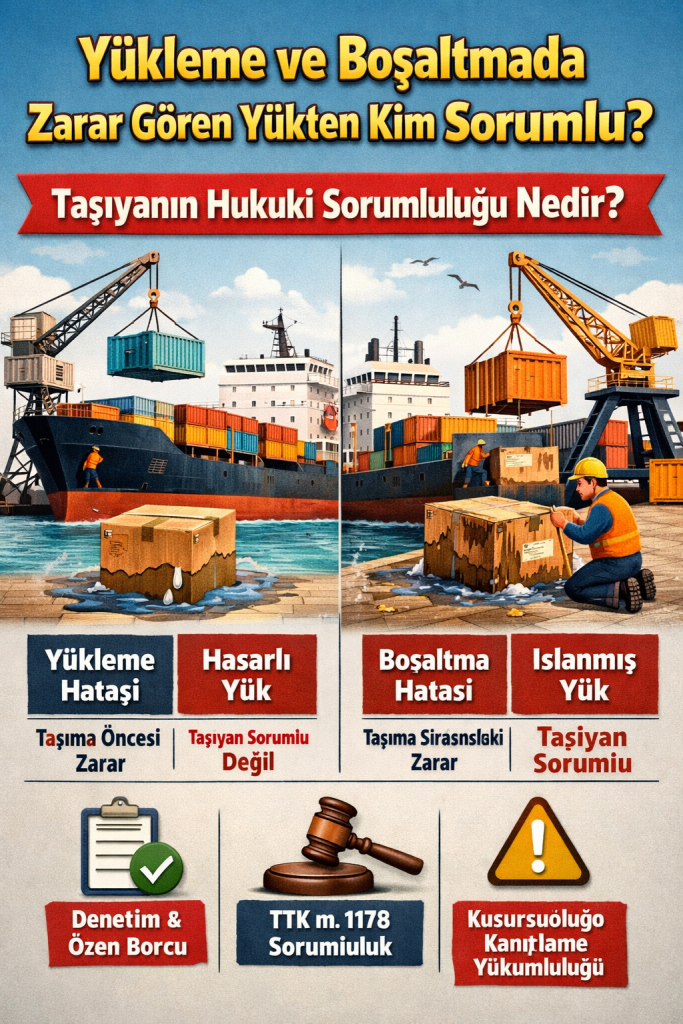
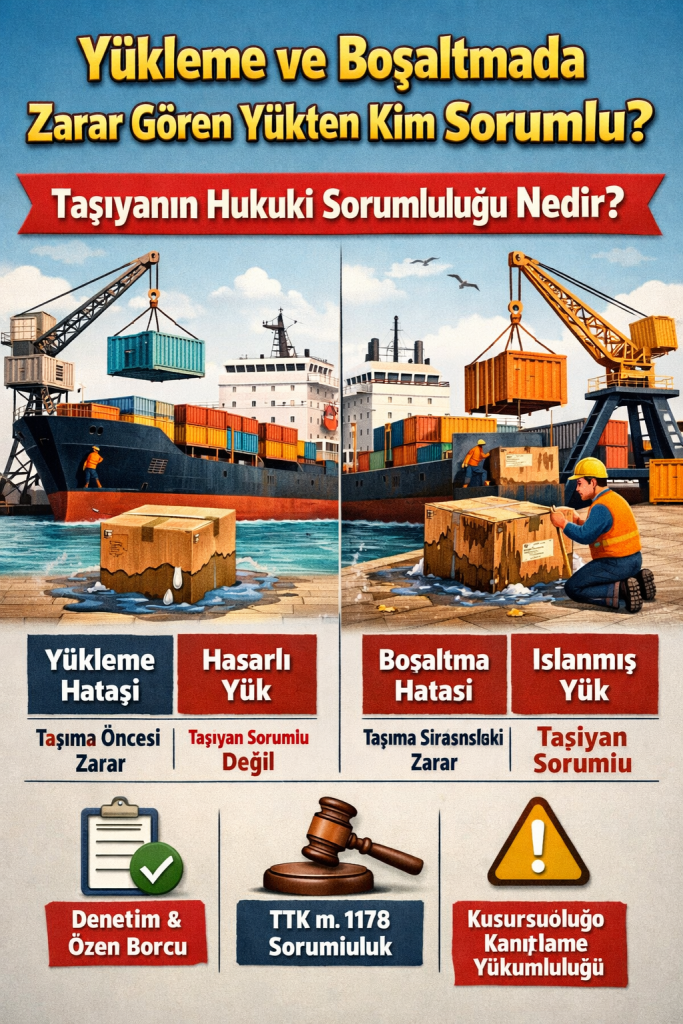
Water Entered the Ship’s Hold, Cargo Damaged: Is the Carrier or the Port Responsible? Cargo Damage Due to Bilge Leakage: Is it Considered a Maritime Claim, and From Whom Can it Be Demanded?
1. Legal Qualification: The Concept of a Maritime Claim
Damage to goods resulting from wetting during loading and unloading processes or from water leakage from hold bilge wells, is explicitly defined as a “maritime claim” within the framework of the Turkish Commercial Code (TCC). As stated in the decisions of the Istanbul 2nd Commercial Court of First Instance (2024/308 E. K) and the Istanbul 11th Commercial Court of First Instance (2022/891 E. ; pursuant to TCC article 1352/1-h, claims arising from “loss of or damage to goods carried on board the ship, or relating to such goods” are maritime claims. This scope includes not only navigation but also port services such as loading and unloading.
2. Carrier’s Duty of Care and Principles of Liability
The carrier’s liability, pursuant to TCC article 1178 (repealed TCC article 1061), is based on the obligation to “exercise the care and diligence expected from a prudent carrier” in the loading, stowage, carriage, custody, and discharge of goods.
Period of Liability: The carrier is responsible for loss and damage occurring during the period from the moment the goods are received until they are delivered.
Seaworthiness and Cargo-worthiness: Pursuant to Article 1141 of the TCC, the carrier is obliged to ensure that the ship is seaworthy, roadworthy, and fit for cargo (the adequacy of the holds, refrigeration systems, and other parts where cargo is carried). In the decision of the Samsun Civil Court of Commerce (2019/628 E. K), the water leakage from the hold ballast covers was accepted as “unsuitability for cargo” and a breach of the duty of care.
3. Concrete Case Analyses and Liability Scenarios
Bilge and Ballast Operation Errors: Istanbul 17th Civil Court of Commerce (2020/77 E. K) in its file, the wetting of bulk cargo as a result of water being mistakenly taken into the hold from the bilge wells due to erroneous ballast operation by the ship’s personnel was considered a fault of the carrier’s agents, and the carrier was held responsible. In the incident subject to the decision numbered 2020/77 E., 2021/421 K. of the Istanbul 17th Civil Court of Commerce; it was determined by an expert report that during the discharge of bulk cargo, part of the cargo was wetted and damaged due to seawater being pumped into the hold from the bilge wells as a result of erroneous ballast operation by the ship’s personnel, and that the damage occurred within the carrier’s area of control and due to the fault of its agents. Therefore, it was accepted that the carrier violated its duty of care for the cargo in accordance with Article 1178 et seq. of the Turkish Commercial Code. The court also ruled that the insurance company covering the damage could recourse to the carrier as subrogee to the insured pursuant to Article 1472 of the TCC, and by partially accepting the case, confirmed the carrier’s liability for compensation.Similarly, the 11th Civil Chamber of the Court of Cassation (2013/5116 E. ), found water leakage from ballast tank pipes to be under the carrier’s responsibility.
Faults During Discharge: In the decision of Istanbul 17th Civil Court of Commerce (2022/376 E. K), the port operator was held responsible under tort (Turkish Code of Obligations Article 49) for damage caused by the careless handling of port workers during the discharge of glass commodity. However, the carrier’s duty of supervision (Turkish Commercial Code Article 1091) is reserved. In the incident subject to the decision of Istanbul 17th Civil Court of Commerce, numbered 2022/376 E. and 2023/436 K., it was understood that damage occurred due to the careless and negligent handling by port workers during the discharge of glass commodity from the ship, and the expert report determined that the damage originated not during transport but during the discharge phase and from port operations. The Court found that the ship captain fulfilled his duties of supervision and notification during the discharge process, and therefore the carrier could not be held liable under Turkish Commercial Code Article 1178. Conversely, it accepted that the port operator was responsible under Turkish Code of Obligations Article 49 due to the damage resulting from the negligent acts of the port operator’s employees, and partially granted the lawsuit filed by the insurer through subrogation within this scope.
Container and Hatch Cover Defects: Istanbul 17th Civil Court of Commerce (2022/366 E. K) In its decision, the carrier was held responsible for the damage caused by seawater leaking into the ship’s hold through a damaged area on the container door. In the incident subject to the decision numbered 2022/366 E., 2023/440 K. of the Istanbul 17th Civil Court of Commerce; it was determined that the goods transported inside the container became wet due to exposure to seawater when opened after delivery, that structural damage was found in the container during technical examinations, and that saltwater entering the hold during ship operations leaked into the container through this damaged area, causing damage to the cargo. The Court, stating that the damage occurred during sea carriage and within the carrier’s area of control, that damage notification was made on time, and that the carriers could not prove their blamelessness, ruled that the carriers were liable pursuant to Article 1178 of the Turkish Commercial Code and relevant provisions, accepted the lawsuit filed by the insurer through subrogation, and decided for the continuation of the enforcement proceedings.The 11th Civil Chamber of the Court of Appeals (2015/12971 E. Source) on the other hand, deemed the failure to apply the necessary sealing tape (ramneck) to the hatch covers sufficient for the shipowner’s liability. In the incident subject to the decision numbered 2015/12971 E., 2017/240 K. of the 11th Civil Chamber of the Court of Appeals; after steel goods transported by sea were damaged due to exposure to seawater during discharge, recourse collection of the compensation paid by the insurer was demanded, and the first instance court ruled that the shipowner was responsible for not applying the necessary sealing (ramneck) to the hatch covers. However, the Court of Appeals overturned the first instance court’s decision, stating that the arbitration clause was incorporated into the carriage relationship by reference to the charter party in the bill of lading, and on the grounds that the dispute should be resolved through arbitration, not in court, ruled that the rejection of the arbitration objection was unlawful.
4. Responsible Parties and Standing
Carrier and Shipowner: As a rule, the contractual carrier, the actual carrier, and the shipowner are jointly and severally liable for the damage (TCC Art. 1191).
Status of the Agent: Pursuant to Article 105 of the TCC, a lawsuit can be filed against an agent on behalf of the principal carrier; however, if the lawsuit is directed directly against the agent’s own legal entity, decisions of dismissal may be issued due to lack of passive legal standing (Istanbul Regional Court of Justice 13th Civil Chamber, 2025/796 Case No. Decision; Izmir 5th Commercial Court of First Instance, 2017/1326 Case No. Decision). In the case subject to the decision of the Istanbul Regional Court of Justice, 13th Civil Chamber, numbered 2025/796 E. (Case No.), 2025/813 K. (Decision No.); the annulment of the objection to the enforcement proceeding initiated by the insurer on the grounds that the goods transported by sea were damaged by getting wet was requested, but it was determined that the lawsuit was filed against the wrong defendant. The court ruled for the dismissal of the case, stating that the defendant did not have the capacity of a carrier or a carrier’s agent, but was only listed as “agent to be contacted” in the bill of lading, and therefore lacked passive legal standing; and during the appeal review, the first instance court’s decision was upheld and the appeal was rejected on its merits, on the grounds that for a lawsuit to be filed against an agent, it must be directed on behalf of the carrier, and also because a lawsuit for the annulment of an objection is strictly tied to the enforcement proceeding, a subsequent change of parties cannot be made.
Exceptions (FIO/FIOS Clauses): If the contract contains a “FIO” (Free In and Out) clause, the responsibility for loading and unloading may shift to the cargo interest. However, this does not completely relieve the captain of their general supervisory duty within the framework of maritime rules.
5. Types of Lawsuits, Jurisdiction and Authority
Types of Lawsuits: “Recourse Compensation” lawsuits filed by insurance companies based on the principle of subrogation (Turkish Commercial Code Art. 1472) or “Annulment of Objection” lawsuits in case of objection to enforcement proceedings are the most common concrete examples.
Competent Court: These lawsuits are heard in Commercial Courts of First Instance acting as a “Specialized Maritime Court”. In Istanbul, this duty has been exclusively assigned to the Istanbul 17th Commercial Court of First Instance.
Forfeiture Period: Pursuant to Turkish Commercial Code Art. 1188, a lawsuit must be filed within 1 year from the delivery of the goods. In recourse lawsuits, an additional 90-day period may be granted under certain conditions.
Burden of Proof and Notification: According to Article 1185 of the Turkish Commercial Code (TCC), damage must be notified to the carrier at the time of delivery or (if it is hidden damage) within 3 days at the latest. Failure to notify within the period creates a presumption that the goods were delivered undamaged and places the burden of proof on the plaintiff (the party concerned with the cargo) (Istanbul 17th Commercial Court of First Instance, 2023/192 DN. D.).In the case subject to the decision of the Istanbul 17th Commercial Court of First Instance, numbered 2023/192 DN. and 2024/278 D.; upon the rice commodity transported in a container being found wet and moldy in the buyer’s warehouse after delivery, the insurer sought recourse for the compensation paid, but as a result of the trial and expert examination, it was understood that it could not be proven that the damage occurred during sea transport and within the carrier’s sphere of control. The court also ruled that the carrier’s liability could not be invoked under Article 1178 of the TCC, taking into account that timely and proper damage notification was not made, that the loading and stacking operations of the container were carried out by the shipper as per the “shipper’s load and count” notation, and that it could not be determined at which stage the damage occurred, and dismissed the case.
6. Secondary Sources and Additional Context Decisions that qualify as secondary sources shed light on similar processes outside of maritime transport:
Road Transportation: Istanbul 4th Civil Court of Commerce (2023/307 E. K) and Bakırköy 2nd Civil Court of Commerce (2021/657 E. K) decisions examined situations such as cold chain breakage or erroneous loading within the framework of the road transportation provisions of the Turkish Commercial Code (Art. 875 et seq.) and the CMR Convention. In these decisions, the term “maritime claim” is not used; rather, general transportation law principles are applied.
Port Area Damages: Bursa 1st Civil Court of Commerce (2022/807 E. K) decision discussed the liability of the port operator as an “auxiliary person” of the carrier regarding damage to a container that overturned in the port area before loading.
International Jurisdiction: Regional Court of Appeals (BAM) Istanbul 43rd Civil Chamber (2021/1507 E. K) and Court of Cassation 11th Civil Chamber (2022/1904 E. ) decisions emphasized that Turkish courts may rule on lack of jurisdiction when foreign court jurisdiction clauses (e.g., London/English Courts) stated in the bill of lading are valid.
Conclusion: Wet damage resulting from loading/unloading and bilge leakage is a maritime claim under the carrier’s duty of care. Lawsuits must be filed by the insurer through subrogation or directly by the cargo interest, against the carrier/shipowner in Specialized Maritime Courts. In determining liability, proof that the damage occurred within the carrier’s sphere of control and timely notification of damage are of critical importance.
Frequently Asked Questions
Gemi yükleme veya boşaltma sırasında yükün ıslanması deniz alacağı mıdır?
Evet. Yükleme, boşaltma ve liman hizmetleri sırasında meydana gelen ıslanma, zıya veya hasarlar; Türk Ticaret Kanunu m.1352/1-h kapsamında deniz alacağı olarak kabul edilmektedir. Bu nitelendirme, gemi üzerinde kanuni rehin ve ihtiyati haciz gibi özel güvencelere başvurulmasına imkân tanır.
Sintine veya balast hatasıyla yük zarar görürse taşıyan sorumlu olur mu?
Taşıyan, eşyayı teslim aldığı andan teslim ettiği ana kadar geçen sürede meydana gelen zararlardan sorumludur. Hatalı sintine veya balast operasyonları, taşıyanın adamlarının kusuru sayılır ve özen borcunun ihlali olarak değerlendirilir. Bu durumda taşıyan ve donatan sorumluluk altına girer.
Liman işçilerinin tahliye sırasında verdiği zarardan kim sorumludur?
Tahliye sırasında liman işçilerinin kusuruyla oluşan hasarlarda, liman işletmesi haksız fiil hükümlerine göre sorumlu tutulabilir. Ancak taşıyanın nezaret yükümlülüğü tamamen ortadan kalkmaz. Olayın niteliğine göre birlikte veya müteselsil sorumluluk gündeme gelebilir.
FIO veya FIOS kaydı varsa taşıyan sorumluluktan kurtulur mu?
FIO/FIOS kayıtları, yükleme ve boşaltma masraflarını yük ilgilisine devredebilir; ancak bu durum taşıyanın gemiyi yüke elverişli halde bulundurma ve denizcilik kurallarına uygun gözetim yükümlülüğünü tamamen ortadan kaldırmaz. Her somut olay ayrıca değerlendirilir.
Gemi yük hasarında dava açma süresi ve görevli mahkeme hangisidir?
Yük hasarına ilişkin davalar, eşyanın tesliminden itibaren 1 yıl içinde açılmalıdır. Bu tür uyuşmazlıklar, Denizcilik İhtisas Mahkemesi sıfatıyla görev yapan Asliye Ticaret Mahkemelerinde görülür. İstanbul’da bu görev İstanbul 17. Asliye Ticaret Mahkemesi’ne verilmiştir.
Why is Expert Legal Support Necessary?
Wet damage resulting from loading, unloading, and bilge leakage are not ordinary transport damages but are disputes specific to maritime trade law, requiring high technical knowledge. In such cases, the correct determination of liability depends on detailed maritime assessments such as the stage at which the damage occurred, whether it was within the carrier’s sphere of control, the ship’s seaworthiness, and whether bilge and ballast operations were performed in accordance with proper procedures.
Specifically, the incorrect classification of a claim as a maritime claim under Article 1352 of the TCC, can lead to the lawsuit being filed in the wrong court and the loss of strong collateral rights such as legal liens and precautionary attachments. Similarly, missing the damage notification period, not properly keeping letters of protest, or incompleteness in survey reports, aggravates the plaintiff’s burden of proof and creates the risk of losing the case.
In a center where maritime trade is intense, such as Istanbul; in disputes arising in major ports like Ambarlı, Haydarpaşa, Pendik, Tuzla, Kumport, and Marport, courts strictly adhere to maritime customs and Supreme Court precedents. Therefore, the correct structuring of multilateral relationships between carrier-shipowner-port operator-insurer, properly addressing all parties liable, and the accurate assessment of the effect of bill of lading clauses such as FIO/FIOS are of vital importance.
At this point, 2M Hukuk Avukatlık Bürosu (2M Law Office), in disputes concerning cargo damages, bilge leakages, and discharge defects occurring in Istanbul ports;
Determination of maritime claims
Strategies for statutory liens and precautionary attachments on vessels
Recourse indemnity lawsuits filed by insurers
adopts a results-oriented approach, well-versed in practice and jurisprudence, regarding proper lawsuit follow-up in Maritime Specialized Courts. Processes conducted without expert legal support in maritime trade disputes can lead to irretrievable loss of rights, even in the strongest-looking cases.