1. Legal Nature of Services and Definition of Maritime Claim
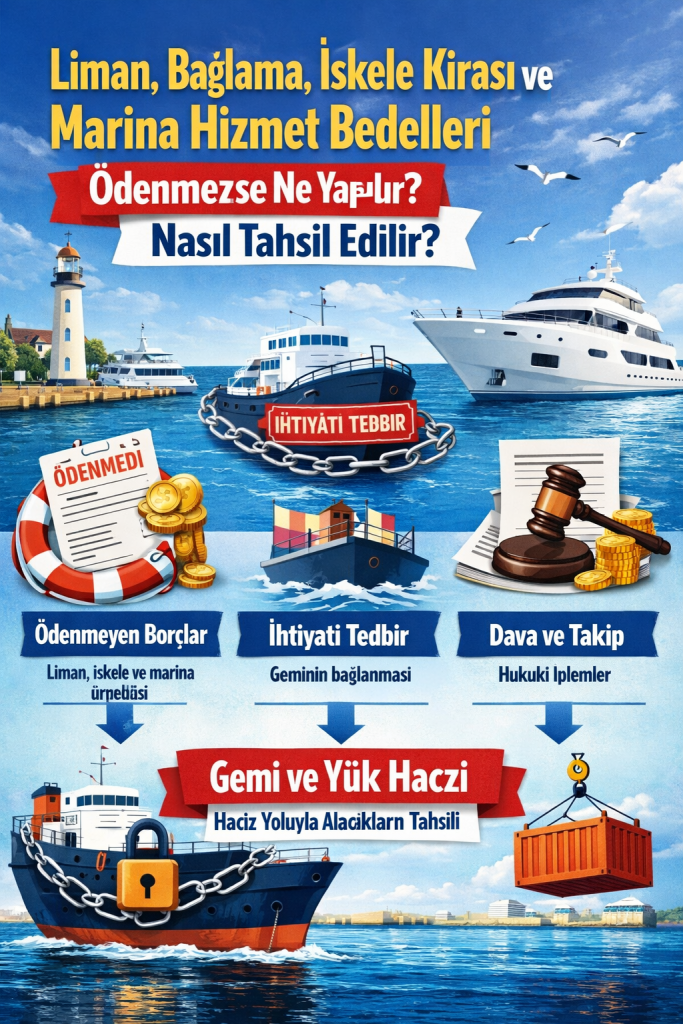
According to court decisions; the berthing, protection, maintenance, repair, and port services of the vessel (pier rent, electricity supply, occupational safety personnel, fire prevention, mooring, towage, pilotage, waste disposal, etc.) are considered as “Maritime Claim” within the scope of Article 1352 of the Turkish Commercial Code (TTK) No. 6102.
TTK Article 1352/1-l: Goods, materials, provisions, fuel, equipment, and services rendered for this purpose provided for the operation, management, protection, and maintenance of the vessel constitute a maritime claim.
TTK Article 1352/1-n: Fees and other charges payable for ports, canals, docks, piers and quays, other waterways, and quarantine are considered maritime claims.
Contractual Nature: Berthing contracts, in court decisions, are considered to be of the nature of “custody contract” and are regarded as a service provided for the protection of the vessel.
2. Legal Remedies and Actions that Can Be Taken for the Collection of the Claim
Creditors, to collect the aforementioned service fees, may resort to the following legal remedies:
Provisional Attachment (TCC 1353): A decision can be made for the provisional attachment of a ship to secure maritime claims. For this request, it is mandatory to provide security in the amount of 10,000 Special Drawing Rights (SDR) in accordance with TCC 1363.
Enforcement Proceedings Without Judgment and Action for Annulment of Objection: Creditors can initiate enforcement proceedings without judgment through enforcement offices. In case of an objection by the debtor, an action for “Annulment of Objection” is filed in accordance with Article 67 of the Enforcement and Bankruptcy Law (EBL).
Enforcement Proceedings by Way of Realizing a Movable Pledge: In some cases, this method of enforcement is also used because the claim grants a maritime lien (statutory pledge) on the ship. However, it should not be forgotten that the right of pledge is subject to a 1-year statute of limitations in accordance with TCC 1259.
Action for Objection to the Order of Priority List: In case of a ship’s sale, an action can be filed against the order of priority list prepared to protect the claim’s priority.
3. Methods of Proof and Evidence
In proving maritime claims, especially during the provisional attachment stage, the rule of “prima facie evidence” (approximate proof) applies (TCC 1362). Full proof is not required; it is sufficient to present evidence that will convince the court of the existence and amount of the claim.
Accepted Primary Evidence:
Written Contracts and Emails: Email correspondence and contracts defining the scope of service and daily fees (e.g., daily pier rent) between the parties are considered binding evidence.
Invoices and Commercial Ledgers: E-archive invoices, current account statements, and duly kept commercial ledgers (serving as evidence in favor of the owner) are means of proof.
Ship Records and Signed Documents: Work lists, proforma invoices, delivery receipts, ship logbook entries, and marina entry-exit schedules bearing the ship captain’s signature and seal.
Official Institution Records: Records obtained from the Port Authority showing the duration of the ship’s stay in port.
Expert Examination: Expert reports obtained by the court for the necessity of the service, comparable values, and calculations.
Witness Statements: Witness testimonies regarding the actual provision of the service.
4. Competent Court Judicial decisions consistently state that disputes arising from mooring, protection, and port services fall within the scope of maritime commercial provisions regulated in Book 5 of the Turkish Commercial Code (TTK). Therefore, in these cases, Maritime Specialist Courts (or Civil Courts of Commerce in this capacity where such specialist courts do not exist) are competent. Specifically in Istanbul, the Istanbul 17th Civil Court of Commerce is designated as the authorized and competent authority.
5. Additional Context from Secondary Sources Decisions acting as secondary sources (Istanbul 14th Civil Court of Commerce, Istanbul Anadolu 5th Civil Court of Commerce, Istanbul 2nd Civil Court of Commerce, etc.) emphasize the following additional points:
In cases of early termination of yacht mooring contracts, requests for the refund of prepaid amounts are also considered within the scope of maritime claims and are directed to Maritime Specialist Courts.
Services such as fuel supply, spare parts supply, and customs brokerage provided to the ship are also considered maritime claims under Article 1352/1-l of the Turkish Commercial Code (TTK) within the scope of the ship’s operation and preservation; in the collection of these claims, invoices, delivery notes, and delivery lists are used as primary means of proof. A related article is suggested.
It is stated that the shipowner may be jointly and severally liable for services received by the charterer (such as repairs, fuel, etc.), but in such a case, it must be proven with concrete evidence (e.g., delivery notes stamped by the ship) that the service was provided directly to the relevant ship.
Marina, iskele ve liman hizmetleri gerçekten “deniz alacağı” sayılır mı?
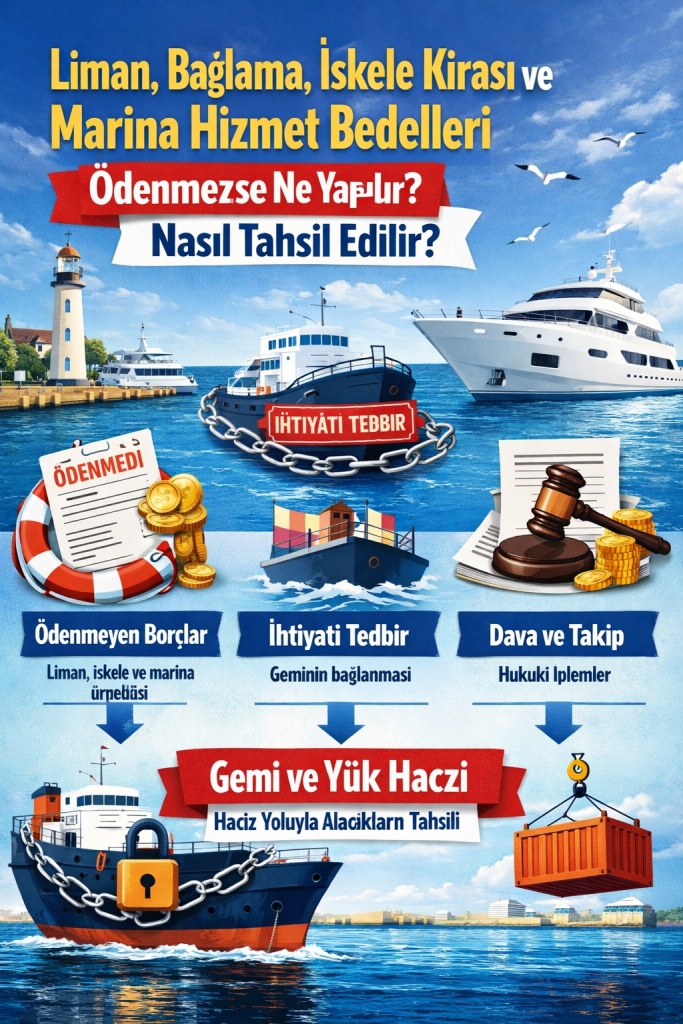
Evet. Yargı kararları istikrarlı şekilde; iskele kirası, bağlama, elektrik, su, palamar, römorkaj, pilotaj, yangın önleme, iş güvenliği ve atık alım hizmetlerini Türk Ticaret Kanunu’nun 1352. maddesi kapsamında deniz alacağı olarak kabul etmektedir.
Özellikle TTK 1352/1-l ve 1352/1-n bentleri, bu hizmetlerin geminin işletilmesi ve korunması için zorunlu olduğunu açıkça ortaya koyar.
Bağlama sözleşmesi basit bir kira mı, yoksa daha güçlü bir hak mı doğurur?
Bağlama ve marina sözleşmeleri, yargı içtihatlarında çoğunlukla saklama sözleşmesi niteliğinde kabul edilir.
Bu nitelendirme önemlidir; çünkü hizmet yalnızca yer tahsisi değil, geminin fiilen korunmasını da kapsar. Bu nedenle doğan alacaklar, sıradan kira alacaklarından farklı olarak deniz ticareti hukuku rejimine tabidir.
Gemi limandayken hangi hukuki yol en hızlı sonuç verir?
En etkili yol, ihtiyati hacizdir.
TTK 1353 uyarınca deniz alacakları için gemi üzerine ihtiyati haciz konulabilir. Bu sayede geminin seferden men edilmesi sağlanır ve alacak fiilen güvence altına alınır.
Bu aşamada alacaklının 10.000 SDR teminat yatırması zorunludur (TTK 1363).
İcra takibi açmak yeterli olur mu, yoksa dava şart mı?
Uygulamada genellikle iki aşamalı yol izlenir:
Önce ilamsız icra takibi başlatılır
Borçlu itiraz ederse → İtirazın iptali davası açılır
Bu davalar, Denizcilik İhtisas Mahkemelerinde görülür. Yanlış mahkemede açılan davalar, alacağın haklılığına bakılmadan görevsizlik nedeniyle reddedilir.
Bu tür alacaklarda mahkeme hangi delilleri yeterli görüyor?
İhtiyati haciz ve dava aşamasında tam ispat değil, yaklaşık ispat yeterlidir. Uygulamada kabul gören başlıca deliller şunlardır:
Yazılı sözleşmeler ve e-posta yazışmaları
E-arşiv faturalar ve cari hesap dökümleri
Kaptan imzalı iş listeleri ve gemi kaşeli belgeler
Liman Başkanlığı kayıtları (geminin limanda kaldığı süre)
Marina giriş–çıkış çizelgeleri
Bilirkişi raporları
Bu belgelerle alacağın varlığı mahkemede kanaat oluşturacak düzeyde ortaya konulabilir.
Why is Expert Lawyer Support Necessary for These Types of Claims?
Claims arising from port, marina, and mooring services are among the maritime claims that are strong in theory, but most frequently lost in practice. The reason for this is often not the merits of the claim itself, but procedural errors.
Common mistakes in practice:
Addressing the wrong debtor (the agent)
Filing a lawsuit in the wrong court
Missing the opportunity to seize the ship while it is in port
Confusing the concepts of a lien/pledge right and a maritime claim
Incomplete or delayed execution of the SDR security process
The rapid movement of vessels, especially in Istanbul ports, Tuzla Shipyard, marinas, and transit ports, makes these receivables time-sensitive cases. Therefore, in port, marina, and vessel mooring receivables, it is critically important to proceed with a lawyer who understands maritime commercial practice, correctly structures precautionary attachments, and is proficient in the application of Maritime Specialized Courts. In Istanbul-based maritime commercial disputes, 2M Hukuk Law Office handles the collection of receivables arising from mooring, marina, and port services with strategies of fast attachment, correct court, and effective collection.