Introduction
This study has been prepared with the aim of analyzing the concept of “vehicle deprivation (downtime) compensation”, the liability of insurance companies for this damage, calculation methods, and the persons responsible for the damage, in light of the judicial decisions presented. The analyzed decisions reveal the approaches of the Court of Cassation, Regional Courts of Appeal, and Courts of First Instance on the matter.
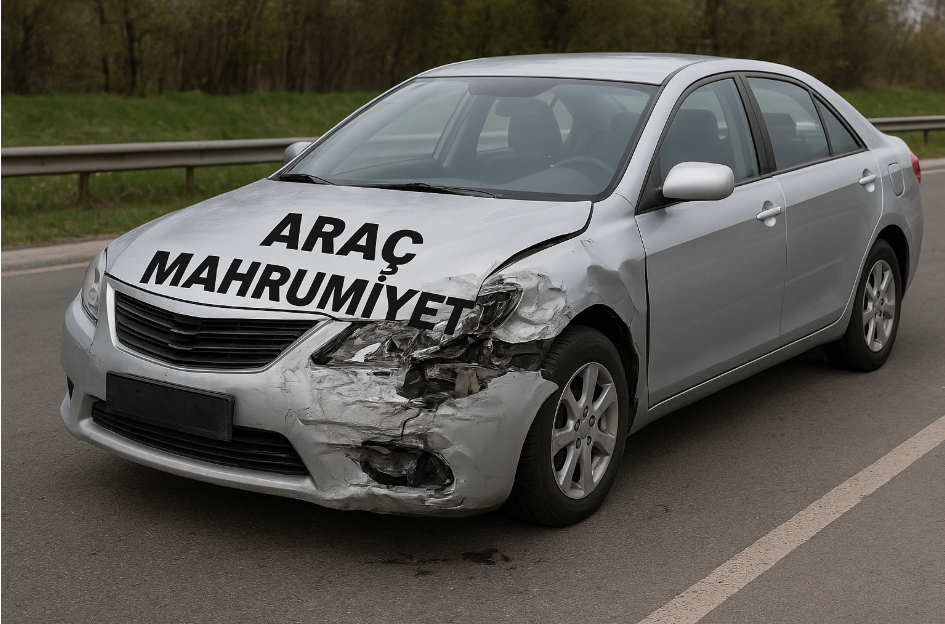
Definition: Vehicle deprivation compensation refers to the damage resulting from a vehicle, damaged in a traffic accident, being unusable for the reasonable period required for its repair. This damage may arise in the form of substitute vehicle rental costs or loss of earnings for commercial vehicles.
Responsible Parties: In judicial decisions, it is consistently accepted that the driver and operator (owner) of the vehicle at fault in the accident are primarily jointly and severally liable for vehicle deprivation compensation.
Liability of Insurance Companies: The most debated issue is the liability of insurance companies. The vast majority of decisions state that vehicle loss of use damage is in the nature of “indirect damage” and is not covered under the General Conditions of Compulsory Financial Liability Insurance (CFLI). However, it is stated that the insurance company may be liable if there is favorable coverage such as a “substitute vehicle clause” in the comprehensive insurance policy.
Calculation Method: Vehicle loss of use compensation is calculated not based on the actual time the vehicle spent in service, but based on the “reasonable repair period” during which the damage can be objectively repaired. In the calculation, the rental cost of a vehicle comparable to the damaged vehicle is taken as the basis. However, Supreme Court decisions emphasize that expenses such as fuel, maintenance, and depreciation saved due to the non-use of the vehicle should be deducted from this amount.
1. Definition and Legal Nature of Vehicle Loss of Use Compensation
In all examined decisions, vehicle loss of use compensation is accepted as damage incurred by the owner who cannot use their vehicle due to a tortious act. In the decision of Diyarbakır Civil Court of Commerce (2024/699), this situation was expressed as: “It is clear that due to the accident subject to the lawsuit, the plaintiff will have to provide a substitute vehicle and incur expenses during the reasonable period required for the repair of the damage to the plaintiff’s vehicle, and that this damage must be compensated.” Supreme Court decisions, on the other hand, state that this damage can be claimed within the framework of the Code of Obligations.
2. Liability of Insurance Companies
In court decisions, a distinct differentiation regarding the liability of insurance companies is noticeable:
Regarding Compulsory Financial Liability Insurance (Traffic Insurance): The overwhelming majority of decisions state that ZMSS does not cover this damage. The reason given is that this damage is not a direct damage but is considered “indirect damage”. This point was clearly articulated in the decision of the 26th Civil Chamber of Ankara Regional Court of Justice (2019/428): “the damage related to vehicle deprivation is not within the scope of actual damage but is an indirect damage, therefore, the defendant insurance company is not liable for this damage item. The plaintiff can claim the damage related to vehicle deprivation from the out-of-suit vehicle operator and/or driver.” Similarly, the Istanbul Anatolian 3rd Civil Court of Commerce (2014/1608) also ruled that the insurance company had no liability, referring to the article titled “Cases Excluded from Coverage” in the General Conditions of ZMSS.
Regarding Comprehensive Insurance: Unlike ZMSS, comprehensive insurance policies may cover this damage. In the decision of the Bursa 1st Civil Court of Commerce (2023/1359), “since there is a replacement vehicle clause in the comprehensive insurance policy between the parties, the plaintiff can claim the vehicle deprivation cost” it was stated and the insurance company was held liable. The decision of the Izmir 2nd Civil Court of Commerce (2022/673) also supported this, emphasizing that replacement vehicle coverage can be added to the policy by paying an additional premium.
3. Calculation of Vehicle Deprivation Cost
The calculation method has been tied to certain principles in court decisions:
Principle of Reasonable Period: The damage is calculated not according to the actual time the vehicle remained in repair, but according to a reasonable repair period to be determined based on the nature of the damage. If the vehicle is a total loss, this period is considered “the time required to purchase a new vehicle of comparable quality” (Supreme Court 17th Civil Chamber – 2015/5643).
Comparable Vehicle Rental Fee: The basis of the calculation is the cost required to rent a vehicle with the same characteristics as the damaged vehicle for the duration of the reasonable repair period.
Deduction of Saved Expenses: According to the settled jurisprudence of the Supreme Court, from the determined gross rental fee, expenses such as fuel, maintenance, and depreciation saved by the plaintiff due to not using their own vehicle must be deducted. This principle was stated as follows in the decision of the Supreme Court 17th Civil Chamber (2016/87):“…while a detailed, auditable, and reasoned supplementary report should have been obtained, examining matters such as what the vehicle deprivation compensation would be, taking into account the amounts saved by the plaintiff during the period they could not use their vehicle, such as maintenance costs, depreciation, etc., and a decision rendered accordingly…”
Burden of Proof: The plaintiff’s inability to provide a document proving that they actually rented a vehicle does not necessitate a complete rejection of their claim. The Supreme Court 17th Civil Chamber (2011/11664) has ruled that in such a case, the court must determine an equitable amount in accordance with the Code of Obligations.
4. Responsible Parties: Who Pays for the Damage?
Decisions paint a clear picture in the hierarchy of responsibility. In situations where the Compulsory Financial Liability Insurance (CFLI) excludes coverage, the driver and operator (owner) of the vehicle at fault in the accident are jointly and severally liable for the vehicle deprivation compensation. The ruling of the Ankara 5th Civil Court of Commerce (2020/527), stating, “the defendant vehicle operator and driver are responsible for the vehicle deprivation compensation, and the insurance company has no responsibility for the vehicle deprivation compensation…” summarizes this general rule.
Conclusion
In line with the presented court decisions, it is clear that vehicle deprivation compensation is a real loss incurred by a person unable to use their vehicle due to a tort, and it must be compensated. However, who is responsible for compensating this loss is of critical importance. As a general rule, since this loss is considered “indirect damage”, it is outside the scope of Compulsory Financial Liability Insurance coverage and should be claimed directly from the at-fault driver and vehicle operator. For the insurance company’s liability to arise, there typically needs to be a special provision, such as a “replacement vehicle” clause, explicitly covering this damage under a Comprehensive (Kasko) policy. When calculating the damage, technical criteria such as reasonable repair time, comparable vehicle rental cost, and deduction of saved expenses should be considered. A text suggestion
Why is Tuzla Lawyer Support Necessary?
Cases related to vehicle deprivation compensation often involve complex elements such as technical calculations, detailed examination of insurance policies, and interpretation of different court decisions. Especially, correctly identifying the differences between Compulsory Financial Liability Insurance and Comprehensive (Kasko) policies can directly affect the outcome of the case. Furthermore, calculating vehicle deprivation compensation according to criteria such as reasonable duration, equivalent vehicle rental fee, and deduction of saved expenses is a process that needs to be supported by expert witness reports.
Therefore, in regions such as Istanbul, Tuzla lawyer, Pendik lawyer, Kartal lawyer, Maltepe lawyer, Aydınlı lawyer, Orhanlı lawyer, Gebze lawyer, Çayırova lawyer, Tepeören lawyer, Darıca lawyer, Bayramoğlu lawyer, obtaining legal support from an experienced lawyer in Tuzla is critically important both to avoid loss of rights in processes conducted with insurance companies and to determine the correct legal strategy during the litigation process. Legal support can ensure that the damages are calculated and claimed correctly, that unfair objections from insurance companies are overcome, and that a favorable decision is obtained in court.