1. Basic Punishment for the Crime of Drug Use According to paragraph 1 of Article (TCK) 191 of the Turkish Penal Code No. 5237; a person who purchases, accepts, possesses, or uses narcotics or stimulant substances for consumption shall be punished with imprisonment ranging from two to five years. As emphasized in the decisions of the Grand Criminal Chamber of the Court of Cassation and the Constitutional Court, with the amendment made by Law No. 6545, the lower limit of the penalty has been set at two years. In cases where the crime was committed at an earlier date, it is observed that older provisions, which stipulated imprisonment from one to two years, could also be considered within the scope of more lenient law assessment.
2. Legal Procedure Regarding First-Time Arrestees According to judicial decisions, in investigations initiated due to the crime of drug use, direct imprisonment is not applied to suspects apprehended for the first time; a special postponement mechanism is implemented:
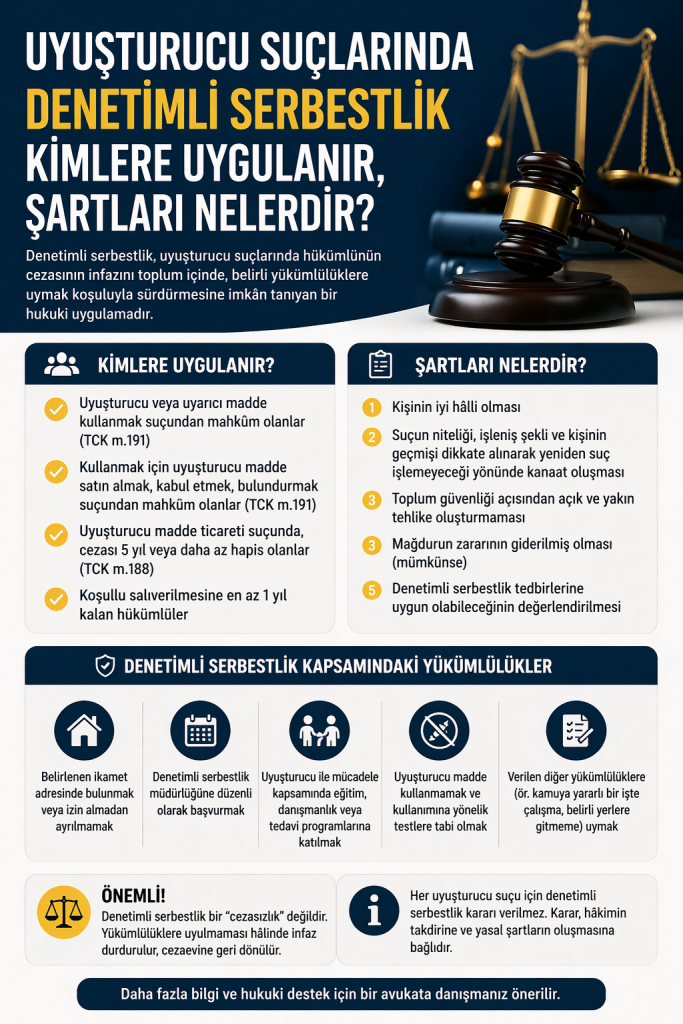
Postponement of Public Prosecution: In accordance with Article 191/2 of the TCK, in investigations initiated due to this crime, a decision is made to postpone the initiation of public prosecution for a period of five years for the suspect, without requiring the conditions specified in Article 171 of the CMK.
Probation Measure: During the postponement period, a probation measure for a minimum period of one year is applied to the suspect. During this period, a decision may also be made for the individual to undergo treatment.
Decision of No Grounds for Prosecution: If the suspect complies with the obligations imposed on them during the five-year deferral period, and does not use or possess narcotic substances again, at the end of the deferral period, a decision will be made that there are “no grounds for prosecution”. In this case, the person will not receive a prison sentence and it will not be recorded as a conviction in their criminal record.
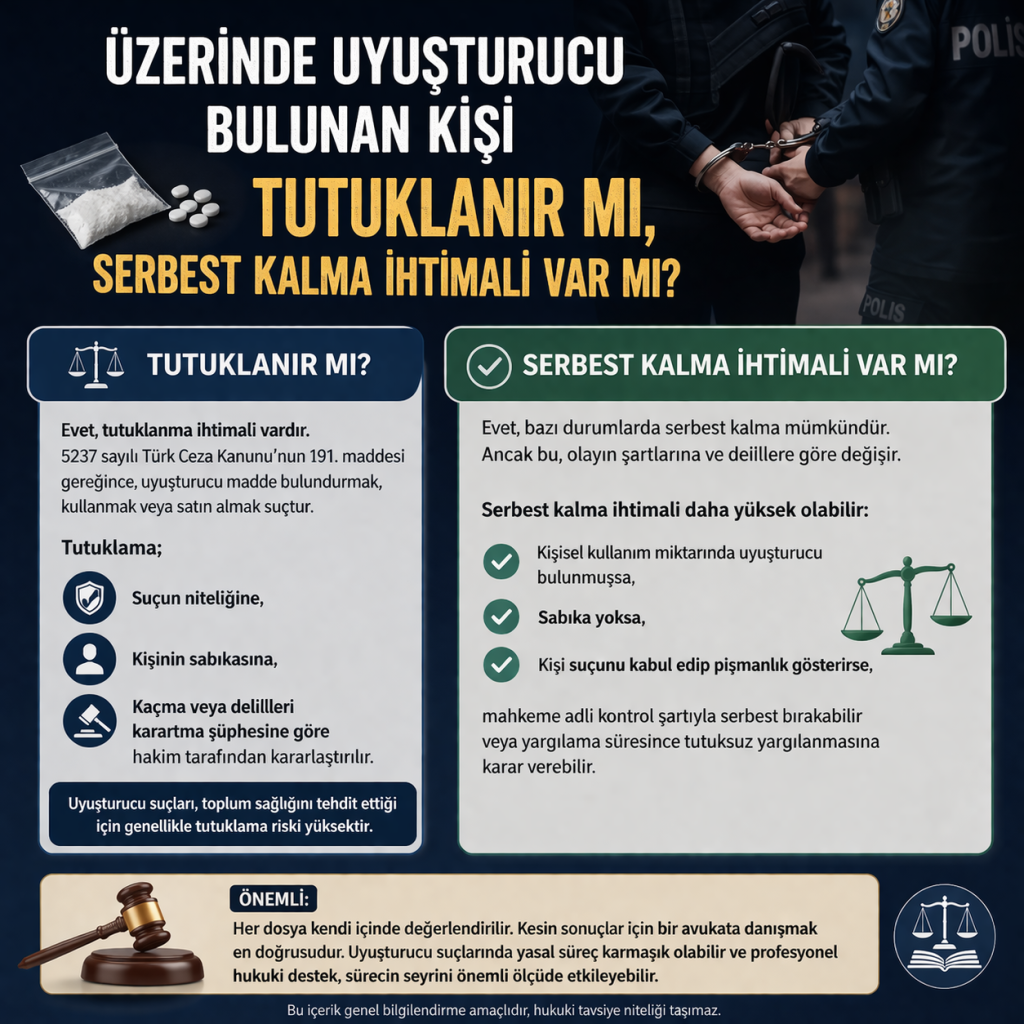
3. Imposition of Prison Sentence and Conditions of Execution A first-time offender being imprisoned is only possible if they violate their obligations during the deferral period. The violation conditions specified in the decisions are:
Persisting in not complying with the obligations imposed on them or the requirements of the treatment,
Buying, accepting, possessing, or using narcotic substances again.
If these violations occur, the deferral decision is revoked, and a public prosecution is initiated. If a conviction is rendered as a result of the trial, the prison sentence will be executed. In some Supreme Court decisions (e.g., 10th Criminal Chamber 2023/4869), there are also examples where the prison sentence was converted into a judicial fine.
4. Information Obtained from Secondary Sources and Additional Context Decisions considered as secondary sources provide the following additional contexts regarding the crime of drug use:
Alternative Sanctions: In some cases, courts are observed to be able to convert prison sentences into alternative sanctions, such as “prohibition from entering places where alcoholic beverages are sold” under Article 50/1-d of the TCC (Turkish Criminal Code).
Recidivism and HAGB: It is emphasized that for those caught for the first time, the mechanism of Postponement of the Announcement of the Verdict (HAGB) can be applied; however, if a new crime is committed during the probation period, this verdict is announced and the prison sentence begins to be executed.
Distinction from Trafficking: It is stated that criteria such as the quantity of the substance found on the person, the manner of packaging, and the place where it was seized determine whether the act is “use” or “trafficking”; and that the crime of trafficking (TCK 188) stipulates much heavier prison sentences (5-15 years).
Procedural Errors: It is stated that in cases where postponement decisions are not duly notified or do not become final, directly filing a lawsuit due to subsequent actions is unlawful and that a “stay” or “dismissal” decision should be made.
In Summary: Although the penalty for drug use is 2 to 5 years imprisonment, for those caught for the first time, the filing of the lawsuit is postponed for 5 years as a legal requirement, and supervised probation is applied. Individuals who do not violate this process do not go to prison.