1. Nature and Legal Basis of SGK Termination Code 49
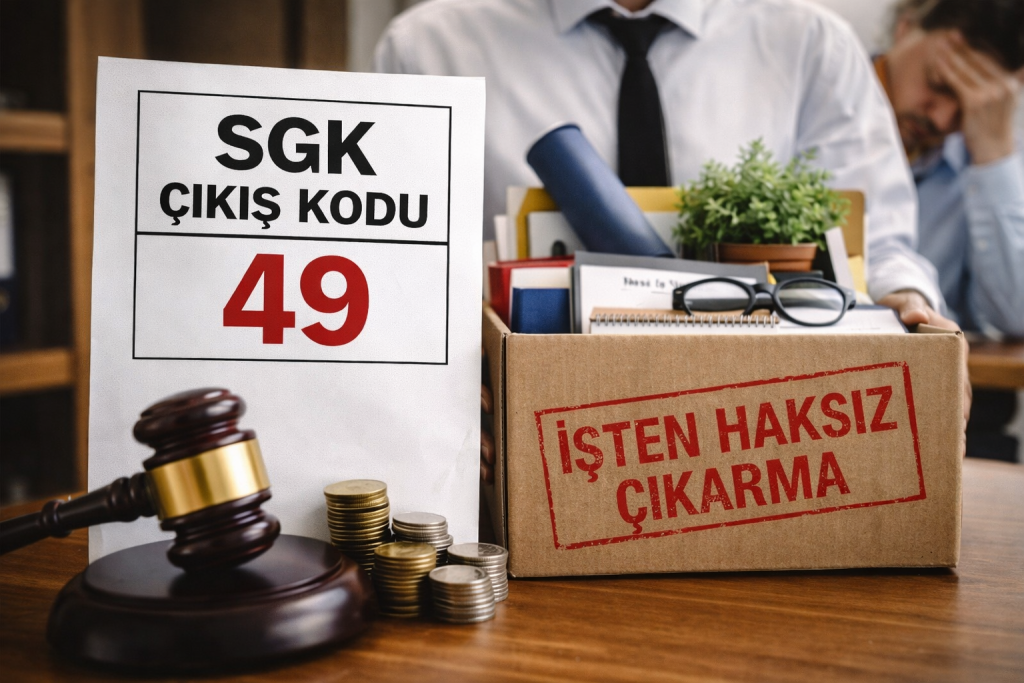
SGK termination code 49 refers to the situation where “the employee insists on not performing the duties they are obliged to perform, despite being reminded of them” pursuant to Article 25/II-(h) of Labor Law No. 4857. This code is considered within the scope of “Violation of Morality and Good Faith Rules,” which authorizes the employer to immediately terminate the employment contract for just cause and without severance pay. In Supreme Court decisions, this code is based not so much on the employee’s low performance or inefficiency, but on their “insistence” on not performing the duties they have been reminded of.
2. Lawsuits That Can Be Filed Under SGK Termination Code 49
The legal remedies an employee terminated with SGK termination code 49 can pursue are as follows:
Severance and Notice Pay Lawsuits: The employee can claim that the termination was unjust and demand the collection of severance pay, notice pay, and other employee receivables (e.g., annual leave, overtime, etc.).
Reinstatement Lawsuit: Employees covered by job security can file a lawsuit demanding the determination of the invalidity of the termination and reinstatement. This lawsuit is accepted if the termination violates formal requirements (written notice, receiving defense) or substantive requirements (just/valid cause).
Lawsuit for Correction (Determination) of Termination Code: (Secondary Source) An employee can file a lawsuit for the determination and correction of an incorrect or false termination code in SGK records (for example, 04 or 25 instead of 49). This lawsuit is particularly important to ensure that it does not pose an obstacle to benefiting from unemployment benefits and in new job applications.
Lawsuits Regarding Unemployment Benefits: (Secondary Source) An employee whose unemployment benefit application has been rejected due to a Code 49 notification can request the annulment of this action and the determination that they are entitled to the benefit, by proving that the termination was in fact made by the employee for just cause or that the employer’s termination was unfair.
3. Distribution of Burden of Proof in SGK Termination Code 49
The established principles regarding the burden of proof in judicial decisions are as follows:
Employer’s Burden of Proof: The burden of proof regarding the termination of the employment contract for just cause rests entirely with the employer. The employer must prove with concrete evidence that the employee failed to perform their duties and persisted despite being reminded about it.
Principle of Code Adherence: The employer is bound by the termination code reported to SGK and cannot subsequently change the reason for termination. If the notification was made as “termination without stating a just cause” (Code 04), it becomes difficult for the employer to make a just cause defense in court.
Burden of Proof for the Employee: If it is claimed that the termination is based on a union-related reason, the burden of proof for this claim rests with the employee. Furthermore, while the burden of proof that wage receivables have been paid rests with the employer; the burden of proof for the existence of claims such as overtime and weekly rest days rests with the employee.
4. What the Employer Must Do Before Termination and the Warning Procedure
For a termination carried out under Code 49 to be considered lawful, the employer must follow these procedures:
Reminding of Duties and Documenting Persistence: The employee must be clearly reminded of their duties, and it must be documented with records that the employee “persisted” in not performing these duties.
Obligation to Obtain Defense: Pursuant to Article 19 of the Labor Law, the employee’s defense must be obtained before termination is made for reasons related to their conduct or performance. Terminations made without obtaining a defense are considered “formally invalid” by the Supreme Court.
Written Notification and Clarity: The termination notice must be made in writing, and the reason for termination must be stated in a “clear and precise” manner. Vague expressions such as “etc. reasons” may lead to the invalidity of the termination.
Principle of Proportionality and Being a Last Resort: (Secondary Source) Termination should be a last resort. The employee should be given a reasonable period to correct their behavior, and warning and notice mechanisms should be utilized. Direct termination in the first instance may be found to be contrary to the principle of proportionality.
5. Specific Case Analyses
Example 1 (Lack of Defense): In a case where an employee was dismissed on the grounds of “unwillingness to perform the assigned work and inefficient performance,” it was determined that the employer did not obtain a defense prior to termination. The Supreme Court considered the failure to obtain a defense directly as a reason for the invalidity of the termination and reinstatement.
Example 2 (Tasks Outside Job Scope): The termination of an employee working as a forklift operator, who continued engaging in behaviors such as working in areas outside their job scope and disrupting workplace order despite warnings, can be deemed justified when supported by concrete records and defense statements.
Example 3 (Performance and Warning): (Secondary Source) In a case where a synthetic fiber production worker showed low performance, and the employer obtained a defense, issued a warning, and found the inefficiency continued the next day, the Code 49 notification was deemed lawful because a proper warning and defense process was followed.
Example 4 (Employer’s Insufficient Proof): In cases where the employer terminates an employee’s contract claiming the employee damaged machinery, but fails to provide concrete documents or records regarding the damage, the court rules for severance and notice pay on the grounds that “the burden of proof has not been met.”
6. Additional Notes from Secondary Sources
Legal Interest in a Determination Lawsuit: In determination lawsuits filed to correct the termination code, it is a prerequisite for the employee to have a “current legal interest” (e.g., inability to receive unemployment benefits or find new employment) in filing this lawsuit.
Effect of Mediation: If severance and notice pay for the employee have been agreed upon with a mediation settlement document, it is possible to change the termination code based on this document, in accordance with SGK circulars.
Disciplinary Board Process: In workplaces with collective bargaining agreements, terminations made without a disciplinary board decision and defense process can be procedurally annulled, even if they occur within preclusive periods. A paper suggestion.
Why is Expert Legal Support Necessary? | To Avoid Loss of Rights with SGK Termination Code 49
SGK termination code 49 is one of the termination codes most frequently subject to unjust or erroneous termination claims in practice. In terminations made with this code, extremely severe consequences such as the complete loss of severance and notice pay, inability to benefit from unemployment benefits, and rejection of reinstatement lawsuits can arise. Therefore, obtaining expert legal support from the outset of the process is critically important.
Especially;
The employer’s inability to prove, with concrete and written evidence, that the employee failed to perform their duty and persisted despite reminders,
Terminations made without taking a defense or contrary to procedure,
The discrepancy between the termination code reported to SGK and the reason for termination put forward in court,
The use of Code 49 to conceal actual reasons such as poor performance, personal conflict, or union-related reasons,
Improper establishment of legal interest in lawsuits for the correction of the termination code,
are factors that directly affect the outcome of the case.
As is frequently seen in practice, if the employer fails to fulfill their burden of proof, severance and notice pay may be awarded despite Code 49, and even, if conditions are met, a reinstatement decision can be issued. However, achieving this outcome is possible only with a lawyer who is proficient in Supreme Court precedents, establishes a correct evidence strategy, and manages the process in accordance with procedures.
At this point, 2M Law Office, with its office based in Istanbul Tuzla; provides professional legal consultancy and litigation services to its employee and employer clients in cases concerning SGK termination codes, unfair dismissal, re-employment, and labor receivables. If you have been dismissed from work with SGK Termination Code 49 or if you plan to terminate employment with this code, make sure to manage the process with an expert lawyer to avoid difficult-to-remedy loss of rights. Tuzla / Istanbul – 2M Law Office